
EPISODE · Jun 1, 2026 · 5 MIN
Episode 732 - Cosmic Conundrums
from Kevin McFarlane's podcast · host Kevin McFarlane
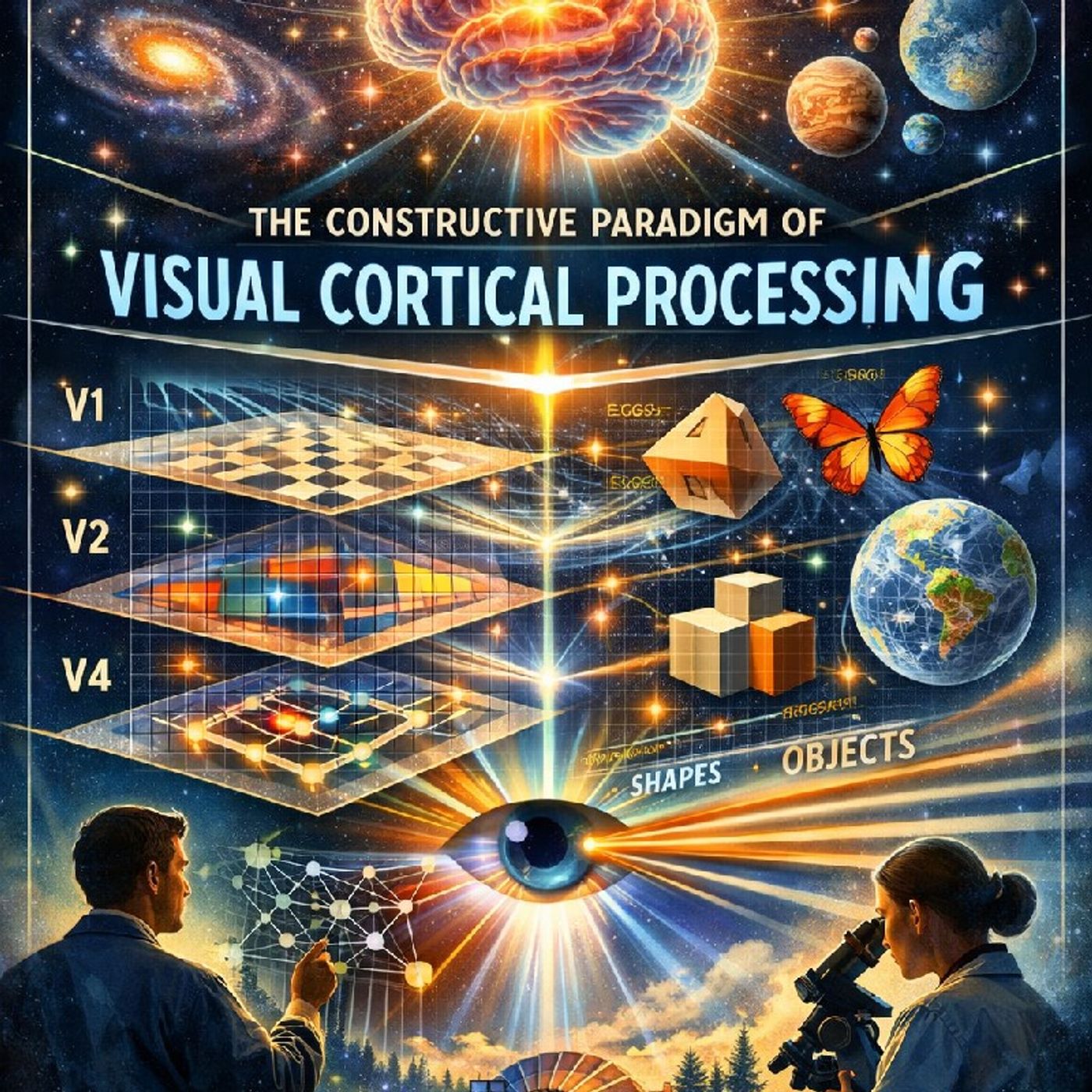
A defining shift in modern cognitive neuroscience is the recognition that the brain does not passively record external reality, but actively constructs a modeled representation of the physical environment. The human experience of color serves as a clear demonstration of this constructive architecture. Color is not an intrinsic property of the physical world; rather, it is a neural construction generated by the brain to interpret fluctuating electromagnetic signals. While light waves are characterized by physical wavelengths, the subjective experience of hue categories is an active cortical computation. The pioneering neurobiological research of Semir Zeki on cortical area V4 provided the definitive empirical foundation for this constructive model. By mapping the primate visual cortex, Zeki identified specialized, wavelength-selective, and hue-selective neurons within the V4 complex. He demonstrated that these neurons do not merely register raw spectral input. Instead, they compute relational differences to categorize hue regardless of varying environmental illumination—a phenomenon known as color constancy. When area V4 is bilaterally damaged or structurally offline, patients develop cerebral achromatopsia. In these individuals, the external physical reality remains entirely unaltered: objects reflect identical electromagnetic wavelengths, and the retinal photoreceptors continue to detect them. Yet, the subjective experience of color is completely lost, leaving the patient’s experienced world rendered in monochrome shades of gray. Area V4 is therefore the critical neural site where raw physical signals are synthesized into a constructed layer of perceptual meaning. This neurobiological framework directly aligns with the Spacedepth paradigm, which posits that reality is structured not by isolated objects, but by a stack of relational layers that collectively generate coherence, identity, and existential meaning. Spacedepth treats reality as relational before it is spatial, asserting that the meaningful world is constructed through sequential, interdependent tiers of interpretation. Color perception acts as a perfect microcosm of this macrocosmic ontological framework, demonstrating how raw, uninterpreted physical signals are progressively translated into stable perceptual, cognitive, cultural, and temporal dimensions of meaning.
Embed this episode
NOW PLAYING
Episode 732 - Cosmic Conundrums
No transcript for this episode yet
Similar Episodes
No similar episodes found.
Similar Podcasts
No similar podcasts found.