
EPISODE · Jun 2, 2026 · 5 MIN
Episode 736 - Cosmic Conundrums
from Kevin McFarlane's podcast · host Kevin McFarlane
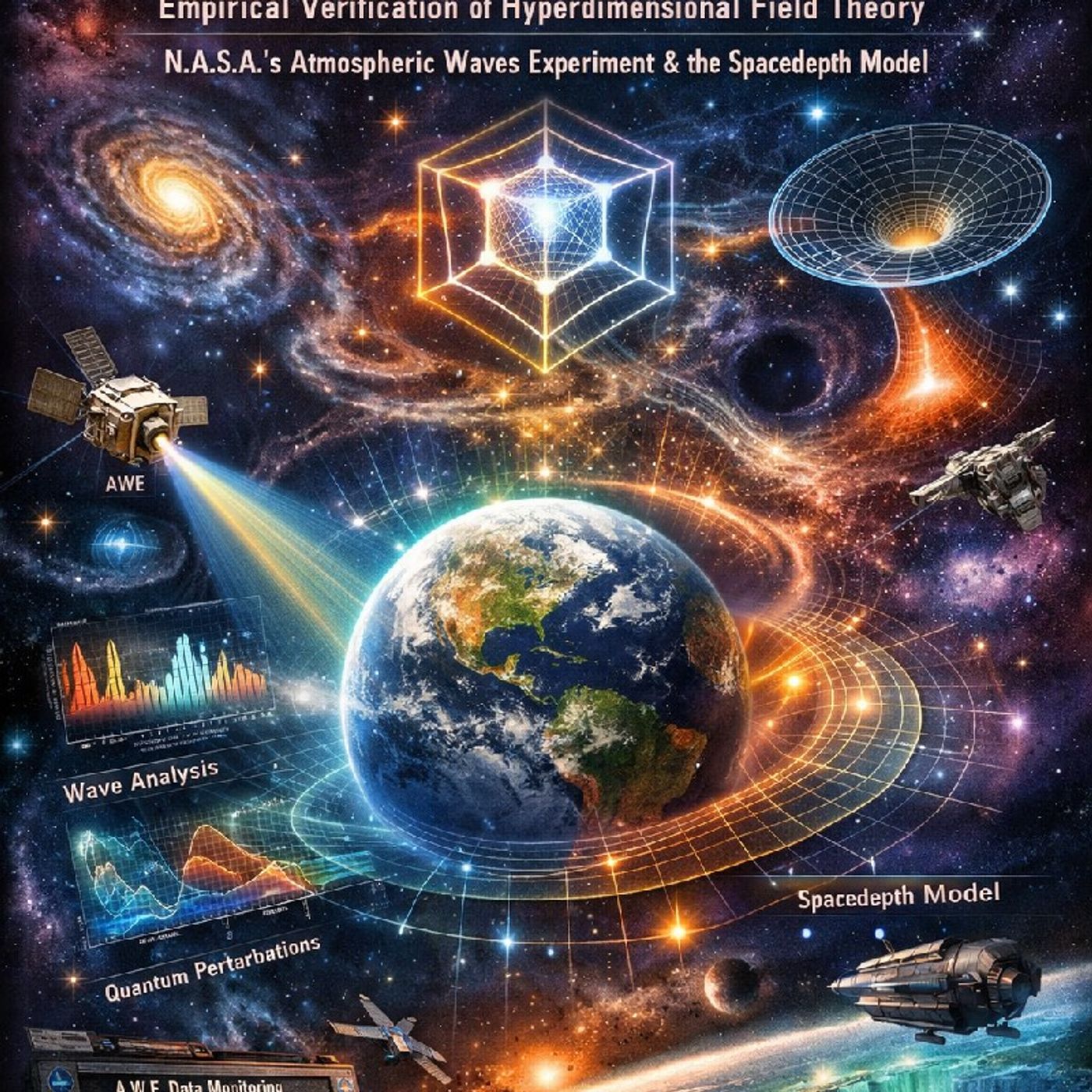
The trajectory of modern theoretical physics has reached a critical juncture where the traditional four-dimensional Minkowski-Einstein spacetime paradigm is increasingly challenged by anomalies in magnetospheric physics and emergent hyperdimensional models. Within the Cosmic Conundrums discourse and the broader 4DFAMILY canon, the transition away from a static spacetime continuum has crystallized around the Spacedepth framework. This model redefines the fourth dimension not as linear time, but as a dynamic spatial organizer—specifically, depth—where structural coherence is established as the primary invariant of physical and relational reality. Concurrently, magnetospheric observations demonstrate that the near-Earth environment is not an absolute vacuum but a highly structured, complex magnetic cavity governed by electrodynamic interactions, plasma populations, and a gargantuan magnetotail that acts as a reservoir of terrestrial and solar energy. On May 21, 2026, ground controllers officially powered down NASA’s Atmospheric Waves Experiment (AWE), bringing a highly successful thirty-month data collection phase to a scheduled end. Developed by the Utah State University Space Dynamics Laboratory under the leadership of Principal Investigator Ludger Scherliess, the $59 million instrument was launched to the International Space Station (ISS) on November 10, 2023, aboard SpaceX CRS-29. Mounted on the station’s Express Payload Adapter (ELC-1 Site 3), AWE looked directly down into the Earth’s upper atmosphere to observe atmospheric gravity waves (AGWs) propagating through the mesopause. By recording variations in infrared airglow—an ethereal radiance at the boundary between Earth's atmosphere and space—the AWE mission provided the first continuous, global dataset of how lower-atmospheric meteorological disturbances drive space weather. While mainstream heliophysics interprets these wave dynamics through classical fluid mechanics and ionospheric coupling, the Spacedepth framework recognizes AWE's empirical dataset as a physical visualization of hyperdimensional depth-layer coupling. Under this framework, Earth is modeled as a depth-resonant system where localized events propagate upward through continuous dimensional gradients into cosmic relational space.
Embed this episode
NOW PLAYING
Episode 736 - Cosmic Conundrums
No transcript for this episode yet
Similar Episodes
No similar episodes found.
Similar Podcasts
No similar podcasts found.