
EPISODE · Jun 11, 2026 · 5 MIN
Episode 750 - Cosmic Conundrums
from Kevin McFarlane's podcast · host Kevin McFarlane
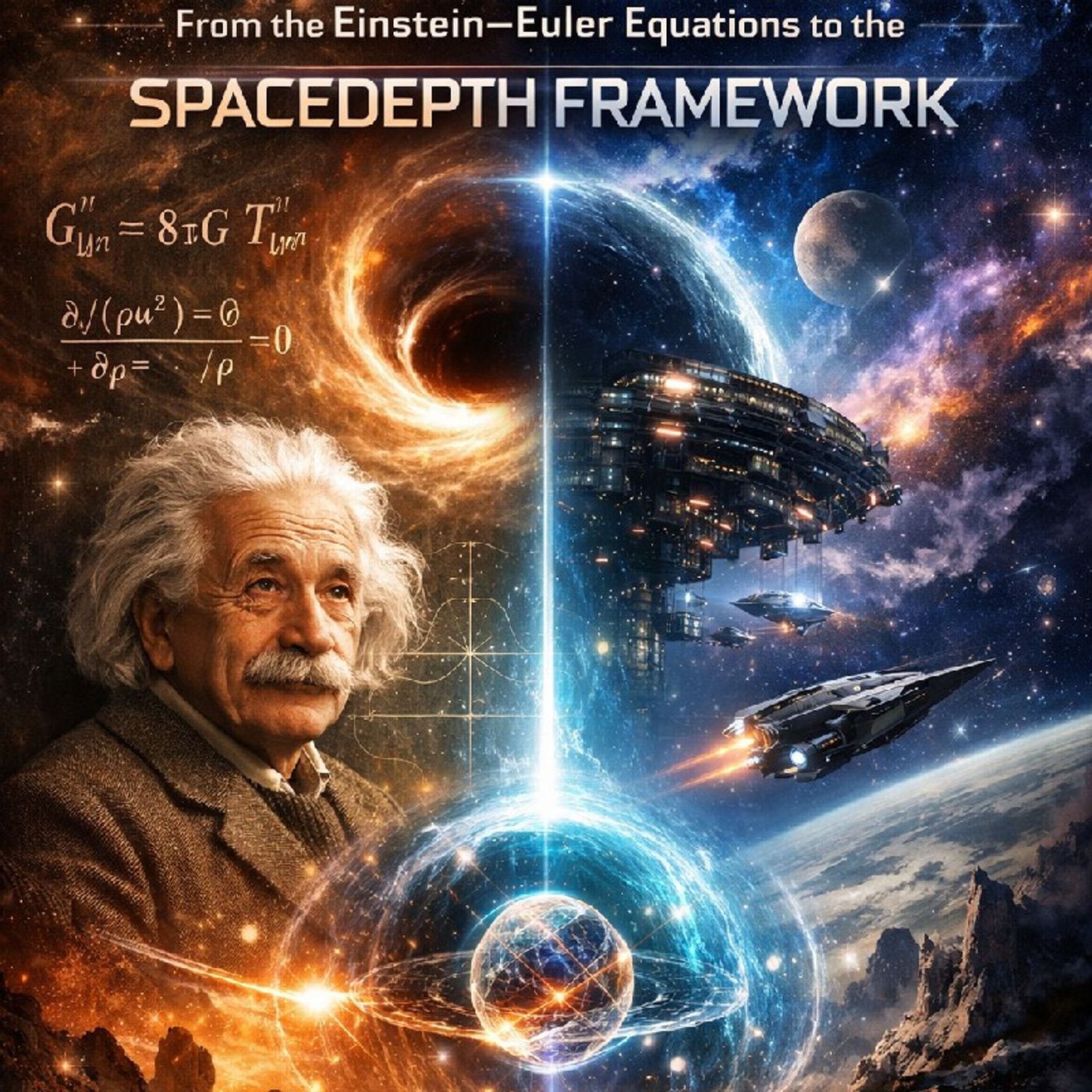
The foundation of modern physical cosmology relies on the assumption of a homogeneous and isotropic universe described by the Friedmann-Lemaître-Robertson-Walker (FLRW) metric. Under this standard paradigm, the late-time accelerated expansion of the universe is attributed to dark energy, most commonly parameterized as a non-zero cosmological constant (\Lambda) representing a uniform vacuum energy density. However, a series of mathematical studies by Christopher Alexander, Blake Temple, and Zeke Vogler challenges the physical viability of this starting point. The authors prove that pressureless Friedmann spacetimes are dynamically unstable to radial perturbations at the Big Bang, indicating that the standard flat (k = 0) model is physically unviable as a stable description of the early universe. To conceptualize this instability, the standard cosmological model is compared to a pencil balanced upright on its sharpened tip. While the balanced pencil constitutes a mathematically valid solution to the gravitational and mechanical equations of motion, it is physically unstable; any infinitesimal disturbance triggers a rapid departure from that state. In classical physics, solutions that cannot survive a microscopic perturbation are considered non-physical, as they are generically unobservable in nature.
Embed this episode
NOW PLAYING
Episode 750 - Cosmic Conundrums
No transcript for this episode yet
Similar Episodes
No similar episodes found.
Similar Podcasts
No similar podcasts found.