
EPISODE · Jun 13, 2026 · 5 MIN
Episode 752 - Cosmic Conundrums
from Kevin McFarlane's podcast · host Kevin McFarlane
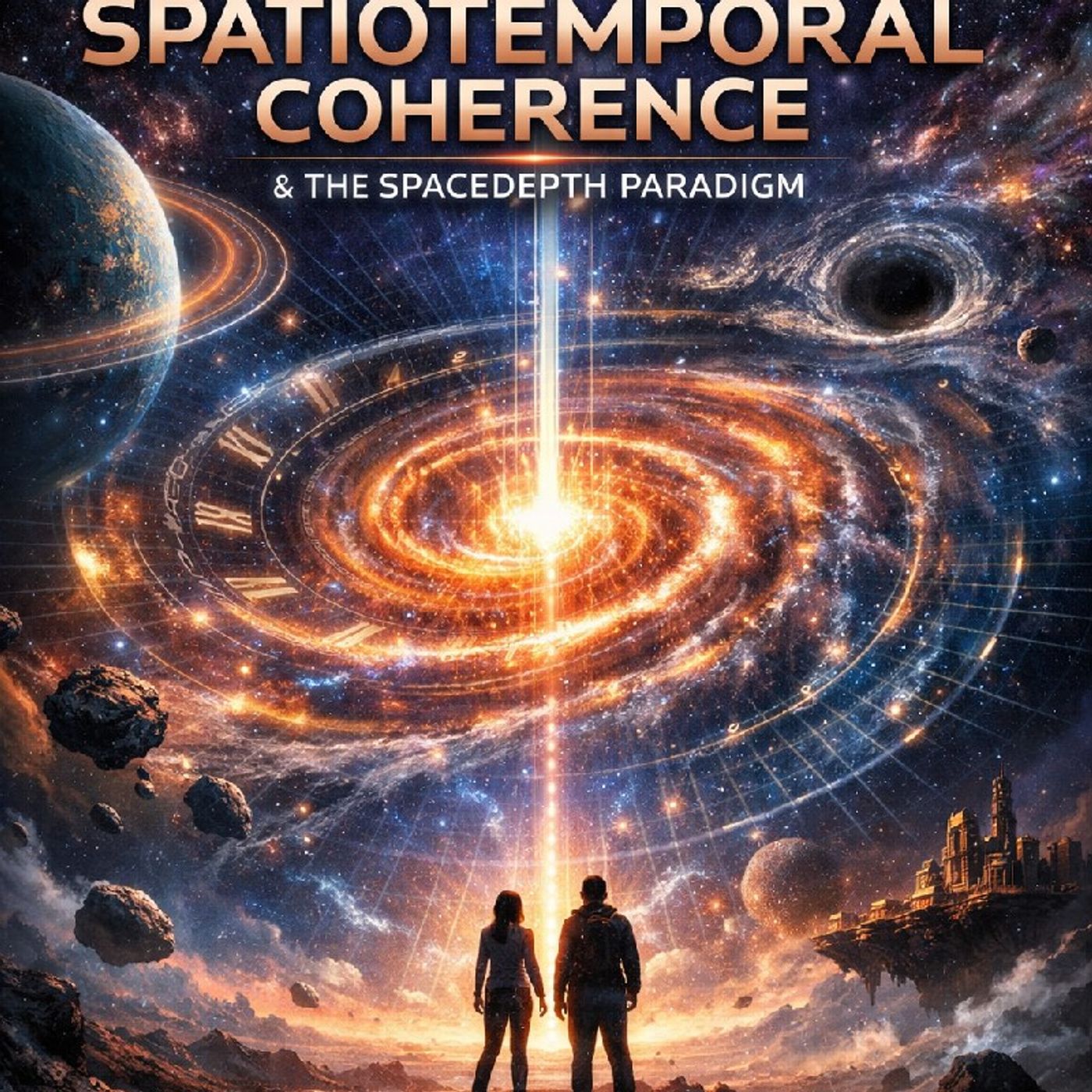
In modern theoretical physics, the constancy of the speed of light in a vacuum, denoted by the universal constant c, is a foundational postulate of relativistic kinematics and electrodynamics. However, an epistemological critique of this postulate reveals that it relies heavily on the unverified cosmological assumption that "empty space" is perfectly uniform and isotropic across all spatial and temporal scales. Mainstream frameworks treat the vacuum as a sterile, structureless background, asserting that the vacuum refractive index remains invariant at exactly 1.00000. This perspective is fundamentally localized, as every empirical measurement of the velocity of light has been performed deep within Earth's local gravitational potential, inside its specific electromagnetic environment, and within a highly localized spatial density. The scientific community has never directly measured the propagation velocity of electromagnetic radiation in remote or extreme cosmic environments, such as the galactic halo, intergalactic voids, active black hole accretion jets, dense dark matter filaments, or the plasma remnants of the early universe. Consequently, treating the vacuum refractive index as a universal invariant is a mathematical extrapolation rather than an empirically validated fact. In physical media, the reduction of electromagnetic velocity is a well-documented phenomenon, directly quantified by the refractive index n = \frac{c}{v}. As light interacts with the atomic and electronic structures of a medium, its velocity decreases significantly, showing that physical structures directly govern the propagation rate of electromagnetic waves.
Embed this episode
NOW PLAYING
Episode 752 - Cosmic Conundrums
No transcript for this episode yet
Similar Episodes
No similar episodes found.
Similar Podcasts
No similar podcasts found.