
EPISODE · Jun 13, 2026 · 6 MIN
Episode 753 - Cosmic Conundrums
from Kevin McFarlane's podcast · host Kevin McFarlane
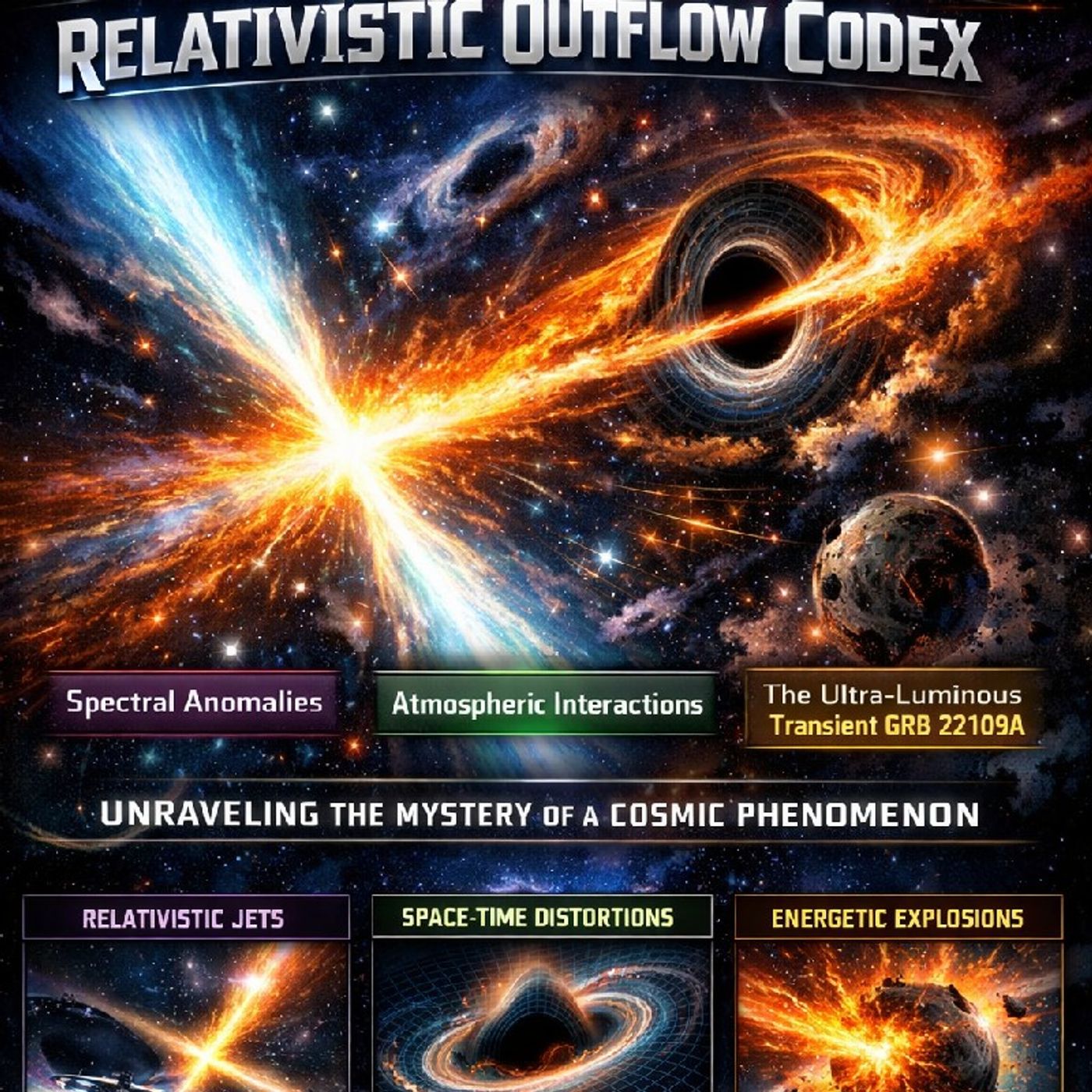
The detection of the exceptionally bright and long-duration gamma-ray burst (GRB) designated GRB 221009A on October 9, 2022, represented a watershed moment in high-energy astrophysics. Arriving from the constellation Sagitta, this event occurred at a spectroscopic redshift of z = 0.151, positioning the progenitor at a luminosity distance of approximately 720 \text{ to } 745 \text{ Mpc} (roughly 2.4 \text{ billion light-years}). Despite this cosmological distance, the transient delivered a flux of ionizing radiation so intense that it was colloquially dubbed the "BOAT" (Brightest Of All Time). The prompt phase of the burst emitted an unprecedented count rate that peaked at over 6 million photons per second, effectively blinding and saturating standard space-borne detectors. Statistically, a GRB of this magnitude within the nearby universe is estimated to be a once-in-a-millennium or even a once-in-10,000-year event, serving as an extreme baseline for testing the physical limits of stellar collapse, relativistic beaming, and astrophysical-geospace coupling.
Embed this episode
NOW PLAYING
Episode 753 - Cosmic Conundrums
No transcript for this episode yet
Similar Episodes
No similar episodes found.
Similar Podcasts
No similar podcasts found.