Escaping Containment: A Security Analysis of FreeBSD Jails (39c3) episode artwork

EPISODE · Dec 27, 2025 · 59 MIN

Escaping Containment: A Security Analysis of FreeBSD Jails (39c3)

from Chaos Computer Club - recent events feed · host ilja, Michael Smith

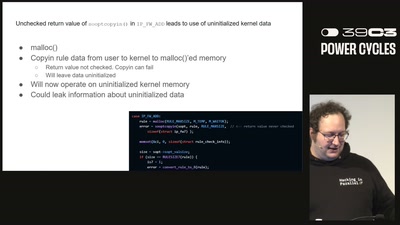
FreeBSD’s jail mechanism promises strong isolation—but how strong is it really? In this talk, we explore what it takes to escape a compromised FreeBSD jail by auditing the kernel’s attack surface, identifying dozens of vulnerabilities across exposed subsystems, and developing practical proof-of-concept exploits. We’ll share our findings, demo some real escapes, and discuss what they reveal about the challenges of maintaining robust OS isolation. FreeBSD’s jail feature is one of the oldest and most mature OS-level isolation mechanisms in use today, powering hosting environments, container frameworks, and security sandboxes. But as with any large and evolving kernel feature, complexity breeds opportunity. This research asks a simple but critical question: If an attacker compromises root inside a FreeBSD jail, what does it take to break out? To answer that, we conducted a large-scale audit of FreeBSD kernel code paths accessible from within a jail. We systematically examined privileged operations, capabilities, and interfaces that a jailed process can still reach, hunting for memory safety issues, race conditions, and logic flaws. The result: roughly 50 distinct issues uncovered across multiple kernel subsystems, ranging from buffer overflows and information leaks to unbounded allocations and reference counting errors—many of which could crash the system or provide vectors for privilege escalation beyond the jail. We’ve developed proof-of-concept exploits and tools to demonstrate some of these vulnerabilities in action. We’ve responsibly disclosed our findings to the FreeBSD security team and are collaborating with them on fixes. Our goal isn’t to break FreeBSD, but to highlight the systemic difficulty of maintaining strict isolation in a large, mature codebase. This talk will present our methodology, tooling, and selected demos of real jail escapes. We’ll close with observations about kernel isolation boundaries, lessons learned for other OS container systems, and a call to action for hardening FreeBSD’s jail subsystem against the next generation of threats. Licensed to the public under http://creativecommons.org/licenses/by/4.0 about this event: https://events.ccc.de/congress/2025/hub/event/detail/escaping-containment-a-security-analysis-of-freebsd-jails

FreeBSD’s jail mechanism promises strong isolation—but how strong is it really? In this talk, we explore what it takes to escape a compromised FreeBSD jail by auditing the kernel’s attack surface, identifying dozens of vulnerabilities across exposed subsystems, and developing practical proof-of-concept exploits. We’ll share our findings, demo some real escapes, and discuss what they reveal about the challenges of maintaining robust OS isolation. FreeBSD’s jail feature is one of the oldest and most mature OS-level isolation mechanisms in use today, powering hosting environments, container frameworks, and security sandboxes. But as with any large and evolving kernel feature, complexity breeds opportunity. This research asks a simple but critical question: If an attacker compromises root inside a FreeBSD jail, what does it take to break out? To answer that, we conducted a large-scale audit of FreeBSD kernel code paths accessible from within a jail. We systematically examined privileged operations, capabilities, and interfaces that a jailed process can still reach, hunting for memory safety issues, race conditions, and logic flaws. The result: roughly 50 distinct issues uncovered across multiple kernel subsystems, ranging from buffer overflows and information leaks to unbounded allocations and reference counting errors—many of which could crash the system or provide vectors for privilege escalation beyond the jail. We’ve developed proof-of-concept exploits and tools to demonstrate some of these vulnerabilities in action. We’ve responsibly disclosed our findings to the FreeBSD security team and are collaborating with them on fixes. Our goal isn’t to break FreeBSD, but to highlight the systemic difficulty of maintaining strict isolation in a large, mature codebase. This talk will present our methodology, tooling, and selected demos of real jail escapes. We’ll close with observations about kernel isolation boundaries, lessons learned for other OS container systems, and a call to action for hardening FreeBSD’s jail subsystem against the next generation of threats. Licensed to the public under http://creativecommons.org/licenses/by/4.0 about this event: https://events.ccc.de/congress/2025/hub/event/detail/escaping-containment-a-security-analysis-of-freebsd-jails

NOW PLAYING

Escaping Containment: A Security Analysis of FreeBSD Jails (39c3)

0:00 59:16

No transcript for this episode yet

We transcribe on demand. Request one and we'll notify you when it's ready — usually under 10 minutes.

LIGHTS, CAMERA, SMILE! Creatives Club Media Lights, Camera, Smile, is a podcast for anyone with a dream to share something with the world, out of the overflow of themselves - be it their mind, their heart, their personalities, and much more. Each of us are alive in this moment in time, with an innate ability to have ideas and create various things to benefit both ourselves and the people around us for a reason, and here, you will find the encouragement, the inspiration, and the motivation to do just that. Hosted by Cicily, founder of Creatives Club, she dives into various topics surrounding creativity and business. Exploring entrepreneurship for creatives in a corporate reality, sharing tips and tricks in a media centered company, answering questions regarding what a creative actually is are just a few of the things discussed on this podcast. Be encouraged to create for yourself as Cicily gets vulnerable by pivoting the camera to herself for the first time.To submit questions for Cicily to answer, or have her address certain t The PFN Cincinnati Bengals Podcast Pro Football Network The PFN Cincinnati Bengals Podcast is where you can stay up-to-date with the latest news and analysis on the Cincinnati Bengals! Our hosts, industry experts Jay Morrison and Dallas Robinson, provide weekly coverage of all the latest rumors and updates about the Bengals. Don’t forget to follow the show to receive new episodes directly in your podcast feed and leave a rating and review to let us know your thoughts. Piramidi Club The Bitcoin Butcher La Migliore Pizza di Firenze IT IS WHAT IT IS with SHALLZ - SHALLY ZOMORODI Shally Zomorodi What?  "It is what it is" with ShallZ – Shally ZomorodiWhen? WeeklyHow long? 35 minutesEvery week, Mother of 4, wife, morning TV news anchor and ultimate hostess, Shally Zomorodi talks about life - its up's and downs and how to stay on track in her weekly podcast, ‘It is what it is.’  Known for her high energy, infectious smile and ability to see the cup as half full Shally talks about all things in life and how to work through its challenges. From parenting, marriage, friendships, current events to how to smile when it just seems impossible ‘It is what it is’ is the perfect podcast to help inspire you to dance through the rain.

Frequently Asked Questions

How long is this episode of Chaos Computer Club - recent events feed?

This episode is 59 minutes long.

When was this Chaos Computer Club - recent events feed episode published?

This episode was published on December 27, 2025.

What is this episode about?

FreeBSD’s jail mechanism promises strong isolation—but how strong is it really? In this talk, we explore what it takes to escape a compromised FreeBSD jail by auditing the kernel’s attack surface, identifying dozens of vulnerabilities across exposed...

Can I download this Chaos Computer Club - recent events feed episode?

Yes, you can download this episode by clicking the download button on the episode player, or subscribe to the podcast in your preferred podcast app for automatic downloads.
URL copied to clipboard!