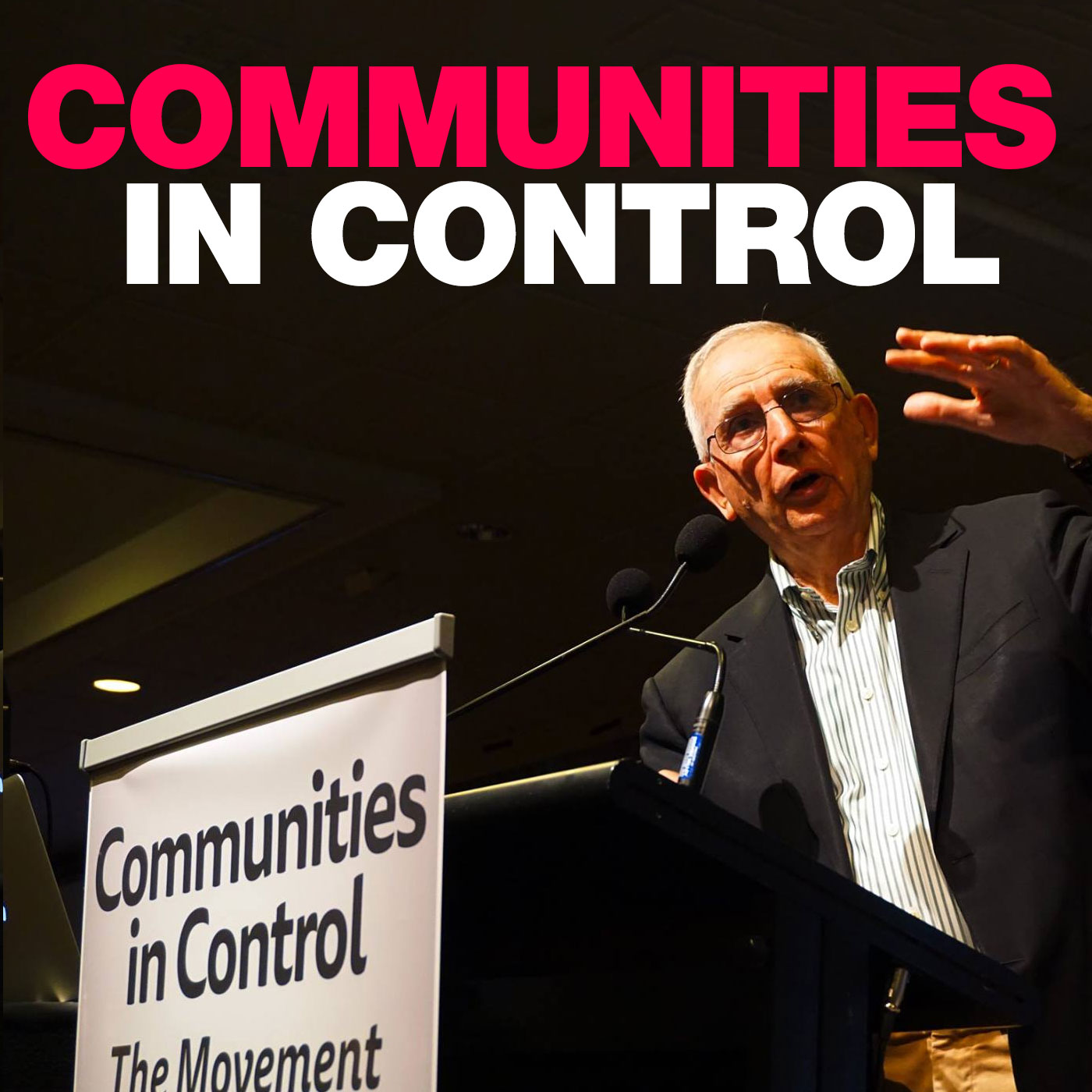
Here's another inspiring speech recorded at Communities in Control, Australia's biggest and best annual community sector gathering. Getting angry and then getting organised. Well, I'm angry. Don't know about you. Are you angry? So we're all angry. Let's start to get a little bit organised. Anger is, of course, the human natural response to injustice. Whenever we feel a little bit of injustice, our natural response is anger. That's what the terrible twos are all about when we get the throw down and the screaming and the kicking. That's that first dawning consciousness that we live in a world that sometimes just isn't just. And so that's why we are angry.
I was born into injustice. Any society that takes a child away from its mother, when that mother is perfectly capable of raising that child, if surrounded by a just society where that mother belongs, that society is quite simply unjust. And so I've spent the last 56 years being angry because I've spent the last 56 years deeply conscious of the lack of justice within our society. But now I've got something else to be angry about because I've now got grandchildren in an unjust society. This is the oldest of my four grandchildren. This is Isabella Rose, or Izzy as she likes to be called, or Munchkin as I call her.
Izzy just had her ninth birthday. We hired an indoor climbing centre and about a dozen of her friends gathered together, climbed and then it came to the cake time and so it was a Pokemon party and the cake was vegan. Izzy has decided about three or four years ago, she said, Pa, if we eat all the little lambs, there'll be no little lambs left. And so Izzy has chosen to be vegetarian because she's a person who is quite interested in injustice issues that surround her. So to keep everybody comfortable at the party, the cake was vegan, gluten-free and nut-free, and it was very tasty. And it all went very well until we came to the cutting of the cake, where Pikachu sustained a mortal wound.
And we had 12 traumatised little kids. And my grandson, who is three, was hiding under the table and was vowing never to eat cake again because Pikachu had befallen the knife. Well, this was a special day for my granddaughter because she was surrounded by friends. And that's not something that has been easy for Izzy. This little video is Isabella six years ago. When Izzy was three, she could recite the periodic table. Now I'm going to get all upset. Izzy's superpower is autism. But that means she finds it difficult to find belonging.
She was homeschooled for a little while, but then she decided that she wanted to go to school. And it was such an exciting day when she got her school uniform. She didn't know what a school uniform really meant, but she knew that it was really cool to have one. And so off she went to school on her first day. But the trouble is, on her first day, Izzy decided that she wanted to teach the class. And the teacher didn't respond in a particularly helpful way to Izzy wanting to teach the class.
And she was basically given the message that she had to fit in. And she said to me, Pa, they want us to fit in. They want us all to be the same. And I'm an individual. So Izzy's foray into the education system was very unproductive. Because she's not a little girl who fits in easily. But a little girl with a desperate desire to belong.
And Izzy learnt, and I think I began to learn and to reflect and to understand even more deeply, that belonging and fitting in are not the same thing. To fit in, she had to be something that she wasn't. She had to deny something of herself. And that is the opposite to belonging. Because we can only belong when we are truly ourselves, when we are truly who we are. And she went off to guides.
They live in a tiny little town up in the Pilbara at the time. Now, while guides had a uniform, just like school had a uniform, they had rules and regulations and all sorts of other things that are very important, just like the school does. But the agenda for this little group wasn't about fitting in. It was about belonging. And that made all the difference to Izzy. All of a sudden, she began to feel that she belonged and that she didn't just have to fit in.
Fitting in is the responsibility of the individual. It's something that we as individuals feel that we just have to do. But belonging is the responsibility of the entire community. And that's what we have to be on about. Because each and every one of us struggles to belong sometimes. Did anybody wake up on Sunday morning and feel as though they belonged a little less than they did on Friday morning? Why was that?
Why do we feel we belonged less on Sunday morning? Kerry was up until two o'clock on Sunday morning on her phone looking for jobs for me in New Zealand. Because all of a sudden we felt we didn't belong as much as we did because there was something going on that made us feel we didn't quite fit in the same way. And that's a really important thing to remember when we start to think about people that we may not agree with or we may not feel comfortable with, people who are different to us. Because I'm an adopted person, I grew up almost in exactly the place where your school programs are going, in the Hunter Valley. And in the valley I grew up in, there was a high level of familial identity. Everybody was related to everybody else, except me.
And I had a lovely family, a wonderful family, who loved me very much and communicated how much I was wanted and all of that kind of stuff. But still, there was that nagging sense that I didn't belong. I can clearly remember the day I was having this testosterone competition with another 12-year-old, as young boys do, and we were arguing about whose family had been in the valley for the longest. And it came to a stalemate at about six generations where we both came to the same great-great-great-great-grandfather. And then he said, ah, but that doesn't count.
because you're adopted. And it was kind of like a deep sense of I don't belong and so I've just got to try harder and harder to deny who I am and to fit in with everybody else. And that pretty much destroyed my entire adolescence, to be honest, because as I grew, I continued to get into this habit that I started to deny who I was. I left school as early as I could and I got a job in a shop in Newcastle. And one of the jobs for the apprentice was to go out every morning and to sweep the footpath. And another friend of mine from school who escaped school at the same time as I did, he got a job at the BHP, and he used to catch the bus just outside the shop of a morning. He was a Torres Strait Islander boy. And so I'd go out in the morning, I'd sweep the footpath, and I'd say g'day to Wayne, and then I'd come back in. Until one morning, a new manager began in the shop, and I went out and I swept the footpath, and I had a chat with Wayne, and then I came back in, and he just looked at me, I can still remember, over the top of his glasses in that intimidating way that the older people look at younger people.
And he said, so, you talk to blackfellas, do you? And from that day on, I waited till Wayne got on the bus before I went out to sweep. What's going on there? What's going on there is that desperate need we have to fit in, to deny ourselves, to deny our friends even, so that we can fit in. But this workplace wasn't a workplace of belonging. It was a workplace of fitting in.
It's because of what we call a domination system. Domination systems are not about belonging. They're about making people deny who they are and fit in. And all cultures have them, and they normally have five elements. They normally have an ethnic, a cultural, a spiritual, a gender, and a sexuality dynamic. We mostly live in a white Western...
Male, sorry, ladies, but, you know, you only walk out to where the toilets were during the break and you know the blokes are in charge, don't you? Because all the women are lined up to go to the loo and the men are just walking straight in and out. So we still live in this male, psychologically dominated, heterosexual, psychologically not Western, white Western. And that requires people to deny just a little bit of who they are so that they can fit in. And for any one of those boxes you can't tick, it just gets that little bit harder.
Because we live in a society that's about fitting in. And maybe that's why we felt a little bit less at home on Sunday morning than we were comfortable with. Because we're afraid that it could be a little bit more about fitting in than it is about belonging. And so, what are we to do? There's a lot there to get angry about. But how do we get organised?
Well, I think one of the first things we have to do when we want to think about belonging is to... I'm going to have to skip over a few of these things here, there we go, because we're short of time. The first thing we need to do in this place if we want to think about belonging is listen to the people who have belonged here for 65,000 years. Because they were a group of people who were incredibly different, one from the other, and yet had this deep sense of belonging. 500 nations, 800 languages.
All existing and thriving in the same place. So belonging has got something to do with sharing that same space, that same place, walking on that same land. And in doing so, sharing that same humanity. We're going to hear a lot about what it means to be Australian over the next three years. We're going to hear a lot about what Australian culture is over the next three years. And we're going to hear a lot about fitting into that.
Especially if you belong to a minority group of some description. But we have to remember and keep talking about it. There are only two things that are required to belong here. And that is a consciousness that we walk gently on the same land, in the same place. And that we do so recognising each other's humanity. That's what belonging is about. That's the place that we have to start. I was very active in the marriage equality.
And that was because I think belonging is about participating in the same civic universe as everyone else. When we don't participate in the same civic universe, then we can't belong together. And when human rights are divorced from belonging, then it becomes confusing for everyone. The first place to begin with human rights is the place of belonging. And when some people don't belong quite as much...
as someone else, then their human rights are indeed in jeopardy. So what do we do? What do we do with those people in a just society? If all justice is social, if all justice really comes down to everyone belonging, then what do we do with the people that we find it hard to belong with? How do we stop from otherising? How do we actually delight in the unique otherness of the other, which creates a healthy society?
You may recognise this guy from Melbourne. He's one of yours. I don't want to claim him. He was in court the other day. He invaded a gay church last Sunday, not yesterday, the night before. His name is Neil Erickson. And he invaded our worship about a year ago. Obviously, he was in Ramadan this time last year because of my support for the Islamic community, especially in Sydney and New South Wales.
Now, what he did to us was incredibly traumatic, and he did it again to another church only a couple of Sundays ago. He invaded with a loud hailer and traumatised our congregation. It's happened to us a number of times now. But what I recognise in him is a deep sense of not feeling he belongs anymore. The world is changing around him.
He belongs, he thinks, to a white Western male nominally Christian heterosexual dominated society and that's changing around him and he just doesn't know what to do about it. He thinks he benefits and his group benefit from that white male Western nominally Christian heterosexual community where in fact they really don't. They don't have a job. They don't have any life partners. They don't benefit from the society that they are trying to hold up and hold together. Just as the people who voted for Donald Trump in the United States, most supportive of Donald Trump are the people who benefit from least from his regime. And sadly, what we will find over the next three years, the same dynamic here. The Queensland miners, for instance, will least benefit from the vote that they cast last Saturday.
if they'd have voted for renewables and renewable manufacturing and they would have job security well into this century. So why do we do that? Why do we shoot ourselves in the foot so much and why do we support structures that actually don't help us? Because they create the illusion of belonging. But it is an illusion because it's not really about belonging. It's just about fitting in.
I was asked a question the other day, I was doing an interview, and a very insightful young person asked the question, who would you most like to have lunch with? And all these names, I said, they have to be alive, because I wouldn't actually mind having lunch with Jesus, because I'd kind of like to really know what he was on about. And I thought, oh, maybe Barack Obama, he'd be a really cool person to have lunch with, love to have lunch. But then I remembered I'd put up this sign, and I said, well, actually, if I'm all about belonging, if I believe belonging is the pathway...
to better communities, to healthier communities, then the person I really need to have lunch with is Pauline Hanson. The person whose humanity I really need to be able to see and understand and connect with more deeply is Pauline Hanson and Neil Erickson and those people. Now, I don't pretend for one moment that I would enjoy that lunch, but it's the lunch we need to have. Because until people who push the kind of policies...
that divide people can actually feel that they themselves belong, then they will continue to behave in the way they are behaving. So when we go out, my watch is now buzzing on my arm, when we go back to our workplaces with our anger, and it's an anger that is real and valid because our society is not yet just. Go back into our jobs, our neighbourhoods, our communities, our workplaces with the question... how deeply do I feel I belong? How deeply does the person that I'm speaking with, how deeply do they feel they belong? And when we've asked those two questions, the next question is always, how can we together create a deeper sense of belonging? And it is when we have done that that some of the answers to the other questions will just become so beautifully and manifestly obvious to us.
We hope you've enjoyed this highlight from the Communities in Control library.