Grooving: Kiki and Bouba Minds episode artwork

EPISODE · Dec 11, 2019 · 13 MIN

Grooving: Kiki and Bouba Minds

from Behavioral Grooves Podcast · host Kurt Nelson, PhD and Tim Houlihan

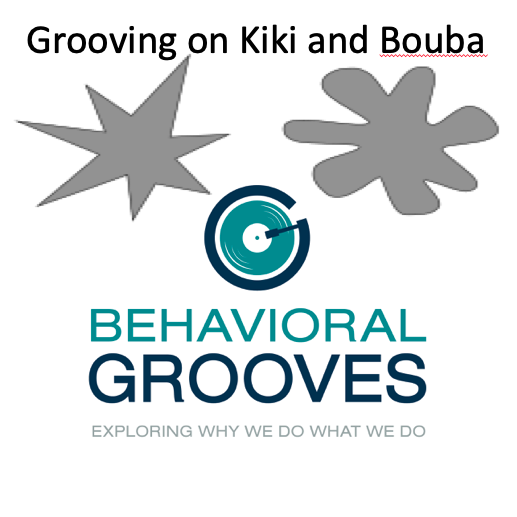
Imagine that the two drawings below are called Kiki and Bouba in some alien language.  If you had to guess which one was Kiki and which one was Bouba - without any other information, which one would be Kiki, and which one would be Bouba?   If you are like most people, the sharp angular shape (on the left) would be named Kiki while the curvier rounded shape (on the right) would be named Bouba.  This effect is called the Bouba/Kiki effect which highlights how we map sounds to visual shapes and was first observed by Wolfgang Kohler in the late 1920s and then refined in the early 2000s by Vilayanure Ramachandran and Edward Hubbard.   In experiments, over 95% of respondents selected the curvy shape as Bouba and the jagged one as Kiki.  The effect shows that words that have softer, rounded sounds (i.e., oo’s and ah’s) are associated with rounder shapes, while sounds that have more angular, sharp sounds (i.e., k’s and I’s) are associated with more pointed shapes.  While this effect focused on speech and visuals, my colleague and co-host of Behavioral Grooves, Tim Houlihan and I have started to use it as a way to describe how we think.  Some of us think with a “Kiki” like a brain.  Others of us think with a “Bouba” like a brain.  While not perfect, it does help in understanding the differences in how our brains process, retain, and regurgitate information.  For instance, a “Kiki brain” is precise and sharp and can remember specific names, dates, and titles.  While a more “Bouba brain” retains information about the general concepts and impacts but is less precise and more holistic in the combination of ideas and thoughts.   So while Tim can typically recall the name of a behavioral science study, the year it was published, and the author(s) (very much a Kiki brain), Kurt can usually only recall the concept that the study explored, how that concept can be applied, and how it interacts with other behavioral science concepts (more of a Bouba brain).    Often times during the podcast, my Bouba mind will be at a loss for the name of a study or a particular researcher, however, Tim’s Kiki brain will have those names readily available.  On the other side of the coin, Tim will be reciting a specific study and my Bouba brain will instantly go to the nuances of the application of how this works and implications for the people involved.  Of course, like most other ways of describing ourselves, this is not an either/or situation.  I would argue that we all have aspects of Kiki thinking AND Bouba thinking depending on the topic, situation, and other factors (i.e., how much sleep we had the night before).  And no brain is just Kiki or Bouba – we shift between the two on a regular basis.  Like personalities, these descriptions are just the tendencies for the way we think.  For instance, I’m not always at a loss for remembering a study name or researcher nor do I not understand the subtleties or connections from those studies that I do remember.  We fluctuate on a continuum and we often move easily between the thinking styles.  In general, my notion is that Kiki brains are more admired.  Those are the people that I don’t like getting into debates with, because they will bring in facts and figures and names at lightning speed and I’m just trying to stay up and connect the dots.   I need to be on my phone looking up references and facts, while they are seemingly pulling them out of the air.  People with KikI brains come across as smarter and more informed – because they can recall these details whereas people with Bouba brains are left talking about the general proposition.  Kiki brains are not fumbling to remember people’s names, the exact figure for the organization’s budget or the year that the Challenger exploded.  At this point, there is no research that is on this or supports this crazy theory.  However, by naming these types of thinking styles, I think we can better interact with each other and contribute to our work.  The power of this is in helping us understand how we communicate with others and understanding how we process and remember information.       Notes Image:  Monochrome version 1 June 2007 by Bendž Vectorized with Inkscape  Maurer, Pathman, and Modloch (2006), The shape of Boubas: sound-shape correspondences in toddlers and adults.  Developmental Science. Ramachandran, V.S. & Hubbard, E.M. (2001). "Synaesthesia: A window into perception, thought and language" (PDF). Journal of Consciousness Studies.   © 2019 Behavioral Grooves

Imagine that the two drawings below are called Kiki and Bouba in some alien language.  If you had to guess which one was Kiki and which one was Bouba - without any other information, which one would be Kiki, and which one would be Bouba?   If you are like most people, the sharp angular shape (on the left) would be named Kiki while the curvier rounded shape (on the right) would be named Bouba.  This effect is called the Bouba/Kiki effect which highlights how we map sounds to visual shapes and was first observed by Wolfgang Kohler in the late 1920s and then refined in the early 2000s by Vilayanure Ramachandran and Edward Hubbard.   In experiments, over 95% of respondents selected the curvy shape as Bouba and the jagged one as Kiki.  The effect shows that words that have softer, rounded sounds (i.e., oo’s and ah’s) are associated with rounder shapes, while sounds that have more angular, sharp sounds (i.e., k’s and I’s) are associated with more pointed shapes.  While this effect focused on speech and visuals, my colleague and co-host of Behavioral Grooves, Tim Houlihan and I have started to use it as a way to describe how we think.  Some of us think with a “Kiki” like a brain.  Others of us think with a “Bouba” like a brain.  While not perfect, it does help in understanding the differences in how our brains process, retain, and regurgitate information.  For instance, a “Kiki brain” is precise and sharp and can remember specific names, dates, and titles.  While a more “Bouba brain” retains information about the general concepts and impacts but is less precise and more holistic in the combination of ideas and thoughts.   So while Tim can typically recall the name of a behavioral science study, the year it was published, and the author(s) (very much a Kiki brain), Kurt can usually only recall the concept that the study explored, how that concept can be applied, and how it interacts with other behavioral science concepts (more of a Bouba brain).    Often times during the podcast, my Bouba mind will be at a loss for the name of a study or a particular researcher, however, Tim’s Kiki brain will have those names readily available.  On the other side of the coin, Tim will be reciting a specific study and my Bouba brain will instantly go to the nuances of the application of how this works and implications for the people involved.  Of course, like most other ways of describing ourselves, this is not an either/or situation.  I would argue that we all have aspects of Kiki thinking AND Bouba thinking depending on the topic, situation, and other factors (i.e., how much sleep we had the night before).  And no brain is just Kiki or Bouba – we shift between the two on a regular basis.  Like personalities, these descriptions are just the tendencies for the way we think.  For instance, I’m not always at a loss for remembering a study name or researcher nor do I not understand the subtleties or connections from those studies that I do remember.  We fluctuate on a continuum and we often move easily between the thinking styles.  In general, my notion is that Kiki brains are more admired.  Those are the people that I don’t like getting into debates with, because they will bring in facts and figures and names at lightning speed and I’m just trying to stay up and connect the dots.   I need to be on my phone looking up references and facts, while they are seemingly pulling them out of the air.  People with KikI brains come across as smarter and more informed – because they can recall these details whereas people with Bouba brains are left talking about the general proposition.  Kiki brains are not fumbling to remember people’s names, the exact figure for the organization’s budget or the year that the Challenger exploded.  At this point, there is no research that is on this or supports this crazy theory.  However, by naming these types of thinking styles, I think we can better interact with each other and contribute to our work.  The power of th

NOW PLAYING

Grooving: Kiki and Bouba Minds

0:00 13:50

No transcript for this episode yet

We transcribe on demand. Request one and we'll notify you when it's ready — usually under 10 minutes.

That Hoarder: Overcome Compulsive Hoarding That Hoarder Hoarding disorder is stigmatised and people who hoard feel vast amounts of shame. This podcast began life as an audio diary, an anonymous outlet for somebody with this weird condition. That Hoarder speaks about her experiences living with compulsive hoarding, she interviews therapists, academics, researchers, children of hoarders, professional organisers and influencers, and she shares insight and tips for others with the problem. Listened to by people who hoard as well as those who love them and those who work with them, Overcome Compulsive Hoarding with That Hoarder aims to shatter the stigma, share the truth and speak openly and honestly to improve lives. The Small Business Startup School – Business Notes | Financial Literacy | Retail Psychology – For Professionals & Entrepreneurs The Small Business Startup School Inc. Starting or buying a small business? While personal circumstances may vary, business patterns remain timeless. On The Small Business Startup School, we explore strategies, insights, and practical solutions to help entrepreneurs confidently navigate their journey.Hosted by Ola Williams—a retail entrepreneur, fintech founder, and financial coach with over two decades of experience—this podcast marries financial awareness and retail psychology with optimism to deliver actionable takeaways.Join us to learn, grow, and connect as we uncover the keys to business success.Let’s continue to learn together and be encouraged to keep on connecting! DIOSA. Carolina Sanper This podcast is a sacred space created by Carolina Sanper where you connect with your inner wisdom and embody your magnetic feminine power.It is the realization that the mystical realm is where you plant the seeds of your desired reality.It is a portal to your true essence: awareness, presence, and receiving with ease. Welcome home, DIOSA. 🖤 XXX Tech by SOVRYN Dr. Brian Sovryn The crossroads between technology, sensuality, and metaphysics - and the longest running anarchist podcast in the world! Brought to you by Dr. Brian Sovryn.

Frequently Asked Questions

How long is this episode of Behavioral Grooves Podcast?

This episode is 13 minutes long.

When was this Behavioral Grooves Podcast episode published?

This episode was published on December 11, 2019.

What is this episode about?

Imagine that the two drawings below are called Kiki and Bouba in some alien language.  If you had to guess which one was Kiki and which one was Bouba - without any other information, which one would be Kiki, and which one would be Bouba?   If you...

Can I download this Behavioral Grooves Podcast episode?

Yes, you can download this episode by clicking the download button on the episode player, or subscribe to the podcast in your preferred podcast app for automatic downloads.
URL copied to clipboard!