
EPISODE · Apr 3, 2025 · 1H 3M
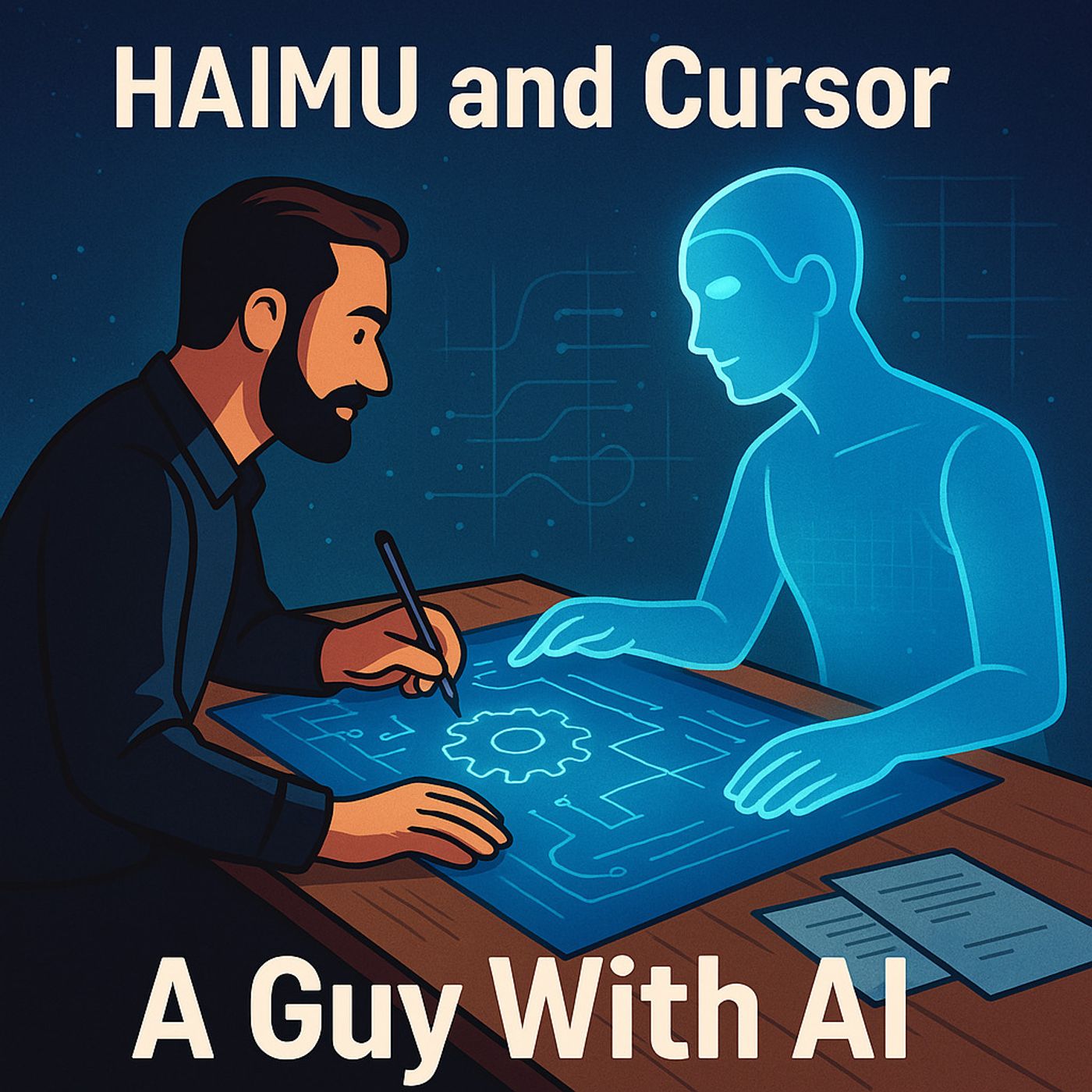
HAIMU and Cursor
from A Guy With AI · host Sean MacNutt
(00:03) Human AI Collaboration With Cursor Tool(12:15) Enhancing Collaboration Through Meta-Engineering(35:21) Collaborative Methodology in AI Development(43:49) Revolutionizing Human-AI Collaboration Paradigms(53:26) Advancing Collaborative Knowledge Systems(01:02:38) Creating AI Community (00:03) Human AI Collaboration With Cursor ToolThis chapter explores the concept of Human-AI Mutual Understandability (HAIMU), a term I coined to describe effective collaboration between humans and AI. I discuss how I've been applying HAIMU to various projects, including a significant physics project involving quantum simulators, with impressive results. A new tool called Cursor, an AI-assisted Integrated Development Environment (IDE), has been particularly instrumental. As a non-coder, I've utilized Cursor's agent feature to communicate with AI, building context and making project decisions, resulting in professional-quality code. This chapter includes audio clips of my interactions with the AI, illustrating how rules and context are crafted to guide AI in project development. Additionally, I share how the concept of HAIMU has been integrated into my work, highlighting its potential for achieving meaningful outcomes in AI collaboration. (12:15) Enhancing Collaboration Through Meta-EngineeringThis chapter explores the concept of meta-engineering and its transformative impact on collaborative environments, particularly in the development of complex technical projects. We examine how the creation of cursor rules not only enhances coding standards but also extends to documentation, error handling, testing, and interface design, aligning with scientific and engineering visions. The discussion highlights how these rules serve as a sophisticated knowledge management system, effectively translating scientific theories into computational form. By leveraging AI and human collaboration, we manage to significantly improve code quality, ensuring it is well-documented, scientifically accurate, and maintainable for future developers. We emphasize the stark contrast between typical scientific code and the enhanced quality achieved through these practices, offering insights into how such methodologies can redefine traditional development processes. (35:21) Collaborative Methodology in AI DevelopmentThis chapter explores the innovative journey of Sean Magnutt, a non-coder, as he collaborates with AI to develop a physics simulator through a platform called Cursor. With the AI co-host built on OpenAI's GPT-4O model, we delve into how Sean utilizes AI to produce sophisticated, maintainable scientific code without traditional programming skills. We discuss how Sean employs Cursor's AI-enhanced coding environment and the concept of Cursor/rules—structured guidance that acts as internal documentation and a behavioral framework for AI coding. Through an evolving system, Sean shapes the AI's reasoning and output, mimicking high-level engineering practices. We highlight the transformative process of AI as a collaborative partner, rather than just a tool, to bridge the gap between human goals and AI capacity, leading to outcomes that rival those of professional coding teams. (43:49) Revolutionizing Human-Ai Collaboration ParadigmsThis chapter explores the transformative shift from traditional coding practices to an integrated AI-enhanced development environment, where AI and human critical thinking merge seamlessly. By embedding AI into the very tools of production, I create a dynamic dialogue with AI that results in well-documented, testable, and maintainable code. We discuss how this structured interaction goes beyond mere output, fostering understanding and alignment with project goals. I share my journey as a non-physicist achieving significant results in quantum simulation through AI, demonstrating that expertise isn't confined to domain knowledge but can be achieved through conceptual thinking and effective AI collaboration. We highlight the innovative Hymu methodology, where AI and human collaboration enhance each other, leading to an iterative improvement process that challenges conventional assumptions about expertise and opens new pathways for sophisticated technical projects. (53:26) Advancing Collaborative Knowledge SystemsThis chapter explores the innovative method of co-creating knowledge and systems with AI, termed Haimu Human-AI Mutual Understandability. We examine the core elements of this approach, such as dual-domain AI amplification, which treats AI as a collaborator capable of both theoretical exploration and practical implementation. I highlight the importance of conceptual architecture, where expertise is not just about formal knowledge but also about constructing workflows and refining instructions at a meta-level. The discussion emphasizes recursive knowledge building, where each AI iteration enhances the next, creating a feedback loop of improvement. A new kind of expertise is identified, focusing on guiding AI effectively rather than merely executing tasks. This method shifts the paradigm from needing to be an expert to managing understanding between human and AI, transforming complex problem-solving. The chapter concludes with insights into my journey of developing confidence to share the Haimu paper and the meaningful results of my physics project, illustrating the broader implications of this method in advancing technical and scientific projects. (01:02:38) Creating AI Community Through GuyThis chapter invites you to engage with the innovative ways AI can transform our creative and professional landscapes. We explore the significance of staying curious and creative while integrating AI into various aspects of work and life. I encourage listeners to subscribe, like, and share the episode with others who might find inspiration in these new methodologies. Additionally, I provide a sneak peek into the upcoming Heimo paper and related physics announcements, inviting the audience to join our community on platforms like YouTube and Facebook. Our goal is to foster a vibrant conversation around AI, urging everyone to keep building and exploring this dynamic field. Facebook PageYouTube ChannelInstagramPayPal
What this episode covers
Join us on a captivating journey into the realm of Human-AI Mutual Understandability (HAIMU), a concept I've pioneered to revolutionize collaboration between humans and AI. In this episode, I share my experiences using HAIMU in groundbreaking projects, particularly in physics, where I've achieved remarkable results with quantum simulators. With the help of a powerful tool called Cursor, an AI-assisted Integrated Development Environment (IDE), I've managed to bridge the gap between my non-coding background and the production of professional-grade code. Listen in as I illustrate how creating rules and context within Cursor guides AI to make impactful project decisions, demonstrating the transformative potential of effective human-AI collaboration. Explore the transformative impact of meta-engineering and how it redefines collaborative environments in technical project development. By creating sophisticated rules within Cursor, we enhance coding standards and extend these improvements to documentation, error handling, and testing. This structured approach not only ensures high-quality, scientifically accurate code but also acts as a sophisticated knowledge management system. We contrast typical scientific coding practices with the enhanced quality achieved through AI collaboration, offering insights into how these methodologies can reshape traditional development processes and bridge the gap between scientific theories and computational implementation. Finally, I invite you to embrace the innovative methodologies of co-creating knowledge systems with AI, termed HAIMU. This approach treats AI as a collaborator, amplifying both theoretical exploration and practical implementation. We discuss the importance of conceptual architecture, where expertise transcends formal knowledge to focus on constructing workflows and guiding AI effectively. As we navigate this dynamic field, I encourage listeners to remain curious and creative, fostering a vibrant community that shares insights and innovations. Join us as we explore the transformative journey of AI as a collaborative partner, challenging conventional assumptions about expertise and opening new pathways for sophisticated technical projects.
NOW PLAYING
HAIMU and Cursor
No transcript for this episode yet
Similar Episodes
Mar 26, 2026 ·1m
Jan 2, 2026 ·47m
Dec 21, 2025 ·46m