
EPISODE · Jun 29, 2026 · 0 MIN
Happiness at Work Is the Ability to Be Oneself: How Belonging, Authenticity, and Psychological Safety Drive Performance
from AgilEmpath · host Alexia Georghiou
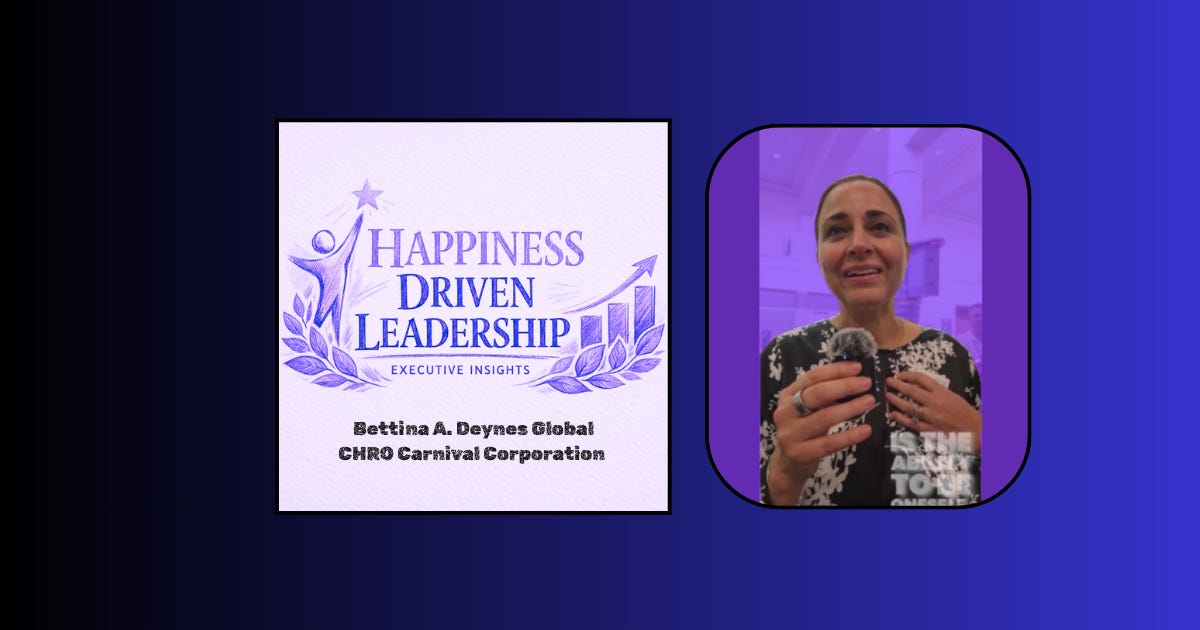
At SHRM 2026, the panel “HR Executive Insights: Architecting the Future of the Global Frontline Workforce” brought together some of the most influential HR leaders in the world for a conversation that cut straight to the core of modern leadership.I approached Bettina A. Deynes, Global Chief Human Resources Officer of Carnival Corporation, the world’s largest cruise company, immediately after the panel. Continuing the thread from each executive in this series, I asked her one question: What is happiness at work?Her answer was immediate, personal, and profound.“Happiness at work is the ability to be oneself, to know that you’re going to be able to be part of a community where you feel like you belong, where you can do your best work, when you can connect with people that aim to have the same goals and achieve the same success.”Read that one more time. In a single sentence, Bettina identified the four pillars that decades of research have proven drive human thriving:* Authenticity — the ability to be oneself* Belonging — being part of a community* Peak performance — doing your best work* Shared purpose — connecting with people who share the same goalsLater she added, “happiness often grows when we take a moment to recognize and appreciate what we already have—gratitude truly has a way of brightening even the simplest moments.”This isn’t corporate optimism. This is an executive who leads People Strategy for over 200,000 employees across 9 cruise line brands, sailing to over 700 ports around the world; distilling what makes people actually happy at work into its purest form.Who Is Bettina A. Deynes?Bettina A. Deynes serves as the Global Chief Human Resources Officer of Carnival Corporation & plc, the world’s largest leisure travel company. Carnival’s portfolio includes iconic brands such as Carnival Cruise Line, Princess Cruises, Holland America Line, and others, operating over 90 ships across six continents.In this role, Bettina oversees the global people strategy for a workforce that spans dozens of nationalities, languages, and cultures, all operating in one of the most complex and people-intensive industries on the planet. Managing HR for a global cruise fleet is unlike any other industry: your employees don’t just work for the company; they live inside the company. The ship is their office, their home, and their community — sometimes for months at a time.Before Carnival, Bettina served as Chief Human Resources Officer of the Society for Human Resource Management (SHRM) itself; the world’s largest HR professional society; giving her an unparalleled vantage point on the trends, research, and challenges shaping the future of work globally. Her career spans senior HR leadership roles across industries, and she is widely recognized as one of the most influential HR executives in the world.When Bettina speaks about belonging and community, she isn’t speaking in abstraction. She is speaking from the reality of building cultures where people from every corner of the world must come together, find belonging, and deliver extraordinary experiences every single day, at sea.The Belonging Principle: Breaking Down the InsightBettina’s response is deceptively simple. Within it are three interconnected leadership lessons that every executive needs to understand:1. Authenticity Is the Foundation of Happiness“The ability to be oneself.” Before belonging, before performance, before connection there must be a workplace where people don’t have to mask who they are. Bettina places authenticity first in her definition, and that’s not accidental. If employees can’t show up as themselves, no engagement initiative, no team-building retreat, and no compensation package will produce genuine happiness.2. Belonging Is a Community, Not a PolicyBettina doesn’t say “inclusion” she says “part of a community where you feel like you belong.” There’s a critical difference. Inclusion can be a policy, a checklist, a training module. But belonging is a felt experience. It’s the difference between being invited to the table and actually feeling like you’re supposed to be there. In Carnival’s world, where thousands of employees from different countries live and work together on a ship this isn’t optional. It’s operational survival.3. Shared Purpose Fuels Connection“Connect with people that aim to have the same goals and achieve the same success.” Happiness at work isn’t just about individual fulfillment, it’s about collective alignment. When people feel they are working toward something together, connection becomes organic. Bettina is describing the difference between a group of individuals performing tasks and a community pursuing a shared mission.The Science: Psychological Safety and Google’s Project AristotleBettina’s definition of workplace happiness isn’t just executive wisdom, it maps directly onto one of the most important discoveries in modern organizational science.The Foundational Research: Dr. Amy EdmondsonResearcher: Dr. Amy Edmondson, Novartis Professor of Leadership and Management, Harvard Business School Published: 1999, Administrative Science Quarterly — “Psychological Safety and Learning Behavior in Work Teams”In 1999, Edmondson studied hospital nursing teams expecting to find that the best teams made the fewest errors. She found the opposite: the highest-performing teams reported more errors. But they weren’t making more mistakes they felt safe enough to report them. Teams with psychological safety, a shared belief that the team is safe for interpersonal risk-taking, caught errors before they became crises. Teams without it suppressed problems out of fear.Edmondson defined psychological safety as: “A shared belief held by members of a team that the team is safe for interpersonal risk-taking.” In psychologically safe teams, individuals feel they can speak up, admit mistakes, ask questions, and be themselves without fear of embarrassment, rejection, or punishment.The Validation at Scale: Google’s Project AristotleOrganization: Google People Operations Scope:180 teams studied over 4 years (2012–2016) Published via: Google re:WorkGoogle launched Project Aristotle to answer a deceptively simple question: What makes some teams significantly more effective than others?After analyzing 180 teams and over 250 variables, the results were stunning:Psychological safety was the #1 predictor of team effectiveness — more important than individual talent, seniority, team size, or even the skills of team members.The five dynamics of effective teams, in order of importance:* Psychological Safety — Team members feel safe to take risks and be vulnerable* Dependability — Members reliably complete quality work on time* Structure & Clarity — Clear goals, roles, and plans* Meaning — The work is personally important to members* Impact — The team believes their work mattersThe Numbers:* Teams with high psychological safety exceeded sales targets by 17%* Teams with low psychological safety fell short by as much as 19%* High-safety teams showed 31% more innovation and 27% lower turnover* Members of the best teams spoke in roughly equal proportions and showed high social sensitivityThe Most Counterintuitive Finding: The factors most people assume drive team success; individual star performers, team size, seniority, colocation, and even consensus-driven decision making; showed no significant correlation with team effectiveness. It wasn’t who was on the team. It was how the team treated each other.The bridge: Bettina is describing, from the vantage point of leading 160,000+ employees across dozens of nationalities, the exact conditions that Edmondson discovered in her lab and Google validated at scale. Authenticity requires safety. Belonging requires inclusion. Peak performance requires both high safety and high standards. And shared purpose requires the structural clarity and dependability that hold it all together.The Four Zones: Edmondson’s Performance FrameworkOne of the most powerful tools from Edmondson’s research is her Four Zones model, which explains why psychological safety alone isn’t enough — and why Bettina’s emphasis on “doing your best work” alongside belonging is so precise:Edmondson's research reveals that psychological safety alone isn't enough — it must be paired with high standards to unlock peak performance. Her framework identifies four distinct zones. When both psychological safety and standards are low, teams fall into the Apathy Zone — people don't care, turnover is high, and quality suffers. When standards are high but safety is low, teams enter the Anxiety Zone — people are stressed, burned out, and afraid to admit mistakes, so problems get buried instead of solved. When safety is high but standards are low, teams drift into the Comfort Zone — people feel good but aren't challenged, and performance stagnates. The magic happens when both psychological safety and standards are high: teams enter the Learning Zone, where people feel safe enough to be themselves, take risks, speak up, and push each other toward excellence. This is exactly what Bettina is describing — not just belonging for the sake of comfort, but belonging in service of doing your best work and achieving shared success.Bettina’s definition of happiness lives squarely in the Learning Zone — she doesn’t just want people to feel safe. She wants them to feel safe and do their best work and pursue shared goals. That combination, safety plus standards plus purpose, is the formula for teams that don’t just feel good, but perform at the highest level.5 Actionable Takeaways for Leaders* Measure Psychological Safety, Not Just Engagement: Use Edmondson’s 7-item survey to assess whether your teams feel safe to speak up, admit mistakes, and be themselves. Engagement scores can mask fear. Safety scores reveal truth.* Respond to the First Voice: The single most powerful thing a leader can do is how they respond to the first person who raises a concern, admits a mistake, or challenges an idea. If that person is thanked and heard, everyone learns that speaking up is safe. If they’re dismissed or punished, everyone learns that silence is safer.* Audit Your Belonging Climate: Ask yourself: Do people feel invited, or do they feel like they belong? Invited means you have a seat at the table. Belonging means you feel like the table was built with you in mind. Conduct “Belonging Interviews,” short, candid conversations where you ask team members, “Do you feel like you can be fully yourself here?”* Aim for the Learning Zone, Not the Comfort Zone: Safety without standards breeds complacency. Pair psychological safety with clear goals, high expectations, and constructive accountability. Bettina’s teams at Carnival don’t just feel welcome they’re expected to deliver extraordinary guest experiences. That’s the Learning Zone in action.* Build Shared Purpose Deliberately: Don’t assume alignment. Regularly articulate whythe team exists, what you’re collectively pursuing, and how each person’s contribution connects to the mission. Bettina’s insight, “connect with people that aim to have the same goals,” only works when those goals are visible, shared, and reinforced.For more executive insights from that SHRM 2026 panel, read my full article: Motivating the Global Frontline Workforce — Vulnerability at SHRM 2026 This is a public episode. If you'd like to discuss this with other subscribers or get access to bonus episodes, visit alexia.substack.com/subscribe
Embed this episode
NOW PLAYING
Happiness at Work Is the Ability to Be Oneself: How Belonging, Authenticity, and Psychological Safety Drive Performance
No transcript for this episode yet
Similar Episodes
No similar episodes found.
Similar Podcasts
No similar podcasts found.