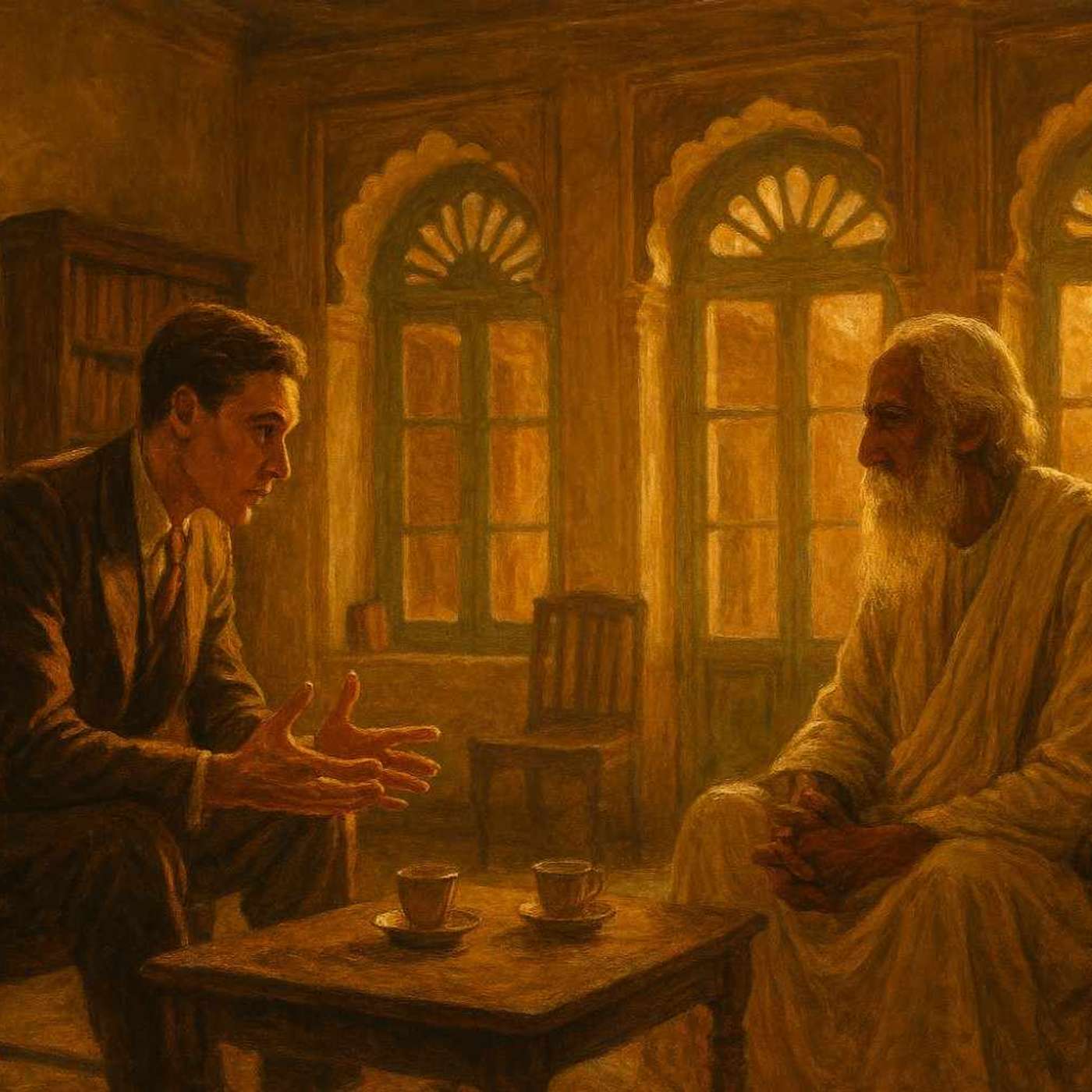
Heisenberg Tagore Kolkata: When the Uncertainty Principle Met the Upanishads episode artwork

EPISODE · Jun 10, 2026 · 19 MIN

Heisenberg Tagore Kolkata: When the Uncertainty Principle Met the Upanishads

from Incredible India Travel | Social Impact & Culture Tours · host 5 Senses Tours | Cultural Experiences & Social Impact Guides

On the afternoon of October 4 1929 a 28-year-old German physicist arrived at the house of a 68-year-old Indian poet in Kolkata.The physicist had two years earlier published the uncertainty principle, one of the most philosophically disturbing discoveries in the history of science. It had shaken the foundations of physics so completely that he himself could not fully make peace with what he had found. The mathematics was unambiguous. The implications were overwhelming. And nothing in the Western philosophical tradition within which he had been educated gave him a framework for understanding what his own equations were telling him about the nature of physical reality.The poet was one of the most celebrated minds of the 20th century. Nobel laureate. Composer of the national anthems of both India and Bangladesh. The first non-European to win the Nobel Prize in Literature. And a philosopher whose understanding of the relationship between consciousness and reality, between the observer and the observed, between the individual and the universe, was rooted in the Upanishadic tradition that the Indian subcontinent had been developing for three thousand years.Their names were Werner Heisenberg and Rabindranath Tagore.They talked for hours at Tagore's ancestral home at Jorasanko in North Kolkata. And when Heisenberg left he wrote to his parents the following day. In the afternoon I was the guest of the Indian poet Rabindranath Tagore.Decades later Heisenberg told the physicist Fritjof Capra what those conversations had meant to him. After these conversations with Tagore he said some of the ideas that had seemed so crazy suddenly made much more sense. That was a great help for me.The man who had discovered that the act of observation changes the thing being observed found comfort and clarity in a philosophical tradition that had been saying exactly this for three thousand years. The most disturbing finding of 20th-century physics had already been anticipated by ancient Indian thought. And it took a conversation in a house in Kolkata to make the connection visible.This is the complete story of the Heisenberg Tagore Kolkata meeting. And it is one of the most extraordinary intellectual encounters in the history of modern science.What You Will Discover in This EpisodeThe complete story of Werner Heisenberg and the uncertainty principle, why the discovery he published in 1927 at the age of 26 was so philosophically disturbing that it left him searching for a framework within which to understand what his own mathematics had revealed, and why nothing in the Western philosophical tradition he had been educated in could provide that frameworkWho Rabindranath Tagore was and why his intellectual formation in the Upanishadic tradition of ancient India had given him precisely the philosophical tools that Heisenberg needed, tools for understanding the non-separation of observer and observed, the interconnectedness of all phenomena and the impermanence of apparently solid and separate objects that the Indian tradition had been developing for three thousand years before quantum mechanics arrived at the same conclusions through mathematicsThe precise account of how the October 4 1929 meeting came to happen, how Heisenberg was brought to Jorasanko by Debendra Mohan Bose the nephew of the extraordinary scientist Jagadish Chandra Bose, and what Heisenberg wrote to his parents the following morningThe specific philosophical parallels between the Upanishadic tradition and quantum mechanics that Heisenberg found so clarifying in the Jorasanko conversations, including the relationship between the uncertainty principle and the Upanishadic teaching about the non-separability of consciousness and the physical world, the connection between quantum entanglement and the concept of Indra's Net, and the parallel between the Copenhagen interpretation and the Advaita Vedanta understanding of how definite objects emerge from the unified ground of beingThe honest account of what the meeting did and did not mean, why Indian philosophy did not cause the discovery of the uncertainty principle since Heisenberg published it two years before he met Tagore, and why the comfort and clarity the conversations provided is nevertheless genuinely extraordinary and genuinely significantThe second great conversation between a 20th-century physics giant and Indian philosophy, the Einstein Tagore meeting of July 14 1930 in Berlin, the recorded exchange about the nature of reality published in the Modern Review in January 1931, and why Einstein and Tagore's famous disagreement about mind-independent reality maps precisely onto Einstein's disagreement with Bohr about the interpretation of quantum mechanicsWhy Tagore and Bohr were on the same philosophical side and Einstein was on the other, and what it means that an Indian poet-philosopher and a Danish physicist working from completely different traditions and completely different methods arrived independently at the same position on the deepest question in the philosophy of physicsThe Jorasanko Thakur Bari, the ancestral home of the Tagore family built in 1784 in North Kolkata, the birthplace of Rabindranath Tagore and the site of the Heisenberg conversations, now a museum and the campus of Rabindra Bharati University open Tuesday to Sunday from 10:30 am to 4:30 pmThe complete Kolkata intellectual heritage landscape that surrounds the Heisenberg Tagore story, including Presidency College where Jagadish Chandra Bose taught Satyendra Nath Bose and Meghnad Saha, the Bose Institute whose founder's nephew brought Heisenberg to Tagore's house, and the extraordinary Bengali scientific tradition that produced both the scientists who reshaped modern physics and the philosopher whose Upanishadic understanding gave Heisenberg the peace of mind to accept what he had discoveredHow 5 Senses Tours brings the complete Heisenberg Tagore Kolkata story to life for international travellers through expert guided heritage experiences at Jorasanko Thakur Bari, Presidency College, the Bose Institute and the complete intellectual landscape of one of Asia's most extraordinary citiesExperience the Heisenberg Tagore Heritage With 5 Senses ToursThe house where Heisenberg and Tagore talked is still standing in North Kolkata. The rooms where those October afternoon conversations happened are still there. The carved wooden screens still cast the same geometric patterns of amber light across the floor. And the city outside, with its extraordinary tradition of intellectual and cultural achievement that produced both the Bengali scientists who reshaped modern physics and the poet-philosopher whose ancient wisdom gave one of those physicists his peace of mind, is still one of the most rewarding heritage destinations in Asia for a traveller who arrives with the complete story.Our Kolkata tours cover the complete intellectual heritage of the city including Jorasanko Thakur Bari, Presidency College, the Bose Institute and the Indian Museum with expert cultural guides who bring every story to life at the physical place where it happened. Book at https://5sensestours.com/home-kolkata-tours/Our Varanasi tours cover the Kashi Vishwanath tradition of accumulated knowledge on the banks of the Ganges where the Upanishadic philosophy that Tagore articulated to Heisenberg was developed and maintained for three thousand years. Book at https://5sensestours.com/home-varanasi-tours/Our Bodhgaya tours cover the Buddhist philosophical tradition that developed alongside the Upanishadic tradition and whose own insights about consciousness and re...

On the afternoon of October 4 1929 a 28-year-old German physicist arrived at the house of a 68-year-old Indian poet in Kolkata.The physicist had two years earlier published the uncertainty principle, one of the most philosophically disturbing discoveries in the history of science. It had shaken the foundations of physics so completely that he himself could not fully make peace with what he had found. The mathematics was unambiguous. The implications were overwhelming. And nothing in the Western philosophical tradition within which he had been educated gave him a framework for understanding what his own equations were telling him about the nature of physical reality.The poet was one of the most celebrated minds of the 20th century. Nobel laureate. Composer of the national anthems of both India and Bangladesh. The first non-European to win the Nobel Prize in Literature. And a philosopher whose understanding of the relationship between consciousness and reality, between the observer and the observed, between the individual and the universe, was rooted in the Upanishadic tradition that the Indian subcontinent had been developing for three thousand years.Their names were Werner Heisenberg and Rabindranath Tagore.They talked for hours at Tagore's ancestral home at Jorasanko in North Kolkata. And when Heisenberg left he wrote to his parents the following day. In the afternoon I was the guest of the Indian poet Rabindranath Tagore.Decades later Heisenberg told the physicist Fritjof Capra what those conversations had meant to him. After these conversations with Tagore he said some of the ideas that had seemed so crazy suddenly made much more sense. That was a great help for me.The man who had discovered that the act of observation changes the thing being observed found comfort and clarity in a philosophical tradition that had been saying exactly this for three thousand years. The most disturbing finding of 20th-century physics had already been anticipated by ancient Indian thought. And it took a conversation in a house in Kolkata to make the connection visible.This is the complete story of the Heisenberg Tagore Kolkata meeting. And it is one of the most extraordinary intellectual encounters in the history of modern science.What You Will Discover in This EpisodeThe complete story of Werner Heisenberg and the uncertainty principle, why the discovery he published in 1927 at the age of 26 was so philosophically disturbing that it left him searching for a framework within which to understand what his own mathematics had revealed, and why nothing in the Western philosophical tradition he had been educated in could provide that frameworkWho Rabindranath Tagore was and why his intellectual formation in the Upanishadic tradition of ancient India had given him precisely the philosophical tools that Heisenberg needed, tools for understanding the non-separation of observer and observed, the interconnectedness of all phenomena and the impermanence of apparently solid and separate objects that the Indian tradition had been developing for three thousand years before quantum mechanics arrived at the same conclusions through mathematicsThe precise account of how the October 4 1929 meeting came to happen, how Heisenberg was brought to Jorasanko by Debendra Mohan Bose the nephew of the extraordinary scientist Jagadish Chandra Bose, and what Heisenberg wrote to his parents the following morningThe specific philosophical parallels between the Upanishadic tradition and quantum mechanics that Heisenberg found so clarifying in the Jorasanko conversations, including the relationship between the uncertainty principle and the Upanishadic teaching about the non-separability of consciousness and the physical world, the connection between quantum entanglement and the concept of Indra's Net, and the parallel between the Copenhagen interpretation and the Advaita Vedanta understanding of how definite objects emerge from the unified ground of beingThe honest account of what the meeting did and did not mean, why Indian philosophy did not cause the discovery of the uncertainty principle since Heisenberg published it two years before he met Tagore, and why the comfort and clarity the conversations provided is nevertheless genuinely extraordinary and genuinely significantThe second great conversation between a 20th-century physics giant and Indian philosophy, the Einstein Tagore meeting of July 14 1930 in Berlin, the recorded exchange about the nature of reality published in the Modern Review in January 1931, and why Einstein and Tagore's famous disagreement about mind-independent reality maps precisely onto Einstein's disagreement with Bohr about the interpretation of quantum mechanicsWhy Tagore and Bohr were on the same philosophical side and Einstein was on the other, and what it means that an Indian poet-philosopher and a Danish physicist working from completely different traditions and completely different methods arrived independently at the same position on the deepest question in the philosophy of physicsThe Jorasanko Thakur Bari, the ancestral home of the Tagore family built in 1784 in North Kolkata, the birthplace of Rabindranath Tagore and the site of the Heisenberg conversations, now a museum and the campus of Rabindra Bharati University open Tuesday to Sunday from 10:30 am to 4:30 pmThe complete Kolkata intellectual heritage landscape that surrounds the Heisenberg Tagore story, including Presidency College where Jagadish Chandra Bose taught Satyendra Nath Bose and Meghnad Saha, the Bose Institute whose founder's nephew brought Heisenberg to Tagore's house, and the extraordinary Bengali scientific tradition that produced both the scientists who reshaped modern physics and the philosopher whose Upanishadic understanding gave Heisenberg the peace of mind to accept what he had discoveredHow 5 Senses Tours brings the complete Heisenberg Tagore Kolkata story to life for international travellers through expert guided heritage experiences at Jorasanko Thakur Bari, Presidency College, the Bose Institute and the complete intellectual landscape of one of Asia's most extraordinary citiesExperience the Heisenberg Tagore Heritage With 5 Senses ToursThe house where Heisenberg and Tagore talked is still standing in North Kolkata. The rooms where those October afternoon conversations happened are still there. The carved wooden screens still cast the same geometric patterns of amber light across the floor. And the city outside, with its extraordinary tradition of intellectual and cultural achievement that produced both the Bengali scientists who reshaped modern physics and the poet-philosopher whose ancient wisdom gave one of those physicists his peace of mind, is still one of the most rewarding heritage destinations in Asia for a traveller who arrives with the complete story.Our Kolkata tours cover the complete intellectual heritage of the city including Jorasanko Thakur Bari, Presidency College, the Bose Institute and the Indian Museum with expert cultural guides who bring every story to life at the physical place where it happened. Book at https://5sensestours.com/home-kolkata-tours/Our Varanasi tours cover the Kashi Vishwanath tradition of accumulated knowledge on the banks of the Ganges where the Upanishadic philosophy that Tagore articulated to Heisenberg was developed and maintained for three thousand years. Book at https://5sensestours.com/home-varanasi-tours/Our Bodhgaya tours cover the Buddhist philosophical tradition that developed alongside the Upanishadic tradition and whose own insights about consciousness and re...

NOW PLAYING

Heisenberg Tagore Kolkata: When the Uncertainty Principle Met the Upanishads

0:00 19:53

No transcript for this episode yet

We transcribe on demand. Request one and we'll notify you when it's ready — usually under 10 minutes.

Breaking News Show | eTurboNews Juergen Thomas Steinmetz News is relevant to the global travel and tourism industry, human rights and global issues.Breaking news when it happens and only from the source. Solving for Change MOBIA Technology Innovations Solving for Change welcomes business and technology leaders to share stories of bold business transformation within complex organizations. In an era when technology and markets are changing around businesses, the key to staying competitive is to evolve in response to those changes.  MOBIA’s Mike Reeves and Marc LeBlanc investigate business transformation, deconstructing the challenges, ambitions, and market disruptions that drive companies to embark on transformation journeys, and exploring their unique approaches to achieving meaningful outcomes.  What sparks leaders to pursue business transformation? How do they overcome the challenges along the way? What are the keys to creating enduring change?  Through in-depth conversations with business and technology leaders, Mike and Marc answer these questions and explore how businesses evolve by pulling four key transformation levers: people, process, technology, and culture. Cool Story Bro TheSneakyBros Welcome to *Cool Story Bro*, a dynamic podcast hosted by TheSneakyBros, where gaming takes center stage. Join us for engaging discussions, insights, and stories about your favorite games and gaming culture. Tune in for an entertaining exploration of the virtual world! RAISING THE BAR MUSICHYPEBEAST The RAISING THE BAR Podcast is dedicated to providing a fresh and unconventional broadcast platform for the biggest names in music and entertainment.The interview insight provided by the staff of MUSICHYPEBEAST separates us from the pack. The passion of RAISING THE BAR podcast is fueled by Millennial Music culture. Hosted on Acast. See acast.com/privacy for more information.

Frequently Asked Questions

How long is this episode of Incredible India Travel | Social Impact & Culture Tours?

This episode is 19 minutes long.

When was this Incredible India Travel | Social Impact & Culture Tours episode published?

This episode was published on June 10, 2026.

What is this episode about?

On the afternoon of October 4 1929 a 28-year-old German physicist arrived at the house of a 68-year-old Indian poet in Kolkata.The physicist had two years earlier published the uncertainty principle, one of the most philosophically disturbing...

Can I download this Incredible India Travel | Social Impact & Culture Tours episode?

Yes, you can download this episode by clicking the download button on the episode player, or subscribe to the podcast in your preferred podcast app for automatic downloads.
URL copied to clipboard!