
EPISODE · May 27, 2026 · 11 MIN
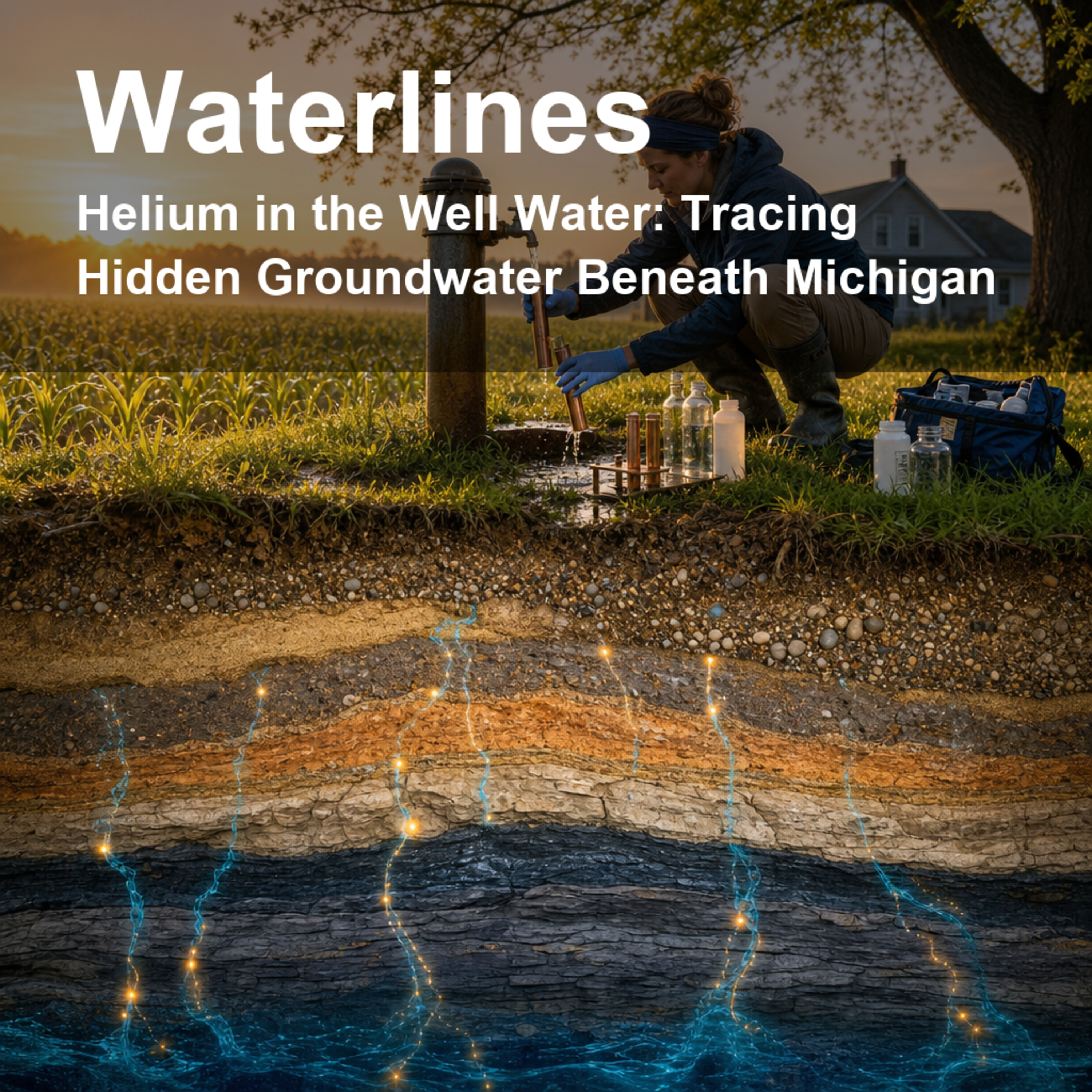
Helium in the Well Water: Tracing Hidden Groundwater Beneath Michigan
from Waterlines: How Water Shapes Our World · host jaywen
Groundwater can look still from the surface, but deep below our feet it may be slowly moving, mixing, and carrying clues from rocks, ancient climate, and even Earth’s interior. This episode matters because communities depend on shallow aquifers for water, while society also asks the subsurface to store waste, energy, and carbon. A study from the Michigan Basin shows how tiny amounts of helium dissolved in well water can reveal whether deep salty waters are leaking upward into younger, fresher aquifers—and why that matters for water quality and long-term underground decisions.We follow researchers using helium-3 and helium-4, radiocarbon, tritium, salts, and groundwater models to read the “travel history” of water in the Glacial Drift, Saginaw, and Marshall aquifers. The big idea: unusually high helium in shallow groundwater points to upward cross-formational flow, diluted toward the surface by recharge from rain and snowmelt. Along the way, we explain what helium isotopes are, why they act like quiet tracers, where uncertainty enters the modeling, and what this kind of science can and cannot tell us.Citation: Wen, T., Castro, M. C., Hall, C. M., Pinti, D. L., & Lohmann, K. C. (2016). Constraining groundwater flow in the glacial drift and saginaw aquifers in the Michigan Basin through helium concentrations and isotopic ratios. Geofluids, 16, 3–25. https://doi.org/10.1111/gfl.12133Disclosure: This Waterlines episode package is designed for production using AI-generated voices.
Embed this episode
NOW PLAYING
Helium in the Well Water: Tracing Hidden Groundwater Beneath Michigan
No transcript for this episode yet
Similar Episodes
No similar episodes found.
Similar Podcasts
No similar podcasts found.