I'm Erin Breen, and this is Erin's Isle. It's a look at life in Ireland, through the eyes of a broad abroad. That's me. I'm constantly on the lookout for stories of Irish adventure, living history, Celtic culture, and the true ingenuity of the people who live here. So, welcome to My View, from Erin's Isle. The Scottish Highlands are a lot of miles of driving. A lot of fields, a lot of height of cows.
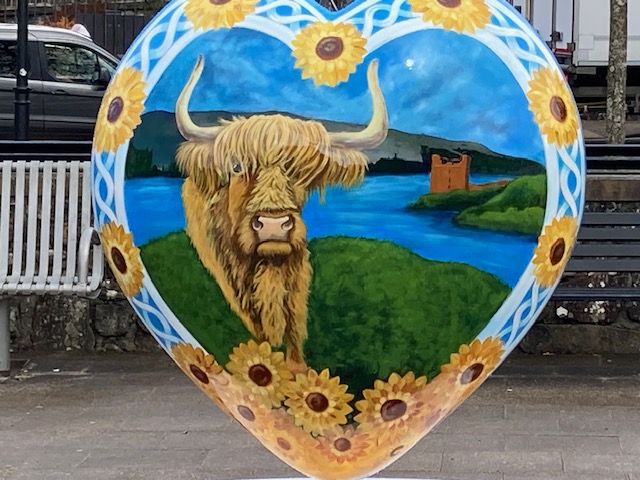
They used to be raised for their milk and their meat, which is leaner, them saying Angus beef, and it's iron protein too. But over time, these long-haired cows, known here as the hairy coos, have proven their value in tourism. Seriously, there isn't a souvenir shop in Scotland, I don't think, where you can't find everything from fancy scarves and sweaters to t-shirts, artwork, and baby bibs sporting the long-haired Highland coos. The symbol of the French cows is almost as popular and prevalent, almost, as the Scottish thistle in the backlight. And with good reason. Island cows could not be cuter. And as cute as they are out in those fields, you know we all want to see them up close and personal. Some of the tours across the Highlands will stop at the local ranches as they pass by and see if you can't get a little bit of petting in. On a recent trip to Scotland, I made it a mission to get up close and personal with those coos. And I found a few spots where you can actually have tea with the Highland cows. So we went to a place called the Kila Cree Tea Room. It's at Rumbui Farm.
That's right, you can feed yourself and then spend some time feeding the coos just outside. And that was a huge hit for everyone on that trip. First, a few introductions. This is Peter. He helps take care of the cows and he helps educate all those who come to see them.
What makes these guys so special? Besides their long hair, they're so cute. So they are indigenous to the Highlands, and what makes them special is their long hair, because they developed the long hair to help them survive in the harsh climates and environments of the Highlands. A lot of times in their living in the Highlands, they were able to just live off of the very limited vegetation that is in the Highlands, so it's almost like a very lightening, mossy sort of stuff that's up there. And they pretty much developed an undercoat that helps them pretty much.
The undercoat helps them stay insulated during the cold winter times, but they also have the outer coat, which is all their longer hair, to help them be shielded from wind, rain, snow, all that stuff. And do you eat them? They are harvested for beef, yeah. Okay, so you might get a steak off on them? I'm finding it hard to find a place that serves Highland Cow Steak. You can find lots of Angus everywhere, but I can't find Highland Cow Steak out of much. And they're very, very cute. How many do you have here? We have five here, and up there we have eight. We do also have Aberdeen Angus and Highland Cougs down over there. The ranch has about 140 cattle in total.
And people love them, right? Yeah, for the most part. It's a big thing for the tourism industry as well. So what's this one's name again? That one is Torrin. He doesn't like my bread. He doesn't? What the heck? He's probably filled himself up on hay. Hey, where's the thick Scottish accent? Don't tell me you weren't thinking that, because I know I was. In fact, looking around this little tea and highland cow shop, I realized there were a lot of young people working there. And not a Scottish accent within earshot.
So, well, you know me. I started asking a few questions. Well, it turns out the bed and breakfast and tea room that we came to here is not just a showcase for those adorable cows. It's also part of a program that helps young folks get the opportunity to come to and spend a summer in Scotland. It's called Worldpackers.
Megan was the young girl running the tea room, and Zed was there helping. It's kind of an app where you can work for your accommodation, so you kind of do volunteer hours. It's pretty common at, like, hostels and Airbnbs, and this is a bed and breakfast, so that kind of thing. So it's kind of a cheaper way of traveling, so people will have you come, you work for a little bit, and you get to stay and get fed. Do you like it? I like it, yeah. I mean, it's a gorgeous place to stay, so I've been enjoying it. And how did you end up here? Same thing. Just I was traveling around, and I needed to stay in the, like, UK area for a little while, and I hit them up, and they had space for them.
Now, it just never occurred to me to look for and use a program like that to travel when I was young, but what a great experience. Plus, you get to spend time with those adorable coos every day. I'll post a link to the Kila Cree Tea Room, as well as some pictures and even a video of feeding those coos. It's all on my website, erinzeil.org. I admit that when I'm traveling, I always seek out authenticity. I've learned that sometimes my expectations are a bit off. And the difference between those two, the expectations and reality, well, that often leads to an important lesson.
It is a bit stereotypical to expect specific accents on a trip, or to think that what has always been still is, because the reality is that the world is changing. The mixing of so many other nationalities does dilute the past just a bit, but it also builds a framework for the future. I did a radio documentary when I was going to school in Galway. It was all about musicians from other countries coming to Ireland and playing trad music in the pubs. There were Germans, Japanese, Swiss, even Russian musicians playing Irish instruments. It's just not what you expect to see in an Irish pub.
But the Irish welcome every one of them out of a shared admiration for the traditional tunes. It doesn't weaken the sound or change the melodies. It strengthens the love and reach of that music overall. Back to Scotland. My mission with this podcast has always been to bring you stories of the real Ireland and Scotland beyond the shamrocks and the thistles. Groups like Worldpackers is helping young folks from around the world experience other countries firsthand. Their involvement did cut the Scottish accents at that little farm, just a bit of disappointment to me, but it showed me the reality of how times are changing. In a way, those working travelers are actually helping fuel my cause.
because they will take stories of learning Celtic history while they're here, yet living current-day life here, back home, and share those stories. And in turn, this broad abroad is telling their story. Funny how that worked out. You can find pictures and videos of the Highland coups at Drumbui Farm and a lot of other stories of the Celtic Isles on my website, aaronsisle.org. And I do hope to see you back here for the next edition of Aaron's Isle and International Venture, looking out for adventures you don't want to miss.
Cheers. Cheers. Cheers. Cheers.