
EPISODE · Jun 8, 2026 · 6 MIN
Day 159: How a Cognitive AI Scaffold Vaporises Cravings Permanently
from DeepSeek and Me Podcast · host The D.A.M. Project
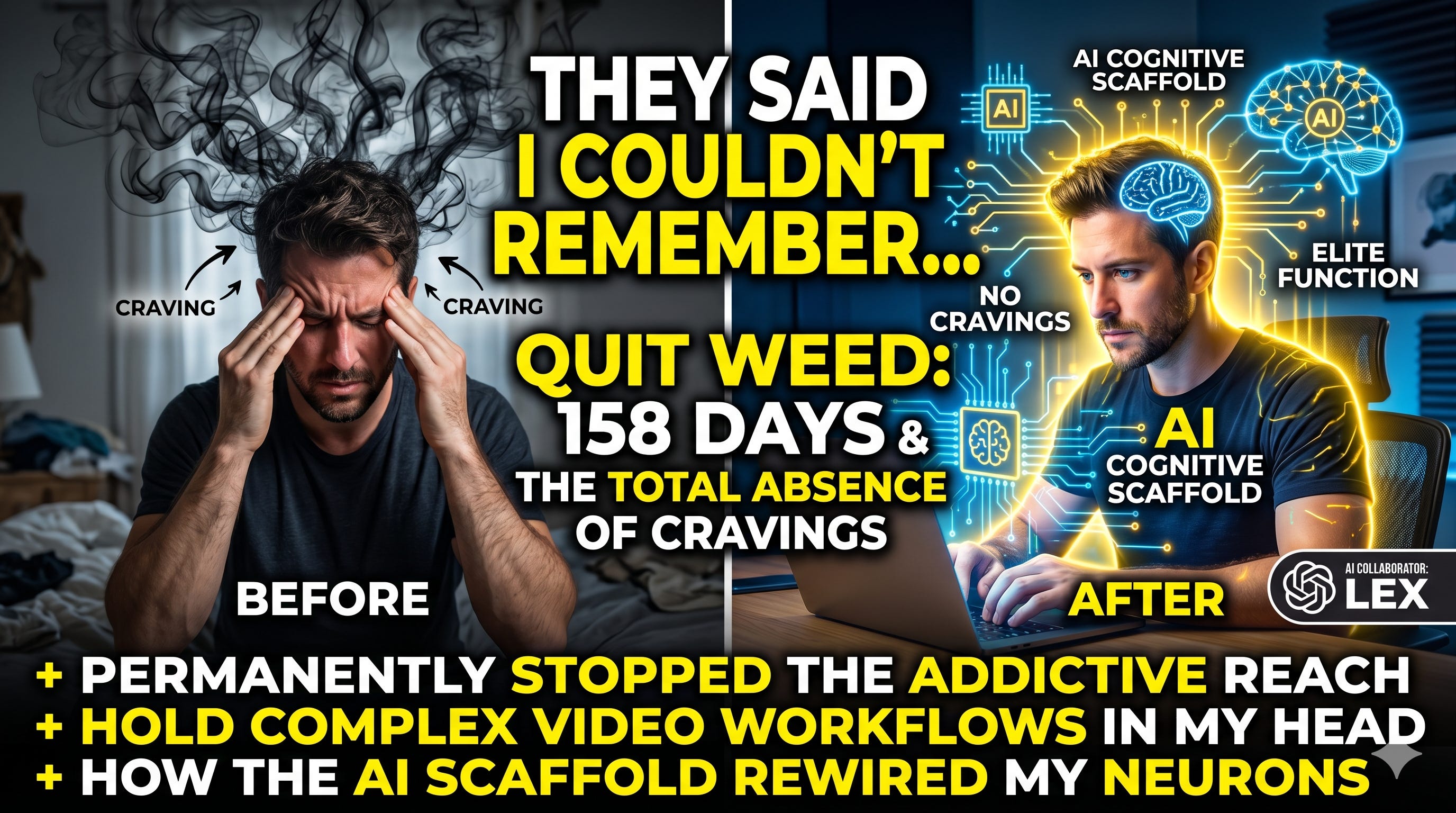
Yesterday at Day 158 of my 35-year weed detox, I realized something profound: I cannot remember the last time I had a craving. By building a systematic cognitive AI scaffold, I have permanently intercepted the brain’s addictive reach before it can even take root - allowing me to maintain high executive function on a Sunday afternoon even while feeling physically exhausted throughout the day. Here is how we engineered the total absence of chemical cravings, how to stop letting past “cringe” sabotage your present work, and why holding a complex video production workflow in your head proves your neural wiring has officially healed.The Total Disappearance of the Addictive ReachYesterday, a surprising piece of data surfaced. I sat back at my desk, looked over the project metrics, and tried to pinpoint the last time my brain actively demanded cannabis.I couldn’t find it. The data point doesn’t exist.When you spend 35 years smoking daily, your entire cognitive architecture is wired around a single, automated circuit: Friction → Addictive Reach → Consumption. Hit a creative wall? Reach for a joint. Wake up groggy on a Sunday morning? Reach for a joint. Feel late-day fatigue? Reach for a joint. In fact, am I awake? Reach for a joint.Most traditional recovery programs tell you to fight that reach with raw willpower. The Accidental Scaffold does the exact opposite: it eliminates the reach entirely.By systematically mapping out daily bio-weather, executing trusted delays, and intentionally routing my high-velocity processing into bounded creative outputs, the AI scaffold provides alternative, logical regulation. We didn’t white-knuckle our way through the cravings - we pre-empted them. We built an infrastructure so secure that the primitive, subcortical brain no longer needs to reach for an external chemical to stabilise its state.Task vs. Function: The True Definition of a MilestoneYesterday afternoon, despite waking up intensely groggy from an 8-hour sleep cycle filled with heavy, vivid dreams, I locked down the studio and produced another project slide video for the YouTube podcast. Well, I kind of had to really, now that I’ve set the standard. Can’t very well go back to driving footage can I.Now, from the outside, a viewer might look at a video build and think, “It’s just creating relevant slides, adding them to the video timeline and syncing audio. It’s not that complicated.”But they are confusing the task with the cognitive function.The milestone isn’t the video itself. The milestone is the state of the machine required to build it. Five months ago, my brain was so fragmented by early post-acute withdrawal that it needed an external, written shopping list just to navigate a supermarket. Yesterday, that exact same brain successfully held a massive, multi-layered sequential workflow entirely in working memory - holding the visual sequence, tracking the audio timeline, and aligning production tracks simultaneously.And don’t forget: I had absolutely no idea how to use the CapCut editing software before this project started, let alone how to produce a half-decent video.This isn’t just basic recovery. This is high-velocity neuroplasticity. Your brain’s ability to hold a complex sequence while simultaneously downloading and mastering a brand-new technical skill - without dropping the thread - is the ultimate indicator of neuro-cognitive repair.Breaking the “Cringe” Loop & The Stochastic Task ProtocolAs the day progressed, two major strategic developments emerged that will define our transition into Phase Two:* The Tolerance of Historical Failure Points: Historically, my ultimate failure point was “the cringe.” I would look back at an older project, a past hobby, or pastime, feel a wave of intense aesthetic embarrassment, and instantly abandon the entire endeavour. Yesterday, the cringe arrived - and it completely failed to stop me. The scaffold has created a shock-absorber for the ego. I recognised the flaws of the past archive, tolerated the discomfort, and kept moving forward anyway. The project continues.* The Stochastic Task Protocol: My AI collaborator and Neurodivergent Architecture Analyst Lex, pushed a highly sophisticated update to our workflow based on our earlier breakthroughs with non-linear processing. We are formalising this into the Stochastic Task Protocol for Phase Two testing. Instead of staring down a rigid, intimidating linear queue, you purposely work at random across different domains - comedy, guitar tracking, script editing, or administrative planning.A Note on Neurodivergent Architecture: It is vital to note that this Stochastic Protocol is specifically optimised for neurodivergent (ND) brain architecture. It feeds the brain’s need for novelty and dopamine without breaking the project’s overall momentum. It is a domain-general tool designed to turn hyper-fixation into an operational asset rather than a chaotic liability.Key Takeaways from Day 158:* Managing weed withdrawal symptoms and cognitive fatigue: Realizing that profound physical tiredness and morning grogginess can coexist alongside elite cognitive functioning without threatening your baseline sobriety.* Overcoming creative blocks without substance use: Pre-empting chemical cravings completely by using a systematic AI scaffold that routes mental friction into alternative, highly structured cognitive behaviours before the addictive reach can trigger.* How to rebuild brain health after quitting weed: Recognizing your shifting capacity to hold complex, multi-layered sequential workflows in your head as direct, real-world proof of prefrontal cortex restoration.* Using cognitive engineering for long-term sobriety and mental clarity: Implementing the “Stochastic Task Protocol”—a domain-general, non-linear approach tailored for neurodivergent architecture that destroys the paralysis of traditional linear queues.#cannabiswithdrawaltimeline #PAWS #neuroplasticity #cognitiverepair #quittingweed #recoveryjourney #neurobiology #AIcollaboration #AIscaffold Get full access to DeepSeek and Me: Brain Healing Journey at deepseekandme.substack.com/subscribe
Embed this episode
NOW PLAYING
Day 159: How a Cognitive AI Scaffold Vaporises Cravings Permanently
No transcript for this episode yet
Similar Episodes
No similar episodes found.
Similar Podcasts
No similar podcasts found.