
EPISODE · Aug 4, 2026 · 12 MIN
How an unshared cake can lead to an explosion
from Divorced me Podcast · host Missy Rönsch
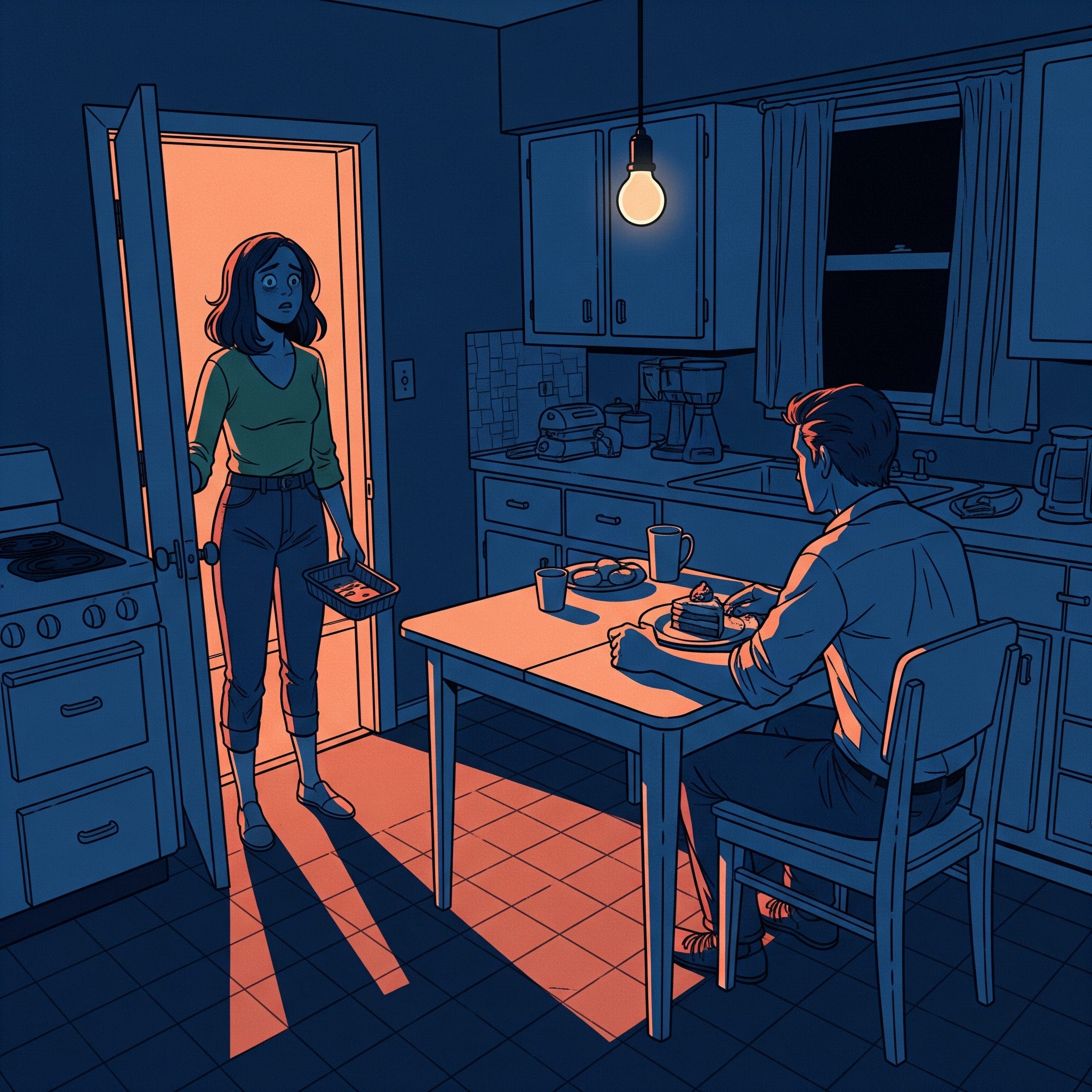
[From my diary]June, 22nd 2021I know that I am projecting a lot of my childhood traumas on my ex-husband, but I can’t help it. All I can do is to feel ashamed afterwards, like today.Like once, back when I was a child, Mom baked us a cake, and left it in the oven, just in the baking form. And then the two of us left for a walk, or I don’t know exactly, anyway, dad stayed at home. We left and, like, the cake was there untouched, and it was visibly untouched. And when we came back, it was just gone. Only the dirty form was left. And, yeah, when she asked dad if he just ate it, he said yes. Just like that. Like, he saw the cake was untouched and he ate it, and she asked him, “You did not even leave us anything to try?” And he said yes, just like that.Today my [husband] and I went for a walk and stumbled upon a café and he bought a piece of cake and brought it home and ate it without sharing. And, I don’t know, it was like a tornado, a tornado of emotions that I felt, and I started to blame him for not sharing this stupid cake. Literally, I, even in the moment when I was doing this, I was, in the moment I was saying this to him, I already knew I’d been projecting this past situation and still I did it.A lot of other things from our past that still reach out with their claws into my present and future.Of course it was not really about the cake. A small, familiar cue — a partner eating something sweet without sharing — reached back and made an old wound ache again, and for a moment my mind treated the man in front of me as if he were the person who first cut it. The rage did not originate in the present, it had its roots in a scene from childhood, firing again in the present. And knowing that, even as I said the words, did not stop me — because our emotions are always faster than our mind is, and, even worse so, they are more powerful.Let’s look into the science behind these dynamics.The cake was a cueThe psychologist Susan Andersen has spent her career giving the old idea of transference a rigorous, testable form. In her social-cognitive model, each of us carries mental representations of the significant people in our lives — a parent, above all — and when someone new gives off even a faint cue that resembles that person, the old representation switches on. From that moment, her studies show, we begin to perceive and respond to the new person as if they were the old one: their motives, our expectations, even our own feelings and behavior shift to match the original relationship. We do not merely remember the significant other. For a moment, we relate to the person in front of us as though they were that other, and we become the version of ourselves we once were with them.A man eating cake without sharing is a very small cue. But it was enough. It matched, precisely, the shape of an old wound, and the instant it landed, the representation of my father switched on and reached for the nearest available face to hide behind it, and my ex-husband happened to be that one face. I was not, in that moment, a wife arguing with her husband. I was a child again. The child that was not allowed to be pissed off by her father.He may have been chosen for itThere is another aspect worth mentioning even though the ground beneath it is softer. Perhaps the resemblance was not only something I stumbled into in the moment. Perhaps it was part of what drew me to him in the first place.Everyone has heard some version of the idea: that a woman ends up with a man like her father, and a man with a woman like his mother — that we are unconsciously pulled toward a partner who resembles the opposite-sex parent. It is mostly folk wisdom, repeated at weddings and over kitchen tables, and the hard evidence for it is thinner and more tangled than the confidence with which people say it. The couples therapist Harville Hendrix gave it its best-known clinical form — the imago, a composite image of our earliest caregivers, wounds and all, that we carry without knowing it and search for in the people we love, drawn of all people toward someone equipped to reopen the oldest injury, in the buried hope of a different ending this time.Illustration provided by Supportive StrangerThis theory is to be taken with a grain of salt. But folk belief or clinical hunch, it names something many people recognize with a small chill: that we do not choose as freely as we imagine, and that the very quality that pulls us in can be the one we later cannot forgive.Thus, it may have been that very resemblance that first made my ex-husband feel like “my person” — and then, later, he had to pay for this uncomfortable resemblance.Only the dirty form was leftLet’s get back to that scene from my childhood one more time. What I remember is not hunger, or even the missing cake which I think I observed my mom preparing. What I remember is the dirty form left on the counter — like some crime scene, full of screaming evidence — and my father saying yes, very bluntly, even slightly suprised as though the question of whether he might have saved us any did not compute.The cake was never only cake. It was a clear manifestation of something much bigger: of me (or us) being neglected, of living beside a person who could take the shared thing entirely and feel zero apologetic about it. Emotional memory tends to fasten onto exactly this kind of vivid, particular detail. The feeling of not mattering is hard to hold in the hands; a baking form with dirty edges is easy to keep. So the form became the keeper of the wound. And thirty years later, when a second cake disappeared, unshared, the detail of this keepsake brought the entire feeling back with it, amplified by the years it lived inside me suppressed.I knew, and did it anywayThe part that unsettles me most is not that I overreacted. It is that I overreacted with full awareness — I could feel, even as I spoke, that I was in the wrong tense, and it changed nothing.Why do emotions work quicker and have a stronger impact than the rational mind?There is a reason why even a full comprehension does not save a person in the moment of an outrage. The neuroscientist Joseph LeDoux has shown that the brain handles a perceived threat along two routes: a fast, low road that reaches the emotional centers and fires a response almost immediately, and a slower, higher road through the thinking cortex that arrives afterward to interpret it and, if it can, apply the brakes. The connections running up from the emotional brain to the rational one are stronger and quicker than the connections running back down. Which means the feeling nearly always arrives first, at full volume, while understanding follows a beat behind — often too late to stop what is already moving.So the awareness was real. It was simply outrun. I knew I was projecting the way a falling person knows they have tripped: the knowledge arrives, accurate and useless, after the ground is already coming up.What it doesn’t meanIt does not mean the feeling was crazy, or that something is wrong with me for having had it. The emotion was real, and in its way even accurate — it was only addressed to the wrong person. The rage was a true report about my father, delivered thirty years late to my ex-husband.Although, I would not have minded my ex-husband sharing this cake with me. It looked and smelled very tasty. Nevermind …Which is the second thing it does not mean: that he was guilty. He bought himself a piece of cake. That is the whole of what he did. He was not withholding, or careless, or anything like the man the feeling was really about — and some part of me knew it in the moment, which is exactly why the projection was so disorienting. That flash — loving a man and, for a second, seeing my father where he stood — is not evidence that the man has failed. It is evidence that an old cue has found a new face.And it does not mean I am condemned to repeat it forever. Insight does not supply a brake in the heat of the moment; the wiring makes that much clear. The slow, higher road can be trained, and over time, with enough recognitions like the one I had mid-sentence, the brakes begin to jump in a little sooner, and then sooner again. Catching it too late is not failure. It is the first, clumsy version of catching it in time. The claws of the past do reach into the present — but realizing whose claws they are is how the loosening begins.Illustration provided by Supportive StrangerI write these reflections while building Supportive Stranger, a small iOS app for the moments you recognize a little too late, so that next time you might recognize them a little sooner. This is a public episode. If you would like to discuss this with other subscribers or get access to bonus episodes, visit divorcedme.substack.com
Embed this episode
Ready to play
How an unshared cake can lead to an explosion
No transcript for this episode yet
Similar Episodes
No similar episodes found.
Similar Podcasts
No similar podcasts found.