
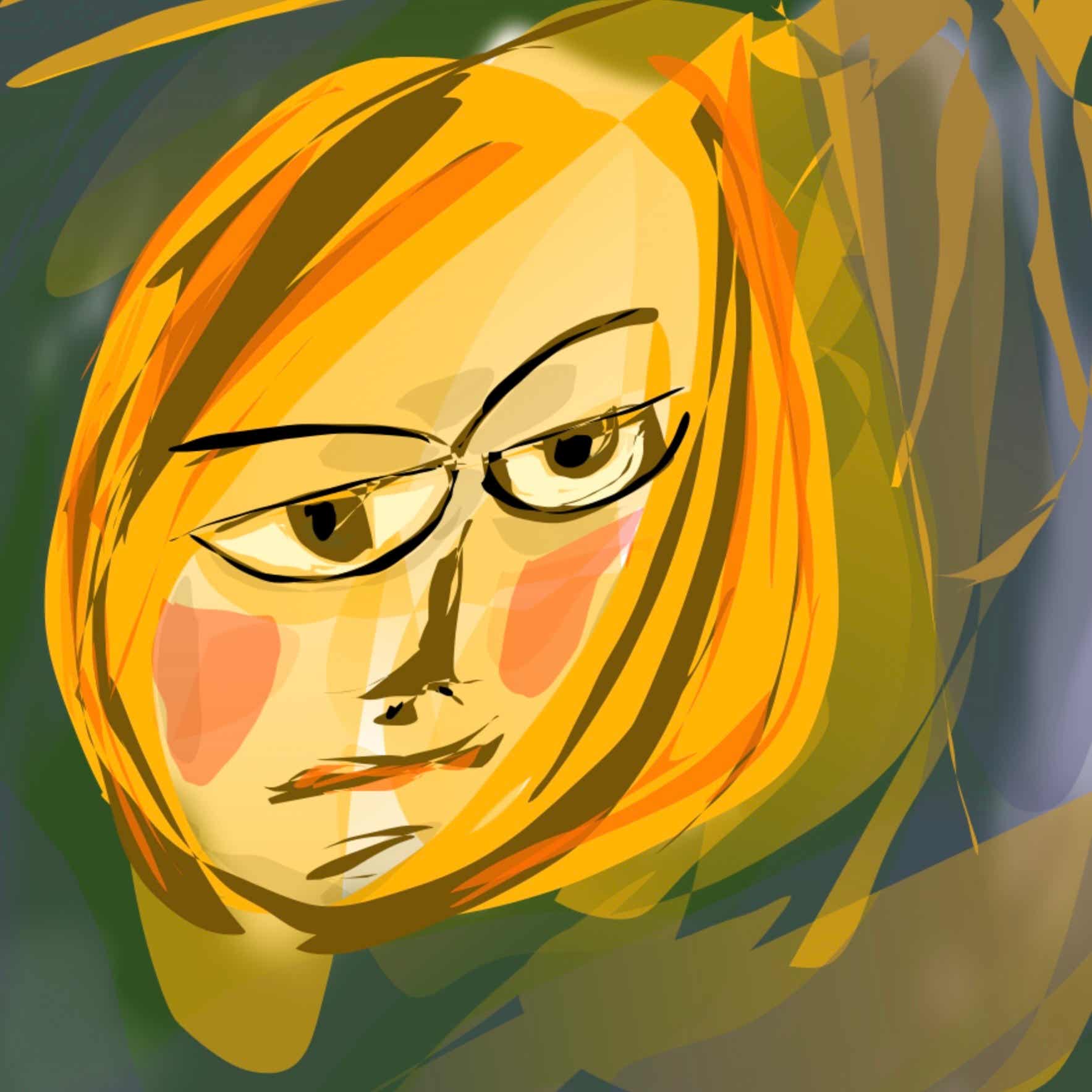
PODCAST · health
Divorced me Podcast
by Missy Rönsch
After my marriage ended, one question stayed: "Why did I get divorced?". I did love my ex husband, and I do believe he also loved me back then. But we somehow did not work as a couple. That’s why I started to put our story on paper.Not to find someone to blame. Just to understand what I had been quietly noticing for years and not yet putting into words. This podcast is where I try to do that — in small pieces, one moment at a time. divorcedme.substack.com
-
24
Did my fears make him into the man I feared?
[From my diary]July 23d 2024Of course, I saw signs already at the beginning of our relationship. Or maybe I thought I was seeing them: the so-called red flags. And then you do not know where the truth is, and where your fears, clichés, inferiority complexes take over … Like, once he was driving out of a gas station, and a teenage girl almost bumped into our car, because she was busy impressing her friends with her walk. My husband screamed at her very rudely.I thought back then: “He will be screaming at me like this one day”. He did. But did I make him to?The near-miss at the gas station was a genuine fright — a driver feels that jolt, and some anger is part of the fear. Indeed, the teenager stepped into the path of a moving car. But the driver did not just brake, swear once, and drive on shaken. He screamed at her viciously, at a stranger he would never see again, who had no history with him and expected nothing of him. My fear did not conjure that. It was an early, accurate look at what he does when something crosses him, long before it was me.Red flags or my own fear?Early in a relationship, a real warning sign and plain anxiety can feel exactly the same. I had fears, and an inferiority complex I had been carrying long before I met my ex husband. Always prepared for the worst, I found evidence of bad things coming everywhere, and I stopped trusting my own eyes. Often I could not tell whether I was seeing something being wrong with him or was it my distorted perception, imposed by something from my past onto our shared present and future.Illustration provided by Supportive StrangerSuch confusions are an honest problem. A warning and a worry feel identical, and back then, sitting in the passenger seat, I could not decide which it was.Legitimate surge, but illegitimate mannerThe girl walked into the path of a moving car because she was watching her friends instead of the road. That is a real danger and a real fright. If he had hit her, he would have been the one questioned and maybe charged, however careless she had been, because that is how it falls on drivers, and it is its own kind of unfair. Fear ran through that moment, and anger is part of fear. Most people would have felt something sharp. So there is no need to argue that this was a man abusing an innocent for no reason.Illustration provided by Supportive StrangerWhat struck me is not that he got angry, but how. The fright explains the surge. It does not explain — and less excuse — the manner.But was such a short situation enough for an honest judgement at all?Nalini Ambady and Robert Rosenthal spent years measuring how much a person reveals in a few seconds. In a 1992 review of dozens of studies, they found that people shown very short video clips — often under a minute, sometimes seconds — judged a stranger’s character about as accurately as people who had watched far longer. Thin slices, they called them. My gut took a thin slice at that gas station. It did not read “he yelled when frightened,” which anyone might do. It read the rudeness and the disproportion, and it made a prediction: that will be me one day.Did I make him into a rude man?He did, in the end, scream at me during our fights the way he screamed at that girl. After the divorce, I wondered whether I had summoned it — whether expecting it, bracing for it, flinching in advance, invited him into being the worse version of himself.The self-fulfilling prophecy has been studied — among others — by the sociologist Robert Merton back in 1948. A belief about a situation can change how a person behaves, and that behavior can make the belief come true. Expect the worst of someone often enough, and you can sometimes help draw it out.The fine-grained “how does one person draw the feared behavior out of another” was demonstrated by later researchers. Applied to a marriage, the relationship version is Downey and colleagues’ work on rejection sensitivity from 1998: people who anxiously expect rejection tend to behave more defensively or negatively in a conflict, which pulls a colder or angrier response from their counterpart. Same shape — the fear steers your conduct, and your conduct shapes theirs: less warmth, more nervousness, worse performance, a chillier or more conflictual exchange.However, it has never been shown to manufacture a partner’s rage or cruelty. There is a real distinction between behaving in ways that draw out coldness and being the cause of another adult’s screaming.Set the two of us — me and the girl — beside each other. I carried the prophecy for years. I had watched him at that gas station, made my quiet prediction, and lived with it the whole time, half-braced, waiting. The girl carried nothing. She had known him for the length of one near-miss. She had no fear of him, no theory about him, nothing to fulfil. Whatever I carried changed nothing about how he behaved.What it doesn’t meanEven with all of that laid out, I kept blaming myself. Self-blame is very tempting. If I made him scream, then I had a hand on it. I could have been warmer, or calmer, or less afraid, and he would have softened, and the marriage becomes something I could have steered. That “realization” first feels painful, but in fact, it is a comforting one, because the other option is even worse: that I had almost no power at all, that his behaviour was his and ran on its own logic, and that no change in my behaviour, however good, would have changed the outcome.Illustration provided by Supportive StrangerThe correct realization takes the agency away from me at all, which is scary; that’s why I was reluctant to see it.A lot of people who have been badly treated invent the same explanation. We would rather be at fault than be helpless, because being at fault at least means being in charge of something.I write these reflections while building Supportive Stranger, a small iOS app for journaling through difficult moments.Thanks for reading Divorced me! Subscribe to receive new posts and support my work.This blog and podcast exist for educational purposes. To make the content more substantial and grounded in real research, I use AI tools for finding quotes and polishing the written style. The podcast episodes are spoken by myself. This is a public episode. If you would like to discuss this with other subscribers or get access to bonus episodes, visit divorcedme.substack.com
-
23
Why did we stop doing the one thing that made us feel alive together?
[From my diary]November, 11th 2022“On that mountain peak, I felt alive,” he said once, as we were going through photographs from our “good old days,” some time after we had decided to separate. We went for mountain hikes often when we first started dating. We actually met on a hike [with our common friends], and over the next few hikes we connected. We kept going out into nature almost every weekend that second summer, the first one after we moved in together. But then we stopped. I put on weight and hated myself. I am not sure if it was a symptom of the alienation or something that accelerated it.Standing next to something vast, out in nature, gives people a rush of feeling alive, and doing it beside someone tends to pull the two of them closer. Our hikes did that for us. Then we stopped going. For a long time I have wondered whether giving it up was a sign that we as a couple were already fading, or one of the things that made us fade. My best guess is that it was both. When the hikes stopped, so did the main thing that kept us feeling alive next to each other.Marvelling together“Feeling alive on the mountain” is not only a popular poetic expression; it is a scientifically grounded concept. Dacher Keltner has spent years studying awe, the feeling that comes over people in front of something vast: a mountain range, a canyon, a sky full of stars, an ocean, a desert, or even Manhattan. Awe has a few particular effects on us. It shrinks the self, but not in a negative way; mostly it feels like relief. After being close to something huge, people come away with a stronger sense of being alive. Those giant things tend to pull us closer to one another, leaving us more generous and more inclined to belong to something.Illustration provided by Supportive StrangerMy ex-husband and I were, without ever realizing it, awe-seekers together. We met on a hike. The early part of us was built out of weekends in the mountains, the two of us small under something enormous, and that is not a small way to fall in love.Keltner has written about this from his own life. He and his brother were awe-seekers too, and when his brother died, he found that much of the feeling had been bound up in the person he shared it with.I knew that feeling all too well. Shortly after the divorce I started going to the mountains regularly, and I kept catching myself looking for the guy I had met back then, the one I used to hike with.He was nowhere to be found.The symptom and the causeI still cannot say exactly whether the hikes ending was a symptom of the trouble between us or one of its causes.The research does not pick a side either. There is a long line of studies, going back to the sociologist Dennis Orthner in the 1970s, on what shared activity does for a couple. Couples who do involving things together tend to be closer and more content, and couples who drift into doing everything apart tend not to be. The study that fits my question best came later. Crawford and his colleagues followed married couples for more than a decade and found that shared activity and marital happiness move together, each one a cause and a consequence of the other.Illustration provided by Supportive StrangerThat is the loop I could feel too. We hiked less because something was cooling, and it cooled faster because we hiked less. There was no clean line where the one turned into the other. They fed each other until the weekends were empty.The same research adds one condition worth keeping. Shared activity only helps when both people actually want to be there. Ours was that kind. We both loved it, which is probably part of why losing it took so much with it.The weaker oneI did love hiking. But I was usually the weaker one, and I would fall behind, and falling behind made me feel less like a partner in the thing than like the one slowing it down. There is a reason for why that stings. Abraham Tesser’s self-evaluation maintenance model describes what happens when someone close outdoes a person at something that matters to them: the nearer the two are, the more it threatens how that person feels about themselves. Being outpaced by a stranger on a trail would have meant nothing to me. Being outpaced by the man walking beside me, over and over, was a different kind of ache. Had it been his skill at something I had no stake in, I could simply have been proud of him; the same model says a talent in a domain a person does not care about becomes a gift instead of a threat. But keeping up mattered to me. So instead of sharing in his strength, I measured myself against it, and came up short every weekend.Illustration provided by Supportive StrangerAnd not all of it was about him. A slope that matched his fitness gave him the easy, absorbed state that Mihaly Csikszentmihalyi called flow, which arrives when the challenge is matched by the ability to meet it. The same slope outran my fitness, so it gave me strain instead. Same mountain, different fit.When the marvelling stoppedSomewhere in all of that, the shared marvelling stopped too. Not only the hikes, but the thing the hikes were for: standing together above the clouds, dwarfed by the same view. With nothing to look at, the mirror I used to pass without a glance became something I studied, and did not much like, as I also put on weight. What it doesn’t meanIt does not mean the weight was why he stopped loving me, or why I stopped feeling loved. I kept telling myself the opposite, because it was an easy explanation, deeply rooted in the mainstream Western culture.But bodies do change in every long relationship.Regarding this, there is another interesting finding in the awe research.Standing in front of something vast shrinks the sense of self, and it even shrinks how people judge their own bodies to be. On the mountain I was small in the good way, next to something enormous, and my size was nowhere in my thoughts. It was afterward, in the emptied weekends with nothing vast to stand under, nothing left to look at but my refleciton in the mirror, that my attention fell back onto myself, and I turned it into something to dislike. The self-hatred did not come from being overweighted (or not as tiny as before).It came from losing something that previously made other problems look unimportant: a good, exhausting hike that used to knock all dark thoughts and frustration out of my head.Coming back downI have kept going back. For a while I told myself it was for the exercise, or the quiet, but that was never the real reason. I went up to look for him, and for the two of us we used to be up there.Anthropologists — e.g., Arnold van Gennep — called it a rite of passage: the pilgrim leaves the ordinary world, climbs into somewhere set apart, and comes back down into it changed. People have walked that shape up sacred mountains for centuries, in the name of their religion. My solo hikes were a small, private version of the same thing: A pilgrimage of grief.Illustration provided by Supportive StrangerI never found him up there. I did not really expect to. What I found, over a lot of weekends, was that I could climb up carrying him and come back down without him, and be all right.I write these reflections while building Supportive Stranger, a small iOS app for journaling through difficult moments.Thank you for reading Divorced me! Subscribe for free to receive new posts and support my work. This is a public episode. If you would like to discuss this with other subscribers or get access to bonus episodes, visit divorcedme.substack.com
-
22
Why did we try so hard to look like the couple that would last?
[From my diary]August, the 8th 2023I felt like in competition with other couples, wanting us to be better. I think my ex-husband felt the same urge. Maybe, it came from our own families where first marriages ended nightmarish. Many of his friends came together or even got married at the same time as we did. Many broke quickly enough, some much faster than we did. Each time we met with those couples, we tried to show how special we were. It was something subtle, like a kiss, or a detail about our daily routine that made us "stand out". It did not save us, indeed.The wish to have the best relationship in the room usually comes from insecurity, even when it feels like the opposite. We competed with the couples around us. A kiss at the right moment, some detail about our life mentioned so the others would notice it, and I took all of it as a sign we were doing well. The research mostly disagrees: people who keep measuring their relationship against other people's tend to be the least secure about it. We had our reasons. Both of us grew up in families where the first marriages fell apart, and at some point not repeating that became a full-time job. It changed nothing, and I have come to think the effort was part of what went wrong. All that energy went toward other people. Very little of it was left for us.The best couple in the roomAlmost everyone thinks their own relationship is a little better than other people’s. That is normal, and mostly harmless. Bram Buunk, who has spent years studying how couples size themselves up against other couples, found the belief is nearly universal; one of his papers is titled, roughly, most relationships are good, but ours is the best. A private sense that yours is the good one helps people stay committed. There is nothing wrong with having it.The illustration has been kindly provided by Supportive StrangerWe went further than that. We did not just think it, we kept score, and we wanted to win. That is the part the research treats less kindly. People who compare their relationship to other people’s a lot, who reach for other couples as a measuring stick again and again, tend to be more insecure rather than less, and the habit tends to lower commitment over time instead of raising it. At the time the scorekeeping felt like confidence. Looking back, it was closer to worry.The families we came fromThe drabble points at the families we came from, and it is right to. Both of us grew up watching a first marriage fall apart, and in both cases it was bad. That matters more than it might seem. It is one of the most consistent findings in the research on divorce: if your parents divorced, your own marriage is roughly twice as likely to end the same way, and the risk is higher still when both partners bring that history, which we both did. Paul Amato, who has studied this for decades, has said it is about as well established as anything in social science.What passes down is not really a curse. It is more like a shortage of confidence, a learned sense that marriages come apart, even ones that look fine from outside. Amato found something strange here: the effect was strongest when the parents’ marriage had been fairly calm before it ended, the kind that looked okay until it suddenly was not. Two people raised on that arrive at their own wedding already tense. The tension has to go somewhere, and for us it went into proving. If we could be clearly better than everyone else, maybe we would be the ones who made it. We thought we were competing with the other couples. Really we were still arguing with our parents.A kiss, for an audienceThe shape it took is the part I least like remembering. A kiss. A comment about our routine — some ordinary thing we did that I made sound special — mentioned so the other couple would catch it. Small, and staged.Half of that kiss was for the room. Only half was actually ours. That is the problem with performing a relationship: the work goes to the people watching, and not to the marriage. We put our best attention into people whose opinion could never keep us together, and we spent it in the settings where we were relaxed and off duty, where it could have gone to each other instead. Most of those couples were breaking up anyway. Some sooner than we did.What it doesn’t meanNone of this means there was nothing real between us. In some ways we probably were good together, and the specialness we kept advertising may have had something true underneath it. Feeling it was never the problem. The problem was that we could not stop performing it, and over time the performance wore away the thing it was meant to show.The illustration has been kindly provided by Supportive StrangerIt also does not mean our families sentenced us to this. Twice the odds is still only odds. Plenty of people who grew up around divorce go on to build marriages that last, usually by deciding to trust what they have instead of testing it over and over. What we inherited was not the divorce itself but a nervousness about marriage, a habit of treating ours as something to win instead of somewhere to live.The performance did not fail because we did it badly. It failed because that is what performing does. Whatever holds a marriage together sits underneath all of it, out of sight, in how two people are with each other when nobody is around to be impressed. We put almost nothing there. That is why the kisses and the scorekeeping never amounted to anything. They were aimed at the wrong audience the whole time.I write these reflections while building Supportive Stranger, a small iOS app for the parts of a relationship that no one can see, except for yourself.Thanks for reading Divorced me! Subscribe for free to receive new posts and support my work. This is a public episode. If you would like to discuss this with other subscribers or get access to bonus episodes, visit divorcedme.substack.com
-
21
Why did I feel like a breakwater when we chatted with others?
[From my diary]June, 25th 2021More often then not, it is not any particular action taken by him that brings me down.It is just a feeling, a small nuance.… Each time we go for a walk with friends — literally walking next to each other — he starts talking to someone, and then .. not sure, how it happens. He kinda … puts me between him and that person. Like he motions in space in such a way, that I end up in the middle, like a breakwater. And he and the other keep shouting in each of my ears while talking, me disconnected from the conversation.There is a difference between being in the middle of something and being part of it. He would put me physically between himself and whoever he was talking to, and the two of them would talk across me. I was the center of the arrangement and not in the conversation at all. None of it was nameable — he never insulted me, never ignored me, never did anything I could point to afterward and ask him to stop doing it.I did try in this particular case, but I could not even explain properly, and he could not grasp it either.That was the whole problem. A hurt with no name cannot be raised, so the annoyance just silently builds up in the background, until it reaches critical mass.Let’s look at some science behind these dynamics.In the middle of the talk, out of itWhen people talk, they build a little space. Adam Kendon spent years watching how bodies arrange themselves in conversation, and in the 1970s he gave the arrangement a name: the F-formation. Two or three people face inward and, without ever agreeing to, make a shared pocket between them — the o-space, he called it — that belongs to everyone in the huddle and to no one outside it. That pocket is where the conversation actually takes place, it is a small bubble, reserved for it.And what happens is that people start defending it without thinking. They angle their shoulders, close the circle, turn a newcomer into an outsider by nothing more than how they stand.So, what is contradictory or problematic about the past situations I described? The fact is that my body was inside the pocket—or bubble, you name it— the other two were using. I was standing in their o-space. But the words were passing over me, from one to the other and back, and I was the thing the talk went around.The hierarchy in a conversationThere is a second half to this, about roles inside this space. Erving Goffman, in Forms of Talk (1981), took apart the flat little word “listener” and found several roles hiding behind it. Some are ratified — they belong to the conversation whether or not anyone is addressing them at that particular moment. Others are only bystanders. And a ratified person, Goffman noticed, can be quietly demoted to bystander when the talk narrows onto two people and pushes everyone else to the edge of the frame. That was the line that cracked something open for me.Illustration provided by Supportive StrangerI was not shut out at the start. I was let in, set down at the very center, and demoted while I stood there. Thus, the problem did exist, and my perception of it was right.Mattering has multiple facetsWhy did I actually feel “used” in this situation? Whether my ex-husband meant it or not, remains unknown, as none can look into his head, but there is a name for the sense of being significant to another person, called mattering, and the sociologists Rosenberg and McCullough noticed back in 1981 that it comes in pieces.“To matter” is not unidimensional. It has multiple facets. and the whole point is that they come apart — you can have one without the others.Attention is the most basic one: the feeling of being noticed, of your presence and actions being registered by another person. Rosenberg considered this the most central form of mattering — the ground floor.Importance is being the object of someone’s concern — the sense that another person cares about your needs, thoughts, and feelings and acts on that care. This is the “cared about” facet.Dependence means you matter because others rely on you. It is significance that comes from being needed, useful, leaned on. Rosenberg put the puzzle plainly — it’s obvious that our behavior is shaped by our dependence on others; what’s stranger is how much it’s governed by their dependence on us.Dependence is one of the three ways a person matters, and it is the thin one.So mapped onto my situation, I scored high on dependence — he relied on me, I was needed, load-bearing, but I scored low on attention (I was not noticed; on the walks, literally talked across) and low on importance (not treated as an object of concern or care). It all can be interpreted in a way that I mattered as something he depended on, and not as someone he noticed or cared for.(But, as I said, we will never know for sure…)But only their synergy makes you feel you matterSince attention is the most fundamental facet, its absence tends to be the one that stings most — being unseen is a more basic deprivation than being uncared-for, and the breakwater is almost a pure case of it.And there’s a relevant footnote in the literature: Schlossberg (1989), who extended mattering into adult life, observed that some people — she was thinking of caregivers — can feel trapped by mattering too much through dependence: relied on so heavily that the reliance becomes pressure rather than value. That is close to what “used as a breakwater” actually feels like. Being needed can sit right next to being unseen, and the needing does not help to fix the feeling of being unseen. Dependence is not a consolation prize for the missing care.An illusion of being socialInterestingly, my ex-husband looked much more social than I did. He also always started those conversations, or suggested those walks. Why would someone like him need a breakwater?This all feels very contraintuitive. However, I did find some possible answers.If he was the confident one who reached out, he clearly didn’t need a buffer to shelter behind. So the breakwater wasn’t protection. It was something else.Being the one who reaches out, who opens conversations, who fills the air — that is not the same as being socially self-sufficient. Very often it’s the reverse. The partner doing all the reaching is frequently the one who needs more social input, more stimulation, more response, and who is least comfortable in stillness. The quieter partner is not the needy one in that pairing. She’s usually the ballast. So “more social” may actually mean “more socially hungry,” and hunger is a form of need, not of ease.Now put that next to the fact that he brought me into it. He didn’t wander off to socialize and leave me behind — he pulled me along into conversations he started and kept me physically at his side. That is the tell. What he might have needed was not a shield and not an interlocutor. He needed my presence. Someone of his own, right there, anchoring him while his attention shot outward. In attachment terms it’s almost a textbook secure base: the one who ventures needs a fixed point to venture from, and he kept his fixed point standing in the middle of the huddle. He could be so social precisely because I was reliably there, next to him.An illusion of matteringWhich loops straight back to mattering. The breakwater is the dependence facet made visible. He depended on me being present — needed it, arranged the space around it — while paying me less to none of the attention or care. That’s the exact shape we named: relied on, not seen. His sociability might have existed thanks to my steadiness. The sad thing is that he never once turned around to acknowledge the engine.I was less an anchor than a fixture — kept close as something shown or possessed rather than leaned on, the calm partner they appear to overshadow, to hold himself steady. The breakwater is what that looks like from inside the wave.Tiny moments that matter muchIt took me years to understand how something this small could do so much damage. The answer is in what actually ends relationships, and it is almost anticlimactic.Illustration provided by Supportive StrangerJohn Gottman—whom I already mentioned before— has been recording couples since the 1970s, and the discovery that made his name is not about fighting. Couples who lasted and couples who divorced did not differ much in what they argued about. They differed in the tiny moments — the small reaches one person makes across an ordinary day, a comment, a glance, a look at that — and whether the other turns toward them or lets them drop. The couples who stayed together turned toward each other around 86 percent of the time. The ones who split, about a third. Those small numbers, measured once, predicted divorces six years later.Nobody remembers a single dropped moment. That is the trap. Once the turning-away becomes the pattern, the whole relationship starts to feel like weather rather than a sequence of events. Gottman has a name for that stage too — negative sentiment override — the point at which a person reads everything their partner does in the worst available light, because the critical mass has been “successfully” reached.A breakwater walk is one of those dropped moments, on repeat. And it never got fixed for the simplest reason: there was nothing to fix. You put me in the wrong place on the walk is not a sentence anyone can say out loud and still feel sane. So it was kept unspoken, making a solution impossible.What it doesn’t meanIt does not mean I was too sensitive, or made a problem out of thin air. The feeling was there.It does not mean he was cruel with me on purpose. He might also just have been a person who loses whoever is standing at the edge of his attention, which is common, and forgivable, and still wore a groove in me over time. Impact does not wait around for intent. I was worn down by something that may have been nobody’s fault.And it does not mean small things are small. That is the part I had upside down for years. I kept waiting for a real reason — an affair, a betrayal, one clean fight I could hold up as proof — and felt faintly illegitimate for being ground down by where I got placed on a walk. “Small things like this” work in silence, and the fact that I could never quite get it into words was not evidence that it did not exist. Unspoken conflicts are always the most persistent ones.I write these reflections while building Supportive Stranger, a small iOS app for the feelings that never quite make it into a sentence. This is a public episode. If you would like to discuss this with other subscribers or get access to bonus episodes, visit divorcedme.substack.com
-
20
How an unshared cake can lead to an explosion
[From my diary]June, 22nd 2021I know that I am projecting a lot of my childhood traumas on my ex-husband, but I can’t help it. All I can do is to feel ashamed afterwards, like today.Like once, back when I was a child, Mom baked us a cake, and left it in the oven, just in the baking form. And then the two of us left for a walk, or I don’t know exactly, anyway, dad stayed at home. We left and, like, the cake was there untouched, and it was visibly untouched. And when we came back, it was just gone. Only the dirty form was left. And, yeah, when she asked dad if he just ate it, he said yes. Just like that. Like, he saw the cake was untouched and he ate it, and she asked him, “You did not even leave us anything to try?” And he said yes, just like that.Today my [husband] and I went for a walk and stumbled upon a café and he bought a piece of cake and brought it home and ate it without sharing. And, I don’t know, it was like a tornado, a tornado of emotions that I felt, and I started to blame him for not sharing this stupid cake. Literally, I, even in the moment when I was doing this, I was, in the moment I was saying this to him, I already knew I’d been projecting this past situation and still I did it.A lot of other things from our past that still reach out with their claws into my present and future.Of course it was not really about the cake. A small, familiar cue — a partner eating something sweet without sharing — reached back and made an old wound ache again, and for a moment my mind treated the man in front of me as if he were the person who first cut it. The rage did not originate in the present, it had its roots in a scene from childhood, firing again in the present. And knowing that, even as I said the words, did not stop me — because our emotions are always faster than our mind is, and, even worse so, they are more powerful.Let’s look into the science behind these dynamics.The cake was a cueThe psychologist Susan Andersen has spent her career giving the old idea of transference a rigorous, testable form. In her social-cognitive model, each of us carries mental representations of the significant people in our lives — a parent, above all — and when someone new gives off even a faint cue that resembles that person, the old representation switches on. From that moment, her studies show, we begin to perceive and respond to the new person as if they were the old one: their motives, our expectations, even our own feelings and behavior shift to match the original relationship. We do not merely remember the significant other. For a moment, we relate to the person in front of us as though they were that other, and we become the version of ourselves we once were with them.A man eating cake without sharing is a very small cue. But it was enough. It matched, precisely, the shape of an old wound, and the instant it landed, the representation of my father switched on and reached for the nearest available face to hide behind it, and my ex-husband happened to be that one face. I was not, in that moment, a wife arguing with her husband. I was a child again. The child that was not allowed to be pissed off by her father.He may have been chosen for itThere is another aspect worth mentioning even though the ground beneath it is softer. Perhaps the resemblance was not only something I stumbled into in the moment. Perhaps it was part of what drew me to him in the first place.Everyone has heard some version of the idea: that a woman ends up with a man like her father, and a man with a woman like his mother — that we are unconsciously pulled toward a partner who resembles the opposite-sex parent. It is mostly folk wisdom, repeated at weddings and over kitchen tables, and the hard evidence for it is thinner and more tangled than the confidence with which people say it. The couples therapist Harville Hendrix gave it its best-known clinical form — the imago, a composite image of our earliest caregivers, wounds and all, that we carry without knowing it and search for in the people we love, drawn of all people toward someone equipped to reopen the oldest injury, in the buried hope of a different ending this time.Illustration provided by Supportive StrangerThis theory is to be taken with a grain of salt. But folk belief or clinical hunch, it names something many people recognize with a small chill: that we do not choose as freely as we imagine, and that the very quality that pulls us in can be the one we later cannot forgive.Thus, it may have been that very resemblance that first made my ex-husband feel like “my person” — and then, later, he had to pay for this uncomfortable resemblance.Only the dirty form was leftLet’s get back to that scene from my childhood one more time. What I remember is not hunger, or even the missing cake which I think I observed my mom preparing. What I remember is the dirty form left on the counter — like some crime scene, full of screaming evidence — and my father saying yes, very bluntly, even slightly suprised as though the question of whether he might have saved us any did not compute.The cake was never only cake. It was a clear manifestation of something much bigger: of me (or us) being neglected, of living beside a person who could take the shared thing entirely and feel zero apologetic about it. Emotional memory tends to fasten onto exactly this kind of vivid, particular detail. The feeling of not mattering is hard to hold in the hands; a baking form with dirty edges is easy to keep. So the form became the keeper of the wound. And thirty years later, when a second cake disappeared, unshared, the detail of this keepsake brought the entire feeling back with it, amplified by the years it lived inside me suppressed.I knew, and did it anywayThe part that unsettles me most is not that I overreacted. It is that I overreacted with full awareness — I could feel, even as I spoke, that I was in the wrong tense, and it changed nothing.Why do emotions work quicker and have a stronger impact than the rational mind?There is a reason why even a full comprehension does not save a person in the moment of an outrage. The neuroscientist Joseph LeDoux has shown that the brain handles a perceived threat along two routes: a fast, low road that reaches the emotional centers and fires a response almost immediately, and a slower, higher road through the thinking cortex that arrives afterward to interpret it and, if it can, apply the brakes. The connections running up from the emotional brain to the rational one are stronger and quicker than the connections running back down. Which means the feeling nearly always arrives first, at full volume, while understanding follows a beat behind — often too late to stop what is already moving.So the awareness was real. It was simply outrun. I knew I was projecting the way a falling person knows they have tripped: the knowledge arrives, accurate and useless, after the ground is already coming up.What it doesn’t meanIt does not mean the feeling was crazy, or that something is wrong with me for having had it. The emotion was real, and in its way even accurate — it was only addressed to the wrong person. The rage was a true report about my father, delivered thirty years late to my ex-husband.Although, I would not have minded my ex-husband sharing this cake with me. It looked and smelled very tasty. Nevermind …Which is the second thing it does not mean: that he was guilty. He bought himself a piece of cake. That is the whole of what he did. He was not withholding, or careless, or anything like the man the feeling was really about — and some part of me knew it in the moment, which is exactly why the projection was so disorienting. That flash — loving a man and, for a second, seeing my father where he stood — is not evidence that the man has failed. It is evidence that an old cue has found a new face.And it does not mean I am condemned to repeat it forever. Insight does not supply a brake in the heat of the moment; the wiring makes that much clear. The slow, higher road can be trained, and over time, with enough recognitions like the one I had mid-sentence, the brakes begin to jump in a little sooner, and then sooner again. Catching it too late is not failure. It is the first, clumsy version of catching it in time. The claws of the past do reach into the present — but realizing whose claws they are is how the loosening begins.Illustration provided by Supportive StrangerI write these reflections while building Supportive Stranger, a small iOS app for the moments you recognize a little too late, so that next time you might recognize them a little sooner. This is a public episode. If you would like to discuss this with other subscribers or get access to bonus episodes, visit divorcedme.substack.com
-
19
How to stop being haunted by a "we" that no longer exists after a divorce
You are divorced. You know there is no couple anymore. And still you keep going back — a story to a friend comes out as “we,” the old years still feel like ours, and you cannot quite shut the door. That is the real difficulty, and it is not a flaw. Marriage had built you into half of a pair, and that half does not switch off the day the marriage ends. You do not let it go by deciding the “we” was never real. You let it go slowly, by noticing — which is what the rest of this is about.Illustration provided by Supportive StrangerIn a recent post, I wrote about rereading a diary entry from the end of my marriage and finding it full of a word I thought I had left behind: we. We agreed. Our trial period. The honeymoon we never had. The story I tell now is in the singular — I left him — and yet the old plural keeps coming back: in the things I say to friends, in the way I still catch myself thinking of those years as ours. I ended that post without resolving it, and a question a therapist once asked me has stayed with me since. I want to hand it to you, in case you, too, keep returning to a we you cannot quite set down:Is the strangeness there because the word feels untrue — or because it belonged to a version of you, and of someone you loved, that you have since had to stop believing in?It matters which. But before reaching for an answer, it helps to understand why the “we” has such a grip — because the grip is not a weakness in you.You were built into a “we”A long relationship does not sit beside your identity. It becomes part of it. Arthur and Elaine Aron called this the inclusion of the other in the self: in a close bond you fold the other person into your own self-concept, until “we” is not merely a word for two people but the shape of a single identity. When that bond ends, studies of separation find that the self left behind is not only sadder but smaller and less clear — you have lost not just a person, but a piece of the structure you used to know yourself by.This is why divorce is never only a legal event. The anthropologist Paul Bohannan argued, in 1971, that a divorce is really several divorces happening at once — legal, financial, co-parental — and that the one which outlasts all the paperwork is the “psychic divorce“: the slow task of redefining yourself as a single person, distinct from both the couple you were and the spouse you had.And that task takes time, because an identity does not switch off on command. The sociologist Helen Rose Ebaugh, who studied how people leave defining roles — including marriage — in her 1988 book Becoming an Ex, found that role exit is a staged process, and that the old role never simply disappears. It lingers as what she called the ex-role: you do not become a stranger to your former self so much as an ex-wife, a status that still carries the old one inside it. More recent studies of divorcing people describe the in-between years as a kind of “strained liminality,” a drawn-out limbo in which a clear new self is real but slow to arrive. So when you keep returning to the “we,” you are not failing to move on. You are living in the gap between two identities — which is exactly where this stretch of life takes place.The case you keep reopeningThere is a reason the “we” will not loosen its grip, and it is the one most likely to keep you stuck. When a marriage ends, the mind treats it as a case to be solved. You go back over it — what went wrong, when it turned, whose fault it was, why it ended in divorce, which version of the story is the true one and which is the one you have quietly edited since. You do this because somewhere you believe that once you finally understand it, you will be able to set it down.But understanding is not the same as letting go, and here they are almost opposites. You can arrive at a complete, airtight account of why your marriage ended and still feel married. Worse, the investigating is part of what keeps you there: each time you reopen the case to examine it, you have to step back inside the “we” to do so. The analysis does not dissolve the marriage. It keeps it on the table, lit and waiting — alive in your mind precisely because you will not stop questioning it.So if you have been trying to think your way free — and if you are reading this, you almost certainly have — the first thing to accept is that more understanding is not the way out. The way out is a different kind of attention altogether.You will not think your way outWhat does that different attention look like? It is, in almost every way, the opposite of the analysis you have been doing. The reasoning mind, turned loose on a question like this, only spins theories, and the theories breed more theories, and you end where you began, more tired. There is another way of knowing, and it does not work by argument.The philosopher and psychologist Eugene Gendlin spent years, beginning in the 1950s, studying why some people changed in therapy while others, no less insightful, did not. The ones who changed were not the sharpest analysts of their own lives. They were the ones who could drop beneath analysis to what he called the felt sense — a vague, whole-body awareness of a situation that holds its meaning before any words arrive. In his 1978 book Focusing, Gendlin argued that this bodily knowing carries information the intellect cannot reach by argument, and that you get to it only by attending gently and waiting for it to speak. The mind circling the same track is not the route to the answer. It is an obstacle on the way to it.Read it out loud, and notice the flavorSo here is something concrete. Find the old words — the diary entry, the message, the caption under a photograph, whatever still carries the we — and read them out loud. Hearing your own past voice does something that silent reading does not; it puts the former self in the room with you.Illustration provided by Supportive StrangerThen, as you reach the word, do not ask what it means. Notice where it lands in your body, and what flavor the strangeness has. Some words, reread, feel like a lie you are embarrassed to have told — a small flinch, a wish to take it back. Others feel like a photograph of someone you used to be: accurate, and painful precisely because that person is gone. Those are completely different sensations, and you will know which one it is before you can explain why. Do not reach for the explanation. The explanation is the trap. Register the flavor, and let that be enough for now.Recover the feeling, not the decisionThe second move is slower, and it runs against the instinct. You will want to recover the decision — the moment, the reason, the how-did-we-get-here. I have written before about why that search usually fails: overwhelming times do not lay down orderly memories. So stop reaching for the script. Reach instead for a feeling from that period.Somewhere in those last months there was an emotion moving through you — relief, tenderness, dread, a strange flat calm. The memory of events fades far faster than the emotional residue beneath them, which is why a person can lose the entire sequence of a season and still, years on, feel its temperature the moment it comes to mind. You probably cannot retrieve how you arrived at the ending. You may well be able to retrieve what it felt like to stand inside it. And that feeling will tell you more about why you wrote we than any reconstructed timeline ever could.Do not rush to resolve itOne warning, especially if you are the kind of person who likes to settle things. The purpose of the question is not to land on “it was untrue” or “it was real and I lost it” and file the matter away. The moment you settle it, you stop learning from it.There is a name for the pull you will feel to close the question quickly. Since the 1990s, psychologists led by Arie Kruglanski have studied the need for cognitive closure — the discomfort an open question produces, and the urge to seize the first firm answer and freeze there simply to be rid of the ambiguity. It is worth resisting here, because the honest account is usually double. I left him because I was frustrated may be your headline, and it need not be wrong. But the old words may be showing you that underneath the headline was something more mutual, more grieved, more shared than the headline admits. Letting both be true at once is harder than choosing one. It is also closer to what actually happened.What it doesn’t meanStopping believing in the we does not mean deciding it was a lie. That is the version of “stop believing” that does damage — the one that goes back and poisons the well, recasting years of real life as a mistake or a performance. To stop believing in a past self is not to disown it. It is to stop asking it to be present tense.Nor does it mean you must choose a side. You are not required to rule the marriage either a love you failed or a frustration you escaped. The “we” can be something that was genuinely true and is genuinely over — a self you really were half of, and are not anymore. Belief, here, is not really about truth. It is about tense. The whole of the work is to let the “we” move, gently, from is into was.And it does not mean the self you are left with is only a smaller one. The same research that maps how the self shrinks after a separation finds that, given time, it recovers parts the marriage had crowded out. The “I” does not merely survive the loss of the “we.” Slowly, it grows back to fill the room the “we” leaves behind.So, not a task for this week. Carry the question loosely. Reread the old words when it is quiet, and watch what surfaces. And to begin, sit with this one, without answering it for anybody: what is the first feeling that rises when you put yourself back in the room where it ended — before you reach for the story of why?I write these reflections while building Supportive Stranger, a small iOS app for journaling through difficult moments — where you write, a supportive stranger draws a quick visual (like the one above), and you decide whether to keep the entry or let it go.Thanks for reading Divorced me! Subscribe for free to receive new posts and support my work. This is a public episode. If you would like to discuss this with other subscribers or get access to bonus episodes, visit divorcedme.substack.com
-
18
Why does memory lose the very days that mattered most?
Because memory is not a recording, and a turning point is the hardest kind of day to hold onto. The mind does not file the past and play it back; it rebuilds each memory to fit the person doing the remembering, and it does this worst during the overwhelming stretches, when the very machinery that lays down orderly memory is flooded. A pivotal, painful day is therefore doubly vulnerable: lived in chaos, then quietly rewritten by a self that has since had to change. Forgetting how it happened is not a lapse in honesty. It is simply what such days do.[From my diary]August, 21st 2022Today it is over. Again. Our "trial" period — the reunification after the first divorce decision — lasted exactly nine months. Like a pregnancy, but instead of a baby, we gave birth to a confirmation of our previous decision: to get divorced. Only a couple of weeks ago, we went on a weekend trip to beautiful Prague. We spent a wonderful time, like a honeymoon we never had. Maybe, we just wanted to catch up on that ritual before eventually separating, but … Well, just kidding. So, where was I? Today, we agreed to give up our apartment and that I was to start looking for a job to ensure I would be able to pay for my own place …Strange thing, but reading this entry only less than four years later, I do not remember how we came to this decision. I do not know why I think “we” when I think back on it. What triggered such a change? I totally forgot the whole circumstances around it, even though it happened “only” three-something years ago. There was no fight. Just a drastic change. It was a roller coaster time for my feelings.What unsettles me is not the decision. It is the blank where the memory of it should be — and that blank, it turns out, is not a personal failing. It is how memory behaves around the days that matter most.Memory is not a recordingIt is tempting to treat memory as an archive: a drawer where the past is filed and waits, intact, to be retrieved. It does not work that way. The psychologist Michael Ross showed, as far back as 1989, that people do not store their histories so much as reconstruct them, and that they reconstruct them to fit the theories they currently hold about themselves. The version of an event a person recalls is shaped, often invisibly, by who that person has since become.Illustration provided by Supportive StrangerThis is why a record written at the time and a memory of the same event so often disagree. The record was set down by the person who was actually there; the memory has been edited, quietly and in good faith, by everyone that person has been since. When the two conflict, it is usually the record that is telling the truth. A diary does not remember better because it is wiser. It remembers better because it cannot revise.What an overwhelming time does to memoryThe second reason turning points blur is physiological. Emotionally overwhelming periods do not lay down orderly memories. Under sustained stress, the hippocampus — the structure that files experience into coherent, retrievable episodes — works against a tide of stress hormones that researchers such as James McGaugh and Dominique de Quervain have shown impair exactly this kind of consolidation and retrieval.What survives such a time is uneven, and uneven in a predictable direction. The emotional gist tends to be preserved, sometimes vividly — the sense of the whole period, its weather. What erodes is the surrounding context: the order of events, the circumstances, the slow chain of how one thing led to the next. This is why a person can remember precisely how a hard season felt and still have no idea how they moved through it. The feeling is kept; the map is lost. The forgetting is not a failure of attention or of honesty. It is the ordinary cost of having lived something at the very limit of what could be absorbed.The self that remembers is not the one who was thereThere is a third reason, and it is the deepest. A long relationship does not only fill a life; it remakes a self. The psychologists Erica Slotter, Wendi Gardner and Eli Finkel have shown that partners come to overlap at the level of the self-concept — they do not merely share a life but share an identity, until telling where one person ends and the other begins becomes genuinely hard. When the relationship ends, that merged self has to come apart, and the research finds the result is a self that is not only sadder but smaller and less clear.Illustration provided by Supportive StrangerMemory is keyed to identity. An event lived by a self that no longer exists is, in a real sense, filed under a name the mind no longer uses, which is part of why it grows so hard to reach. The forgetting of a pivotal day is partly the forgetting of who one was on it. And there is a quiet mercy in that. Forgetting is not only something that happens to a person after a separation; it is part of how they become a single person again.What it doesn’t meanNone of this means the forgetting is a flaw to be corrected, or that a person who cannot reconstruct the hardest day of their life has failed at honesty, or at love. The blank is not evidence of indifference. It is the residue of a day lived in overwhelm, rewritten by a changing self, and filed under an identity already retired. Expecting to retrieve the record cleanly is like expecting to read a letter written in a language one no longer speaks.What it does suggest is practical: write things down while they are happening. Not to analyze them, and not for anyone else to read — only because memory is a narrator, not a witness, and it will revise. A record kept in the middle of a hard season is the one document the future cannot edit. Years later, when memory and record disagree about who a person was and what they chose, it is the record that tends to be the kinder, and the truer, of the two.I write these reflections while building Supportive Stranger, a small iOS app for sitting with the feelings that arrive before their explanations.Thanks for reading Divorced me! Subscribe for free to receive new posts and support my work. This is a public episode. If you would like to discuss this with other subscribers or get access to bonus episodes, visit divorcedme.substack.com
-
17
Why does swallowed anger come back as a storm — and what it cost my marriage?
[From my diary]December, 29th 2019Today, we went cross-country skiing on the Sněžka plateau. Up there, the view is stunningly beautiful: the dark emerald green of the pine trees, covered in snow, white but with blue undertones and tiny sun reflections, light yellow and flickering. The more stunning is the fact that I exploded again, just out of nothing. Or maybe skiing triggered it, as any sport—as I am bad at any sport, which always upsets me—triggers my self-pitifulness. It is the second time I explode like this. The first time happened on a random evening at home, after we had gone to bed. But it followed the same pattern: I had no idea where it came from, but it felt like a tornado of rage that twisted and turned me and made me scream. This time, we were passing through a beautiful winter forest, as I felt an urge to let it all out. The only similarity is that both times it was about his family.Anger that erupts “out of nowhere” is usually anger that accumulated from small grievances left unspoken, compressed over time until they exceed what you can hold. It surfaces in the unguarded moments — in bed on a cozy evening, on a beautiful trail — not because those moments trigger it, but because ease is when the effort of suppressing it finally slips.And then the emotions feel like a tornado — mixed, sudden, strong — because the actual trigger was never acknowledged.Rage has solid roots …The relationship researcher John Gottman has argued that most of a couple’s conflicts are not solvable problems but perpetual ones — recurring tensions rooted in difference, the same fault line surfacing again and again. The clinician Daniel Wile put it more bluntly: choosing a partner means choosing a particular set of unsolvable problems.Rage never comes from nothing; it comes from things that went unspoken long enough to compress. The psychologist James Gross has spent decades studying what he calls expressive suppression — the strategy of holding a feeling in, keeping it off the face and out of the room. His central finding is that suppression does not make the feeling go away. The emotion continues underneath, often at full strength, while the work of holding it down accumulates its own cost.… but bad timingSuppression is not a drain that empties. It is a lid that can get blown away one day. Interestingly, the blow is not triggered by any violent blast; the lid gives in when the pressure drops. That’s what makes it feel so contraintuitive.Which is why the timing in the entry is not random, even though it looks that way. Both eruptions came in moments of safety and ease — after we had gone to bed, or on a stunningly beautiful trail through a winter forest. Those are exactly the moments when the lid slips, because holding a feeling down takes continuous effort, and ease is when the effort lapses. There was no task to perform, no face to keep. Very probably, those unguarded, loving moments were the only times I felt safe enough to let any of my rage out at all.Illustration provided by Supportive StrangerThus, the storm did not arrive despite the beauty and the closeness. It arrived because of them — because they were the only conditions under which it was permitted.Unspoken conflicts and boundariesIn-laws are among the most common causes of tensions in a couple. But it’s not so simple as it seems. Funnily, the “direction” of the relationship between the spouse and the in-laws plays a crucial role.Terri Orbuch, following 373 couples across twenty-six years, found that when a husband felt close to his wife’s family, the couple’s divorce risk dropped by about twenty percent — but when a wife felt close to her husband’s family, the risk rose by roughly the same amount. Her explanation was about boundaries: a wife who is close to her husband’s parents often finds it harder to set limits with them, and over time can come to experience that closeness as interference — as meddling in the very role, wife, that she is still trying to define.A tornado with no nameA tornado is formless, total, and external; it happens to you. That is what an emotion looks like when it has never been given a name; when you never confess to yourself that you do have negative feelings, but stack them into some hidden place in your soul, where they feed off each other, until their synergy makes them strong enough to come out.Emotions that did not receive enough recognition from you will push you back. You need to learn to talk one emotion from another: not the abstract emotions, but the ones that you feel.The psychologist Lisa Feldman Barrett calls this capability emotional granularity — the capacity to tell one’s feelings apart with precision, to distinguish disappointed from dismissed from resented from afraid. People low in emotional granularity tend to experience strong feeling as an undifferentiated mass, a general “bad,” rather than a specific emotion pointing at a specific cause. And precision really helps here: research on affect labeling, much of it by Matthew Lieberman, finds that putting a feeling into words — especially exact words — measurably lowers its intensity.Feel the difference: I am furious that his family did this, and that he did not take my side is a sentence with edges; it can be answered. A tornado of rage from nowhere is weather. The grievance had never been named precisely enough to become anything but a storm, and in a storm you easily get lost.Good girls don’t screamSadly, on top of all the confusion, what I did with my anger was to route it, instantly, into self-criticism. The rage becomes my self-pitifulness; the trigger becomes my being bad at any sport. A feeling that was, by my own account, about his family is converted into evidence of my own defectiveness. That conversion is itself the finding.The clinician Harriet Lerner has written for decades about exactly this move — that women are widely taught to fear their own anger and to turn it inward, recasting a legitimate grievance as a personal flaw, because the flaw feels safer to hold than the grievance. Anger, in her account, is not noise to be ashamed of. It is information: a signal that something is being violated, that a boundary or a sense of fairness is under strain. When a person reliably translates he, or his family, did something that hurt me into something is wrong with me, it usually means that saying the first version aloud has felt unsafe, or pointless, or has gone badly before.Illustration provided by Supportive StrangerSo the work the entry points to is NOT learning to suppress the tornado more skillfully. It is letting the anger keep its original trigger — the unknown thing about his family — long enough to find out what it was actually trying to say. I could not do that at the time. I could only explode, and then hand the blame to the one person in the story least responsible for the fault line: myself.What it doesn’t meanIt does not mean his family were villains, either: the anger marks where I felt the line crossed, not that anyone set out to cross it. Even now, I cannot say for sure what the issue was. The honest possibilities are mostly ordinary ones — divided loyalties, unspoken expectations, two sides reading each other wrong across a language I was not raised in and a set of family codes that were never quite mine. The research makes the point in passing: closeness can be experienced as meddling whether or not any meddling was meant. It is entirely possible that there were no villains here at all — only a fault line, and a misunderstanding that no one managed to name in time.What it sadly means is that the spouse witnessing such “tornado” during peaceful moments, may feel bad—in different ways—and withdraw emotionally in the future as they start to “fear” that a short sunlight is always followed by a miserably strong rain.I write these reflections while building Supportive Stranger, a small iOS app for journaling through the moments when a feeling arrives unannounced and faster than you can handle it.Thanks for reading Divorced me! Subscribe for free to receive new posts. This is a public episode. If you would like to discuss this with other subscribers or get access to bonus episodes, visit divorcedme.substack.com
-
16
Why did becoming myself pull me away from the man I loved?
[From my diary]January, 18th 2023I remember how, two years or so after we started to date, I sat at our dining table, and a sudden realization crashed down on me: that I smiled forcedly. Any time we spoke. We were chatting about something completely innocent when I noticed how much I had been pretending, adjusting, imitating, and that for such a long time. My previous boyfriend once told me I had a “poker face”, and I was scared I’d look not friendly enough. … In the coming years, I was like a fruit being peeled off more and more layers, discovering myself, drifting away from my beloved one.This past relationship had quietly formed around a version of me that was performing — smiling on cue, adjusting, imitating — and the more I stopped performing, the less the fit held. Becoming yourself is not always an addition; sometimes it is a subtraction, a peeling away of the accommodations that once made closeness feel possible. I did not stop loving him. I stopped being the person the love had been arranged around, and there was no guarantee the two of us would still match underneath.The crashing and crushing realizationThe realization arrived suddenly, without any transition. I was sitting at our dining table, talking about nothing in particular, when I noticed that my own smile was effortful — that I was holding it up the way you hold up something heavy, and that I had been holding it up for a very long time.Illustration provided by Supportive StrangerThe sociologist Arlie Hochschild gave this kind of effort a name in 1983: emotional labor. She distinguished surface acting, where you display a feeling you do not have, from deep acting, where you work yourself into actually feeling it. A forced smile is surface acting in its purest form, and Hochschild’s point was that it is work — real, depleting work, even when no one can see it. I had been doing that work any time we spoke, for years, and had not once registered it as labor. The body keeps the ledger the mind refuses to.Later I remembered doing the same with many other people. That was one of the moments that made me wonder how little I knew about myself.And surface acting does something quieter than tire you, though it tires you too. It stands between you and your own feelings. So much of my attention went into producing the right mood — pleasant, warm, faintly excited — that I lost the thread of whatever I actually felt beneath the production. The performance did not only drain me. It drowned out the very signal it was meant to be sending.Ghosts that order us to smileThe smile had an author, and it was not my ex husband. It was not even the boyfriend quoted in the entry. My previous boyfriend once told me I had a “poker face.” What the entry leaves out is that the line did not surprise me when he said it. It only confirmed something much older.My father used to tell me, when I was a girl, that my face had no expression. I do not know now what he was looking at — whether it was some quiet distress, or simply the face I was born with, or an ordinary child’s seriousness read through the expectation that girls are supposed to be smiley. I have decided not to litigate the face itself. The point was never the face; it was the verdict laid on it, and how early it was laid. So by the time a boyfriend handed me the same phrase years later — and he probably meant little by it; I notice I am quick to excuse the men I have left — he was not introducing an idea. He was reinstalling one.Illustration provided by Supportive StrangerThe psychologist Dana Crowley Jack described this kind of internal monitor in her work on self-silencing. She called it the Over-Eye: an internalized, judging observer, usually assembled out of other people’s standards, that watches the authentic self and orders it to comply — to stay pleasant, to mute whatever might read as too much or not nice enough. Mine was assembled in childhood and reinforced by a man I trusted, and then it followed me, intact, to a third person’s table, still issuing its instructions: look softer, look friendlier, do not let the unguarded face show.Good girls are all smiley kidsThe instruction was not even idiosyncratic; it was the standard one handed to women. Marianne LaFrance’s meta-analysis of 162 studies (LaFrance, Hecht and Paluck, 2003) found that women do smile more than men, but that the gap widens sharply when people believe they are being watched and nearly vanishes when they think no one is. The smiling tracks social expectation, not inner weather. LaFrance called it emotion work. My father’s idea that a girl should be sunny was only the household version of a pressure that turns out to be everywhere.Illustration provided by Supportive StrangerHere is the part that still unsettles me most. At some point in the marriage I said it out loud — that I thought I was forcing my face — and my husband told me, plainly, that I did not have to smile all the time, that it was all fine. He revoked the order. And it changed nothing. I went on smiling on cue, went on performing, because the Over-Eye does not take instructions from whoever happens to be in the room. The man who could have freed me was not the man who had installed the voice, and the one who installed it was long gone and could not be made to take it back.What a smile was never measuringThere is a deeper error folded into all of this,: a smile is not always a measure of affection. James Gross and Oliver John, studying what they called emotional expressivity in the late 1990s, established that how much feeling a person shows on the outside is a fairly stable trait, and only loosely coupled to how much they feel inside. Expression and experience are separate dials. A low expresser is not a low feeler. A forced smile, then, proves nothing about warmth, and a neutral face disproves nothing either. We assume the quiet, unsmiling person feels less; the research says only that less of it reaches the surface.Where affection actually lives, according to the communication scholar Kory Floyd and his affection exchange theory, is spread across at least three channels: words (I love you, praise, reassurance), direct nonverbal acts (touch, holding, closeness), and supportive behaviors (doing things for someone, showing up, getting involved in the practical work of a life). Relationship researchers reviewing the popular idea of “love languages” (Impett, Park and Muise, 2024) reached a compatible conclusion — that people value the whole range of these expressions rather than one true channel, and that love is less a single language to be matched than a balanced diet. None of those channels is the face. I had spent years guarding the one doorway affection does not actually use, terrified that a slack mouth would betray a cold heart, when the warmth — mine and his — was coming and going through entirely different doors.Me, the onionFunnily, my original family name (given to me by my father), sounds similar to the Russian word for “onion”, and “onion” was the one of the names I was teased by at school. That’s why the metaphor: a fruit being peeled off more and more layers, discovering myself, drifting away from my beloved one. And peeling onions always makes you cry …It is worth noticing that the metaphor is one of subtraction. I do not describe growing, or adding, or blooming. I describe layers coming off — and underneath them, both a self I was discovering and a distance I was opening.Illustration provided by Supportive StrangerThe pediatrician and analyst Donald Winnicott drew a line, in 1960, between what he called the false self and the true self. The false self is a facade built early and maintained to meet the expectations of others; it is accommodating, watchful, good at being whatever a situation requires. The true self is the spontaneous, unmanaged one underneath. There is a small relief buried in the distinction: the accommodating self is not a freak’s invention. It is one of the most ordinary things a person builds, and most of us are running some version of it. Whatever I had been doing at that table, I had not been doing something strange. I had been doing something nearly universal, and only just catching myself at it.Illustration provided by Supportive StrangerThe forced smile, the adjusting, the imitating — those were the false self doing its competent work. The peeling was the true self surfacing.Why a true self does not always seal the marriageThere is a version of this story in the research where it ends well. Stephen Drigotas and Caryl Rusbult, with their colleagues, named it the Michelangelo phenomenon in 1999, after the sculptor’s idea that the figure is already sleeping inside the stone and the artist only releases it. In a good relationship, they found, a partner perceives the self you are growing toward and behaves in ways that affirm it, and that affirmation actually helps you become it, while drawing the two of you closer. The chisel can be loving.But the theory has a sharper edge, and it fits my case better. The sculpting only affirms when the partner’s image of who you are becoming matches the self that is actually surfacing. When the figure emerging from the stone is not the one the partner had been carving toward — not the self they expected to release — the same devoted attention curdles into something else: surprise, resistance, a quiet failure to recognize you. He was not cruel with the chisel. He was carving faithfully toward a person I turned out not to be becoming. The bond had formed around the layers, not the core, and so the same uncovering that should, in the kinder version, have brought us closer was instead the thing that set us apart. I was not drifting because I had stopped loving him. I was drifting because the person the love had attached to was, layer by layer, ceasing to exist.When one of you becomes someone newThe drift was not only mine. In another entry I have written about how he changed inside the marriage — grew more social, gathered friends, turned outward — while I was moving the opposite way, growing quieter, performing less, especially with him, because I had begun to trust that he could take me unperformed. We were both peeling. We were simply peeling toward different rooms.To a certain extent, how couples weather this comes down to belief. C. R. Knee’s work on implicit theories of relationships (Knee, 1998) separates destiny believers — who hold that two people are either a match or they are not — from growth believers, who hold that a relationship is cultivated over time. When strain appears, destiny believers tend to read it as proof of a hidden mismatch and withdraw, while growth believers treat it as the next thing to work through. A new trait in a partner can land as evidence the whole thing was wrong, or as the next thing to grow around, depending on the belief the reader brings to it.The stakes of getting this right have risen, too. Eli Finkel’s suffocation model (Finkel and colleagues, 2015) traces how the expected purpose of marriage has climbed over generations from survival and safety toward self-expression and personal growth — near the top of Maslow’s hierarchy. Marriages that do support a person’s becoming are more fulfilling than the best marriages of earlier eras; but more of them fall short, because help me become who I am is a far harder brief than help me survive the winter. Ours was a self-expression marriage, entered out of want rather than necessity — which is exactly the kind that asks the most and comes apart the most easily.Limitations of this reflectionAt a certain point, the academic literature goes honest and quiet. Researchers have established that disaffirmation and divergence predict a marriage’s decline, but not much about the drift itself — when it begins, how it moves, where it ends. The studies mostly follow couples who stayed; the ones who came apart leave less data behind. The repair this might have needed — tracing the verdict on my face back to whoever first issued it, and destroying it there — is the work couples do in therapy. I cannot do that work now. There is no couple left to bring into the room, only the diary entries, and the slow, dry papers I read in their place.Illustration provided by Supportive StrangerThere is one more thing I have to be honest about. When I finally stopped performing, I think I expected it to bring us closer — that opening would invite opening, that he would meet my unguarded face with his own. Perhaps he even tried. But what I felt was not closeness; it was that I was disappointing him. Not as a verdict, and not cruelly — more as a surprise. Late in the relationship, shortly before we married, I had begun introducing him to a person he had never dated. The self he had chosen was being quietly retired, and the one stepping into the frame was someone he had not signed up for.What it doesn’t meanIt does not mean I betrayed him by changing. The entry calls it drifting away, which sounds like negligence, like something I simply let happen. But drift was the shadow side of arrival. I was not leaving him so much as I was finally going somewhere — toward a self that had been folded up for years — and he happened to be standing in the place I was leaving from. There is a contradiction worth sitting with here: the thing that ended the relationship, becoming myself, is the exact thing everyone is told to do. Nobody warns you that it comes with no guarantee the people you love will still fit you on the other side.Nor does it mean he had loved someone who was not real, or that he loved badly. He had loved me through the accommodations, and the accommodations were partly how I had learned to be loved at all. He may well have been offering affection the whole time, in the plainer channels — the touch, the showing up — while I was busy auditing my own face. A love can be entirely genuine, and competently given, and still be arranged around a version of a person that is quietly being set down. When that version goes, what is left is not a fraud exposed, but two people finding out, honestly and too late, whether they still match underneath.Perhaps the question the fruit leaves open is the one I still cannot answer: whether a relationship can survive one of its people quietly becoming someone new.I write these reflections while building Supportive Stranger, a small iOS application for journaling through the moments when you realize you have been performing a fake version of yourself for longer than you knew.Thanks for reading Divorced me! Subscribe for free to receive new posts and support my work. This is a public episode. If you would like to discuss this with other subscribers or get access to bonus episodes, visit divorcedme.substack.com
-
15
Why couldn't I believe a kind man loved me?
[From my diary]February, 23d 2022I will never believe that such a beautiful man can love me. I am seeking for deviations in him, for some pervertedness that would explain his interest in a freak like me: a socially awkward, unsexy, fake nerd without any girlfriend skills. I can never believe I deserve someone who will not abuse me. To compensate for the dissonance — me dating a handsome kind man — I invent his abuses, like dirty mugs and forgotten grocery lists ...When you are certain you do not deserve to be loved well, a kind partner does not feel like relief — he feels like a contradiction. The mind resolves contradictions, and it is far easier to find fault in one person than to overturn a lifelong belief about yourself. So you go looking for his cruelty, and when you cannot find it, you invent it — small, deniable, the size of a dirty mug — until the relationship finally matches the story you already believed.Let’s talk about the science behind this phenomenon.A contradiction the mind cannot solveI named the mechanism myself, inside the entry: to compensate for the dissonance. The dissonance was between two things I could not hold at once — that I was, in my own description, a freak who deserved to be hurt, and that a kind and beautiful man had chosen me anyway. Both could not be true.Illustration provided by Supportive StrangerI learned about the cognitive dissonance theory while doing my PhD in media studies, but the theory goes far beyond media research and extends to routine life attitudes. What I remember about it, is that existing attitudes are very difficult to change, unless there is some physical threat to you. What else does the science say on the subject? Leon Festinger, who gave cognitive dissonance its name in 1957, observed that the discomfort of holding two contradictory beliefs pushes us to resolve it, and that we almost always change whichever belief is cheaper to change. Overturning a conviction about my own worth, built over years, was expensive. Rewriting one man was cheap. So the man was the one who had to give in.Searching for confirmation, as easy as it goesI blamed him for forgetting his sun glasses next to the couch, saying, I could have stepped into them and cut my foot (at home, I often run around without my glasses, bump into things, and then complain about the chaos). That was also the clever Elsie talking inside myself, but that’s worth another post. I knew from the media studies that confirmation biases make us search for facts aligning with our existing believes in the media reports, but we do the same thing with our personal experiences, unrelated to media consumption.The psychologist William Swann calls this self-verification: the pull to seek out experiences that confirm what we already believe about ourselves, even when the belief is unkind. In his studies, people with negative self-views often preferred feedback that agreed with those views over warmer feedback that did not — because being seen accurately, even harshly, feels more stable than being seen well and waiting for the correction. A man who treats you gently while you are braced for the catch does not feel safe. He feels like a trap.On dirty mugs ruining our marriagesTo be honest, dirty mugs should have been in quotes, as I only used them as an example of a “small thing like this” that has a bigger impact than you can expect.In one of my previous posts, I complained that my ex husband took over all household tasks, making me feel small. Well, I was not quite honest with myself, forgetting to mention that I made a big drama a few times when he did not start the washing machine or forgot to put my tea pot into the dish washer. Apart from the cognitive dissonance theory and self-verification, another explanation of my actions seems plausible in the aftermath. Sandra Murray and her colleagues described the same pattern in their work on what they called risk regulation. People who doubt their own worth tend to underestimate how much their partners actually love them, and when closeness leaves them feeling exposed, they protect themselves by finding fault — devaluing the partner and the relationship before either can do the hurting. The fault does not have to be real, or large. It only has to be enough to justify keeping a little distance. A dirty mug is not evidence of his cruelty. It is evidence of me, preparing myself for it.What it doesn’t meanI was not scanning him for danger because he was dangerous. Neither didn’t he have his own “dark sides”: here, I am only talking of what I have invented about him, because I was scanning him since his goodness did not match the verdict I already carried about myself, and I needed to find the justification for the verdict to stay right.Illustration provided by Supportive StrangerThe conviction that one does not deserve to be loved without being hurt is almost always learned somewhere, long before the kind man arrives. It is information about what came before, not a measurement of worth — and deserve may be the wrong word entirely. Nobody earns gentleness by being good enough for it. It is simply how some people treat the people they love, and being on the receiving end of it is allowed, even when it does not yet feel believable. And I know very well where this pattern of distrust is coming from: from where I learned all other things in my life, from my own family. But that is worth another publication that I am currently planning. I write these reflections while building Supportive Stranger, a small iOS app for journaling through the moments when the kindness seems undeserved and you are torn between contradictions.Thanks for reading Divorced me! Subscribe for free to receive new posts and support my work. This is a public episode. If you would like to discuss this with other subscribers or get access to bonus episodes, visit divorcedme.substack.com
-
14
Did moving together too early jeopardize my marriage?
[From my diary]January, 15th 2022I can spend hours hugging him, lying next to him on the couch, wrapped into his strong arms. But when I imagine still being with him in ten years, it makes me feel sick. Scared.I told him — after our first breakout — that marriage is not my format. That I want him to be (again) my secret lover to visit me spontaneously, a partner-in-crime for adventures in the mountains and in the bedroom. Like when we were dating.I told him we moved together too early. Things settled down too quickly. It is not boring, it feels lifeless, like a bus schedule printed on a cheap sheet of paper.Couples rarely struggle only with whether to live together; just as often, the harder question is when. In the consulting room, the timing of cohabitation turns out to be one of the quiet hinges on which a relationship swings — not because there is a correct number of months before sharing a home, but because that decision is so often made for a couple rather than by them. A lease ends, a job lands in a distant city, a living situation becomes unbearable, and what ought to be a deliberate, mutual transition arrives instead disguised as relief. The couple slides across a threshold neither of them quite chose to cross, and the consequences of that mistimed step are rarely loud. They tend to surface later, and subtly: as a bond that feels secure and yet, inexplicably, lifeless.On contradictory feelings and self-expansion that stoppedLifelessness and boredom are strong words, and it kept wondering me, why and how could they co-exist with the feeling of security and affection.In fact, an anthropologist — Helen Fisher — spent her career arguing that romantic life does not run on a single feeling but on three separable systems — sex drive, romantic attraction, and attachment — and that they do not have to fire together. Attachment is the calm, deep, steadying bond that makes another person’s body feel like home. It is entirely possible for that system to be fully online while the others have gone quiet.Read this way, the two halves of the entry stop contradicting each other. Being soothed by him was attachment, real and not performed. The sickness at the thought of a decade was a different instrument giving a different reading. I was not lying (to myself, in the first place) when I felt safe, and I was not lying when I felt scared.The psychologists Arthur and Elaine Aron gave that second — negative — feeling a mechanism. Their self-expansion model proposes that people are drawn to relationships that enlarge them — new experiences, perspectives, capacities — and that much of the rush of early love is the rush of expanding quickly. In a 2000 study, couples who did novel and stimulating things together reported more satisfaction than those who did pleasant but familiar ones. Boredom is what that running-down feels like day to day; lifeless is the diagnosis underneath it — not a relationship with too little going on, but one that had stopped enlarging me. The schedule was the proof. Ten more years of it was simply the same sheet of paper, extended.From secret lover to a companionThe therapist Esther Perel has written for years about the quiet war between security and desire — that the very things which make a partnership safe and knowable are often the things that extinguish wanting, because desire feeds on distance, novelty, and a degree of the unknown. The fantasy of a secret lover is, read closely, a fantasy of restored distance: a wish to make a familiar person unknown again.Illustration provided by Supportive StrangerThere is an older distinction underneath this. The researchers Elaine Hatfield and Ellen Berscheid separated passionate love — intense, uncertain, novelty-fueled — from companionate love, the warm and stable bond that tends to follow it. Most couples make that transition and experience it as deepening. The phrase we moved together too early, things settled down too quickly describes the passionate phase being closed before it had finished — filed under companionate while I still wanted the charge. And so “marriage is not my format” might not be a complaint about him at all. It might be accurate information about me: that permanence and cohabitation themselves, and not any particular man, are what flatten the thing I live for.Why we moved together so quicklyWhen I finished my PhD in Dresden, I could not find a job. I did three internships—I started one and finished two—but none of them turned into an offer. In Dresden itself there was barely anything to apply for. I got one offer in Berlin, close enough to keep my life intact, and it was actually a good one, but I turned it down, which I regretted later.All of this landed on top of an already difficult phase in my life. Before any of it, before I had even started dating him, I had broken with my family, so the disappointment of the job search settled into an already lonely time.My boyfriend—who would become my husband, and then my ex-husband—lived in Dresden, and his family was from that area too. We had started dating while I was still there, still finishing the PhD, and we had vaguely imagined staying. We never really discussed the future; it just quietly became serious. Then I looked further afield, an offer came from Munich, and I took it. The job itself was stupefying, and I was wildly overqualified for it, but it was a job, and I moved.In Munich I rented a room from an old lady. On paper it was a shared apartment; in practice I had no rights there at all. She had lost her adopted daughter and had some unresolved trouble with her son, and I think there was something narcissistic in her—she tried to adopt me, in a way, while imposing endless rules. She kept me awake, staying up near my room until the middle of the night, making noise. When I tried to set boundaries, politely, she would not accept even that. She threw my soap out of the bathroom.Through all of this we commuted, every second weekend. On Friday evening I would ride to Dresden with strangers, organized through an app—a kind of arranged hitchhiking, not dangerous, sometimes even funny, but always exhausting. Four or five hours on the road, then Saturday together, then Sunday only until lunch, and then nine hours back to Munich by bus, in the best case. The next weekend he made the same trip in the other direction. It was punishing, and slowly he got exhausted too.So when the old lady finally told me to move out, and I started hunting for yet another room I could afford, the obvious answer arrived. He saw a future for us. He said we should simply move together—Munich was bigger, easier for him to find work—and he found a job quickly. We found a beautiful flat. After everything, it felt like an enormous relief.But I had put myself into a golden cage. The whole romance of us had lived in those road trips: seeing each other only twice a month, missing each other in between, having to put real effort into being together. And then, abruptly, that stopped. Commuting is not pleasant—I do not want to pretend it was—but that phase, even though it lasted a year, ended too early. We had never had the time to know each other outside of a shared apartment. We never learned how we argue, how we negotiate, how we spend free time together. We skipped straight past the romantic phase without finishing it, moved in, and were somehow supposed to become a calm, companionate couple. We never made that transition.Does speed jeopardize the relationship?The most cited framework here is the “sliding versus deciding” model. Stanley, Rhoades, and Markman argue that cohabitation often occurs rapidly, and that speed combined with ambiguity can land people in situations that are hard to exit because of inertia from accumulated constraints — situations they might not have chosen had they been more deliberate. The core idea is that couples slide through the transition without an explicit mutual decision, after which shared leases, finances, and routines create “constraint commitment” that keeps lower-quality relationships together longer than they otherwise would last.Thus, the answer is “it depends, mostly on the decision process rather than the calendar.” Speed correlates with risk largely because fast-moving couples are more likely to have slid in without resolving commitment, not because elapsed time is itself protective.Was it bad that I was (also) longing for a sanctuary?There isn’t a literature using the word “sanctuary,” so let’s map the folk concept onto the two adjacent research constructs: reasons for cohabitation and attachment (safe haven). Both are defensible, but it is worth naming the bridge explicitly.Illustration provided by Supportive StrangerThe synthesis the literature supports: seeking a partner as a safe haven is normal and healthy within a securely committed bond. The risk appears when the refuge motive substitutes for mutual commitment — it tends to co-occur with attachment insecurity, and once shared living adds constraints, the person seeking shelter can become harder to leave and harder for, producing the “stuck” pattern rather than a chosen partnership.Is cohabitation the only format?Of course, not, but …The direct research term is Living Apart Together (LAT) — couples in an ongoing, self-defined relationship who deliberately keep separate homes. Irene Levin framed LAT as a historically new family form that lets people have the intimacy of a couple while retaining individual autonomy.Two honest caveats on the “healthy” framing. First, the autonomy benefit is gendered: for women in particular, LAT can offer increased autonomy and control over resources. Second, the satisfaction evidence is mixed — a couple of recent studies found LAT couples were generally less satisfied with their relationships than married or cohabiting couples. So “stays committed and exclusive long-term” is well supported; “happier on average” is contested and probably depends heavily on whether the arrangement is chosen or imposed by constraint. That gladly/regretfully distinction is the variable that does most of the work.What it doesn’t meanIf you are in a similar situation, it does not have to mean you are incapable of staying anywhere. Wanting a bond to stay alive is not the same as being unable to commit to one. Perhaps the harder question that my diary circles around without asking: whether a life that runs perfectly on time is something a person is allowed to grieve leaving.Regarding my own situation, looking at all the stories I have posted so far, I probably should stop asking myself “Why did I get divorced?”, but “How did my marriage survive even such a short period of time, under all those circumstances?..”More often than not, we underestimate small things like this, that, nonetheless, make up our lives and propel us and our relationships into unexpected directions.I write these reflections while building Supportive Stranger, a small iOS app for journaling through the doubts that arrive without a reason — when nothing is wrong, and you still cannot stay.Thanks for reading Divorced me! Subscribe for free to receive new posts and support my work. This is a public episode. If you would like to discuss this with other subscribers or get access to bonus episodes, visit divorcedme.substack.com
-
13
Why did I miss him most when he stopped being lonely?
[From my diary]June, 10th 2023When we first met, he was a very shy guy. He had friends, but barely hung out with them. As we came closer, we spent all the time together, as if none else existed around us.But then, around the time we got our puppy, he started to change, to transition into an extravert. It started even before, after we moved together, and he got a new job in Munich. Anyway… The timing does not matter much, but the change in him.Before, he belonged only to me. I did not have to share him with anyone else. It changed.Some relationships begin in a state of mutual seclusion — two people who are slightly isolated from the world finding each other and forming a small, private universe. When one partner later opens up to the world, the other can experience this as loss, even though nothing objectively bad has happened. The early intensity of the relationship was partly produced by the seclusion itself, and when the seclusion ends on one side, the relationship's emotional shape changes in ways that are difficult to name and harder to grieve, because there is no obvious thing to mourn. The partner has not betrayed anyone. They have simply become more themselves in the world. But the world was the thing the relationship had been a refuge from, and when it stops being a refuge, the relationship has to become something else, or fail to.What it means when a relationship begins in seclusionSome relationships start as an oasis. Two people who are, for one reason or another, slightly outside the social world meet each other and find that the other person fills a space the world had not been filling. This is one of the recognized patterns in the early-relationship research literature — the folie à deux of two introverts, the mutual retreat, what some couples therapists call a closed dyad. It is not pathological. It is one of the most common ways relationships begin, especially among people who are shy, recently moved, between jobs, in a new city, or simply temperamentally introverted.The intensity of such a relationship in its early period is partly produced by the seclusion itself. With no other significant people drawing on either partner’s attention, the entire emotional bandwidth of two human beings flows toward each other. Each becomes the other’s whole social world: confidant, best friend, witness to daily life, source of validation, recipient of every observation and complaint. The pace of intimacy is rapid because there are no competing claims on it. Each partner feels, accurately, that they are fully known by the other in a way they have not been known before.This is not artificial. The intimacy is real, and the bond is real. But it is, in a specific sense, bounded — it works because the rest of the world has been quietly excluded. The exclusion is rarely intentional. It is simply what happens when two people who were not particularly engaged with the world to begin with find a relationship that meets them where they were.What it means when one partner stops needing the seclusionThe trouble arrives when one partner, but not both, begins to open up to the world outside the relationship. This can happen for many reasons. A new job that brings new colleagues. A move to a city where the partner’s pre-existing friends are easier to see. The slow restoration of confidence that being loved tends to produce in a previously shy person. Sometimes a small life event — a promotion, a hobby, a pet that draws them into a new community of dog owners or neighbours — opens a door that had been closed for years.Illustration provided by Supportive StrangerThe partner who is opening up usually experiences this as growth. They have become more themselves, more confident, more engaged with the world. They have nothing to apologize for. From the inside, the change feels like becoming a better version of who they always were. They still love their partner. They still come home. They simply no longer need the relationship to be their whole social existence, because they have begun to have an existence outside it.The other partner, the one who has not similarly opened up, experiences something very different. The early relationship — the one that began as an oasis, with all of his attention flowing in one direction — has ended. It has not been replaced by anything dramatic. He has not become distant or cold. He has not stopped loving. He has simply begun, in small increments, to share his attention with other people. Friends he used to barely see. Colleagues he is now spending time with. The neighbour he met through the dog. There are dozens of new small claims on his time and his stories and his energy, and each one is innocent, and none of them mean anything, and together they have changed what the relationship is.Why this is so hard to nameThe painful thing about this kind of loss is that there is nothing to point at. The partner has not done anything wrong. They have, by every conventional measure, become healthier. To complain about a partner becoming less lonely sounds either selfish or pathological, and the partner who is grieving the change often cannot bring themselves to say what they are actually feeling, because the saying of it would seem to be a request for them to go back to being lonely. Which they cannot, and should not.So the grief stays private. The remaining-introverted partner watches as the relationship’s emotional shape changes around them. There are still good moments. The love is still there. But the quality of attention has shifted. Where before he was fully present, fully theirs, now he is partly here and partly somewhere else — checking his phone for the group chat, telling stories about people they have never met, going out for evenings that do not include them, coming home with social energy spent on others.The relationship now requires sharing, where before it had not. And the sharing is not really about time — although the time matters — it is about the structural fact that there are now other significant people in his life, when before there had been only her. The exclusivity of mattering, which had been the secret heart of the early relationship, has ended. He no longer belongs only to her. She has to share him, and the sharing is with people who, individually and collectively, did not exist as far as the relationship was concerned a year earlier.This is what the entry’s final line is naming: Before, he belonged only to me. I did not have to share him with anyone else. It changed.Why the partner who opens up rarely notices what has been lostThe asymmetry is also worth understanding. The partner who is opening up to the world is usually so absorbed in the newness of it — the friendships, the social confidence, the sense of becoming more capable in the world — that they do not notice what their partner is experiencing on the other side of the change. The partner who is grieving is grieving something invisible: not behaviour, but a quality of attention that has dimmed. There is nothing concrete to point to and ask the partner to stop doing.If the grieving partner does try to say something, the conversation often goes badly. “You spend more time with your friends now” is easily met with “yes, isn’t that good?” — and it is, by any normal measure. “You don’t seem as focused on me as you used to be” sounds like a demand for the impossible. “I miss when it was just us” sounds nostalgic in a way that the other partner cannot quite take seriously, because the just us phase was, in retrospect, a phase produced partly by his loneliness, and asking for it back sounds like asking him to be lonely again.So most of the time, the conversation does not happen. The grieving partner carries the loss alone. The opening-up partner does not realize what has changed for the other person, because for them the change has been pure expansion. Both partners are operating on different maps of what the relationship has become.What it doesn’t meanIt does not mean my husband was wrong to grow more social, or that his transition into being more engaged with the world was somehow a betrayal of the marriage. He was becoming more fully himself. That is what people in healthy environments tend to do, given time, and being loved is often one of the things that gives them the safety to do it. He owed me his honesty and his presence, but he did not owe me the continued seclusion that had defined our first phase.It also does not mean the early phase of the marriage was unreal or that the intensity of those years was a mistake. The intensity was real. It was simply produced by conditions that did not last. The mistake — if there was one — was not in either of us, but in our shared inability to notice that the relationship’s foundations were quietly shifting, and to find a way to talk about what we both would have needed in order to build something new on the new foundations.Illustration provided by Supportive StrangerWhat it might mean, looking back, is that a relationship which begins as a mutual oasis has to eventually be renegotiated when the oasis dissolves — or it cannot survive the change. The renegotiation rarely happens explicitly. Most couples never sit down and say, the conditions under which we fell in love have ended; what does our relationship need to become in order to continue? That conversation is too abstract to have, and the change is too gradual to notice in time. So the relationship either finds a new equilibrium without anyone meaning it to, or it does not, and what looked like a slow drift was actually two partners on different sides of an invisible threshold.How a couple talks about the difficult fact that one of them has grown in a direction the other did not — that is its own subject, and one I am not sure I have an answer for, even now.I did not name researchers directly in the post this time. The themes here are slightly less crisply tied to single named studies than they were for, say, the contempt or international-marriage posts. But if you want to add a further-reading section or fold a name in later, the four above are the cleanest entry points.* Mark Leary and Roy Baumeister, on the need for belonging and how relationships function as social-need satisfiers when other social needs are unmet.* Susan Cain, Quiet (2012), for the popular-audience version of how introverted partners often form unusually intense dyads.* The couples-therapy literature on “fusion” or “enmeshment”: David Schnarch and Murray Bowen are the foundational sources, though their framing is more critical of close dyads than I would be for this post.* Adult attachment and changing attachment patterns over time: Cindy Hazan and Phillip Shaver’s body of work on how attachment styles can shift in adulthood, including in response to a partner’s social engagement.I write these reflections while building Supportive Stranger, a small iOS app for journaling through difficult moments.Thanks for reading Divorced me! Subscribe for free to receive new posts and support my work. This is a public episode. If you would like to discuss this with other subscribers or get access to bonus episodes, visit divorcedme.substack.com
-
12
Why didn't he leave when I was being cruel to him?
[From my diary]January, 13th 2023“Why didn’t you go?”Why didn’t he leave me, when I was so cruel, day after day, snapping at him and giving him hateful looks, drilling into each small “mistake” and inventing mistakes of his?Why did he actually stay? Was it love? Pity? Habit? A casual belief all would turn fine?I wanted him to go, to save me the guilt for ruining our marriage. Later, after I eventually left him, I tried to get him back, futilely, but it gave me an excuse to feel myself betrayed and abandoned.Not sure, why I needed it, but I did.When one partner becomes intermittently cruel inside a marriage — snapping, criticizing, withdrawing affection, inventing small failures in the other — the cruelty is often not really about the partner who receives it. It is the visible surface of an internal collapse the cruel partner cannot yet name. The non-cruel partner sometimes stays through this not out of weakness or codependence, but because they are doing exactly what the cruel partner has not yet learned to do: keep the marriage alive in the hope that the storm will pass. The painful afterthought, years later, is often the question of why they did, and what it cost the partner who could not stop being cruel that they did not leave.What cruelty in a marriage often isThe first thing worth saying is that intermittent cruelty inside a marriage — the snapping, the cold looks, the hunting for small failures — is rarely about the partner who receives it. Researchers studying marital deterioration have observed for decades that one of the most common patterns in failing marriages is the projection of internal collapse onto the partner. A spouse who is becoming unhappy in the marriage, but cannot yet face what that unhappiness is asking of them, often expresses it as low-grade hostility toward the other person. Each small criticism functions, internally, as a partial admission: something is wrong here, and if it is your fault, then I do not have to be the one to act.The cruelty is, in this sense, a substitute for the decision the cruel partner cannot yet make. As long as the relationship can be framed as the other partner’s failure, the cruel partner does not have to confront the larger question of whether to leave. The hostility produces a steady supply of small grievances that justify the ongoing unhappiness, and the unhappiness justifies the hostility. The loop is self-perpetuating and exhausting, and it often goes on for years.What makes it so painful in retrospect is the recognition that the partner being treated cruelly was rarely the actual cause of any of it. The mistakes were small, or invented, or significant only inside the frame the cruel partner had constructed. The looks of hate were often produced by something internal that had nothing to do with what the other partner had just done or said. The marriage was deteriorating, but the deterioration was being attributed to the wrong source.A different reading of what the cruelty might have beenThere is another way to read the behaviour I described in that entry, and it is one I have only begun to take seriously in retrospect.Illustration generated by Supportive StrangerIt is possible that the cruelty was not really aimed at him at all. That it was aimed, in a confused and indirect way, at no one in particular — or at me. What I was doing was not punishing my husband for things he had or had not done, but signalling, in the only way I had available, that something was wrong with me and I did not know how to say so.Researchers studying adult attachment have a term for this kind of behaviour: protest behaviour. It describes the disorganized, sometimes destructive outward action a person produces when they are in distress, do not understand what they are in distress about, and have not learned to ask for help directly. The behaviour does not match the situation. It is not really a response to what the partner is doing. It is the surface eruption of something the person carrying it cannot yet name, and the partner happens to be the closest available target.Seen this way, the snapping and the hateful looks were not really about him. They were a sustained, low-volume cry for someone to notice that I was not okay. Notice me. Notice that something is wrong. Ask me what is happening. Do something. Anything. I could not say this directly — I did not know it myself, in those terms, at the time. So I produced behaviour that made it visible the only way I could, even if the form it took looked like an attack on him.This reading does not erase the cruelty. He still received it. The damage to him was still real. But it shifts the question of what the cruelty was for. It was not punishment. It was not contempt, exactly. It was, possibly, a request — for attention, for rescue, for someone to interrupt the state I was in. The fact that I made the request in a form that drove him further away rather than closer is part of what made my situation so impossible. The way I was asking made the asking impossible to hear.If this reading is true, then one of the most painful facts about the marriage is that the help I was indirectly asking for was the help he was least equipped to give. He responded by staying patient, by absorbing the cruelty, by waiting for it to pass. What I needed — and could not name — was for someone to stop me, sit me down, and ask what was actually happening. Neither of us knew how to bring that about. So the signalling continued, in the only register I had, until the marriage itself ended.Why the other partner does not leaveThere are several reasons a partner stays through a long period of being treated this way, and most of them are not the ones the cruel partner imagines in retrospect.The first is that the cruelty, however constant it feels from the inside, is often less visible from the outside than the cruel partner thinks. Periods of snapping and coldness are usually interleaved with periods of normality, even tenderness. The partner being treated cruelly does not experience it as a continuous campaign — they experience it as a difficult phase punctuated by moments when things still feel like the marriage they signed up for. The pattern is harder to see from inside the marriage than from any retrospective distance.The second is that many people who marry someone they love operate under an implicit commitment to waiting out hard periods. This is not codependence or weakness — it is one of the things marriage is. In a long marriage, this can mean weathering one difficult phase among many. In a shorter marriage, it often means something subtly different: the belief that the real marriage has not yet begun, that the difficulty is a teething period, that the partner one married is still coming into view. A partner who stays through cruelty in the early years of a marriage is sometimes not waiting for a difficult phase to end so much as waiting for the marriage itself to properly start.Illustration generated by Supportive StrangerThe third is that the non-cruel partner may sense, correctly, that the cruelty is not really about them. They may be quietly waiting for the cruel partner to come out the other side of whatever internal process is producing the behavior. This is sometimes a kind of patience, sometimes a kind of denial, sometimes both. The non-cruel partner is doing, in effect, the holding work that the cruel partner cannot do.The fourth is the simplest and possibly the most painful: love. People who love their spouses through difficult periods do so not because they are saints or fools but because love is the thing that keeps the marriage alive when neither logic nor pleasure is doing the work. The love was real. The fact that it was being met with cruelty did not change what it was on his side.The fifth is the quietest, and worth naming even when the marriage was not a long one: habit. Even a few years is enough to produce shared routines that exert real gravitational pull. The same kitchen each morning. The dog who has to be walked. The shared calendar of obligations to families and friends who expect both of you. The Sunday rhythms, the worn-in choreography of two people who know each other’s small accommodations. In a long marriage, this becomes immense — the marriage and the daily life become almost inseparable. In a shorter marriage, it is smaller but still real. Habit is not the heaviest reason a partner stays in a two-year marriage, but it is part of why leaving is harder than it sounds, even early on.What it doesn’t meanIt would be tempting, now, to read this entry as evidence that I was simply the destructive partner in a marriage that was otherwise fine. That reading is wrong, and it is wrong in a way that matters.The cruelty was real. I am not interested in softening that. But cruelty inside a marriage does not arise from one person. It arises from the specific friction between two people, and the friction in our marriage was not something I produced on my own. There were patterns on his side that I was responding to — quiet withdrawals, things he could not say either, his own ways of holding the marriage at arm’s length while remaining physically present. These do not excuse what I did. They are simply part of what was happening, and any honest account of the marriage has to hold them alongside my own behaviour.For the partner who behaved more visibly badly, the temptation in retrospect — contrary to the time when the marriage still existed — is to take the entire weight of the marriage’s collapse onto themselves. This looks like accountability, but it is something else. It is a final act of the same dynamic I had been performing all along — the inability to share the responsibility for the marriage with him. If I had not been able to share the responsibility for ending it while we were inside it, then taking the whole weight of the failure now, alone, is just the same maneuver in reverse. It still does not let him be a participant. It still does not let him be a person whose actions also contributed to what we became together.Real accountability for a marriage that ended this way is not the same as self-condemnation. It is closer to a refusal of the easy stories. The story where I was a monster and he was a saint is easy. The story where he drove me to cruelty is also easy. The harder thing, and the one this entry is gesturing toward without quite reaching, is to hold both at once: I did what I did, he did what he did, and both sets of actions were happening in the same marriage, in response to each other, over a relatively short period of time.What this entry does mean — and what is genuinely worth taking away from it — is that the wish for the other partner to leave first is more common than it is comfortable to admit, and that recognizing it years later is not a confession of monstrosity but a beginning of seeing the marriage clearly. This is true even, and perhaps especially, when the marriage was short. The shorter the marriage, the more tempting it is to read its failure as a single person’s fault — usually the cruel one’s. But even short marriages are made by two people. The brevity does not change that. It only makes the work of seeing it harder.The research grounding. The relevant body of work, in case you want to add a further-reading section over time:* John Gottman, again — his work on the Four Horsemen of marital dissolution (criticism, contempt, defensiveness, stonewalling) is the central source on how cruelty inside marriage works. Criticism and contempt as described in Gottman’s research map almost exactly onto the behaviors named in the drabble.* Steve Duck, Relationship Dissolution (1982) and later work, on the stages of breakup and the asymmetries between initiator and non-initiator.* Sue Johnson (Emotionally Focused Therapy) and her writing on protest behaviors and pursue-withdraw dynamics in couples — the framework that helps explain why cruelty often coexists with a deep unconscious wish for the partner to do something.* The shame literature, particularly Brené Brown’s and June Tangney’s work, for the dynamic of converting guilt-of-action into the more bearable feeling of having-been-rejected.I write these reflections while building Supportive Stranger, a small iOS app for journaling through difficult moments.Thanks for reading Divorced me! Subscribe for free to receive new posts and support my work. This is a public episode. If you would like to discuss this with other subscribers or get access to bonus episodes, visit divorcedme.substack.com
-
11
Why did he look relieved when I asked for divorce?
[From my diary]January, 4th 2021Today I told him I want a divorce.He looked shocked at first, but then rather … relieved. This drove me mad.My ex-boyfriend also look relieved as I announced my decision.Am I such an awful person they all were glad to get rid of me? Or do I only come together with men that do not even dare to end our relationship by themselves, waiting for me to take over the burden of doubt and guilt?Indeed, I only lasted a week or two (like the last time) before asking him if we shouldn’t give it another try.In many relationships that end, one partner has been quietly hoping for the ending for a long time but cannot bring themselves to be the one who acts on it. When the other partner finally does — exhausted by the weight of carrying the decision alone — the avoidant partner often experiences relief rather than grief, because someone else has done the unbearable thing for them. The partner who initiated the breakup is then left with two compounding burdens: the guilt of having caused the ending, and the disorienting evidence that the other person seems to have wanted it all along. Researchers studying relationship dissolution have a name for this dynamic, and it is one of the most painful asymmetries a relationship can end on.The asymmetry of who actsIn nearly every relationship that ends, one person ends it. This sounds obvious, but it conceals one of the most consequential asymmetries in romantic life. Researchers studying relationship dissolution — the formal name for the body of work on how relationships end — consistently find that the experience of the initiator and the non-initiator differs profoundly, even when both partners had been unhappy for the same length of time. The two roles produce different emotional aftermaths, different recovery trajectories, and different stories about what the relationship was.Illustration provided by Supportive StrangerThe initiator usually carries the public role of the one who caused the ending. They are the one who said the words. They are the one whose name will appear, in friends’ and family’s accounts, as the person who did this. They are also, paradoxically, often the one who suffered longer inside the relationship — because to reach the point of saying it, they had to do years of internal work that the non-initiator did not do. They considered, doubted, hoped, weighed, reconsidered, drafted the conversation in their head dozens of times, and finally crossed the threshold of speech. The non-initiator, by definition, has not done this work — or has done it more privately, or has done it without ever quite reaching the conclusion the initiator reached.This is why, when the initiator finally speaks, the non-initiator’s reaction is so often disorienting. Shock, then something that looks suspiciously like relief. Not happiness, exactly. Not gratitude. Just a slight softening of the shoulders, an exhale that does not match the script.Why some partners cannot end a relationship themselvesThere is a specific type of relationship pattern that researchers have observed and named, in which one partner has wanted out for a long time but is structurally unable to be the one who says so. Several factors can produce this state. Some partners cannot tolerate the guilt of causing pain to someone they once loved. Some cannot tolerate being seen by family and friends as the one who broke the relationship. Some are conflict-avoidant by temperament and would rather endure years of low-grade unhappiness than initiate a single direct conversation. Some are passive by attachment style — drawn to relationships where someone else makes the decisions, including the final one.In all these cases, the avoidant partner ends up waiting — sometimes for years — for the other person to do the work. They may behave in ways that hasten the ending without ever quite naming it: withdrawing, becoming difficult to live with, allowing the relationship to deteriorate, sometimes engaging in small acts that they half-hope will be discovered. Or they may simply remain present, distant and quietly miserable, until the other partner can no longer carry the question alone.When the other partner finally speaks, the avoidant partner is freed from a burden they had been carrying for a long time without admitting it. The relief is not a verdict on the relationship. It is the relief of no longer having to be the one who has to act.Why the initiator often doubles backThen whyI only lasted a week or two before asking him if we shouldn’t give it another try?This pattern is well-documented in relationship research. As the initiator, having done the hardest thing, you often find that the period immediately after the ending is harder than the relationship itself was. There are several reasons for this.The first is that the comparison frame has changed. You made your decision based on accumulated unhappiness inside the relationship — measuring what you had against what you imagined you could have instead. The day after the ending, that comparison no longer exists. The relationship is no longer producing the unhappiness it was. What remains is a different and unexpected comparison: not relationship vs. something better, but loss vs. peace. And loss, in the first weeks, feels much worse than the relationship had felt. The reason for leaving has been removed by the act of leaving, and what is left behind is grief without the original frustration to balance it.The second is the asymmetry of grief timing, and what it makes possible. You did most of your grieving in advance, in the long internal process of deciding. You had months or years to absorb the loss of the relationship while still inside it. Your partner, by contrast, has only just learned the relationship is ending. His grief is beginning at the moment yours is starting to ease.This creates a brief window — usually a week or two — in which both of you are misaligned in a way that makes reconciliation almost inevitable if you reach for it. You are at your most uncertain about whether you made the right decision; he is at the peak of his pain and would say yes to almost anything that stopped it. If you reach back during this window, he almost certainly accepts — not because anything has changed about the underlying relationship, but because the suffering of the first weeks makes both of you reach for the most available form of relief. For him, that is taking you back. For you, that is the chance to undo the act you had not been prepared for the weight of.The third is the disorienting effect of your partner's calm. You expected, somewhere in your imagination, that the breakup would meet resistance — that he would protest, plead, argue, even just visibly hurt enough to show that the relationship had mattered to him. The expected reaction is some form of fight for it. When that reaction does not arrive — when he meets the news with quiet relief instead — your brain looks for an explanation. The simplest one is: Maybe I was wrong. Maybe it was fine. Maybe he is showing me, by not fighting, that I was the one who could not handle it.This is the move that opens the door to let’s try again. Why the second chance never worksSo you reach back. And your partner, who never wanted to be the one to end things, very often says yes. He was not hoping for the ending so he could move on. He was hoping for the ending so he would not have to act. If you are willing to undo the ending, he is happy to be undone with you — until the next cycle.… And, only a few weeks later, when his grief has eased and yours has been replaced by the familiar accumulated unhappiness of being inside the relationship again, you are both back where you started. Nothing has been resolved. The conditions that produced the ending are still there, and they begin to produce the same outcome again, on a slightly delayed schedule.What it doesn’t meanStill, relief on your (ex-)partners’ faces does not mean you are an awful person, or that your partners were “glad to get rid of you,” or that you were somehow undesirable. The relief on their faces was not about you. It was about them. It was the relief of being freed from a burden of decision-making they had not been able to put down themselves. A different woman, ending the relationship the same way, would have produced the same expression on the same face.It also does not mean these men were cowards or that they did not love you. People who cannot end relationships themselves are not always weak in any general sense — they are often functioning, accomplished, kind people whose specific incapacity is around the act of being the one who causes a separation. Loving you and being unable to leave you are not contradictions. Both can be entirely true at once.What it might mean is that there is a particular pairing — between a partner who carries decisions and a partner who waits to be carried — that tends to find itself repeated until it is noticed. Researchers studying relationship patterns sometimes call this complementary attachment matching: an anxious or hyper-responsible partner finds, over and over, a partner who hands them the responsibility, because each style has learned to recognize the other as familiar.The painful insight is not that something is wrong with you. It is that the pattern you are recognizing — across your ex-boyfriend, your ex-husband, possibly others — is structural, not accidental. The person who keeps being the one to end relationships may be the one who keeps choosing partners who could not end them themselves.Why noticing the pattern mattersThe most important thing about this pattern is that it can only be interrupted once it is named. As long as you as the initiator believe you are the awful person whose partners all wanted to leave, you will keep choosing the same kind of partner — because the dynamic feels familiar, and familiar dynamics are difficult to recognize as anything other than how relationships are.Once the pattern is visible, two different responses become possible. The first is to pay closer attention, early in a new relationship, to whether the partner shows signs of being able to express dissatisfaction directly — whether they can say I am not happy, I need something different, let us talk about this — rather than waiting silently for the other person to do the speaking. Partners who can name their own unhappiness are partners who can also, eventually, end a relationship themselves if it needs ending. They do not require the other person to do it for them.The second response is internal. The compulsion to take responsibility for the relationship’s state — to be the one who notices, who decides, who acts — is itself something that can be loosened. Not by stopping caring, but by holding the relationship a little more lightly, leaving more room for the other partner to step into. Sometimes the partner does. Sometimes they do not, and that is its own information.Either way, the loop only ends when the initiator stops asking what is wrong with me? and starts asking whom am I choosing, and who is choosing me?The research groundingThe post leans on relationship dissolution research, which is a well-established field. The relevant researchers, if you want to anchor specific points to specific sources in your further-reading section:* Steve Duck is the central name in relationship dissolution research; his stage models of how relationships end (intrapsychic, dyadic, social, grave-dressing) are widely cited.* Susan Sprecher and her collaborators have studied the initiator/non-initiator asymmetry empirically.* The grief asymmetry between initiator and non-initiator is well-documented; Tashiro and Frazier’s work on post-breakup adjustment is one strong source.* Complementary attachment patterns: the broader attachment literature (Bowlby, Ainsworth, Sue Johnson, Amir Levine) covers this, but the specific term “anxious-avoidant trap” from Amir Levine and Rachel Heller’s Attached describes exactly the pattern in the post.I write these reflections while building Supportive Stranger, a small iOS app for journaling through difficult moments.Thanks for reading Divorced me! Subscribe for free to receive new posts and support my work. This is a public episode. If you would like to discuss this with other subscribers or get access to bonus episodes, visit divorcedme.substack.com
-
10
Why did my international marriage feel unequal?
[From my diary]March, 21 2021I often imagine that I and [my ex-husband] live abroad. “Abroad” I mean, neither in Germany, nor in Russia. Somewhere, which would mean “abroad” for both of us. To make us… I don’t know, how to say… equal?I often feel that my husband is in the better position by being a native. Not needing to translate back and forth in his head. Always understanding the slightest variations in the language. Being able to give a quick, concise, and short answer to a spontaneous question from a stranger. Having a community around him just out-of-the-box.Going abroad… would make us “partners in crime” again. “Isolate” us from the environment, make us unite in front of some common problems, such as bureaucracy, lack of language proficiency, daily routine surprises that all migrants inevitably experience.Now, I am just an appendage to his life, incompatible with the current environment.When one partner in a marriage is an immigrant in the other's home country, an invisible structural inequality sits in the relationship from the first day. Researchers studying intercultural couples have several names for this depending on the trajectory — migrant-spouse asymmetry, trailing spouse, immigrant intermarriage — but the underlying issue is the same. One partner is at home; the other is, however welcomed, structurally outside. The native partner rarely sees this, because being at home is unremarkable to those who are. The immigrant partner often does not name it, because the costs of naming it are too high. So it sits in the room, undiscussed, slowly shaping what the marriage becomes.What it actually means to be the immigrant partnerThere is an inequality in international marriages that has very little to do with how much the partners love each other, and very little to do with how supportive the native partner tries to be. It is structural. It exists in a marriage from the day one you build a household together, and it did not go away with time. In some ways it deepens with time: the longer I was an immigrant in Germany, the more clearly I saw what being a native actually consisted of — and how much of it I could not acquire, no matter how long I stayed.Illustration generated by Supportive StrangerBeing a native means having a community by default rather than by effort. It means understanding the language at the speed at which it is spoken, including the small jokes and the cultural references and the half-finished sentences. It means knowing how the bureaucracy works without having to research each step. It means being able to give a stranger directions without rehearsing the words. It means having parents and old friends and former classmates nearby, a whole social web that took decades to build and cannot be replicated by moving somewhere new. It means looking like someone who belongs, even before opening one’s mouth.I had none of this. I had a job, a home, a marriage, a language I had learned to a high level. But the out-of-the-box belonging my husband took for granted was not available to me, and no amount of effort fully closed the gap. I was always doing more work to be in the same room — translating, decoding, asking for clarifications, missing references, being a beat slower in conversations that the other people in the room were conducting in their own language. The Canadian psychologist John Berry, whose 1997 framework for understanding migration is one of the most widely used in the field, calls this ongoing labor acculturative stress — the cumulative psychological cost of living between two cultural worlds rather than fully inside one.This was not a problem of love or kindness. My husband could not see, most of the time, the labor I was doing, and the invisibility of it was one of the most isolating implications of it.A note on different paths to the same asymmetryIt is worth saying clearly that I was not a trailing spouse. (The term was coined in 1981 by Wall Street Journal reporter Mary Bralove to describe partners — almost always wives at the time — who relocated as a consequence of their spouse's job, often suspending their own careers in the process.) I did not move to Germany because of my husband. I had moved years earlier to do my Ph.D. We came together once I was already here. The relevant research term for my situation is closer to immigrant intermarriage: a partnership between a long-settled native and an immigrant who arrived independently.This matters because the trailing spouse literature, while extensive, describes a different trajectory — partners who relocate as a consequence of their spouse’s job or life and who, in some sense, can “reverse” the move by leaving. The asymmetry I am describing is harder to reverse. My move to Germany was my own life project, not a sacrifice made for someone. Going somewhere else would mean unbuilding the life I had built independently, not undoing a relocation I had made for him. The structural inequality looked similar from the outside, but the path into it was mine, not his — and that made the silence around it even more complicated. It was not a thing I could ask him to fix by moving back somewhere with me, because there was no “back” that had been his fault.The research on both situations — trailing spouses and immigrant intermarriages — converges on similar findings about the cost of unspoken asymmetry. The path in differs. The dynamic, once both partners are settled, often does not.Why the fantasy of a third country was so revealingThe dream in the diary entry was unusually clear about what was missing. It was not a dream of escape, or of a more exciting life, or of somewhere warmer or richer. It was a dream of symmetric belonging. A third country — somewhere that would be foreign to both of us — would do something the current arrangement could not: it would make us equal in our relationship to the surrounding world.Illustration generated by Supportive StrangerThis is why the fantasy kept returning. I was not really fantasizing about a different country. I was fantasizing about a marriage in which I was not, by structural necessity, the partner who needed more help. In which my husband would also need me, in concrete daily ways — to navigate the language, to figure out the bureaucracy, to read the small social cues of a foreign place. In which the two of us would be, as I put it then, partners in crime again, united by the shared condition of being outside, rather than divided by one being inside and one being outside.There is something quietly important in the word again. It suggested that this equality had once existed, perhaps early in the relationship, before the practical realities of one country dominating our daily life had settled in. The linguist Ingrid Piller, whose ethnographic study Bilingual Couples Talk (2002) remains the central work on mixed-language partnerships, observes that many international couples report exactly this trajectory: the first phase of the relationship — often conducted across distance, or in a back-and-forth, or before either partner had settled decisively into one country — feels more balanced than what comes later. The asymmetry tends to crystallize only after one partner has clearly moved into the other’s life. That is when the slow loneliness can begin.The cost of the elephant being in the roomWe never discussed the “multiculturality” of our marriage. Never discussed it as a problem or a challenge. It stayed that elephant in the room.This silence is one of the most common features of international marriages, and one of the most costly. Researchers working with intercultural couples have repeatedly found that those who explicitly discuss the cultural and structural dimensions of their relationship tend to do significantly better, over time, than those who do not. The silence is not neutral. It is itself a force that shapes the marriage. The same finding appears in the management literature on expatriate placements: large-scale studies of corporate relocations consistently identify the trailing spouse’s unspoken adjustment difficulties as one of the most common reasons international assignments fail. The mechanism is the same one I lived through, even though my path into Germany had been my own — when the asymmetry is not spoken about, it does its work in the dark.There are several reasons the silence happens, and looking back, I recognize most of them. My husband most probably did not see anything to discuss, because the asymmetry was invisible to him. I did not raise it because the practical case for staying was overwhelming — his job, his family, his language, his life, but also my own life that I had built here. Naming the problem would have seemed to require asking him to sacrifice something significant, or asking me to admit that the move I had made years earlier was costing me more than I had wanted to acknowledge. There was no obvious solution, so raising the issue felt like complaining without offering a way forward. There was also a reluctance to suggest that the marriage was, in some sense, harder for one of us than the other — because this can feel like an accusation, even when it is just an observation of fact.So the topic stayed unspoken. And the unspoken topic did what unspoken topics always do in long relationships: it accumulated. I carried the asymmetry alone. My husband did not know he was carrying half of something. The marriage became a place where one of the most defining facts about it could not be said aloud, and the inability to say it shaped everything else that did and did not get said.Why the native partner is not at faultIt would be easy, in retrospect, to frame the structural asymmetry as a kind of unconscious unfairness on the native partner’s part. That framing is mostly wrong, and it gets in the way of understanding what is actually happening in such marriages.The native partner did not choose to be a native any more than the immigrant partner chose not to be one. Living in one’s home country is not a privilege one exercises against a spouse — it is a default condition that comes with being there. A native husband or wife is not failing the other by being able to give a quick answer to a stranger, or by understanding a film at native speed, or by having parents an hour away. They are simply being who they are, in the place that is theirs. The fact that this causes the other partner pain is not the result of anything they did wrong.What the native partner can be responsible for is the noticing. The asymmetry is not a fault, but the silence around it is something both partners contribute to, and the native partner has at least as much capacity as the immigrant partner to break that silence. The conversation that would help is the one neither partner starts — and in most marriages like this, neither does, because both are doing the same thing: protecting the marriage from a topic that feels too large to raise.Looking back, the painful thing is rarely what either partner did. It is what neither of them said. The most consequential decisions in many international marriages are not the ones where one partner moved or stayed or learned a language or did not. They are the silences that formed around the question of whether being together in one country was sustainable for both, and what would need to be true for it to be.What it doesn’t meanIt does not mean that such a marriage is doomed because of the structural inequality, or that international marriages cannot last, or that the immigrant partner should never have moved. Plenty of international marriages thrive, and many of them include exactly the asymmetry described above. The difference is usually whether the asymmetry is spoken — whether both partners know it exists, name it together periodically, and treat it as a shared condition to be managed rather than a private burden carried by one.It also does not mean that the longing for a third country is a longing to leave the marriage. The opposite. It is a longing to be more inside the marriage — to recover a sense of equal partnership that the current arrangement has quietly eroded. The fantasy is about union, not escape.What it might mean is that the deepest unspoken question in such a marriage is not do we love each other? but do we both belong here? The first question is easier to ask, and easier to answer in the affirmative. The second is the harder one, and the one that, when left in the room undiscussed, slowly shapes the marriage into something neither partner has consciously chosen.I write these reflections while building Supportive Stranger, a small iOS app for journaling through difficult moments.Thanks for reading Divorced me! Subscribe for free to receive new posts and support my work. This is a public episode. If you would like to discuss this with other subscribers or get access to bonus episodes, visit divorcedme.substack.com
-
9
Why was it the rambling that broke me, not the fights?
[From my diary]January, 5th 2021Today, we were on the riverside, a casual Sunday morning with our dog.He walked next to me and kept babbling, something he read on social networks.Suddenly, I felt like exploding.I started to talk in my native tongue: “Why can’t he just shut up? Why can’t he just shut up?”He noticed the hatred in my words, his head sunk into his shoulders. His misery made its way into my body, made me bow my head. I kept walking, squeezing my teeth from pity and guilt, from seeing my beloved one hurt.I did not know what to do.The sudden flash of hatred toward a partner one still loves is one of the most disorienting experiences in a long relationship. It is rarely about the moment that triggered it. More often it is the surfacing of something that has been accumulating quietly for a long time — small disappointments, unspoken resentments, the slow erosion of admiration. Couples researchers have studied this pattern for decades and have a specific name for what it signals. It is one of the most reliable predictors of a relationship ending.What contempt actually is, and why it mattersThere is a difference between anger and contempt, and the difference is important. Anger is a response to a specific provocation: someone did something, and one is angry about it. Anger has an object, a cause, and usually an end. Contempt is something else. Contempt is the sudden conviction that the other person is, in some fundamental way, beneath — beneath listening to, beneath patience, beneath the standard of who one is willing to be in a relationship with. Anger says what you did is unacceptable. Contempt says who you are is unacceptable.The American psychologist John Gottman, who spent decades studying couples in his University of Washington laboratory, identified contempt as the single most reliable predictor of divorce. He could observe a couple for fifteen minutes and predict, with disturbing accuracy, which couples would still be together a decade later — and the strongest signal was not how much the couple argued, or even how hostile the arguments became. It was whether contempt had begun to appear in their exchanges. The eye roll. The slight sneer. The tone that suggests the other person is being tedious by simply existing.What the walk by the riverside describes is the moment contempt arrives. Not as a slow build, but as a flash — sudden, embodied, almost involuntary.Why can’t he just shut up?The man being addressed in this sentence is the same man one loves. He has done nothing in this specific moment to warrant the reaction. He is rambling, mildly, about something he read online — the kind of low-stakes conversational filler that happens in every long relationship, every day. The flash of contempt is not about what he is saying. It is about something else that has been gathering, and that has finally found a small enough provocation to break the surface.Why it shows up suddenlyThe disorienting thing about contempt is that it does not seem to arrive in proportion to the moment. One can feel it on a Sunday walk by a river, with a dog, on a perfectly ordinary morning. There is no fight. There is no fresh wound. There is just a man talking about something he read, and a wife suddenly wanting him to be quiet forever.The reason it appears this way is that contempt is almost always retrospective. It is the present moment’s interpretation of accumulated past moments. Every time something small went unsaid, every time a disappointment was filed away rather than discussed, every time a need was not met and the unmet need was quietly absorbed — these small currencies build up. They do not appear as a running ledger one can consult. They appear, eventually, as a feeling. The feeling is that this person, in this moment, is intolerable, and the intolerability seems to be about the moment, but it is not. The moment is just the spillover point.This is also why contempt cannot be argued with, in the way ordinary anger can. If a partner is angry about a specific thing, the specific thing can be addressed. If a partner suddenly looks at the other and finds them contemptible, there is nothing to be fixed. The contempt is the surfacing of a long process. Addressing the immediate trigger — the rambling about social media, in this case — does nothing, because the trigger is not the cause.Why the response in the body matteredThe most telling detail in the diary is not the flash of hatred itself. It is what happened next.He noticed the hatred in my words, his head sunk into his shoulders. His misery made its way into my body, made me bow my head. I kept walking, squeezing my teeth from pity and guilt, from seeing my beloved one hurt.This is the description of a love that is still very much present. A person who had stopped loving their partner would not feel his misery enter her body. She would not bow her head in response to his bowed head. She would not squeeze her teeth from pity and guilt. The contempt and the love are coexisting in the same scene, in the same body, on the same walk.This coexistence is one of the most painful experiences in a failing marriage, and one of the least talked about. The cultural script suggests that when a marriage is ending, love departs and is replaced by something else — indifference, resentment, eventually peace. The actual experience is often that love does not depart. It stays. It just begins to share the body with feelings that are incompatible with continuing to live alongside the loved person. The two states do not resolve into one. They sit next to each other, and the person carrying both does not know what to do with the contradiction.The line I did not know what to do is exact. There is no obvious move. To express the hatred fully is to wound someone one loves. To suppress it is to let it accumulate further, with the certainty that the next surfacing will be larger. To explain it requires understanding it, and the understanding has not yet arrived. The walk continues.What it doesn’t meanIt does not mean the frustrated partner is a cruel person, or that the marriage was a sham, or that the love was not real. People who feel contempt for a partner they love are not failures of character. They are people whose accumulated unspoken material has reached the surface, and whose nervous systems are reporting, in the only language they have, that something has become unbearable.It does not necessarily mean the other partner did anything wrong, either. There is no right or wrong. In that scene from my diary, my ex-husband was talking about something he read online. He is allowed to do that. The contempt was not a response to his behavior in any meaningful sense — it was a response to a much longer history that happened to spill into a moment featuring his voice. The asymmetry of the scene, in which one partner is suddenly enraged and the other is innocently chatting, is part of what makes contempt so devastating. The triggered partner is reacting to something invisible to the other.What it might mean is that the marriage had, by this point, accumulated enough unspoken material that it could no longer hold the smallest ordinary moments without breaking through. A marriage that can no longer absorb a Sunday morning is a marriage that is running out of capacity. The walk by the river was not the cause of the ending. It was a symptom — one of many — that the conditions for continuing had quietly stopped existing.How the love and the hatred can both be realThere is a tendency, looking back at scenes like this, to ask which of the two feelings was the true one.Did I love him, if I could think that? Did I hate him, if I bowed my head at his pain?The question assumes one of them must have been the deeper truth and the other a kind of illusion. This is rarely how late marriages actually work.What is more often true is that both feelings were real, and both were operating in the same body, and the marriage had reached the point where they could no longer be integrated. Earlier, the love had been large enough to absorb small irritations without their accumulating. Later, the accumulated irritations had become large enough to break through the love in flashes. The love did not stop. The container holding it had simply begun to crack.This is also why the ending of such a marriage, when it finally comes, is so often experienced as grief rather than relief. The love was not killed by the contempt. The love is still there, on the other side of the divorce, looking for somewhere to put itself. The contempt was just the signal that the marriage could no longer be the place where the love lived.Why the words came out in another languageThere is a detail in the scene that deserves its own attention:I started to talk in my native tongue.The exploded thought did not arrive in the language of the marriage. It arrived in the language of childhood.This is not incidental, and it is not random. Bilingual and multilingual people often notice that strong emotions — anger, fear, grief, sudden tenderness — break through in the first language acquired, even when the second language has been the dominant one for years or decades. There is a substantial body of neurolinguistic research behind this observation. The native language is processed across a wider, more emotionally integrated network of brain regions, because it was acquired during the years when the emotional and linguistic systems were still developing together. A later-learned language is processed more narrowly, often with somewhat reduced emotional weight — which is one reason why some bilingual people report that swearing in a second language does not feel as transgressive as swearing in their first, or that saying I love you in the second language feels less risky than saying it in the native one.The practical consequence is that under emotional load, the brain reaches for the language that is most directly wired into the feeling. The conscious mind may have been operating in the marriage’s shared language for years. The nervous system, when overwhelmed, defaults to the language that was there first.This is why the contempt arrived in the native tongue. The marriage’s daily life was conducted in another language — the language of grocery lists and dog walks and reading something on social networks. But the feeling that broke through was older than the marriage, deeper than its daily vocabulary, and it found its way to the surface through the channel that had always carried the strongest emotions. The native language was not chosen. It was simply the route the feeling took.There is something quietly significant in this. The marriage may have been held, for a long time, in a language that was slightly removed from the deepest emotional self. Daily life worked. Practical communication worked. But the parts of one’s interior that lived in the first language — the rage, the longing, the parts of the self that were formed before either spouse existed in the other’s life — those parts may have had less of a home in the relationship than it appeared from the outside. When they finally surfaced, they surfaced in their own language, because that is where they had been waiting all along.How the language a marriage is held in shapes what can and cannot be said inside it — when the two partners come from different native languages, that is worth a separate post.The “science” anchors, for your further-reading section:* The Four Horsemen and contempt as predictor of divorce: John Gottman’s body of work is the central source. The Seven Principles for Making Marriage Work is the accessible version; the academic work is in The Journal of Marriage and Family and similar publications. The “contempt is the worst” finding is one of the most replicated in relationship research.* The distinction between anger and contempt: developed within Gottman’s work, but also draws on broader emotion research — Paul Ekman’s work on contempt as a basic emotion is foundational.* Accumulated unspoken resentments and “emotional bank account”: again Gottman’s framework. The metaphor is folksy but the underlying research is solid.* Co-existence of love and difficult feelings in failing relationships: less concentrated in a single source, but Esther Perel’s writing (Mating in Captivity, The State of Affairs) addresses this territory accessibly. Therese Borchard and others have written on it from the personal-essay angle.* Aneta Pavlenko — Emotions and Multilingualism (2005) is the foundational work on this.* Catherine Caldwell-Harris — extensive research on emotion words in first vs. second language.* The “emotional resonance” effect — large literature in neurolinguistics, including fMRI studies showing different activation patterns for L1 vs. L2 emotional content.I write these reflections while building Supportive Stranger, a small iOS app for journaling through difficult moments. Thanks for reading Divorced me! Subscribe for free to receive new posts and support my work. This is a public episode. If you would like to discuss this with other subscribers or get access to bonus episodes, visit divorcedme.substack.com
-
8
How to build your own ritual for an ending that didn't get one
This is a summary of the podcast episode. Listen to the audio for the full version. Thank you.A quick clarification on the last post first.Remote divorces have become standard practice for uncontested cases across much of Europe, the UK, and the United States. The absent spouse appears from their lawyer’s office through a court-approved encrypted connection — not from their kitchen, and not on a personal Zoom account. In Germany this is regulated by §128a of the Code of Civil Procedure; similar arrangements exist in the UK, the US, the Netherlands, Belgium, Austria, Canada, and Australia. The general direction across legal systems is toward more remote handling of uncontested cases, with physical presence retained mainly for contested ones.So the technical setup of my divorce was reasonable. The emotional aftermath was something else, and that is what this post is about.Why endings without ritual stay unfinishedFor most of human history, endings were marked by other people. The funeral, the village ceremony, the burned letter, the broken plate. Modern legal divorce, ended over a video stream and concluded with a PDF, does very little of this work. The result is a familiar modern feeling: the change has officially happened, and yet something refuses to register it. The mind keeps returning to the missing moment, looking for the scene that did not occur.A personal ritual is one way to give that mind what it has been waiting for.What a ritual actually needsA ritual is not a performance, and not a spiritual practice unless one wants it to be. At its most basic, it is a chosen act, performed with attention, that signals to the nervous system: this is the moment when the change becomes real.Three components are enough. A chosen moment — a specific date or time set apart from ordinary life. A physical act— something done with the body, not only thought about. And a witness — a friend, a journal, or simply the self paying close attention. Everything else is decoration.A few shapes it can takeThere is no correct form. The right ritual is the one that feels true to the specific ending being marked.The letter never sent. Write a long letter to the person at the centre of the ending — and then seal it, burn it, bury it, or mail it to oneself. The point is not the letter’s content; it is the act of giving the unspoken a final place to live.The visit to the place. Return once, deliberately, to the apartment, the neighborhood, the café — and walk through it with the intention of saying farewell.Illustration has been generated by Supportive Stranger AppThe object released. Identify one small object the previous chapter is concentrated in. Decide, with full attention, what will happen to it.The marked date. Choose a date and commit to marking it each year. A meal alone, a long walk, an annual letter to oneself. After three or four years, most people find the date stops requiring marking — itself a form of completion.What makes a ritual workThree things distinguish a ritual that lands from one that does not. Attention — the same act performed absent-mindedly does not do the work. Finality — rituals that can be undone tend not to register; permanence requires a small loss. And simplicity — twenty minutes of full attention will do more than two hours of distracted performance.The function of these acts is psychological, not metaphysical. The nervous system was designed to register transitions through embodied, witnessed action. When the surrounding culture stops providing such action, the nervous system does not stop needing it. A personal ritual is simply a way of giving the body what the modern world has stopped supplying.One does not need to believe in anything for this to work. The body believes for one.The “science” anchors, in case you add to your further-reading section:* The function of rituals after loss: Michael Norton and Francesca Gino, Rituals Alleviate Grieving for Loved Ones, Lovers, and Lotteries (2014) — the cleanest empirical study on this.* Disenfranchised grief and the need for ritual: Kenneth Doka’s body of work, particularly Disenfranchised Grief: Recognizing Hidden Sorrow.* Embodied cognition and transition: less concentrated in a single source, but Antonio Damasio’s work on the body’s role in emotional processing is the relevant foundation.I write these reflections while building Supportive Stranger, a small iOS app for journaling through difficult moments. Thank you for your attention.Thanks for reading Divorced me! Subscribe for free to receive new posts and support my work. This is a public episode. If you would like to discuss this with other subscribers or get access to bonus episodes, visit divorcedme.substack.com
-
7
Why didn't my divorce feel real after the hearing?
[From my diary]February, 26th 2026I got stuck in this divorce situation.We never met in the court. As an aftermath of the COVID time, live streaming replaced physical presence. If the couple did not live in the same city anymore, only one person had to come to the court. My ex-husband told me to consider it a convenience.I did come to the court.I saw him on a big, flat screen, in an encrypted live streaming session.Afterwards, it just did not feel real to be actually divorced. I asked him for a final personal conversation, but it never took place.Major life transitions usually require some form of ritual — a physical, witnessed moment that marks the change as real. When that moment is missing or stripped down, the mind often refuses to fully register what has happened, and the ending lingers as unfinished business. The growing tendency to handle separations through screens and paperwork has made this kind of unfinished ending more common, and the work of marking the change has shifted from public ceremony onto the individuals themselves.Why endings need ritualsAnthropologists and sociologists who study life transitions have a name for the moments that mark passage from one social state to another: rites of passage. Births, marriages, deaths, comings-of-age, and divorces have all been ritualized in nearly every human culture studied. The forms vary enormously, but the structure is remarkably consistent: a separation from the old state, a threshold period of being neither one thing nor the other, and a public reincorporation into the new state.The thing the ritual does, beyond its religious or legal meaning, is psychological. It tells the nervous system that the change has actually happened. Standing in front of witnesses, performing a specific act, saying specific words in a specific place — these elements give the mind something concrete to anchor the transition to. Without an anchor, the change can remain abstract, and the abstract change has a harder time becoming real.This is why most cultures have refused, for most of their history, to let major endings happen quietly. Funerals exist not because the dead person needs them, but because the living do. Weddings exist not because the marriage requires public confirmation to be valid, but because the new couple needs to be marked as a new couple by people who will continue to treat them as such. Divorce rituals, where they exist, do the same work in reverse: they mark, publicly, that what was joined is now separate.The hearing in a courtroom — a specific room, a specific judge, two people in the same physical space being addressed by a third — is one of the few remaining rituals modern Western culture has for the end of a marriage. It is sparse, but it is something. Both people are present. Words are spoken aloud. A formal act occurs. The room is left.What a screen takes awayThe shift to remote hearings, accelerated by the COVID years and then retained as a convenience, has quietly removed most of what the courtroom ritual was actually providing.On a screen, the other person is present as an image but not as a body. There is no shared room, no shared air, no possibility of meeting eyes in the way that happens when two people are in the same physical space. The encryption that protects the connection also distances it — the partner appears as data, mediated, slightly delayed, framed in pixels. The mind reads this differently than it reads a person standing across an actual courtroom. The encounter happens, but it does not quite land.There is also the absence of arrival and departure. In a physical courtroom, both people travel to the location, enter the building, sit in the same waiting area, see each other before and after the hearing, leave through the same doors. These small framing actions — the journey to the place, the entry, the exit — are part of what makes the event feel like an event. On a screen, the partner appears suddenly and disappears suddenly. There is no shared geography of the day.When one person comes in physically and the other appears only by stream, the asymmetry deepens the unreality. The partner who travels has a body in a room, a journey home, a clear before-and-after. The partner on the screen has none of these markers from the traveling partner’s perspective — and the screen partner, on their side, may not even have left their kitchen. The two endings happen in entirely different worlds. The shared moment that the courtroom was supposed to provide does not occur.Why the request for a final conversation came afterwardThe instinct expressed in my diary — asking for a final personal conversation after the legal divorce — is unusually clear about what was actually missing. The legal end had happened. The emotional end had not, because the legal end had not been embodied enough to count as one.Many people who divorce describe a version of this. The papers are signed, the hearing is concluded, the official status has changed, and yet something refuses to settle. They find themselves wanting one more conversation, one last meeting, a chance to say something — without quite being able to specify what would need to be said. The content of the desired conversation is often less important than the form: two people, in the same place, marking that this is the last time. Not to negotiate, not to fix, not to reconcile. Just to acknowledge, in each other’s physical presence, that what was is now finished.When that request goes unmet — as it often does, because the other partner has already moved on internally, or finds the prospect too painful, or simply does not understand what is being asked for — the ending stays unfinished in a particular way. The mind keeps returning to the missing meeting, looking for the moment that did not happen, trying to construct a closing scene out of imagined material. This can go on for years.What it doesn’t meanIt does not mean the divorce was not real, legally or factually. It was. It does not mean the ex-husband was withholding by treating the stream as a convenience — he may have genuinely experienced it that way, and the legal system increasingly encourages this framing. It does not mean a final conversation would have actually resolved anything, either. People who do get the meeting they were hoping for often find it less conclusive than they imagined. The unfinished feeling does not always come from a specific missing moment; sometimes it comes from the absence of any moment that could carry the weight of the change.What it does mean is that the work of marking the end of the marriage now has to be done privately, in the absence of an external ritual that did most of this work for previous generations. Some people do this through writing — journals, letters never sent, the slow construction of a personal account of what happened. Some do it through symbolic acts: returning to the apartment one last time, removing a ring with intention rather than absently, choosing a specific date as the personal anniversary of the ending. Some do it through ceremony — divorce rituals, formal or informal, are quietly becoming more common again precisely because people are recognizing that the legal process no longer provides what the soul of the ending requires.The “science” anchors, for your further-reading section:* Rites of passage: Arnold van Gennep’s Les Rites de Passage (1909) is the foundational source. Victor Turner’s later work on liminality developed the threshold-period concept significantly.* Ritual and psychological transition: more recent work by Michael Norton at Harvard Business School on the function of rituals after loss — short, accessible, well-cited.* Disenfranchised grief: Kenneth Doka’s term for grief that is not socially recognized or supported by ritual. Highly relevant for divorce, which often falls into this category.* Telepresence and emotional distance: a smaller and newer literature, but research on Zoom fatigue and the limits of video-mediated communication is now substantial. Jeremy Bailenson’s work at Stanford is a starting point.I write these reflections while building Supportive Stranger, a small iOS app for journaling through difficult moments. This is a public episode. If you would like to discuss this with other subscribers or get access to bonus episodes, visit divorcedme.substack.com
-
6
Was my husband trying to tell me he was depressed — or that I was?
[From my diary]February, 23d 2023I remember a certain period of time, when my husband had been talking about depression. Said that he watched one YouTube video about someone in a deep depression, and then another. We even watched a documentary about depression among men together.Was he screaming for help, and I did not notice? Or was he trying to tell me that I might needed help?I remember I felt that his talk had a second layer. Something he did not dare to say openly. I remember I was close to asking him if he felt like in depression, but did not dare.Depression is one of the most commonly missed conditions in close relationships, even when both partners are paying attention. Men in particular often communicate distress indirectly — through hints, third-party stories, or shared media — because direct admission feels unsafe. When a partner repeatedly brings up the subject without quite naming it, it usually means something is being said. The harder question is who the message is about, and the answer is sometimes both people at once.Why depression so often goes unnoticed at close rangeThe intuition is that the people closest to a depressed person should be the first to notice. The opposite is often true. Spouses, parents, and adult children are frequently the last to recognize depression in someone they love, sometimes by months or even years. Doctors notice; colleagues notice; old friends seen once a year notice. The people who share a bed and a kitchen do not.There are several reasons for this. The first is baseline drift. Depression usually arrives slowly. A small loss of energy this month, slightly less laughter next month, a gradual withdrawal from things that used to be enjoyed. Each individual change is small enough to absorb into the ordinary fluctuations of life. A person seen daily simply adjusts their sense of “normal” downward in tiny increments. The shift is only visible when seen from outside the relationship, by someone whose memory of the person has not been continuously updated.The second is role attribution. Within a marriage, behavioral changes get explained through the language of the relationship: he is quiet because of work, he is withdrawn because we argued, he is not himself because of the move. The marriage becomes the frame through which the partner is read, and the frame absorbs all the data. Depression as an alternative explanation does not get a clear chance to be considered.The third is the asymmetry of disclosure. Depressed people often work hard not to be seen as depressed by the people who love them, precisely because being a burden to those people is one of the things they are most afraid of. A partner may notice the curated version of the depressed person more than anyone else does, because the depressed person is doing the most curating in front of them.The result is a strange situation where someone can be in significant distress and the person closest to them can register only a vague sense that something is off, without being able to name what.Why men's depression is especially likely to be missedDepression in men has a different shape than the cultural template suggests, and that shape is part of why it goes undiagnosed. The expected picture — sadness, tearfulness, slowed movement, expressed hopelessness — is more common in women’s presentations. Men more often present with irritability, increased risk-taking, withdrawal into work or screens, somatic complaints (back pain, headaches, fatigue), increased drinking, and a kind of flat anger that is mistaken for personality rather than symptom.This matters because partners watching for “depression” tend to be watching for the wrong signs. A husband who has become quieter, more easily annoyed, more inclined to disappear into YouTube in the evening, does not read as ill. He reads as tired, or grumpy, or middle-aged.Layered on top is the stigma that men carry around emotional weakness. The cultural script around men and feelings has loosened in recent decades, but at close range, in the privacy of a marriage, the old patterns hold more than the public conversation suggests. A man who suspects he is depressed often suspects, simultaneously, that admitting it will cost him something — his standing in the relationship, his sense of being able to handle his own life, his idea of himself. So the admission gets routed through proxies. He watches a video about someone else’s depression. He shares an article. He raises the subject in the third person, as if discussing a phenomenon. He watches a documentary with his wife and waits to see whether she sees him in it.This is not manipulation. It is the only way the message can be sent without breaking something the person is not yet ready to break. The hope is that the partner will read between the lines and offer the conversation that cannot be requested directly.What if it was about both of us?The question from my diary — was he screaming for help, or was he trying to tell me I needed help? — assumes the two are mutually exclusive. In long marriages, they rarely are.When one partner becomes depressed, the other is at significantly elevated risk. Research on couples consistently finds that depression in one spouse predicts depression in the other within a year or two, in both directions. The mechanisms are several: the practical strain of caring for someone who is unwell, the slow erosion of shared pleasures, the emotional contagion that close partnerships are unusually good at transmitting, and the simple fact that the underlying stressors in a couple’s life are often shared and tend to affect both.By the time one partner is depressed enough to start talking about it sideways, the other partner is often already partway into something similar — quieter, more tired, less hopeful, more easily overwhelmed — without having recognized it. The husband watching depression documentaries may have been trying to flag himself, his wife, both at once, or the marriage itself, which was carrying depression as a shared condition by then.This is one of the genuinely hard things about looking back at the end of a marriage. The question who was the depressed one often has a less satisfying answer than the question implies. Sometimes both people were, in different shapes, at different intensities, on slightly different timelines, with neither able to name it for the other because neither had named it for themselves.Why neither of us askedThe entry ends on the most painful line in it: I was close to asking him if he felt like in depression, but did not dare.The not-daring is worth taking seriously, not as a failure but as evidence of how much was being held. Asking a partner if they are depressed is one of the hardest questions in a marriage. It risks several things at once: being wrong and offending him, being right and getting a yes one is not ready to handle, opening a conversation that may not close cleanly, naming something that, once named, will demand action. The fear of asking is not a moral failure. It is a reasonable response to the weight of what an honest answer would require.The same fear was almost certainly on his side. He could not ask the question of himself out loud, so he tried to make me ask it for him. I could not ask it of him, so I waited for him to say it first. Both of us were waiting for the other to do the impossible thing. Both were carrying alone what could only have been carried together.Looking back, the question is not why did I not notice? It is What would it have taken for either of us to feel safe enough to say it? And that question opens onto a much larger one about how marriages handle suffering, what they can hold and what they cannot, and how often the deepest failures of communication are not failures of love but failures of safety.The “science” anchors, for your further-reading section:* Depression’s invisibility at close range: Aaron Beck’s foundational work, plus more recent research by Sherry Pagoto and others on the underdiagnosis of depression in primary care and family contexts.* Men’s depression presentations: Terrence Real’s I Don’t Want to Talk About It is the most influential popular-audience book on this. The clinical concept is sometimes called “male-type depression” or “masked depression.”* Concordance of depression in couples: Mark Whisman’s work on marital functioning and depression is the strongest research source. The finding that depression is contagious within couples is well-replicated.* Help-seeking and stigma in men: substantial sociological literature; Michael Addis’s work is a good entry point.I write these reflections while building Supportive Stranger, a small iOS app for journaling through difficult moments.Thanks for reading Divorced me! Subscribe for free to receive new posts and support my work. This is a public episode. If you would like to discuss this with other subscribers or get access to bonus episodes, visit divorcedme.substack.com
-
5
The spinning drum: why divorce still felt like freedom
[From my diary]January, 12th 2023I move out two weeks ago. Today, I sat in a self-service laundry and stared at the spinning drum. I … just enjoyed doing simple things by myself. Enjoyed taking care of myself.My ex-husband was very kind. He took over all household tasks. In the end, I was barely doing anything for our home at all. I felt useless. Not trusted.One of the truly harmful mistakes in my marriage was the fact that I started to parentify my husband. And I think, in response, he started “childifying” me.He could had become a great father for our non-existing kids …It took me years (and a divorce) to see the dynamic for what it was.When one partner takes on too much of the practical care in a marriage, the relationship can quietly drift into a parent-child dynamic. The over-functioning partner becomes the caretaker; the under-functioning one becomes the cared-for. Both lose something, even when the arrangement looks generous from the outside. The sense of relief many people feel after leaving such a marriage is not just relief from the conflict. It is the return of basic adult agency.When kindness becomes a quiet form of controlThe dynamic has a name in family-systems therapy: the overfunctioning/underfunctioning couple. One partner takes on more and more of the practical, emotional, or logistical labor. The other does less and less. From outside it can look like an unfair distribution being borne with grace. From inside, it slowly shapes both people into roles they may not have agreed to.What makes this dynamic so difficult to see from within is that the overfunctioning partner is often genuinely kind, and the help is genuinely useful. There is no obvious villain, no withholding, no cruelty. The husband doing all the household tasks is not punishing his wife — he is taking care of her. The trouble is that, over time, being taken care of can stop feeling like care and start feeling like being slowly removed from one’s own life. The competence to do basic things atrophies. The sense of trust runs in only one direction.The underfunctioning partner often does not notice this happening until the relationship ends, at which point the sudden return of small tasks — doing one’s own laundry, choosing one’s own groceries, fixing one’s own small problems — feels surprisingly good. Not because the tasks themselves are pleasant, but because doing them is evidence that one is still capable of being a whole adult in the world.What "parentifying" and "childifying" actually doParentification is a concept from family therapy, originally used to describe children who take on parental roles for their own caregivers — emotional support, decision-making, sometimes physical care. It has been extended to adult relationships, where one partner takes on the role of parent to the other.The mirror process — childification — is less formally named but recognizable to anyone who has lived it. The partner who is being parented gradually loses the small markers of adult life: practical competence, decision-making authority, even the expectation that they will be the one to handle a difficult call or a household problem. They are not infantilized in a single moment. They are slowly retired from adulthood, task by task, with their consent each time.What makes this so painful in retrospect is the recognition that both partners contributed to the arrangement. Parentification rarely arrives unilaterally. One person offers; the other accepts; the offer is renewed; the acceptance hardens into expectation. By the time either notices, the dynamic feels like the natural shape of the relationship, and unwinding it would require either the parent-partner to stop helping or the child-partner to take back territory they have not occupied in years. Both moves feel like aggression. So the arrangement continues.Why the laundromat felt like freedomThis genuinely banal experience — sitting in a self-service laundry, watching the drum spin — is doing real work. It is one of the most ordinary scenes imaginable: a person alone with their own dirty clothes, in a public place full of strangers, performing a chore. It should not feel like much of anything.The relief was not about laundry. It was about being, again, the person who handles her own life. The drum spinning was evidence — slow, repetitive, undramatic evidence — that the small competencies were still there, that they had not been permanently outsourced, that adulthood had survived the marriage.Illustration provided by Supportive StrangerThis is why people leaving over-functioning partners often describe the early period after separation as strangely peaceful, even when they are sad.What it doesn't meanIt does not mean the ex-parther was wrong to be kind, or that his helpfulness was secretly manipulative. Most people who slip into the parent role in a marriage do so out of love, anxiety, or both — not out of a desire to control. The dynamic is structural, not characterological. It can develop between two genuinely good people who simply do not know how to do anything else.It also does not mean the partner who was childified was lazy or ungrateful. The slow retreat from household responsibility usually happens without conscious choice, often in response to subtle signals that one’s contributions were not quite trusted or not quite welcome. It is hard to keep folding the towels when one has been gently re-folding them for the third time.The painful insight — he could have become a great father for our non-existing kids — is exactly the right thing to notice. The over-functioning partner in this kind of marriage often does have the qualities that would have made them an excellent parent. The tragedy is that those qualities ended up directed at a person who needed a partner, not a child. The capacity for care was real. It was just deployed in the wrong direction.How a person rebuilds adult agency after years of being quietly parented — that is a longer story, and one for another post.The “science” anchors, for the further-reading section:* Parentification: Salvador Minuchin (structural family therapy) and Gregory Jurkovic (The Plight of the Parentified Child, 1997) are the foundational sources.* Overfunctioning / underfunctioning couples: Murray Bowen’s family-systems theory; Harriet Lerner’s The Dance of Anger and The Dance of Connection are the most accessible popularizations.* The relief after leaving a caretaking dynamic: less formalized in the research, but discussed extensively in codependency literature (Melody Beattie’s work, though it has its critics) and in newer writing on adult attachment.I write these reflections while building Supportive Stranger, a small iOS app for journaling through difficult moments.Thanks for reading Divorced me! Subscribe for free to receive new posts and support my work. This is a public episode. If you would like to discuss this with other subscribers or get access to bonus episodes, visit divorcedme.substack.com
-
4
Why did I withdraw from cleaning up our last shared home?
[From my diary]March, 10 2026We agreed to reserve one day for emptying and cleaning of our apartment.Somehow, I forgot to take a day off, and my boss happened to be on vacation too. Somehow, my brain “forgot” this for me, because it was just too painful to abandon this spacious, light-lit flat where we had a lot of happy moments—alongside with the sad ones.I worked from home. Each time I left my study room, I saw my ex-husband cleaning up and I felt ashamed.I remember clearly him emptying multiple oil and liquid source bottles into the sink, one by one …When something is too painful to face directly, the mind sometimes arranges for us not to face it. The mechanism is real, even when the cost is high. Psychologists have several names for it. The shared life, poured down the drainBack then, it looked like ordinary disorganization and highly unusual for me, but easily explained by the fact that I just started a new job and was not aware of my boss’ vacation schedule.But … I have thought about that particular scene — with the bottles — many times since. It keeps haunting me.In fact, it is not a random memory. It is doing work.Symbolically, pouring out the contents of a kitchen is one of the most literal undoings imaginable: The accumulated supplies of a shared life — the things bought together for meals that would never be cooked again — being emptied, slowly, by one person while the other works in the next room. The image holds the entire ending in a single gesture. No wonder it stayed with me for so long.It is also doing something else. I was not in the kitchen the whole time, but the memory of my ex-husband standing in front of the sink remains unusually clear. That is often how it goes with the moments we were not fully present for: the mind reconstructs them later, in detail, almost as if to make up for the absence. The shame about not being there gets paid back, partially, by remembering the reconstructed scene more vividly than the reality.The mechanism behind such avoidanceFreud called this parapraxis — the so-called Freudian slip. The contemporary frame is gentler and more empirical: psychologists now talk about motivated forgetting and avoidance behavior. The idea is that the mind protects itself from emotional content by quietly rerouting attention away from things that would hurt. The protection is not always conscious, and it is not always proportionate. Sometimes it saves a person from a difficulty they could not have managed in the moment. Other times it stops them from being present for something they later wish they had been present for.The cleaning of a shared apartment after a marriage ends is exactly the kind of event the mind would want to look away from. It is not just logistics. It is the physical undoing of a life — bottle by bottle, drawer by drawer, room by room. Of course something in the system tried to arrange a different schedule.Why guilt is the wrong responseThe painful part of stories like mine is rarely the forgetting itself. It is the shame that comes afterward — the sense that my ex partner did the harder work alone, that I was somehow not equal to the moment, that the absence was a moral failure rather than an emotional limit.In fact, it probably was the same self-protective mechanism that closes your eyes during a fall. The system did what it could to spare me from a scene it judged unbearable, but the shame caused by the memories of it, in the aftermath, does more harm than the original absence did.From the distance of the years passed, it becomes possible to see the avoidance for what it was: not a verdict on character, but evidence of how much was being held.What it doesn't meanIf something similar ever happened to you, it does not necessarily mean that you were a worse partner than the other because of not being able to face the cleaning (or whatever it was in your case). It does not mean the avoidance defines the person. People who can stay present through the hardest parts of an ending are not better humans — they are people whose particular protective mechanisms work differently, often at higher costs that the others do not see.What it might mean is that there are scenes from the end of the marriage that need to be looked at carefully now, with kindness, in the way that was not possible at the time. Not to assign blame. Just to give those scenes a place to sit, where they are not still asking to be remembered.A note on the ideas behind this postBelow you will find some “scientific” anchors, in case you want to add them to your further-reading section over time:* Parapraxis / Freudian slips: Freud’s The Psychopathology of Everyday Life (1901). Old, but the concept survives in popular usage.* Motivated forgetting / suppression: contemporary cognitive psychology (Michael Anderson’s work on the “think/no-think” paradigm is the most rigorous modern source).* Avoidance behavior in grief: George Bonanno again, plus Mardi Horowitz’s older work on “stress response syndromes” and the oscillation between intrusion and avoidance after loss.Journaling is not only a way to steam your negative thoughts, but also a great source for more mature reflections, after the emotional part has been over. I write these reflections while building Supportive Stranger, a small iOS app for journaling through difficult moments — where you write, a supportive stranger draws a quick visual (like the one above), and you decide whether to keep the entry or let it go. This is a public episode. If you would like to discuss this with other subscribers or get access to bonus episodes, visit divorcedme.substack.com
-
3
Did I ever actually love him?
[From my diary]January 5, 2023I often think I never loved him.Because I simply do not know what love is. In the past, I fell in love with men that did not even look in my direction. I missed them badly, dreamt about having them on my side, invented signs that they apparently gave me to confirm my guesses.I did not know how to deal with men who actually invited me for a date. Usually, a date was a mess, and I never saw the man again.I wonder how it even developed into a marriage. Was it love or just some “match”?Many people who grew up without a clear model of mutual love confuse longing for love itself. Unrequited crushes feel intense and recognizable; reciprocated affection feels foreign and uncomfortable. When such a person — like myself — eventually does settle into a long-term relationship, they often spend years wondering whether what they had was love or simply a workable match. Both psychology and attachment research suggest the answer is rarely either-or.Why longing can feel more like love than love doesThere is a quiet pattern in many people’s romantic histories that goes something like this: the strongest feelings are reserved for people who are not really there. The crush from afar. The man who was friendly once but never followed up. The relationship that ended badly but somehow still occupies the most space in your imagination. Meanwhile, the people who actually want to be in your life — who call when they say they will, who turn up, who are available — feel oddly muted by comparison. Sometimes even uncomfortable.Psychologists sometimes describe this as a feature of avoidant or anxious attachment patterns. The intense longing for someone unavailable is not really love. It is the nervous system staying activated — alert, hopeful, slightly painful — in the way it learned to be activated early in life. Reciprocated affection, by contrast, requires a quieter kind of nervous system: one that can sit with closeness without escalating it into either panic or pursuit. If you grew up without much practice at that quieter state, it can feel like nothing is happening when in fact something real is.This is why people often describe their first stable relationship as confusing. Where is the rush? Where is the missing? Why am I not consumed? The absence of those familiar signals can be misread as the absence of love itself.What "match" actually meansThe question in my diary — was it love or just some match? — assumes the two are different. They may not be, or at least not in the way we tend to think.A long-term relationship that works is, in part, a successful match: compatible rhythms, complementary tolerances, a shared sense of how to spend a Sunday. Researchers studying long-term partnerships often find that the couples who stay together are not necessarily the ones who started with the most intensity, but the ones whose daily lives fit together without constant friction. Love, in this view, is partly a capacity and partly a circumstance — what you bring, and what the relationship lets you build.That doesn’t mean a match without feeling is enough. But it does mean that the absence of the dramatic, longing-shaped feeling you knew from your unrequited crushes is not evidence of an absence of love. It might just be evidence that you were, for once, in something that did not require longing to sustain itself.What it doesn't meanIt does not mean the marriage was faked, or that the husband was simply a stand-in for a feeling that could not be had elsewhere. It does not mean every quiet relationship is secretly love and every intense one is secretly not. The question of whether the love was real is itself real, and worth asking, and probably cannot be answered in a single direction.Illustration has been kindly provided by Supportive Stranger AppWhat it might mean is that the categories available for sorting these feelings were not built for what was actually happening. There was a category for longing and a category for messy date that doesn't repeat. There may not have been a category for the long, undramatic, sometimes lonely closeness of a marriage that mostly works until it does not. Without the right category, an experience can feel like nothing — even when it was something.The useful question, looking back, is not did I love him? It is What did I have, and what would I have needed in order to recognize it as love?How a person learns to recognize love when it is finally not painful — that is a longer story, and one for another post.A note on the ideas behind this postA note on what I drew from for this one, in case you want to add it to the further-reading section over time:* Attachment theory (John Bowlby, Mary Ainsworth, and later Sue Johnson, Amir Levine, Phillip Shaver): the framework underneath the “anxious vs. secure” language. Levine and Heller’s Attached is the popular-audience version most readers will have encountered.* The idea that the nervous system mistakes activation for love: this is a common claim in trauma-informed therapy writing (Bessel van der Kolk, Stephen Porges and polyvagal theory). I phrased it more carefully than some popularizations do.* Long-term partnership research (the Gottman Institute, plus large longitudinal studies like the Harvard Study of Adult Development): the finding that lasting couples are characterized by daily-life fit and repair rather than peak intensity.I write these reflections while building Supportive Stranger, a small iOS app for journaling through difficult moments — where you write, a supportive stranger draws a quick visual (like the one in the post), and you decide whether to keep the scene or let it go. This is a public episode. If you would like to discuss this with other subscribers or get access to bonus episodes, visit divorcedme.substack.com
-
2
Why was I still trying to live my ex's life with someone new?
[From my diary]January, 31st 2023At the time we started to date, I was single, but I probably did not quite end the previous relationship in my head, even a year later.My previous ex always seemed too good to be true, even more so than the new one.I now think I missed him and I kinda … tried to fit us, me and my new partner, in his way of living: like, drinking wine, buying expensive food, and doing other fancy things that did not fit with any of us.Like his shadow was still there, but I pretended I did not see it.When we start a new relationship before fully grieving the old one, we sometimes keep performing the previous relationship inside the new one — recreating its rituals, tastes, and habits, even when they don't fit either of us. Psychologists call this unfinished mourning, and it's one of the quieter reasons rebound relationships struggle.Why we keep performing an old relationship inside a new oneWhen a relationship ends, two kinds of things end with it. The first is obvious: the person, the daily contact, the future plans. The second is harder to see — the shape of the life you had built around them. The cuisine you cooked. The places you went. The version of yourself you became in their company. The values, real or borrowed, that you organized your weekends around.Therapists who work with people after breakups sometimes call this the “relational identity” — the self that exists in relation to a particular partner. When the relationship ends, that self doesn’t end with it, at least not right away. It stays around, looking for somewhere to live. And if you start dating again before that self has been allowed to dissolve, it can quietly install itself in the new relationship, regardless of whether the new partner fits.This is part of what makes rebound relationships fragile. Not that they happen too fast in calendar time — some are fine, some last for life — but that they sometimes carry a passenger neither person agreed to.Why the wine, specifically The detail from before — wine, expensive food, “fancy things” — is worth pausing on, because it’s a recognizable pattern. People rarely re-enact an ex’s personality. What gets reproduced is usually the aesthetic: the small consumer rituals that signaled, in the old relationship, that you were a particular kind of couple living a particular kind of life.Illustration has been kindly provided by Supportive Stranger AppThere’s a psychological term for this: symbolic continuation. We use objects and rituals to maintain a connection with what we have lost — the way bereaved people sometimes keep a partner’s coffee mug in the cupboard, or wear their sweater for a year. In a romantic context, the same instinct can show up as importing the previous relationship’s tastes into the new one. The wine isn’t really about wine. It’s about a version of yourself that drank wine with someone, and a hope that if you keep doing the gesture, the meaning will follow.The painful part is that it usually doesn’t. The new partner sips along, slightly puzzled. You feel slightly hollow. Neither of you can name what’s wrong, because the ghost is invisible.What it doesn't meanIt doesn’t mean the new relationship was fake, or that you didn’t love the new person. It doesn’t mean you were using them. The grief and the love can be true at the same time — that is what makes this so disorienting in retrospect.It also doesn’t mean rebound relationships are doomed. They aren’t. What matters isn’t when a new relationship starts, but whether both people are actually present in it, or whether one of them is still living, partly, somewhere else.The useful question, looking back, isn’t “was the new relationship real?” It is “Who was I trying to be in it, and for whom?”If the answer involves someone who isn’t even in the room, that’s not a verdict on the love. It’s just information about what hadn’t finished yet.How you finish it is a different story — and one I will probably write another time.A note on the ideas behind this postI have a PhD in communication science, but grief and attachment are not my field — I am a curious reader here, not an expert. If any of this resonated and you’d like to read further, the concepts I drew on come from these places:* Unfinished mourning and grief trajectories. George Bonanno’s work on how people actually grieve, including his book The Other Side of Sadness, is a good starting point. The ideas apply to breakups as well as bereavement.* The relational self. Susan Andersen and her collaborators have written extensively on the way we develop selves that exist specifically in relation to particular people.* Continuing bonds and transitional objects. Klass, Silverman, and Nickman’s 1996 book Continuing Bonds introduced the idea that healthy grief often involves maintaining a connection with what was lost, rather than “moving on.” Donald Winnicott’s older work on transitional objects is the deeper root.I have simplified all of this for a general audience. If you work in any of these areas and I have got something wrong, I would genuinely like to know.I write these reflections while building Supportive Stranger, a small iOS app for journaling through difficult moments — where you write, a supportive stranger draws a quick visual (like the one above), and you decide whether to keep the entry or let it go. This is a public episode. If you would like to discuss this with other subscribers or get access to bonus episodes, visit divorcedme.substack.com
-
1
Why didn't I want to invest in our shared home?
Copyright Yulia Rönsch. All rights reserved. This is a public episode. If you would like to discuss this with other subscribers or get access to bonus episodes, visit divorcedme.substack.com
We're indexing this podcast's transcripts for the first time — this can take a minute or two. We'll show results as soon as they're ready.
No matches for "" in this podcast's transcripts.
No topics indexed yet for this podcast.
Loading reviews...
ABOUT THIS SHOW
After my marriage ended, one question stayed: "Why did I get divorced?". I did love my ex husband, and I do believe he also loved me back then. But we somehow did not work as a couple. That’s why I started to put our story on paper.Not to find someone to blame. Just to understand what I had been quietly noticing for years and not yet putting into words. This podcast is where I try to do that — in small pieces, one moment at a time. divorcedme.substack.com
HOSTED BY
Missy Rönsch
Loading similar podcasts...
Frequently Asked Questions
How many episodes does Divorced me Podcast have?
Divorced me Podcast currently has 24 episodes available on PodParley. New episodes are automatically indexed when they're published to the podcast feed.
What is Divorced me Podcast about?
After my marriage ended, one question stayed: "Why did I get divorced?". I did love my ex husband, and I do believe he also loved me back then. But we somehow did not work as a couple. That’s why I started to put our story on paper.Not to find someone to blame. Just to understand what I had been...
How often does Divorced me Podcast release new episodes?
Divorced me Podcast has 24 episodes. Check the episode list to see recent publication dates and frequency.
Where can I listen to Divorced me Podcast?
You can listen to Divorced me Podcast on PodParley by clicking any episode. We provide an embedded audio player for direct listening, and you can also subscribe via your preferred podcast app using the RSS feed.
Who hosts Divorced me Podcast?
Divorced me Podcast is created and hosted by Missy Rönsch.
URL copied to clipboard!