
EPISODE · Dec 8, 2025 · 30 MIN
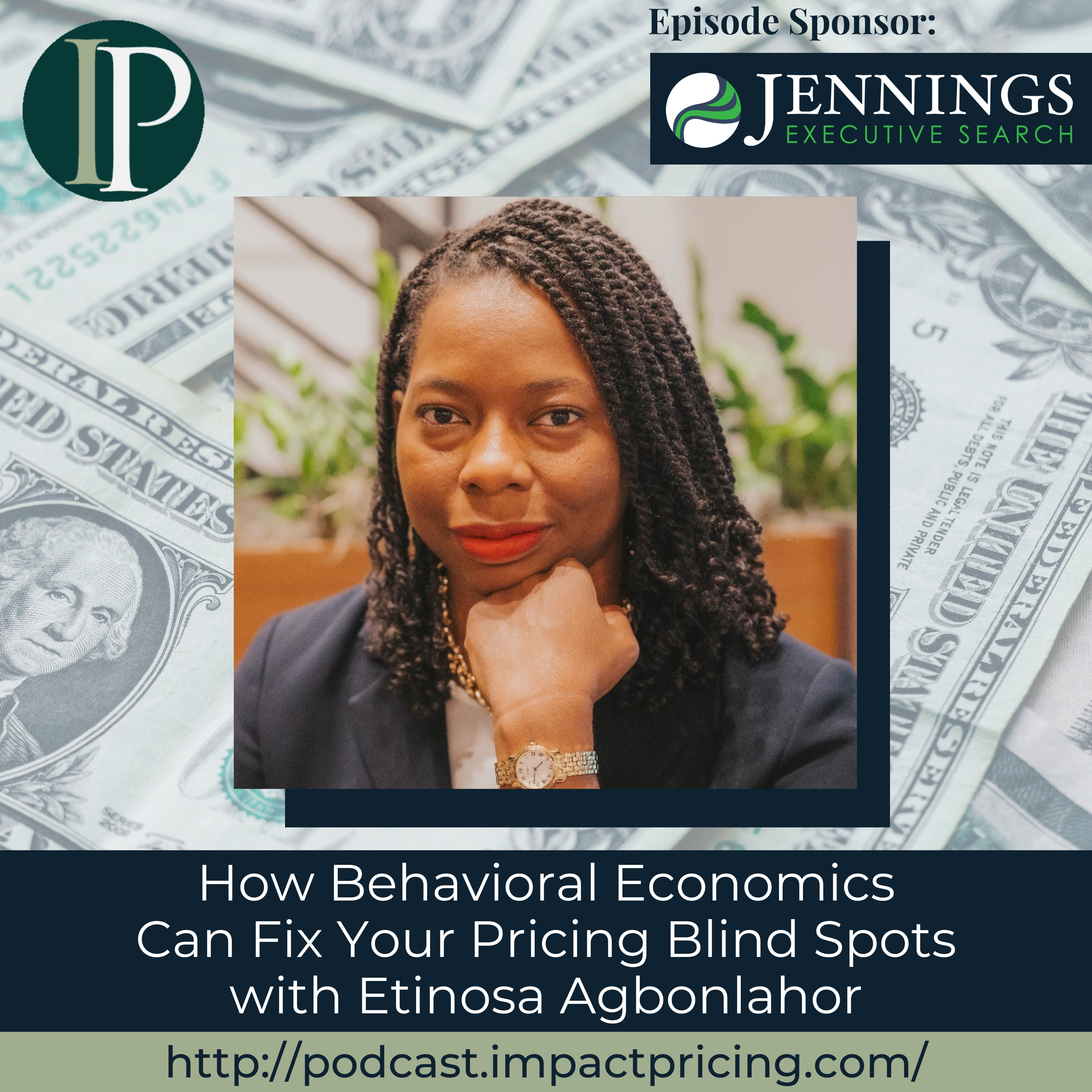
How Behavioral Economics Can Fix Your Pricing Blind Spots with Etinosa Agbonlahor
from Impact Pricing
Etinosa Agbonlahor is the CEO of Decision Alpha and former Director of Behavioral Research at Fidelity Investments. A behavioral economist by training, she helps companies understand how customers actually make decisions—and how that should shape pricing. In this episode, Etinosa and Mark Stiving unpack the tension between real value and perceived value, why customers don't react to prices rationally, and how behavioral economics can strengthen pricing strategies. They explore value drivers, ethical nudging, the fear of raising prices, and why most buyers don't remember prices as clearly as business owners think. If you want clearer, psychology-backed ways to price, communicate value, and make better pricing decisions, this episode gives you practical insights you can use right away. Why You Have to Check Out Today's Podcast: Why customers forget your prices—and how that myth makes business owners afraid to raise them. How behavioral economics expands value beyond profit into perception, context, and emotion. How to raise prices ethically using segmentation, glide paths, and clear communication. "Understand your customer. Do the pricing research with customers—not just with quant models. Go talk to customers. It's important." — Etinosa Agbonlahor Topics Covered: 02:08 – Pricing and Behavioral Economics. Mark and Etinosa debate where behavioral economics fits in pricing—Mark sees it as the final touch, while Etinosa argues it shapes value perception from the start. 05:20 – Defining Real vs. Perceived Value. A foundational question: is value measured strictly in outcomes, or also in emotion, context, and comparison? Their contrasting definitions reveal why pricing teams often misread customers. 09:05 – Value Beyond Monetary Price. Etinosa expands value to include convenience, safety, time saved, emotional comfort, and opportunity cost—benefits customers feel but rarely articulate. 10:37 – Value Drivers in Pricing Strategies. Behavioral research uncovers the real outcomes customers care about. Mark connects this to pricing strategy: quantify value drivers to justify stronger pricing. 15:32 – Manipulation in Behavioral Economics. Mark asks whether nudging is manipulation. Etinosa explains that behavioral tools aren't coercive—intent determines whether they help or harm the customer. 18:02 – Ethics of Choice Architecture. Every pricing page is a designed choice. Etinosa contrasts ethical nudges with dark patterns, while Mark questions how businesses balance their goals with customer wellbeing. 22:22 – Behavioral Economics in Business. Real-world examples show how behavioral insights improve retention, financial outcomes, and long-term customer relationships—not just revenue. 24:20 – Pricing Fears and Customer Perception. The Spotlight Effect is a myth: customers don't track your prices as closely as you think. The two discuss how clearer communication and segmentation reduce backlash when raising prices. 28:48 – Understand Your Customer. Etinosa's closing advice: real pricing power comes from customer conversations—not spreadsheets. Behavioral economics begins with understanding actual human behavior. Key Takeaways: "Value is all about perception. Once you step into perception, you're in behavioral economics." — Etinosa Agbonlahor "There is no such thing as a neutral choice. Every pricing page is designed—intentionally or unintentionally." — Etinosa Agbonlahor "People are not rational. Once you accept that as fact, you can design pricing that fits how people actually behave." — Etinosa Agbonlahor "Business owners think customers remember prices more than they actually do." — Etinosa Agbonlahor People / Resources Mentioned: Richard Thaler – Nobel laureate; originator of transaction utility and foundational behavioral economics concepts. Dan Ariely – Author of Predictably Irrational, referenced in discussing irrational decision patterns. Weber-Fechner Law – Psychological principle used to design perceptually smoother price increases. Connect with Etinosa Agbonlahor: LinkedIn: https://www.linkedin.com/in/etinosasere Email: [email protected] Connect with Mark Stiving: LinkedIn: https://www.linkedin.com/in/stiving/ Email: [email protected]
Embed this episode
NOW PLAYING
How Behavioral Economics Can Fix Your Pricing Blind Spots with Etinosa Agbonlahor
No transcript for this episode yet
Similar Episodes
No similar episodes found.