
EPISODE · Aug 23, 2025 · 6 MIN
How Can Writers Stop Paying the Major Retailer Tax?
from Walter Rhein Podcast · host Walter Rhein
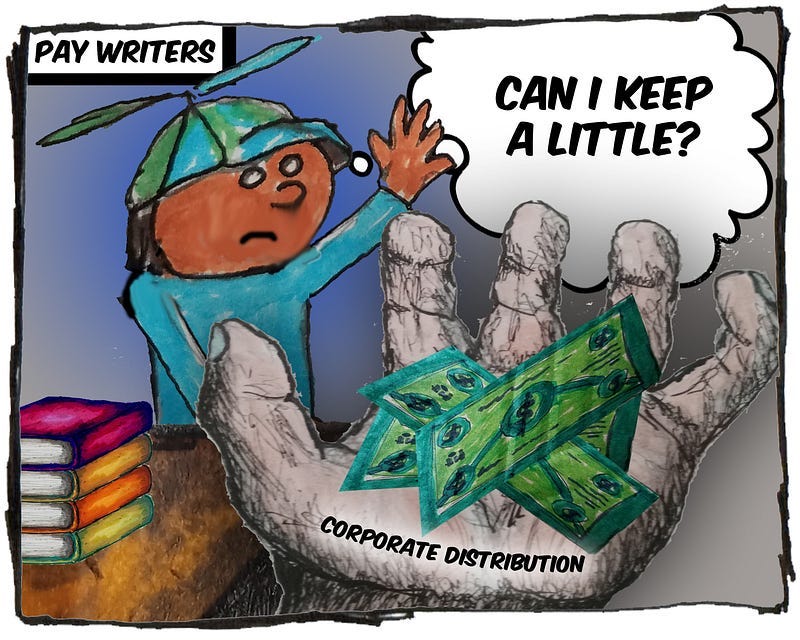
Thanks for the TIPS!I recently sent out a review of a small press book to my newsletter. I wanted to place a purchase link at the end, but I found myself conflicted. Major online retailers are the most convenient, but they run contrary to the ideology of independent publishing.People often say, “Inquire at your local independent bookstore.” But how practical is that? As for me, I don’t have an independent bookstore in my area. Even if I did, where are they likely to get the book?These days there are quite a few small publishers that use some form of print-on-demand technology. In fact, print runs have become rare. Therefore, even if you inquire at an independent bookstore, it’s likely they’ll turn around and make an order at the same major retailer you were trying to avoid.The simple fact is that it’s not so easy to remove major retailers from the equation. If that’s our objective, then we’ll have to embrace a brave new strategy when it comes to publishing.Finding the money in publishingThere is only a limited amount of money to go around. We talk about “profit,” but major retailers are clever in that they figure out how to get their cut before profit is even calculated.Their cut is a production expense. That’s where the money is.From a pure business model, books are a hard sell. Ideally, you want to be able to make something for a penny, and sell it for a hundred dollars. That’s not possible with books.Books cost a lot of money to make, and they’re expensive to ship. From the outside looking in, you’re much better off creating a company that earns its profit through the creation of books, rather than through writing.The problem with print-on-demandThe only way to make any money selling books is through economics of scale. You have to reduce the unit cost of each book so you can maximize your profit. Again, writers are paid from the profit end of the equation. They don’t get anything from production costs.It used to be that publishers would start off with a print run of about 1,000 books. Then they crossed their fingers and hoped the book would be a success so they could make serious money on the second printing. This is why first editions are valuable. It’s because there are fewer of them.I once had a publisher do a small print run of one of my books. The problem is that the publisher got in over its head head and couldn’t sell all the copies. Even if you’re getting into a unit cost of around $2, that’s still a considerable loss of money.The unit cost of print-on-demand for a similar book might be as high as $7-$10. That eliminates the initial investment, but it destroys your chance at profit.The real problem with print-on-demand is that market price is dictated by the profit margin for print run books. If you are a print-on-demand publisher, you have to set your sales price at over $20 dollars to earn the same amount of profit, but even then your margin is much lower because your production costs are so much higher.It’s not a sustainable modelTheoretically, it makes sense to make your book available through print-on-demand to see if it has an audience. Then, if the book sells well, you should switch to the print run model. This reduces your production costs and helps increase the profit so you can actually pay the writer.But how many books make the jump from print-on-demand to print run? It’s likely that if you release your book through print-on-demand, it’s going to stay in print-on-demand.Writers often get pressured into thinking about marketing, but that still keeps them on the profit side of the equation. Practically speaking, it would make more sense for writers to learn about printing.Would it be possible to set up an economical press in your garage so you could create inexpensive, high-quality copies of your book? If you learned this and offered it as a service that undercut the pricing of print-on-demand and traditional publishing, you’d likely make more than you ever would as a writer.But that’s not our objective here. Our objective is to come up with a model that allows writers to be paid for their writing.We have to move away from books entirelyWhen you come right down to it, paper is the anchor around our necks. I have a bunch of truck drivers in my family. They always say that paper is the heaviest cargo.Books are expensive to make and they’re expensive to ship. Our only option is digital, but we already spend too long looking at computer screens. As much as I love reading, I don’t particularly love reading books on my cell phone.Also, people no longer have the blocks of time needed to sit down and absorb a book. Instead, they have 7–8 minute packets of time that are scattered sporadically throughout the day.Rather than writing books, we have to figure out how to deliver our stories to people on their cell phones in self-contained segments that take around 7 minutes to consume.The ‘Calvin and Hobbes’ modelOne of my longstanding family traditions is that I read 12 ‘Calvin and Hobbes’ strips to my kids every night. That’s the last thing we read together before we go to sleep. We’ve been through the complete works multiple times. Every time we close the cover on book 4, we go right back to book 1.‘Calvin and Hobbes’ is quite clever in that it often has stories that string together over a couple of weeks. However, each individual strip contains a joke that is entertaining on its own.This is what modern writers have to aspire to achieve. You have to create an easily digestible, 7 minute piece of content that is complete on its own, but also fits into a larger thematic purpose.In every ‘Calvin and Hobbes’ strip you get a joke, and you get a glimpse at a larger commentary on the joy and magic of childhood. When you take all the strips together, you have the equivalent of a novel.Eliminate production costs to maximize profitThis brings us back to how we can conceive of a model that actually allows writers to get paid. In print run and print-on-demand models, unit pricing is too high and all the profit is gobbled up by the production costs.These days, the only way to even hope to make any money on a book is to establish enough notoriety that thousands of people preorder a copy. That allows you to take the chance out of paying the lower unit cost of a large print run.I’ve come to embrace the idea of creating a larger theme that emerges when all my articles are taken as a whole. I still write novels for fun, but the only way I’m able to support myself as a writer is through the short-form, digital model.The good news is that you don’t have to give up your dreams of being a novelist in order to succeed as a well-compensated writer. You can still wrestle with the concept of long-form storytelling, it’s just that you have to accept that your readers aren’t going to sit down and digest it all at once.If you can eliminate the production expense of a physical book you ensure that the majority of what a consumer is willing to pay goes to the writer.Which is as it should be.You all make this newsletter happen! Thanks for your sponsorship! I have payment tiers starting at as little as twenty dollars a year.Upgrade at 30% offUpgrade at 40% offUpgrade at 50% offUpgrade at 60% offI'm so happy you're here, and I'm looking forward to sharing more thoughts with you tomorrow.My CoSchedule referral linkHere’s my referral link to my preferred headline analyzer tool. If you sign up through this, it’s another way to support this newsletter (thank you).I'd Rather Be Writing is a reader-supported publication. To receive new posts and support my work, consider becoming a free or paid subscriber. Get full access to I'd Rather Be Writing at walterrhein.substack.com/subscribe
Embed this episode
NOW PLAYING
How Can Writers Stop Paying the Major Retailer Tax?
No transcript for this episode yet
Similar Episodes
No similar episodes found.
Similar Podcasts
No similar podcasts found.