
EPISODE · Sep 7, 2024 · 1H 1M
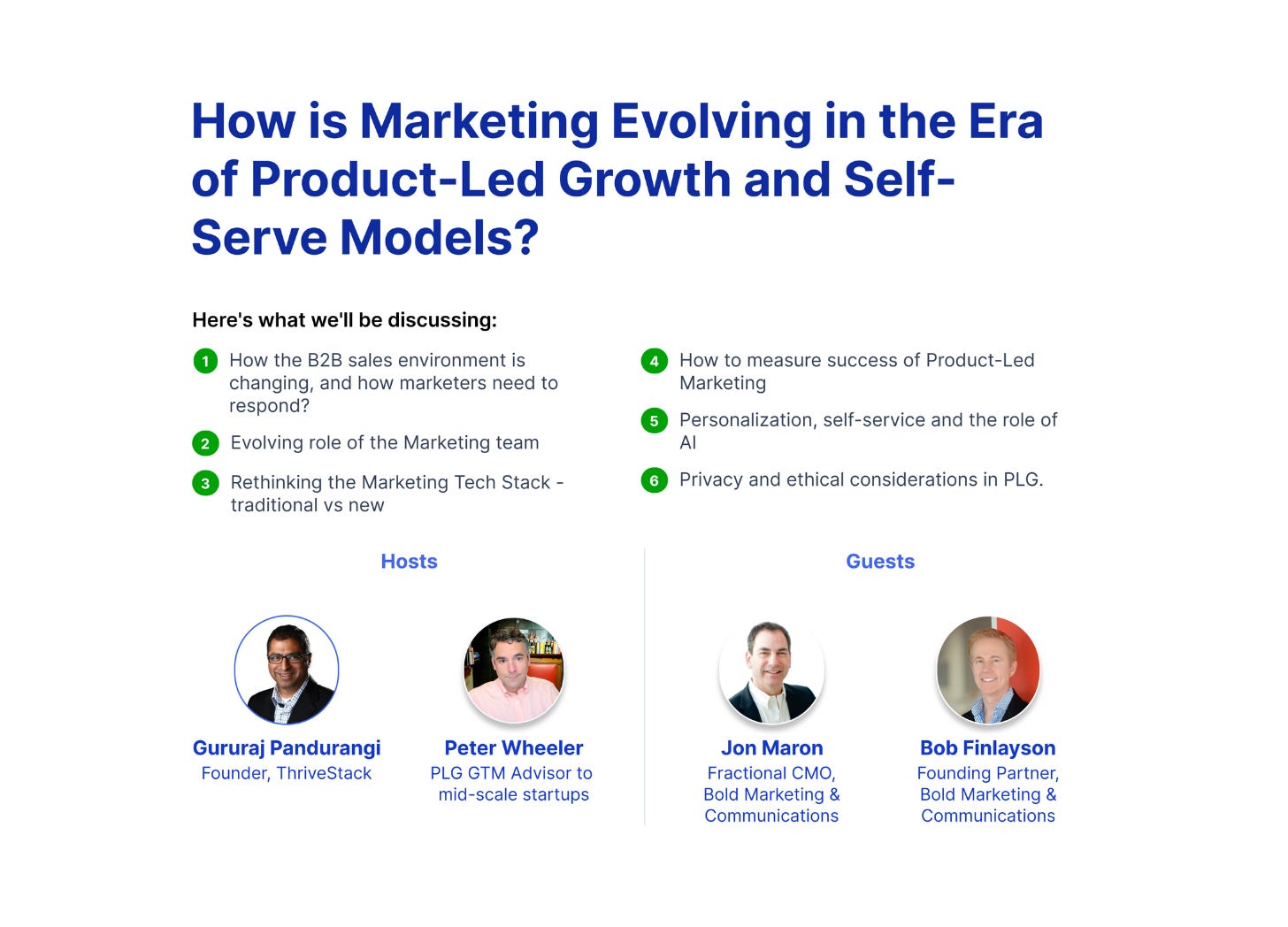
How is Marketing Evolving in the Era of Product-Led Growth and Self-Serve Models?
from Thrivecast · host Anushka Karmakar
tl;dr:* B2B buyers are increasingly self-directed, with 77% completing their journey before contacting a vendor.* The role of marketing has expanded to include product education and close collaboration with product development and customer success teams.* Product-Led Growth (PLG) shifts focus to the product as the main driver of customer acquisition and revenue generation.* Product Qualified Leads (PQLs) are now more valuable than traditional Marketing Qualified Leads (MQLs).* The marketing tech stack now includes tools like product usage analytics and AI-powered personalization.* Customer success teams play a critical role in onboarding, retention, and turning users into advocates.* The future of marketing lies in blending revenue accountability with customer-focused strategies that prioritize value.The Changing B2B Sales EnvironmentB2B buyers are increasingly informed and self-directed. Instead of relying on sales teams, they now prefer to research and evaluate products independently, often through free trials or freemium models. By the time they engage with sales, buyers have already gathered the necessary information, making it crucial for marketing to provide valuable product insights early in their journey.With 77% of buyers completing most of their journey before contacting a vendor, marketing’s role has shifted. It’s no longer about generating leads but about empowering customers with value-driven content that enables informed decisions.Key Takeaways:* Buyers are more self-sufficient, relying on self-service research.* Marketing must deliver informative, value-focused content early in the buyer’s journey.* Product-Led Growth (PLG) supports this shift, offering buyers the independence they seek.The Evolving Role of the Marketing TeamIn the Product-Led Growth (PLG) era, marketing teams have transitioned from simply driving awareness to becoming strategic partners in customer acquisition and retention. Marketing is no longer just about generating leads; it now focuses on the product itself as a primary tool for attracting and retaining customers.Marketers are expected to work closely with product development and customer success teams, understanding the product inside and out. This shift emphasizes product-qualified leads (PQLs)—users who engage directly with the product—as a more accurate measure of intent compared to traditional marketing-qualified leads (MQLs).Marketing now plays a critical role in driving product adoption and revenue growth, serving as the bridge between the product and the customer.Rethinking the Marketing Tech StackAs Product-Led Growth (PLG) reshapes marketing, traditional tech stacks focused on CRM systems and email marketing are no longer sufficient. To thrive in a PLG world, marketing teams need to adopt tools that provide real-time user engagement insights and product usage analytics.Here are the essential tools for modern marketing teams:* Product Usage Analytics: Track how users engage with the product to identify popular features and optimize both marketing and product strategies.* Event Tracking: Capture user actions—like signing up for a trial or upgrading to a paid plan—and segment users for targeted campaigns.* Customer Data Platforms (CDPs): Unify data from various touchpoints to create a 360-degree view of each user, enabling personalized messaging and experiences.* AI and Predictive Analytics: Use AI-driven tools to automate tasks and predict customer behavior, ensuring personalized experiences at scale and anticipating customer needs.By upgrading to these technologies, marketing teams can deliver more targeted campaigns, enhance self-serve experiences, and support product adoption with data-driven insights.Product-Led Growth and Its Impact on RevenueIn a Product-Led Growth (PLG) strategy, the product itself drives customer acquisition and revenue generation. This shift fundamentally changes how marketing and sales teams operate, making the entire process more customer-centric and measurable.Here’s how PLG impacts revenue:* Shift from MQLs to PQLs:The focus is no longer on Marketing Qualified Leads (MQLs) but on Product Qualified Leads (PQLs)—users who have actively engaged with the product. This provides a clearer signal of purchase intent.* Revenue Accountability for Marketing:Marketing is now directly accountable for driving product adoption and revenue growth. It's no longer just about generating leads; it's about ensuring users successfully engage with the product and convert.* Blurring of Sales and Marketing Roles:With the product driving acquisition, the traditional boundaries between sales and marketing are fading. Sales teams now step in later in the customer journey, focusing on helping users who have already engaged with the product.* Accelerated Customer Acquisition:With freemium models and free trials, PLG lowers the barrier to entry, speeding up the customer acquisition process and shortening the sales cycle.By making the product the centrepiece of the buyer's journey, PLG creates a more user-centric approach and shifts revenue responsibility across multiple teams.Customer Success and Its Role in PLGIn the PLG framework, customer success teams play a vital role in ensuring product adoption and long-term user engagement. As customers rely more on the product for self-service, post-sale support becomes crucial for retaining users and driving product advocacy.Key Points:* Onboarding and Education: Customer success teams help users get the most value from the product, providing resources and guidance to ensure smooth onboarding.* Driving Referrals and Advocacy: By focusing on customer satisfaction, these teams turn users into advocates, creating opportunities for referrals and renewals.* Customer Feedback: Success teams serve as the bridge between the user and product development, relaying feedback to ensure continuous product improvements.By making the product the focal point of the buyer's journey, Product-Led Growth redefines how revenue is generated, shifting the responsibility across teams and leading to a more user-centric approach.Personalization and the Role of AI in PLGIn the Product-Led Growth (PLG) model, personalization is essential for driving user engagement. AI-powered tools allow marketing teams to tailor content, product experiences, and outreach based on individual user behavior, automating these interactions at scale.As highlighted during the webinar, personalization is no longer optional—it’s expected. AI-driven features like chatbots, automated emails, and real-time notifications help guide users through their product journey, making the self-serve experience more seamless and efficient.By leveraging AI, companies can create customized experiences for users, meeting their specific needs and scaling customer acquisition and retention efforts.Final ThoughtAs Product-Led Growth continues to reshape how businesses engage with customers, one question remains:Is your company ready to let your product take the lead in driving growth? This is a public episode. If you would like to discuss this with other subscribers or get access to bonus episodes, visit www.hybridgtm.com
Embed this episode
NOW PLAYING
How is Marketing Evolving in the Era of Product-Led Growth and Self-Serve Models?
No transcript for this episode yet
Similar Episodes
No similar episodes found.