
EPISODE · May 27, 2026 · 10 MIN
How Rain Draws Hidden Lines in Soil — and What AI Can Learn From Them
from Waterlines: How Water Shapes Our World · host jaywen
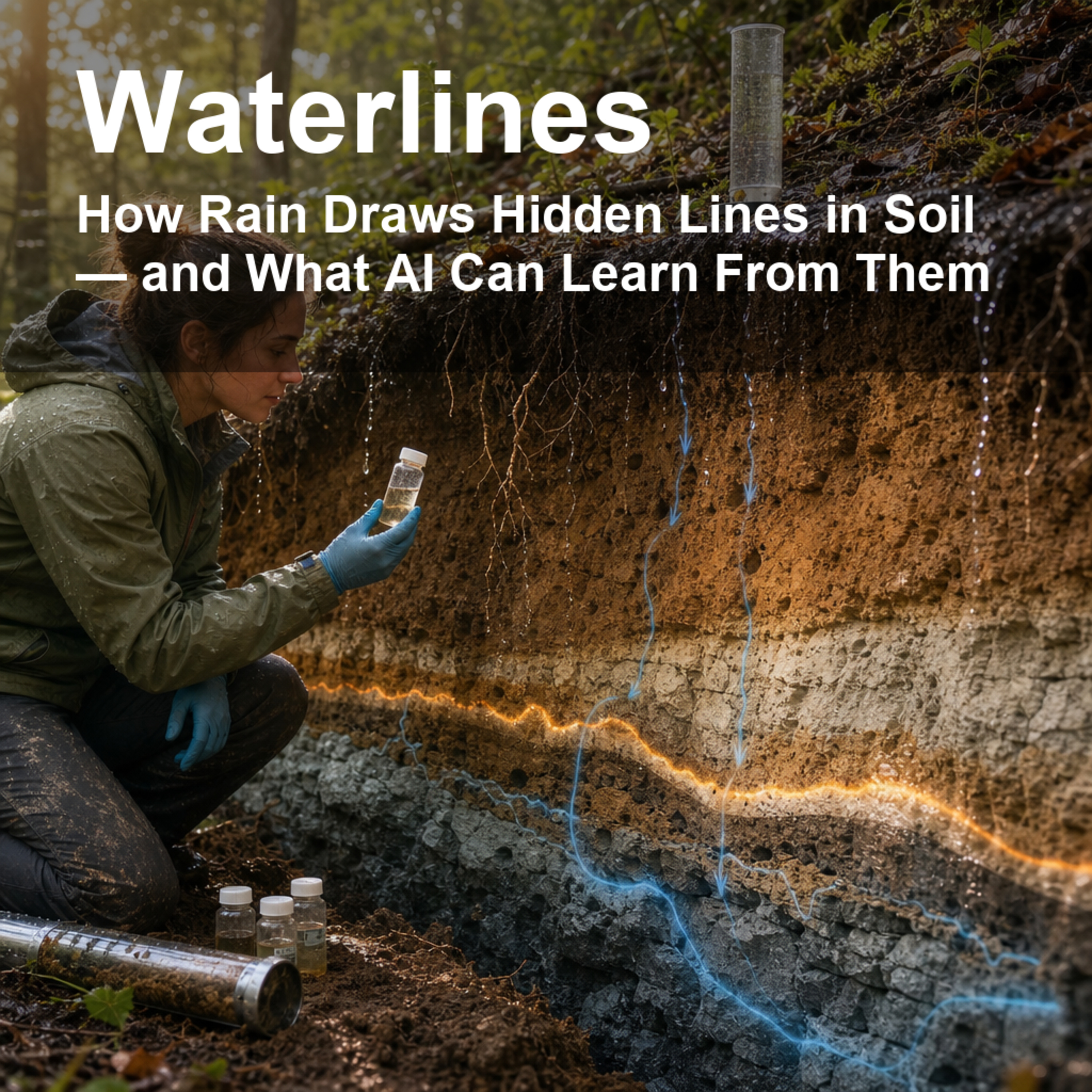
Every rainstorm does more than wet the ground. Drop by drop, water slips through soil, dissolves minerals, carries elements away, and quietly helps build the landscapes, ecosystems, and carbon cycles we depend on. This episode follows a study that asks a practical question for modern Earth science: can artificial intelligence learn from both field data and physical chemistry to predict where those underground weathering lines form?We explore soil “reaction fronts,” the hidden zones where minerals like feldspar dissolve as water moves downward through regolith. These fronts can record how long soils have been exposed, how water has flowed, and how weathering may help remove carbon dioxide over very long timescales. The paper tests a hybrid model: part neural network, part physics-based equation. Instead of letting AI guess freely, the researchers gave it guardrails from known geochemistry, then trained it on soil profiles from California, Georgia, and Virginia.The big takeaway is both promising and humbling. The hybrid model could often reproduce the slope of reaction fronts, and it identified soil residence time as especially useful. Surprisingly, precipitation was the least useful predictor in this small dataset. But the model struggled more with the depth of the front, partly because the physics equation it inherited was not built to predict depth well. The conversation looks at what that means for climate science, soil health, water flow, and the future of trustworthy AI in environmental research.Citation: Wen, Tao, Chacha Chen, Guanjie Zheng, Joel Bandstra, and Susan L. Brantley. 2022. “Using a neural network – Physics-based hybrid model to predict soil reaction fronts.” Computers & Geosciences 167: 105200. https://doi.org/10.1016/j.cageo.2022.105200.Disclosure: This Waterlines episode package is written for public science communication and uses AI-generated voices.
Embed this episode
NOW PLAYING
How Rain Draws Hidden Lines in Soil — and What AI Can Learn From Them
No transcript for this episode yet
Similar Episodes
No similar episodes found.
Similar Podcasts
No similar podcasts found.