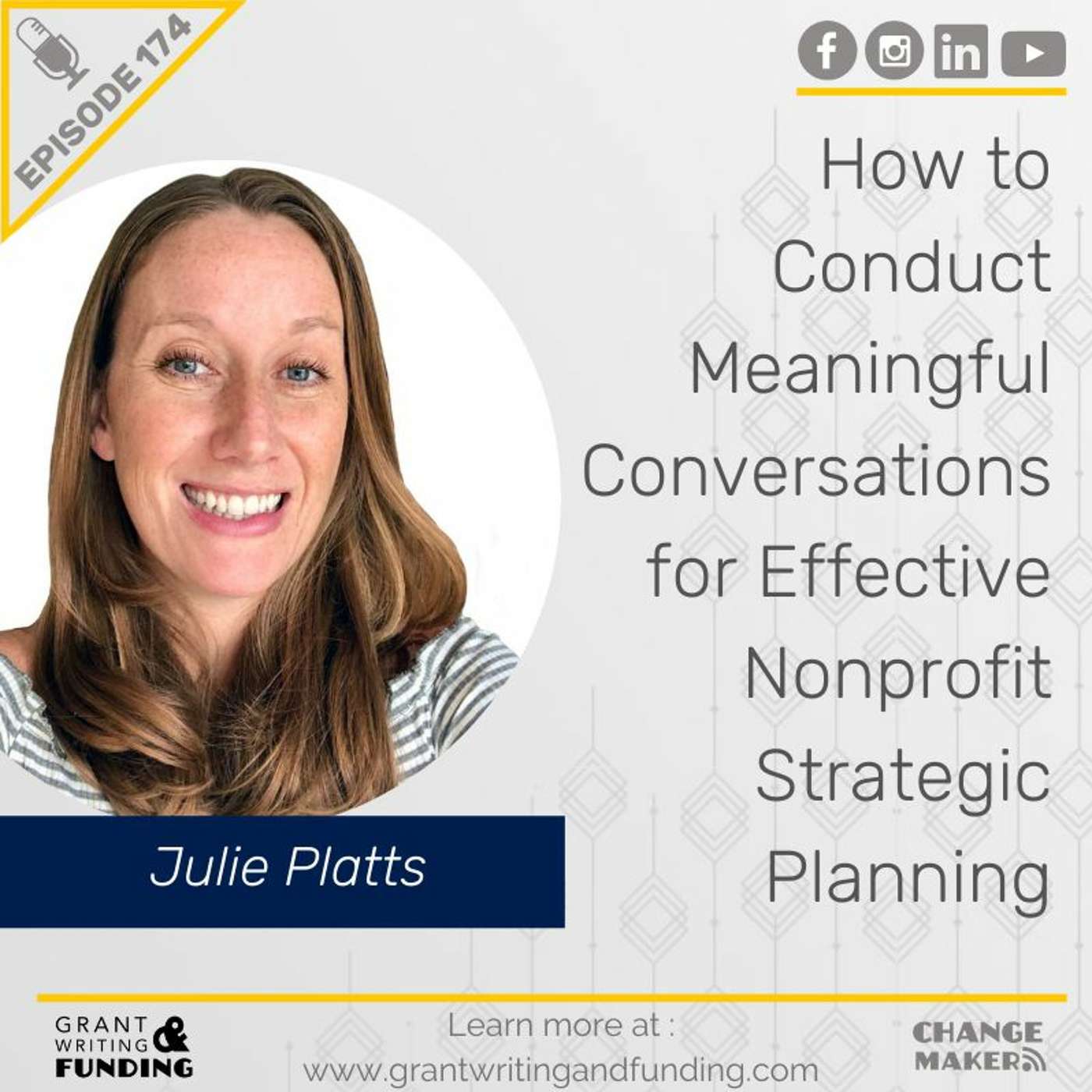
How to Conduct Meaningful Conversations for Effective Nonprofit Strategic Planning episode artwork

EPISODE · Jun 8, 2021 · 54 MIN

How to Conduct Meaningful Conversations for Effective Nonprofit Strategic Planning

from Grant Writing & Funding · host Holly Rustick

Yes, meaningful conversations are a must if you want effective solutions for your nonprofit strategies.I know. It’s easier for many nonprofit leaders to just ask, “Can you just make me a fundraising content calendar within the hour?”But what if that fundraiser isn’t really what your nonprofit needs to grow?I know it can feel taxing to try and fit in a conversation about why you even want the fundraiser in the first place (because we always have one) or what the real outcome you want that fundraiser to have for your nonprofit (er, money?). But the immediate answers aren’t always the right ones.In this week’s episode, Nonprofit Strategist Julie Platts guides me through how she goes deep with nonprofit clients to ask some of these specific questions. After all, she is a nonprofit strategist for a reason.What you hear might surprise you. But chances are, it will also inspire you to slow down for a few shakes so you can speed up with efficiency with your strategies. There are a lot of ‘a-ha!’ moments in this episode. Believe me.Plus, since Julie is also a consultant, she also shares with me some consultancy wisdom. We go deep on this too! I love how she talks about how she organizes her time and selects ideal clients.Need I say more? Just listen. Believe me, you’ll thank me ;)What we discuss:How to have those meaningful conversations with nonprofit leadersWhat questions to ask nonprofits when prepping for strategic planningWhy services usually need to change during these deep divesWhy it’s okay that these services change ;)How to select ideal clients by using a ‘warm’ techniqueOther amazing stuff that you just need to tune-in and listen to!About Julie PlattsJulie Platts is an “accidental entrepreneur” serving social impact leaders across the US. As a Nonprofit Strategy Consultant, Julie uses her 15 years of nonprofit leadership and research experience to help leaders make informed, supported decisions and amplify impact. She specializes in communications, income generation, program development, and relationship building.Julie is known for creating safe spaces for teams to develop authentic and trusting relationships so they can move forward with agile and adaptive strategies. Bringing heart, humor, wisdom, and expertise to each strategy session and coaching call, Julie helps leaders walk away with clarity, confidence, and renewed invigoration for their work.Julie is on the Board of Directors and Executive Committee for The Lucy Project, a start-up nonprofit that spends its days working with some of the smartest kids in Miami who just so happen to have reading-based learning differences like dyslexia. Julie has her Master’s degree in Women, Violence, and Conflict from the University of York in the UK where she researched Amnesty International’s “Rape. Weapon of War.” campaign. She has her Bachelor’s degree from UNCC where she collaborated on research for Habitat for Humanity’s multi-family housing initiatives. Julie has her certification in Nonprofit Management from the Florida Association of Nonprofits and Nova Southeastern University.Julie lives in Delray Beach, FL, and is often found frolicking through South Florida’s wetlands and woodlands with her husband and their 3-year old and 18-month-old children.My Freelancing Journey (so far) – Julie PlattsI didn’t mean to start a freelance business. It was an accident. An accident that has turned into a beautiful adventure. It started as a thought, a fun hobby after my daughter turned one. And then it grew legs of its own. I’ve been sprinting to keep up with it ever since.By my daughter’s first birthday, I had already been away from the nonprofit sector in a leadership capacity for three years. I left to revel in new motherhood when my son was born. I have always been a compulsive volunteer, so that was still a part of my life, but I had a desire to go back to philanthropy writing. Communications, deep storytelling, and relationship-building had always been my passion.It seems like the second I breathed that intention into a conversation with friends, the ball started rolling on its own. Nonprofit leaders started reaching out to me for support. They wanted web content writing, messaging advice, campaign writing, strategy consulting, and grant writing. I had a successful track record with grant writing in the past but always wanted to learn more about it, so I took Holly Rustick’s Grant Writing Master Class and began writing funding proposals.I started out trying to help everyone for free. I was still a full-time, stay-at-home parent, so I was squeezing in content writing and consulting during my kids’ nap times. I was staying up until midnight writing grants and eating popcorn and M&Ms and peanut butter straight out of the jar. When my mom or husband had the kids, I would work in my car just to have some quiet as grant deadlines barreled towards me.I have worked long enough in the nonprofit sector to know what survival mode, stress, and overwhelm look like. And I was full-on in that state. I thought, “What do I tell the nonprofit leaders I work with to do when I see them stuck in survival mode?” I say, “Let’s step back. Take a deep breath. Remember the bigpicture. Find the “why.” Find someone outside of the problem to support you. Create an intentional strategy and next best actions that bring you closer to your vision. Ask someone to keep you accountable. Move steadily and at a pace that is kind to yourself.”So I did just that. I set out to build my own capacity. I began charging, I moved my work into a co-working space, I found a soulful business strategy coach to support me, I resolved to drop the services that didn’t make me feel energized, joyful, and fulfilled. I owed that to my family…and myself. I had to do what all organizations need to do: know the vision, remember the mission, evaluate impact, and iterate constantly to offer something truly special and transformative to the world…and become radically self-aware and courageous in the process. It is an ongoing, ever-evolving exercise – and it’s exhilarating.I have begun building a network around me of talented grant writers, marketers, web designers, nonprofit attorneys, accountants, and other nonprofit consultants to take on work that is not in my zone of genius. I evaluate weekly whether I am choosing work that awakens a deep “Hell, yes!” in me and makes me excited for the day. When I sense I am doing something because I feel I “should” or because I don’t want to disappoint someone, I complete the project with a high level of integrity and then I create a strategy to choose again. To decide to either drop that service altogether or outsource it to someone wholoves doing it.So, now. I spend my days joyfully working with progressive leaders and teams to develop agile, adaptive, next-best-step strategies that help them step out of survival mode and into their zones of genius. Then, I step back and watch them knock it out of the park. And I wake up in the morning buzzing with excitement about the work I get to do. It’s pretty damn magical…and always evolving to where it wants to go next.Connect with Julie:Website: www.julieplattsconsulting.comLinkedIn: Click hereLinks I...

Yes, meaningful conversations are a must if you want effective solutions for your nonprofit strategies.I know. It’s easier for many nonprofit leaders to just ask, “Can you just make me a fundraising content calendar within the hour?”But what if that fundraiser isn’t really what your nonprofit needs to grow?I know it can feel taxing to try and fit in a conversation about why you even want the fundraiser in the first place (because we always have one) or what the real outcome you want that fundraiser to have for your nonprofit (er, money?). But the immediate answers aren’t always the right ones.In this week’s episode, Nonprofit Strategist Julie Platts guides me through how she goes deep with nonprofit clients to ask some of these specific questions. After all, she is a nonprofit strategist for a reason.What you hear might surprise you. But chances are, it will also inspire you to slow down for a few shakes so you can speed up with efficiency with your strategies. There are a lot of ‘a-ha!’ moments in this episode. Believe me.Plus, since Julie is also a consultant, she also shares with me some consultancy wisdom. We go deep on this too! I love how she talks about how she organizes her time and selects ideal clients.Need I say more? Just listen. Believe me, you’ll thank me ;)What we discuss:How to have those meaningful conversations with nonprofit leadersWhat questions to ask nonprofits when prepping for strategic planningWhy services usually need to change during these deep divesWhy it’s okay that these services change ;)How to select ideal clients by using a ‘warm’ techniqueOther amazing stuff that you just need to tune-in and listen to!About Julie PlattsJulie Platts is an “accidental entrepreneur” serving social impact leaders across the US. As a Nonprofit Strategy Consultant, Julie uses her 15 years of nonprofit leadership and research experience to help leaders make informed, supported decisions and amplify impact. She specializes in communications, income generation, program development, and relationship building.Julie is known for creating safe spaces for teams to develop authentic and trusting relationships so they can move forward with agile and adaptive strategies. Bringing heart, humor, wisdom, and expertise to each strategy session and coaching call, Julie helps leaders walk away with clarity, confidence, and renewed invigoration for their work.Julie is on the Board of Directors and Executive Committee for The Lucy Project, a start-up nonprofit that spends its days working with some of the smartest kids in Miami who just so happen to have reading-based learning differences like dyslexia. Julie has her Master’s degree in Women, Violence, and Conflict from the University of York in the UK where she researched Amnesty International’s “Rape. Weapon of War.” campaign. She has her Bachelor’s degree from UNCC where she collaborated on research for Habitat for Humanity’s multi-family housing initiatives. Julie has her certification in Nonprofit Management from the Florida Association of Nonprofits and Nova Southeastern University.Julie lives in Delray Beach, FL, and is often found frolicking through South Florida’s wetlands and woodlands with her husband and their 3-year old and 18-month-old children.My Freelancing Journey (so far) – Julie PlattsI didn’t mean to start a freelance business. It was an accident. An accident that has turned into a beautiful adventure. It started as a thought, a fun hobby after my daughter turned one. And then it grew legs of its own. I’ve been sprinting to keep up with it ever since.By my daughter’s first birthday, I had already been away from the nonprofit sector in a leadership capacity for three years. I left to revel in new motherhood when my son was born. I have always been a compulsive volunteer, so that was still a part of my life, but I had a desire to go back to philanthropy writing. Communications, deep storytelling, and relationship-building had always been my passion.It seems like the second I breathed that intention into a conversation with friends, the ball started rolling on its own. Nonprofit leaders started reaching out to me for support. They wanted web content writing, messaging advice, campaign writing, strategy consulting, and grant writing. I had a successful track record with grant writing in the past but always wanted to learn more about it, so I took Holly Rustick’s Grant Writing Master Class and began writing funding proposals.I started out trying to help everyone for free. I was still a full-time, stay-at-home parent, so I was squeezing in content writing and consulting during my kids’ nap times. I was staying up until midnight writing grants and eating popcorn and M&Ms and peanut butter straight out of the jar. When my mom or husband had the kids, I would work in my car just to have some quiet as grant deadlines barreled towards me.I have worked long enough in the nonprofit sector to know what survival mode, stress, and overwhelm look like. And I was full-on in that state. I thought, “What do I tell the nonprofit leaders I work with to do when I see them stuck in survival mode?” I say, “Let’s step back. Take a deep breath. Remember the bigpicture. Find the “why.” Find someone outside of the problem to support you. Create an intentional strategy and next best actions that bring you closer to your vision. Ask someone to keep you accountable. Move steadily and at a pace that is kind to yourself.”So I did just that. I set out to build my own capacity. I began charging, I moved my work into a co-working space, I found a soulful business strategy coach to support me, I resolved to drop the services that didn’t make me feel energized, joyful, and fulfilled. I owed that to my family…and myself. I had to do what all organizations need to do: know the vision, remember the mission, evaluate impact, and iterate constantly to offer something truly special and transformative to the world…and become radically self-aware and courageous in the process. It is an ongoing, ever-evolving exercise – and it’s exhilarating.I have begun building a network around me of talented grant writers, marketers, web designers, nonprofit attorneys, accountants, and other nonprofit consultants to take on work that is not in my zone of genius. I evaluate weekly whether I am choosing work that awakens a deep “Hell, yes!” in me and makes me excited for the day. When I sense I am doing something because I feel I “should” or because I don’t want to disappoint someone, I complete the project with a high level of integrity and then I create a strategy to choose again. To decide to either drop that service altogether or outsource it to someone wholoves doing it.So, now. I spend my days joyfully working with progressive leaders and teams to develop agile, adaptive, next-best-step strategies that help them step out of survival mode and into their zones of genius. Then, I step back and watch them knock it out of the park. And I wake up in the morning buzzing with excitement about the work I get to do. It’s pretty damn magical…and always evolving to where it wants to go next.Connect with Julie:Website: www.julieplattsconsulting.comLinkedIn: Click hereLinks I...

NOW PLAYING

How to Conduct Meaningful Conversations for Effective Nonprofit Strategic Planning

0:00 54:14

No transcript for this episode yet

We transcribe on demand. Request one and we'll notify you when it's ready — usually under 10 minutes.

The Ultraspeaking Podcast Tristan de Montebello, Michael Gendler The Ultraspeaking Podcast explores modern-day solutions to greater confidence, skill, and ease when speaking at work. Each episode features the founders, Tristan and Michael, as they detail unconventional strategies to thrive under pressure and speak with less preparation. Working on hand-gestures and eye contact is OUTDATED advice. Writing a script or creating a structure is a TRAP.It’s time for a better way. Join the Ultraspeaking movement and you’ll never look back. WW2 - the Key Questions, answered by Laurence Rees. Laurence Rees A former Head of BBC TV History programmes, Laurence has specialized in writing books and making television documentaries about World War Two, the Nazis and Stalinism for thirty years. He won a BAFTA and a Peabody for his TV series 'The Nazis: A Warning from History' and a British Book Award for his book on Auschwitz, which is also the world's best selling book on this notorious camp. His book 'the Holocaust: A New History' was described by the Times as 'exemplary' and by the Daily Telegraph as 'the best single volume account of the atrocity ever written'. Educated at Oxford University, for several years he was a visiting senior fellow at the London School of Economics, London University. He holds honorary doctorates from the University of Sheffield and the Open University. Professor Robert Service, of Oxford University, described Rees as 'one of the world's experts on the Second World War'. Sir Max Hastings wrote in the Sunday Times, in a review of Laurence Rees' 'World War Two: Behi Hot Copy Kate Toon & Belinda Weaver The Hot Copy podcast is a collaboration between seasoned copywriters Belinda Weaver and Kate Toon.Tune in for copywriting tips, shortcuts, writing resources, interviews and laughs. All focused on helping you become a better copywriter. The Writers' Show Geoff Hughes A podcast about writing, featuring interviews with authors and songwriters at all levels of success.Inspiring and successful authors reveal the secrets about writing, creativity and the business of independent publishing and songwriting.Featuring interviews with successful authors and songwriters excited to share the journey from idea to published book and song.Host Geoff Hughes is the founder of Madhouse Media PublishingMore info on the Writers Show Website

Frequently Asked Questions

How long is this episode of Grant Writing & Funding?

This episode is 54 minutes long.

When was this Grant Writing & Funding episode published?

This episode was published on June 8, 2021.

What is this episode about?

Yes, meaningful conversations are a must if you want effective solutions for your nonprofit strategies.I know. It’s easier for many nonprofit leaders to just ask, “Can you just make me a fundraising content calendar within the hour?”But what if that...

Can I download this Grant Writing & Funding episode?

Yes, you can download this episode by clicking the download button on the episode player, or subscribe to the podcast in your preferred podcast app for automatic downloads.
URL copied to clipboard!