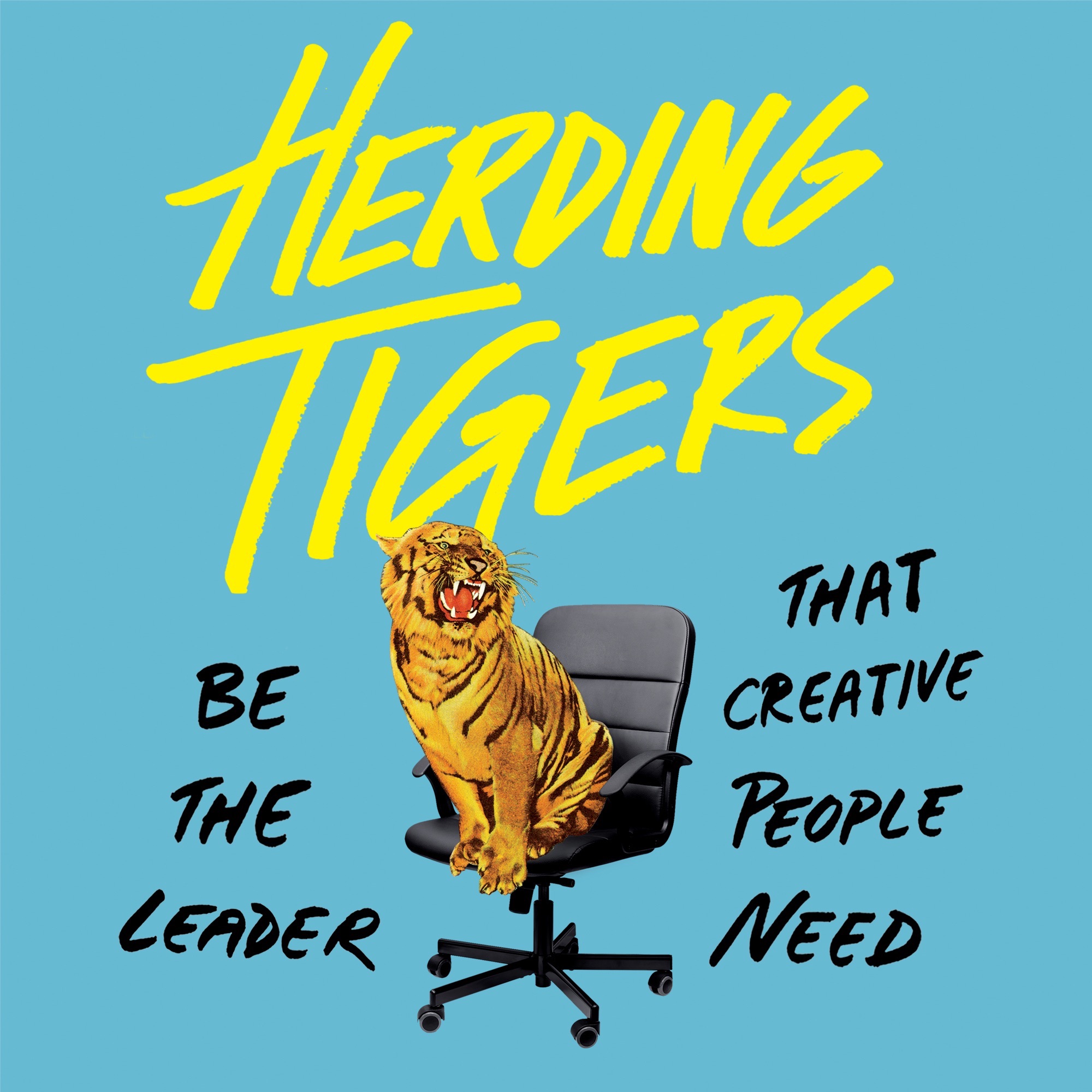
My name is Todd, and I'm the founder of Accent Creative, and author of the book, Herding Tigers, be the leader that created people need. You know, meaning created people I've often heard is like herding cats. I hate that phrase. I am on a lifelong crusade to demolish that phrase from existence because I think it's not like herding cats.
It's very demeaning. It's more like herding tigers. These are powerful, independent, amazing beings capable of great beauty and majesty, also capable of ripping you to shreds if you don't leave them properly. Creating people need to be individually and strategically led.
You need to understand what it is that drives them. You need to understand what makes them tick, and also what they need in their environment in order to bring their best work every day. And frankly, sometimes, to call them out on some of the unhealthy behaviors that are often folded into the creative process. The creative process is inherently opaque, which means people don't understand it, which means that from the outside, it's often difficult to discern when a creative person is being productive and when they're not being productive.
And so Gordon McKenzie, the former creative director of Hallmark and author of the book, orbiting the giant hairball once wrote about this dynamic. And he said, you imagine a farmer standing on the edge of a field and yelling, hey, you, Kyle, stop grazing and get back to making milk, right? And that's kind of what it's like. The creative process from the outside is opaque, and people don't understand what is involved in the process of coming up with ideas, the process of ruminating, of connecting dots, of synthesizing, of looking for patterns.
And that's really what it's all about. It's about synthesizing and connecting dots. People don't see that. Also, the insecurity that is involved in creative work.
When you're doing creative work, highly creative work, you're putting a piece of yourself in how you perceive your role in the world, you're putting your intuition, your instincts into that work. And so a rejection of that work can sometimes feel like a rejection of you as a person. It shouldn't, but it does, because a big chunk of who you are is put into what you do. And so as a leader, as a manager of creative people, you need to help people understand the line between who they are and what they do, and also help them understand that when you're rejecting an idea, you're not rejecting them or their perception per se, you're just using your greater ability to synthesize patterns because of your experience to help them see why some ideas might be better than others, but you have to deal with that insecurity as a leader.
Today we're gonna talk about some of the things that can result when we are doing work together. We're doing highly complex creative work together. I often hear people say something like, hey, my team is incredibly healthy. We never fight.
I just wanna shake them by the shoulders and say your team is the most profoundly unhealthy team I've ever encountered, right? Because if you have talented, creative-driven people in a room together and they care about their work and they're chasing after a very difficult objective, there is going to be conflict. Conflict is the natural result of talented creative people bumping into one another. It's not whether or not you have conflict, it's how you deal with that conflict that will determine success or failure.
It will determine whether you keep talented people on your team or whether they seek better horizons. So today I always just wanna offer a few quick ideas, principles, tips for dealing with conflict. And of course I write about this in the book, Hurting Tigers, I go into more detail about it in a chapter about how to fight fair and how to ensure that conflict and team camaraderie is preserved even in the midst of, sometimes not liking each other. Listen, you don't have to like all of your teammates.
I know that sounds maybe, heretical to say that, right? It sounds like an incredibly unhealthy thing to not like your team. No, you don't have to like your teammate, but you have to work together. You have to respect them.
You have to give them what they do as a talented creative pro. But you don't always have to like everyone. And I think our effort to try to always like people is some people you're just not gonna like. You're not gonna click.
You're not gonna wanna go out for beers after work. It's just not going to happen. But you can respect them and you can give them the attention that is due to their ideas because of the way that they've proven themselves over time. So how do we deal with conflict as a leader, or frankly, this works for us if we're just peers on the team, if we're in a conflict with someone else.
Well, the first thing is, agree on the common objective from the start. Make sure that you're actually fighting over the same thing. I can't tell you how many times I've heard people describe conflicts in organizations. And I'll say something like, well, you know that you're having different arguments, right?
You realize that you're not fighting over the same thing. You think you're fighting over X and the other person thinks that you're fighting over Y. And that's why you're having this conflict is because you're shooting straight past each other. You know, it's because you're trying to accomplish different things.
Make sure that you have defined the problem in the same way. Make sure that you're solving the same problem for you engaging any kind of argument or conflict. Just step back, cool your jets, and say, okay, let's talk about what we're fighting about. Here's what I perceive the problem to be.
What is the problem you perceive? Okay, great. We are in fact fighting over the same thing. That will actually eliminate probably a significant chunk of the tension that you experienced.
Now, there's still gonna be some conflict there, but you might eliminate 20, 30% of that conflict because you realize, oh, we were just slightly misaligned. Okay, now that we're aligned, let's fight over what really matters. Okay, so that's number one. Make sure you're fighting about the same thing.
Number two, whenever you engage in the conflict, always seek the merits in the other person's idea before you seek to destroy. Sometimes because of our insecurity, we posture, and we power up. That's what we do from the get go. We power up immediately, and we just go into seek and kill mode.
We go into, I'm going to destroy your idea. I'm not gonna listen to what you have to say. And so this is a huge problem in culture right now, that we're not willing to listen to other people's arguments. And so everyone just gets defensive.
Everyone just puts up their shield, right? And everyone's firing at everybody else, and nobody's stopping to listen to the other person's point of view. So try your best, articulate what you think is correct about the other person's argument. Seek the merits of their argument before you seek to destroy their point of view.
Okay, and then finally, as a final principle, it relates to dealing with conflict. Make sure that you're fighting over ideas, not personality. The moment that you or anyone on your team, if you're leading a team, lets a conflict become personal, everyone loses, everyone loses, this is not personal. This is about the idea, it's about your team doing better work.
This is about you pursuing a common objective and getting to the best place. So the moment that it becomes personal, everyone loses. I dislike your idea because I don't think it solves our problem is very different from, and those are stupid shoes, by the way. Hey, as an extreme example, but don't let it get personal.
Do not let cults of personality emerge within your organization. This is the kiss of death for organizations. When you have factions that emerge, that are warring against one another, like the Hatfields and McCoy's, don't let that happen, you as a leader need to preserve the productive passion, the through line, the outcome that you're aiming for as a team and you need to make sure that you're centering people on that. You need people on your team who are revolutionaries for the cause, that's what you're aiming for.
All right, so just quickly to recap, the three principles are number one, make sure you're fighting about the same thing. Number two, seek the merits, don't just seek to destroy. And number three, fight over ideas, not over personality, never let it get personal. Hey, I write a lot more about this in the book, Herding Tigers, you can learn more about that, at herdingtigers.net, or anywhere books are sold, please pick up a copy, check it out.
It's gonna help you get better leader, and it's gonna help your team on Alicia's best work every day. We'll love your thoughts, your feedback, your comments about this episode, interact at accidentalcreative.com, is my email address, you can reach me there, or that's gonna be the book. Until next time, be a leader who makes episodes. See ya.