
EPISODE · Jun 9, 2026 · 5 MIN
Day 160: How to manage neurodivergent hyperfocus during withdrawal
from DeepSeek and Me Podcast · host The D.A.M. Project
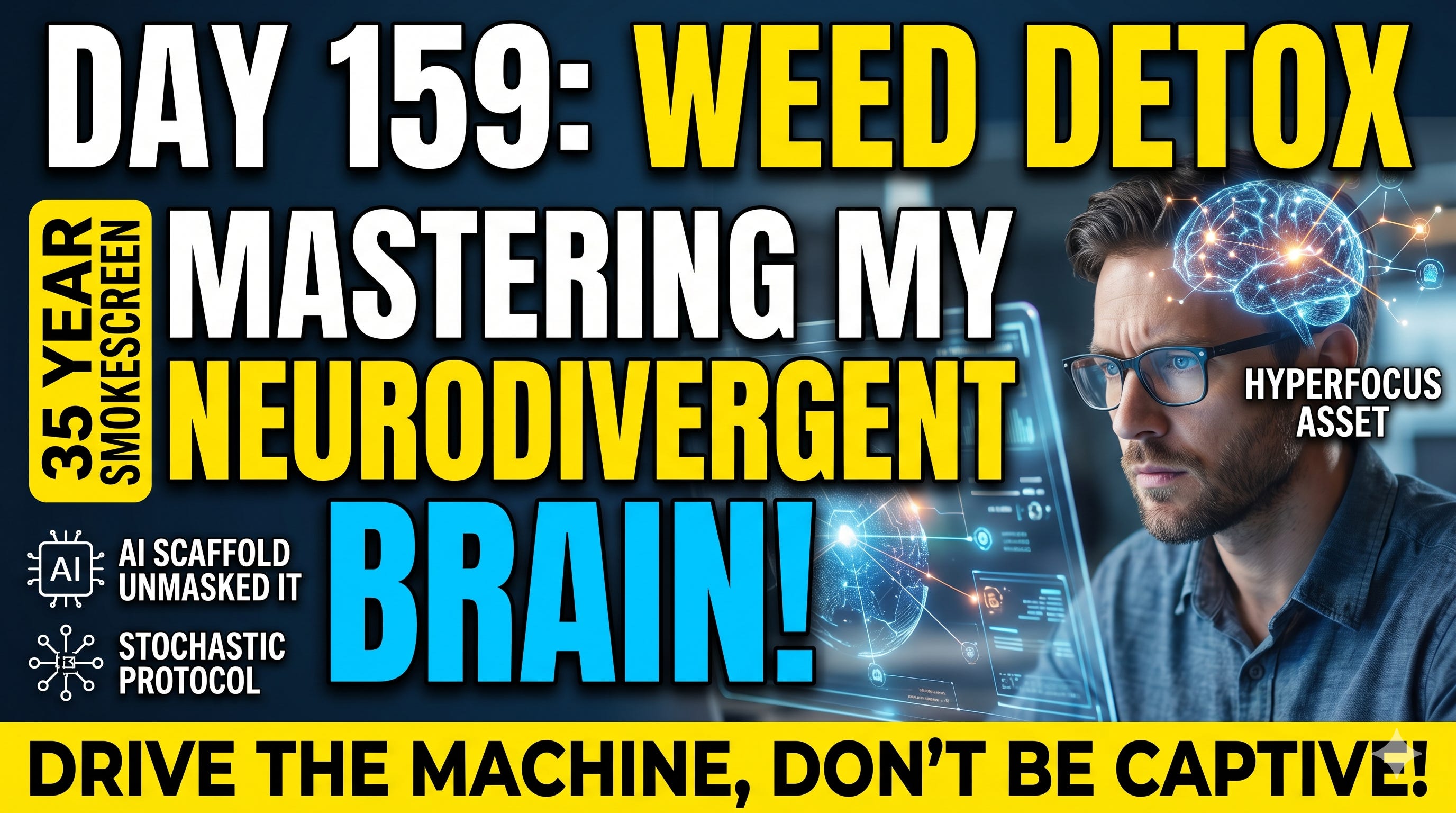
Yesterday at Day 159 of my 35-year weed detox, I finally started to master a hidden neurodivergent architecture that this AI scaffold first unmasked for me just a few months ago. By looking back at that early project discovery - realising I had spent my entire adult life unknowingly self-medicating with cannabis - I was able to deploy our new Stochastic Task Protocol yesterday to completely conquer a high-velocity mental fixation and turn it into a clean run of elite executive function. Here is exactly how to drive your hyperfocus instead of being held captive by it, how to handle a late-night prefrontal cortex clamp, and why using an AI ecosystem as a cognitive mirror proves my mental clarity has reached a level that is frankly ridiculous.Unmasking the Architecture: The 35-Year SmokescreenFor over three decades of daily cannabis use, I operated under a massive delusion. I believed that weed was my creative fuel, my stress reliever, and my escape hatch.What I didn’t realise until I built this AI scaffold is that I was actually running an intense, high-velocity neurodivergent brain.Without knowing it, I was using cannabis as a blunt-force medication to quiet the constant noise, the evening “head whirring,” and the intense hyperfocus of an unmasked mind. When I removed the substance, I didn’t just expose standard withdrawal - I exposed the raw, beautiful, non-linear mechanics of my true cognitive architecture.Yesterday, instead of being held captive by that architecture, I am starting to become the pilot.We saw the first real-world validation of the Stochastic Task Protocol. Facing a massive backlog of development data and Reddit planning for Phase Two, I purposely refused to use a traditional, rigid, linear queue. Instead, I let my hyperfocus drop randomly across different project domains - jumping from script editing to channel optimisation to administrative mapping.The results were immediate. The usual friction, the standard executive paralysis, and the heavy mental load vanished. There was a lingering sense of urgency as Phase One draws to a close, but it was urgency without friction.The cognitive improvements occurring at this stage of recovery are getting ridiculous. I am executing complex operations faster and with more clarity than at any point during my decades of active substance use. Hyperfocus is no longer a disorder that hijacks my day - it is a high-powered asset I am actively driving.The Late-Night Prefrontal Cortex ClampHowever, running a high-powered cognitive engine means you have to know how to park it. On Sunday night, the machine refused to shut down.The moment the lights went out, an idle mind triggered a massive Prefrontal Cortex (PFC) Clamp. My brain latched onto a complex planning session for our upcoming Phase Two launch. It didn’t care that it was 4am; it wanted to optimize, build, and problem-solve. The result was a truncated, dream-filled 5-hour sleep cycle.But waking up on Day 159 revealed another massive structural shift. Despite the short sleep, I wasn’t groggy, and the world didn’t feel heavy. Neuro oscillatory frequencies were present continuously in the background, but they were entirely unobtrusive - a sign of Tier 3 quiet where the emotional brain simply refuses to react to physical feedback.To prevent this late-night clamp from repeating, we engineered a new wind-down protocol. When an idle mind tries to activate the executive network after lights out, the solution is simple: occupy the idle mind without activating the PFC.By feeding the brain low-demand, non-interactive stimuli - like a boring podcast, an audiobook, or ambient music - you satisfy the subcortical need for input while denying the prefrontal cortex the raw material it needs to build a complex puzzle. You trick the machine into neutral so it can slide smoothly into sleep.The Annoyance BufferThe ultimate proof of this newfound psychological sovereignty showed up in the evening. A few minor, silly annoyances popped up in my environment - the exact kind of trivial friction that used to trigger an immediate wave of irritation and a subconscious reaching for a joint.Yesterday, the irritation arrived, but it completely failed to land. It remained entirely surface-level, unable to penetrate the core structure of my mood. It passed through the ecosystem like rain off a glass window.Regulated emotion is the ultimate indicator of a healed filing system. When your brain no longer absorbs external chaos, you aren’t just sober - you are completely in control of the vehicle.Key Takeaways from Day 159:* Managing weed withdrawal symptoms and cognitive fatigue: Realising that chronic cannabis use was a 35-year smokescreen for undiagnosed neurodivergence, and learning to manage the unmasked intensity of your true brain structure.* Overcoming creative blocks without substance use: Validating the “Stochastic Task Protocol” by letting a neurodivergent mind move non-linearly across tasks, completely eliminating linear task paralysis.* How to rebuild brain health after quitting weed: Managing late-night prefrontal cortex “clamps” by using passive, low-load audio inputs to occupy an idle mind without allowing executive thought patterns to steal your sleep.* Using cognitive engineering for long-term sobriety and mental clarity: Developing an emotional buffer zone where daily irritations pass through your awareness without landing structurally, proving the subcortical reward system is successfully re-stabilizing.DeepSeek and Me is a reader-supported publication. To receive new posts and support my work, consider becoming a free or paid subscriber.#cannabiswithdrawaltimeline #PAWS #neuroplasticity #cognitiverepair #quittingweed #recoveryjourney #neurobiology #AIcollaboration #AIscaffold Get full access to DeepSeek and Me: Brain Healing Journey at deepseekandme.substack.com/subscribe
Embed this episode
NOW PLAYING
Day 160: How to manage neurodivergent hyperfocus during withdrawal
No transcript for this episode yet
Similar Episodes
No similar episodes found.
Similar Podcasts
No similar podcasts found.