
EPISODE · Jul 28, 2026 · 13 MIN
How to stop being haunted by a "we" that no longer exists after a divorce
from Divorced me Podcast · host Missy Rönsch
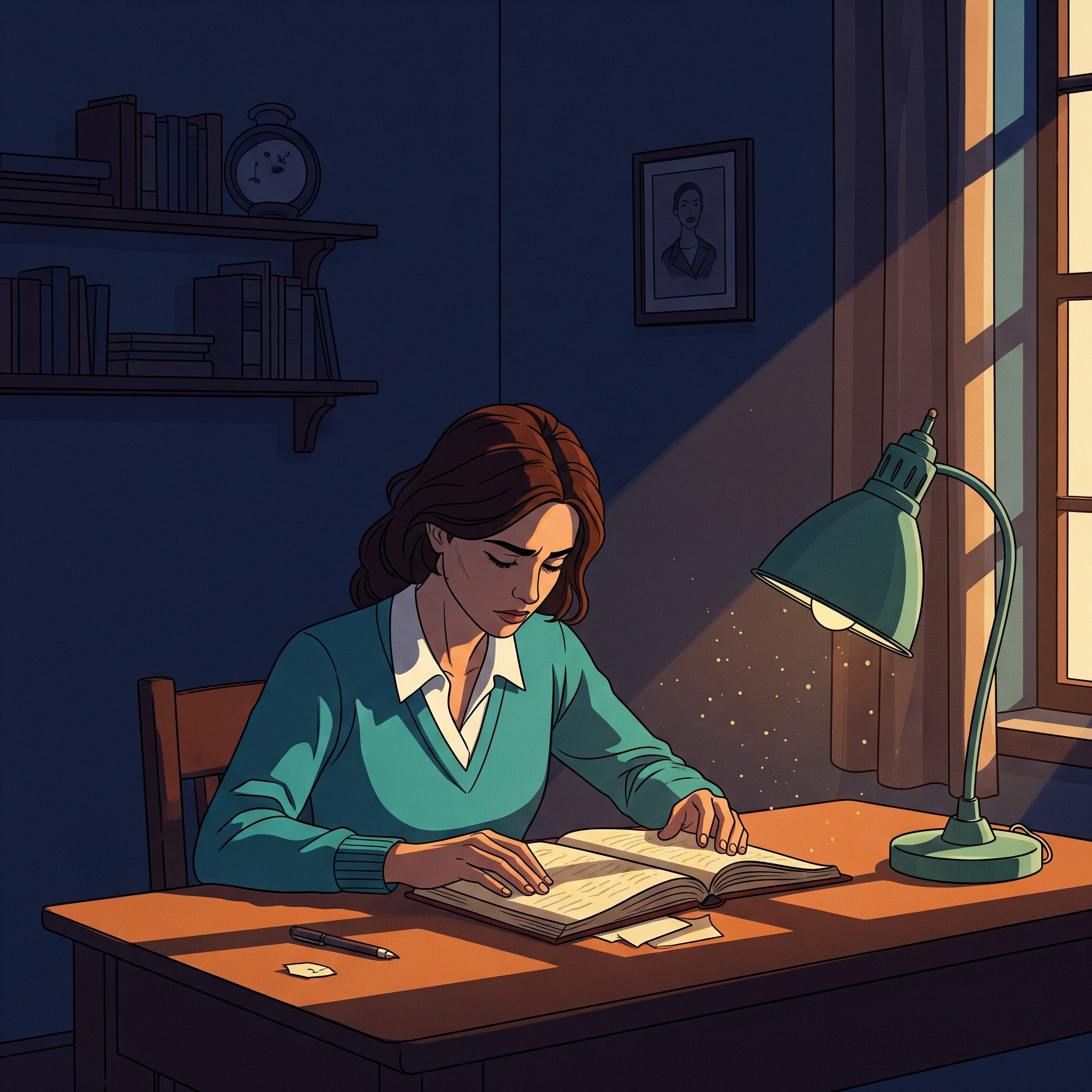
You are divorced. You know there is no couple anymore. And still you keep going back — a story to a friend comes out as “we,” the old years still feel like ours, and you cannot quite shut the door. That is the real difficulty, and it is not a flaw. Marriage had built you into half of a pair, and that half does not switch off the day the marriage ends. You do not let it go by deciding the “we” was never real. You let it go slowly, by noticing — which is what the rest of this is about.Illustration provided by Supportive StrangerIn a recent post, I wrote about rereading a diary entry from the end of my marriage and finding it full of a word I thought I had left behind: we. We agreed. Our trial period. The honeymoon we never had. The story I tell now is in the singular — I left him — and yet the old plural keeps coming back: in the things I say to friends, in the way I still catch myself thinking of those years as ours. I ended that post without resolving it, and a question a therapist once asked me has stayed with me since. I want to hand it to you, in case you, too, keep returning to a we you cannot quite set down:Is the strangeness there because the word feels untrue — or because it belonged to a version of you, and of someone you loved, that you have since had to stop believing in?It matters which. But before reaching for an answer, it helps to understand why the “we” has such a grip — because the grip is not a weakness in you.You were built into a “we”A long relationship does not sit beside your identity. It becomes part of it. Arthur and Elaine Aron called this the inclusion of the other in the self: in a close bond you fold the other person into your own self-concept, until “we” is not merely a word for two people but the shape of a single identity. When that bond ends, studies of separation find that the self left behind is not only sadder but smaller and less clear — you have lost not just a person, but a piece of the structure you used to know yourself by.This is why divorce is never only a legal event. The anthropologist Paul Bohannan argued, in 1971, that a divorce is really several divorces happening at once — legal, financial, co-parental — and that the one which outlasts all the paperwork is the “psychic divorce“: the slow task of redefining yourself as a single person, distinct from both the couple you were and the spouse you had.And that task takes time, because an identity does not switch off on command. The sociologist Helen Rose Ebaugh, who studied how people leave defining roles — including marriage — in her 1988 book Becoming an Ex, found that role exit is a staged process, and that the old role never simply disappears. It lingers as what she called the ex-role: you do not become a stranger to your former self so much as an ex-wife, a status that still carries the old one inside it. More recent studies of divorcing people describe the in-between years as a kind of “strained liminality,” a drawn-out limbo in which a clear new self is real but slow to arrive. So when you keep returning to the “we,” you are not failing to move on. You are living in the gap between two identities — which is exactly where this stretch of life takes place.The case you keep reopeningThere is a reason the “we” will not loosen its grip, and it is the one most likely to keep you stuck. When a marriage ends, the mind treats it as a case to be solved. You go back over it — what went wrong, when it turned, whose fault it was, why it ended in divorce, which version of the story is the true one and which is the one you have quietly edited since. You do this because somewhere you believe that once you finally understand it, you will be able to set it down.But understanding is not the same as letting go, and here they are almost opposites. You can arrive at a complete, airtight account of why your marriage ended and still feel married. Worse, the investigating is part of what keeps you there: each time you reopen the case to examine it, you have to step back inside the “we” to do so. The analysis does not dissolve the marriage. It keeps it on the table, lit and waiting — alive in your mind precisely because you will not stop questioning it.So if you have been trying to think your way free — and if you are reading this, you almost certainly have — the first thing to accept is that more understanding is not the way out. The way out is a different kind of attention altogether.You will not think your way outWhat does that different attention look like? It is, in almost every way, the opposite of the analysis you have been doing. The reasoning mind, turned loose on a question like this, only spins theories, and the theories breed more theories, and you end where you began, more tired. There is another way of knowing, and it does not work by argument.The philosopher and psychologist Eugene Gendlin spent years, beginning in the 1950s, studying why some people changed in therapy while others, no less insightful, did not. The ones who changed were not the sharpest analysts of their own lives. They were the ones who could drop beneath analysis to what he called the felt sense — a vague, whole-body awareness of a situation that holds its meaning before any words arrive. In his 1978 book Focusing, Gendlin argued that this bodily knowing carries information the intellect cannot reach by argument, and that you get to it only by attending gently and waiting for it to speak. The mind circling the same track is not the route to the answer. It is an obstacle on the way to it.Read it out loud, and notice the flavorSo here is something concrete. Find the old words — the diary entry, the message, the caption under a photograph, whatever still carries the we — and read them out loud. Hearing your own past voice does something that silent reading does not; it puts the former self in the room with you.Illustration provided by Supportive StrangerThen, as you reach the word, do not ask what it means. Notice where it lands in your body, and what flavor the strangeness has. Some words, reread, feel like a lie you are embarrassed to have told — a small flinch, a wish to take it back. Others feel like a photograph of someone you used to be: accurate, and painful precisely because that person is gone. Those are completely different sensations, and you will know which one it is before you can explain why. Do not reach for the explanation. The explanation is the trap. Register the flavor, and let that be enough for now.Recover the feeling, not the decisionThe second move is slower, and it runs against the instinct. You will want to recover the decision — the moment, the reason, the how-did-we-get-here. I have written before about why that search usually fails: overwhelming times do not lay down orderly memories. So stop reaching for the script. Reach instead for a feeling from that period.Somewhere in those last months there was an emotion moving through you — relief, tenderness, dread, a strange flat calm. The memory of events fades far faster than the emotional residue beneath them, which is why a person can lose the entire sequence of a season and still, years on, feel its temperature the moment it comes to mind. You probably cannot retrieve how you arrived at the ending. You may well be able to retrieve what it felt like to stand inside it. And that feeling will tell you more about why you wrote we than any reconstructed timeline ever could.Do not rush to resolve itOne warning, especially if you are the kind of person who likes to settle things. The purpose of the question is not to land on “it was untrue” or “it was real and I lost it” and file the matter away. The moment you settle it, you stop learning from it.There is a name for the pull you will feel to close the question quickly. Since the 1990s, psychologists led by Arie Kruglanski have studied the need for cognitive closure — the discomfort an open question produces, and the urge to seize the first firm answer and freeze there simply to be rid of the ambiguity. It is worth resisting here, because the honest account is usually double. I left him because I was frustrated may be your headline, and it need not be wrong. But the old words may be showing you that underneath the headline was something more mutual, more grieved, more shared than the headline admits. Letting both be true at once is harder than choosing one. It is also closer to what actually happened.What it doesn’t meanStopping believing in the we does not mean deciding it was a lie. That is the version of “stop believing” that does damage — the one that goes back and poisons the well, recasting years of real life as a mistake or a performance. To stop believing in a past self is not to disown it. It is to stop asking it to be present tense.Nor does it mean you must choose a side. You are not required to rule the marriage either a love you failed or a frustration you escaped. The “we” can be something that was genuinely true and is genuinely over — a self you really were half of, and are not anymore. Belief, here, is not really about truth. It is about tense. The whole of the work is to let the “we” move, gently, from is into was.And it does not mean the self you are left with is only a smaller one. The same research that maps how the self shrinks after a separation finds that, given time, it recovers parts the marriage had crowded out. The “I” does not merely survive the loss of the “we.” Slowly, it grows back to fill the room the “we” leaves behind.So, not a task for this week. Carry the question loosely. Reread the old words when it is quiet, and watch what surfaces. And to begin, sit with this one, without answering it for anybody: what is the first feeling that rises when you put yourself back in the room where it ended — before you reach for the story of why?I write these reflections while building Supportive Stranger, a small iOS app for journaling through difficult moments — where you write, a supportive stranger draws a quick visual (like the one above), and you decide whether to keep the entry or let it go.Thanks for reading Divorced me! Subscribe for free to receive new posts and support my work. This is a public episode. If you would like to discuss this with other subscribers or get access to bonus episodes, visit divorcedme.substack.com
Embed this episode
Ready to play
How to stop being haunted by a "we" that no longer exists after a divorce
No transcript for this episode yet
Similar Episodes
No similar episodes found.
Similar Podcasts
No similar podcasts found.