
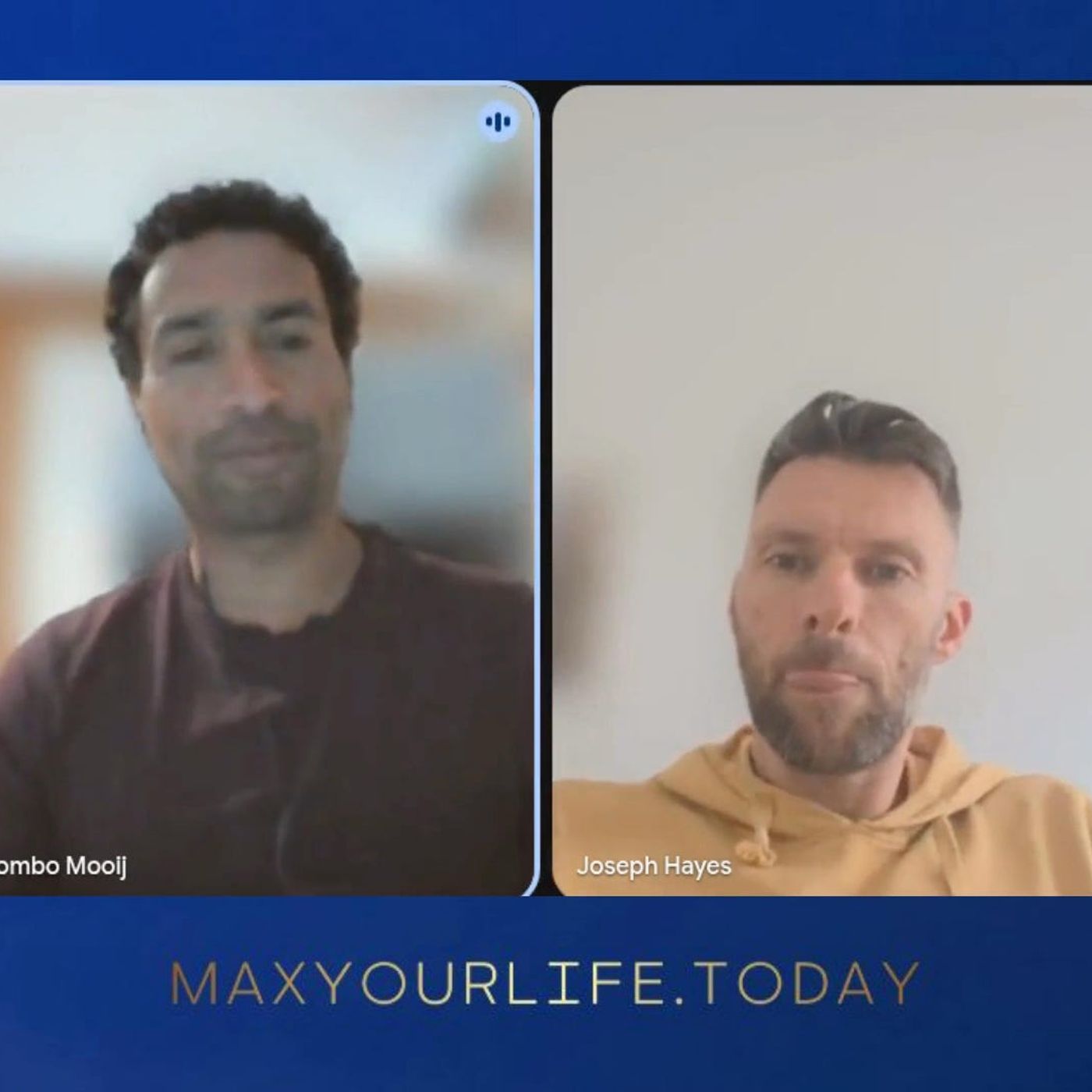
EPISODE · Jul 25, 2026 · 23 MIN
“I didn’t want to become a different person”
from Maxyourlife.today · host Shorombo Mooij
As he prepared to build another company, Joey Hayes realised that ambition alone would not be enough. The harder question was whether he could become more focused and disciplined without losing the social, energetic life that made him who he was.For a long time, Joey Hayes believed he should be able to figure it out himself.He had built a career, developed a strong network and was preparing to start another company. He is the kind of person people naturally gravitate towards: social, energetic and good at creating real relationships. One of his former managers at Booking.com used to tell him that he could be tougher in difficult negotiations than she could, simply because people liked him.But there was another side to that energy.“My mind was always moving,” Hayes says. “There were always a million things and a million ideas bouncing around.”At the end of the year, with a new entrepreneurial chapter ahead of him, he reached a point where the old approach no longer felt sustainable. “I wanted to take more control of myself, my habits, my actions,” he says. “I thought I could do it on my own. But then I realised I always think that way.”The question became unavoidable: was he going to make a genuine shift, or keep repeating the same pattern with more pressure attached to it?“I was about to start another company,” he says. “I didn’t want it to go like the last one did. I knew I had to change something to be successful, but I wasn’t really sure what.”The fear behind disciplineFor many ambitious people, the resistance to structure is not laziness. It is identity.Hayes did not simply worry about whether coaching would work. He worried about what it might turn him into. Would more structure mean becoming rigid, overly serious, less spontaneous? Would getting his life together cost him the parts of himself he actually enjoyed?“I had this weird fear that my personality would change,” he says. “Not necessarily that I would become a worse person. Just different.”It is a familiar tension among founders, high performers and people with highly active minds. They want more focus, better health and greater consistency. But they do not want to trade their freedom, creativity or social life for a perfectly optimised existence.“I didn’t think I could continue to enjoy my life and get my s**t together at the same time,” Hayes says. “I’m still figuring it out. But where I stand now, I realise I can have a really active social life, have a lot of fun and still be a high operator.”That realisation changed the premise entirely.The goal was not to become a different Joey. It was to create conditions in which the best parts of Joey—his energy, relationships and ambition—could work together rather than compete.Small changes, real consequencesThe changes themselves were not dramatic. No extreme morning regime. No life built around deprivation.Instead, Hayes started with practical shifts: planning the next day before going to sleep, identifying one real priority, writing down ideas instead of acting on them immediately and paying more attention to how his body and energy affected his decisions.“Planning the day before was something I never did,” he says. “I used to wake up and think, ‘Ah, what am I doing today?’ Just waking up and understanding what my day was going to look like made a difference.”He also had to reassess the belief that doing many things at once was a strength.“I thought it was a superpower to do a million things at once,” he says. “And I still do a lot. But now I’m able to prioritise what is important right now, instead of getting super distracted by things that don’t have value in the moment.”There were physical changes too. Hayes reduced his coffee intake from six to eight cups a day to two. He adjusted his exercise habits and began treating sleep, movement and recovery as useful information rather than inconvenient interruptions.“Now I sleep like a normal person,” he laughs.The point was not to follow a universal routine. It was to become more aware of what worked for him: when to push, when to walk, when to train and when to slow down.More than productivityIt would be easy to frame Hayes’s story as one of improved productivity. That would also miss the point.“The company has gone really well,” he says. “But my physical health has also gotten significantly better. I have much more space to think. I’m much better at prioritising things. I make more time for important relationships in my life.”He has also found a more workable rhythm between his full-time role and the startup he is building.Those outcomes are connected. Greater focus is not merely about getting more done; it reduces the background noise of an overloaded life. When every idea, task and opportunity demands immediate attention, even a productive person can live in a constant state of internal agitation.The work, Hayes says, helped make his life more intentional without making it smaller.“I expected it to be more regimented—super strict,” he says. “But it was really at my own pace, while still holding myself accountable and being held accountable.”That distinction matters. There is a difference between borrowing someone else’s discipline and building a way of operating you can actually sustain. The former may produce a short burst of change. The latter gradually becomes part of how you make decisions.Building without losing yourselfHayes’s story is not a before-and-after fantasy. He is explicit that he is still figuring things out. But his baseline has changed.The person who once assumed he had to carry everything alone now sees support as part of serious personal and professional development. The person who feared that discipline would erase his identity has discovered that the right structure can protect it.“I think it takes the support of a professional to really make that change,” he says. “Especially if you’ve already been having that conversation with yourself.”For people entering a bigger chapter—starting a company, changing careers, building a team or simply recognising that their current way of living cannot carry their ambitions indefinitely—that may be the more useful question.Not: How do I force myself to become more productive?But: What needs to change in the design of my life for my ambition, health, relationships and attention to stop fighting each other?Hayes has found his own answer in a life that is more structured but not narrower; more focused but not less alive.And perhaps that is the real promise of sustainable high performance: not becoming someone else, but becoming more capable of being yourself—consistently.Are you at this crossroad too?If you recognize this tension in your own life or business and would love to have a chat about how I can help you, you can schedule a free strategy call here. Just answer a few questions and see if you are eligible.Schedule your strategy call here. To hear more, visit maxyourlifetoday.substack.com
Embed this episode
What this episode covers
As he prepared to build another company, Joey Hayes realised that ambition alone would not be enough. The harder question was whether he could become more focused and disciplined without losing the social, energetic life that made him who he was.For a long time, Joey Hayes believed he should be able to figure it out himself.He had built a career, developed a strong network and was preparing to start another company. He is the kind of person people naturally gravitate towards: social, energetic and good at creating real relationships. One of his former managers at Booking.com used to tell him that he could be tougher in difficult negotiations than she could, simply because people liked him.But there was another side to that energy.“My mind was always moving,” Hayes says. “There were always a million things and a million ideas bouncing around.”At the end of the year, with a new entrepreneurial chapter ahead of him, he reached a point where the old approach no longer felt sustainable. “I wanted to take more control of myself, my habits, my actions,” he says. “I thought I could do it on my own. But then I realised I always think that way.”The question became unavoidable: was he going to make a genuine shift, or keep repeating the same pattern with more pressure attached to it?“I was about to start another company,” he says. “I didn’t want it to go like the last one did. I knew I had to change something to be successful, but I wasn’t really sure what.”The fear behind disciplineFor many ambitious people, the resistance to structure is not laziness. It is identity.Hayes did not simply worry about whether coaching would work. He worried about what it might turn him into. Would more structure mean becoming rigid, overly serious, less spontaneous? Would getting his life together cost him the parts of himself he actually enjoyed?“I had this weird fear that my personality would change,” he says. “Not necessarily that I would become a worse person. Just different.”It is a familiar tension among founders, high performers and people with highly active minds. They want more focus, better health and greater consistency. But they do not want to trade their freedom, creativity or social life for a perfectly optimised existence.“I didn’t think I could continue to enjoy my life and get my s**t together at the same time,” Hayes says. “I’m still figuring it out. But where I stand now, I realise I can have a really active social life, have a lot of fun and still be a high operator.”That realisation changed the premise entirely.The goal was not to become a different Joey. It was to create conditions in which the best parts of Joey—his energy, relationships and ambition—could work together rather than compete.Small changes, real consequencesThe changes themselves were not dramatic. No extreme morning regime. No life built around deprivation.Instead, Hayes started with practical shifts: planning the next day before going to sleep, identifying one real priority, writing down ideas instead of acting on them immediately and paying more attention to how his body and energy affected his decisions.“Planning the day before was something I never did,” he says. “I used to wake up and think, ‘Ah, what am I doing today?’ Just waking up and understanding what my day was going to look like made a difference.”He also had to reassess the belief that doing many things at once was a strength.“I thought it was a superpower to do a million things at once,” he says. “And I still do a lot. But now I’m able to prioritise what is important right now, instead of getting super distracted by things that don’t have value in the moment.”There were physical changes too. Hayes reduced his coffee intake from six to eight cups a day to two. He adjusted his exercise habits and began treating sleep, movement and recovery as useful information rather than inconvenient interruptions.“Now I sleep like a normal person,” he laughs.The point was not to follow a universal routine. It was...
Ready to play
“I didn’t want to become a different person”
No transcript for this episode yet
Similar Episodes
No similar episodes found.