
EPISODE · Aug 10, 2026 · 20 MIN
Iron Pillar Delhi: 1600 Years. Open Air. Zero Rust. The Mystery That IIT Kanpur Scientists Finally Solved
from Incredible India Travel | Social Impact & Culture Tours · host Madhusudan Narayanan | 5 Senses Tours
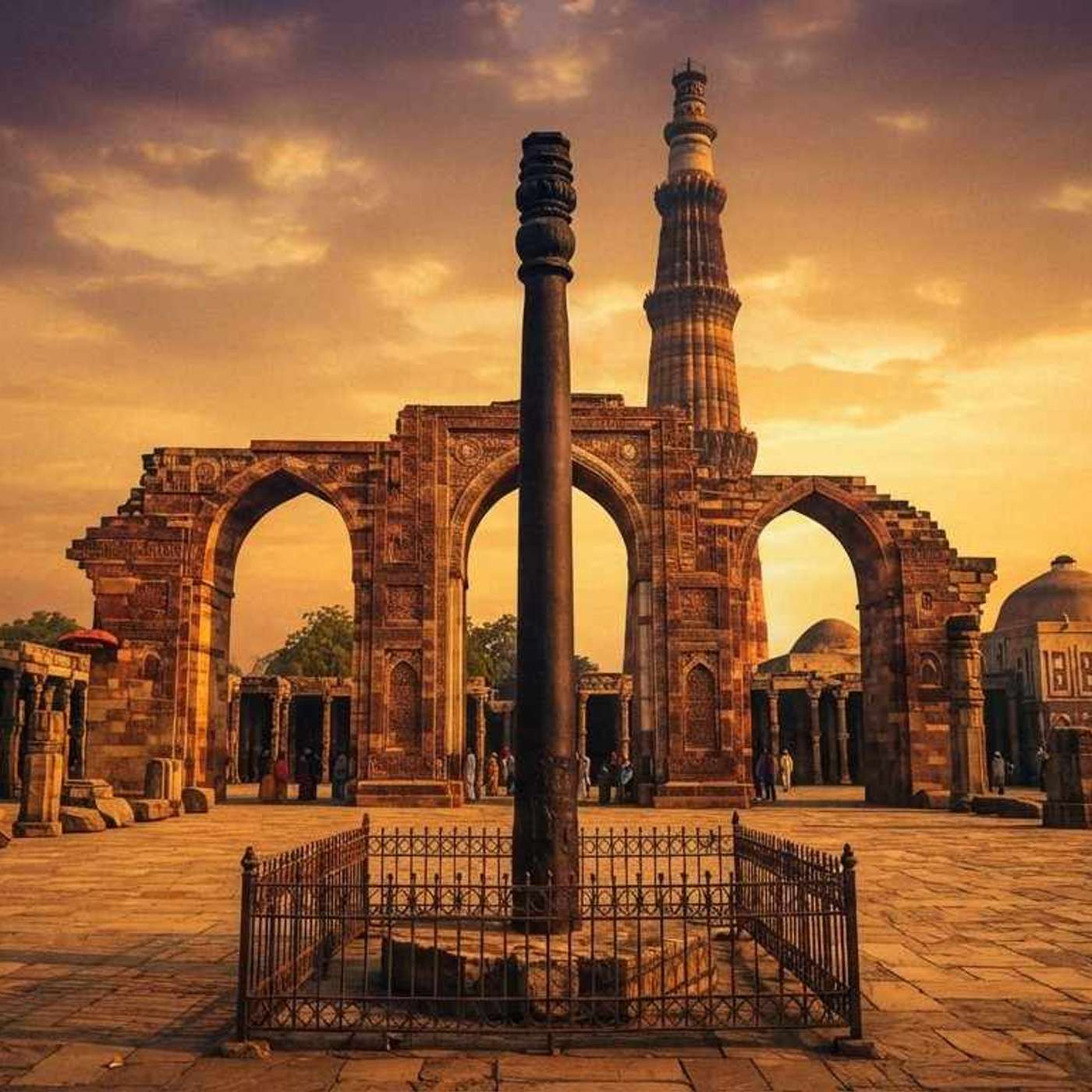
Leave a piece of iron in the open air. Within weeks it rusts. Within years the rust penetrates deep into the structure. Within decades the metal is compromised. This is so universal and so well understood that the entire modern steel industry is built around preventing it, through alloys, coatings, galvanisation and paint. And yet. In the courtyard of the Qutb Complex in Mehrauli, Delhi, a pillar of wrought iron 7.2 metres tall and weighing over six tonnes has been standing in the open air, exposed to Delhi's monsoon rains and summer heat and winter dew, for over sixteen hundred years. It has not rusted. Not virtually rust free in the sense that it is well preserved for its age. Virtually rust free in the sense that the surface of this pillar looks, to a casual observer, like iron that has been standing for a few decades rather than sixteen centuries. There is even evidence that it was hit at close range by a cannonball which merely put a dent in it. For most of those sixteen hundred years, the explanation was mysterious. Theories ranged from a lost alloy to divine protection to the specific spiritual energy of the site. Then in 2000, a metallurgist at the Indian Institute of Technology in Kanpur named R. Balasubramaniam published an analysis in the journal Corrosion Science that finally solved the mystery. The answer was not supernatural. It was not a lost technology. It was phosphorus. This episode tells the complete story of the Iron Pillar of Delhi, the king who commissioned it, the ironmakers who forged it, the accidental chemistry that has protected it for sixteen centuries and the scientists who finally understood why. What You Will Discover in This Episode The complete story of what rust actually is, why iron normally cannot resist it and why the Iron Pillar of Delhi's sixteen centuries of open-air survival is one of the most extraordinary anomalies in the history of materials science Who commissioned the Iron Pillar and the critical distinction between Chandragupta II Vikramaditya of the Gupta Empire, who actually commissioned it in the 5th century CE, and Chandragupta Maurya of the Mauryan Empire, the king associated with Chanakya, who lived seven centuries earlier and had no connection to the pillar What the Iron Pillar actually is as a manufacturing achievement, how it was made by forge welding hundreds of small iron blooms hammered together while hot, and why no other country had the capability to produce an iron mass of this size and purity until the Industrial Revolution of the 18th century The IIT Kanpur discovery of 2000, what metallurgist R. Balasubramaniam found when he analysed the thin passive film on the surface of the pillar, what misawite is and why a one-twentieth millimetre film of iron hydrogen phosphate hydrate has been blocking atmospheric corrosion for sixteen centuries Why the ancient Indian ironmakers had an unusually high phosphorus content of approximately one percent in their iron, compared to barely hundredths of a percent in modern steel, and why this was an accidental consequence of their use of bloomery furnaces without lime and fuel woods such as Cassia auriculata that were naturally high in phosphorus Why modern metallurgy deliberately removes phosphorus from iron despite the Iron Pillar's evidence of its protective properties, and why the very improvement that made modern iron stronger in one respect eliminated the accidental property that made ancient Indian iron so extraordinarily corrosion resistant The role of Delhi's specific climate as an unexpected partner in the pillar's preservation, how the cycle of intense monsoons followed by extreme dry heat strengthens the misawite layer, and why increasing air pollution in Delhi may be threatening the chemical equilibrium that has protected the pillar for sixteen centuries The Iron Pillar's extraordinary historical journey from its original installation as a Vishnudhvaja at Udayagiri in Madhya Pradesh in the 5th century CE, through its relocation to the Qutb Complex at Mehrauli centuries later, to its current position at the centre of a 12th-century Islamic mosque in a UNESCO World Heritage complex The connection between the Iron Pillar and the broader Gupta Golden Age that also produced Aryabhata's calculation of pi and correct model of earth's rotation, Brahmagupta's rules for arithmetic with zero and negative numbers, and Kalidasa's Sanskrit poetry How 5 Senses Tours brings the complete story of the Iron Pillar to life for international visitors as part of the Delhi heritage circuit and the wider ancient Indian science heritage trail Experience the Iron Pillar Delhi With 5 Senses Tours The pillar is still there. The same iron. The same one-twentieth millimetre film of misawite doing its invisible work in the open air of the city. You can stand three feet away from it in the courtyard of the Qutb Complex and understand, if you arrive with the complete story, exactly what is happening on its surface and why it has been happening for sixteen hundred years. Our Delhi tours cover the complete heritage of the Qutb Complex including the Iron Pillar, the Qutb Minar, the Quwwat-ul-Islam mosque and the extraordinary layered history of Mehrauli, alongside the Red Fort, Humayun's Tomb and the complete Delhi heritage circuit at https://5sensestours.com/home-delhi-tours/ For travellers who want the complete ancient Indian science heritage journey connecting the Iron Pillar to Kanada's atomic theory in Gujarat, Madhava's calculus in Kerala, the Bengali scientists of Presidency College Kolkata and the God Particle connection of Satyendra Nath Bose, our tours cover each of these destinations individually or as a complete customised circuit at https://5sensestours.com/ 5 Senses Tours is recognised by India's Ministry of Tourism, winner of the Tripadvisor Travellers Choice Award and the Outlook Responsible Tourism Award. Every tour is private, expert guided and completely customised for your group.
Embed this episode
Ready to play
Iron Pillar Delhi: 1600 Years. Open Air. Zero Rust. The Mystery That IIT Kanpur Scientists Finally Solved
No transcript for this episode yet
Similar Episodes
No similar episodes found.