
EPISODE · Apr 29, 2024 · 34 MIN
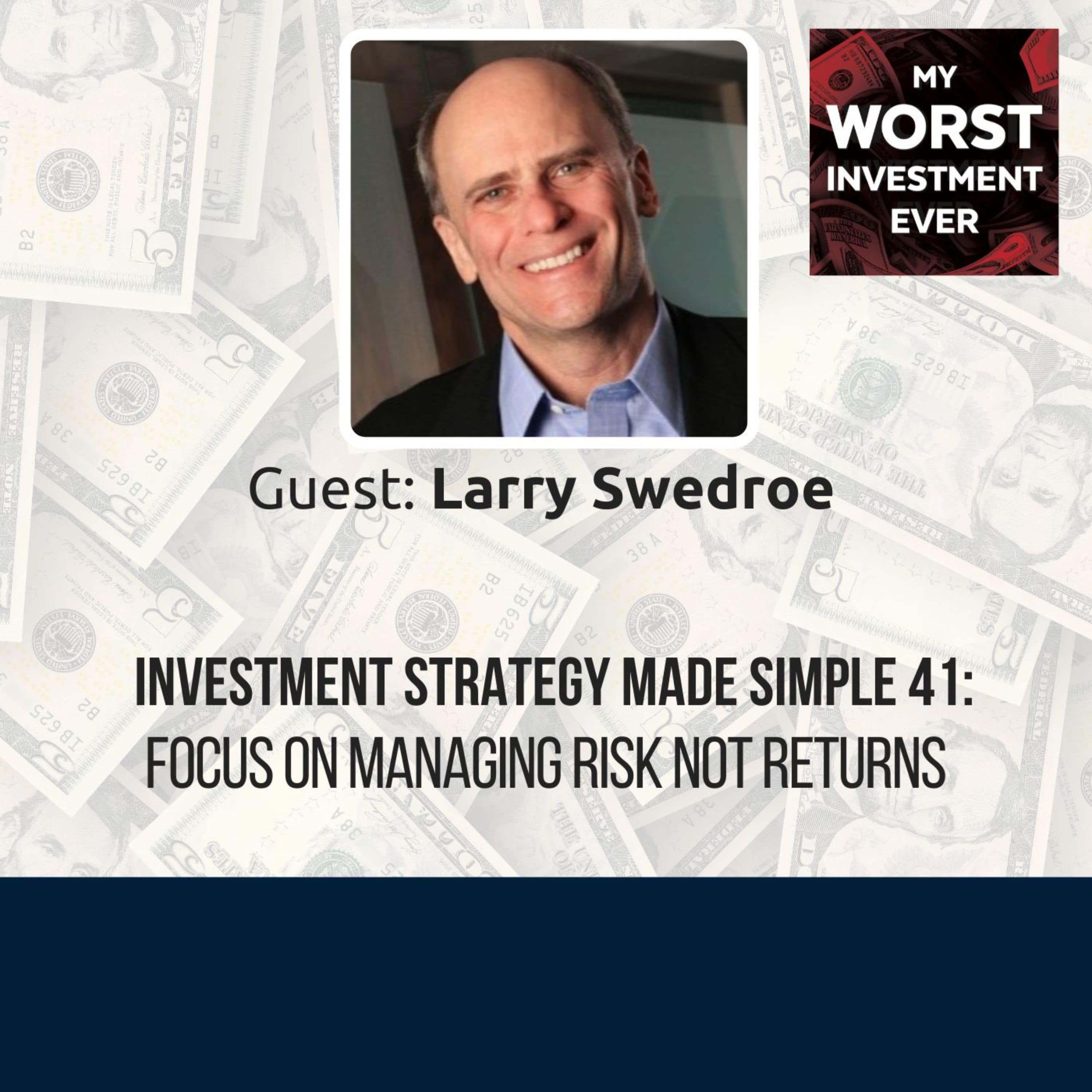
ISMS 41: Larry Swedroe – Focus on Managing Risk Not Returns
from My Worst Investment Ever Podcast
In this episode of Investment Strategy Made Simple (ISMS), Andrew gets into part two of his discussion with Larry Swedroe: Ignorance is Bliss. Today, they discuss three chapters of Larry’s book Investment Mistakes Even Smart Investors Make and How to Avoid Them. In this series, they discuss mistake number 32: Are You Subject to the Money Illusion? Mistake 33: Do You Believe Demographics Are Destiny? And mistake 34: Do You Follow a Prudent Process When Choosing a Financial Advisory Firm?LEARNING: Understand how the money illusion works to avoid making financial mistakes. Focus on managing risk and not trying to manage returns. Past performance is meaningless for active managers. “What amazes me is that I can’t think of anybody who has ever asked the advisor to show them how they invest personally. That’s an absolute necessity because if they’re not putting their money where their mouth is and eating their own cooking, why should you?”Larry Swedroe In this episode of Investment Strategy Made Simple (ISMS), Andrew gets into part two of his discussion with Larry Swedroe: Ignorance is Bliss. Larry is the head of financial and economic research at Buckingham Wealth Partners. You can learn more about Larry’s Worst Investment Ever story on Ep645: Beware of Idiosyncratic Risks.Larry deeply understands the world of academic research and investing, especially risk. Today, Andrew and Larry discuss three chapters of Larry’s book Investment Mistakes Even Smart Investors Make and How to Avoid Them. In this series, they discuss mistake number 32: Are You Subject to the Money Illusion? Mistake 33: Do You Believe Demographics Are Destiny? And mistake 34: Do You Follow a Prudent Process When Choosing a Financial Advisory Firm?Mistake number 32: Are You Subject to the Money Illusion?According to Larry, one of the illusions with great potential for creating investment mistakes is the money illusion. Money illusion occurs when people confuse inflation returns, nominal or real returns, and how the economy is impacted differently. It has great potential for creating mistakes because it relates to one of the most popular indicators used by investors to determine if the market is undervalued or overvalued, known as the Fed Model.The problem with the Fed Model, leading to a false conclusion, is that it fails to consider that inflation has a different impact on corporate earnings than it does on the return on fixed-income instruments. Over the long term, the nominal growth rate of corporate earnings has been in line with the economy’s nominal growth rate, and the real growth rate of corporate earnings has been in line with the economy’s real growth. Thus, the real growth rate of earnings is not impacted by inflation in the long term. On the other hand, the yield to maturity on a 10-year bond is a nominal return, and, therefore, the real return on the bond will be negatively impacted by inflation. The error of comparing a number that is not impacted by inflation to one that is leads to the “money illusion.”Larry says the empirical evidence and logic are pretty simple: Corporate earnings grow in line with the GDP. If they grew much faster, they would dominate the whole economy, and there’d be nothing left for wages.While gaining knowledge of how a magical illusion works has the negative effect of ruining the illusion, understanding the “magic” of financial illusions is beneficial to investors as it should help them avoid mistakes. In the case of the money illusion, understanding how the money illusion is created will prevent investors from believing that an environment of low (high) interest rates allows for either high (low) valuations or for high (low) future stock returns. Instead, if the current level of prices is high (a high P/E ratio), that should lead one to conclude that future returns to equities are likely to be lower than has historically been the case and vice versa. It is also important to note that this does not mean that investors should either avoid equities because they are “overvalued” or increase their allocations because they are “undervalued.” It simply means that if the P/E is higher than the historical average, investors should not expect future returns to be as great as their historical average.Mistake number 33: Do You Believe Demographics Are Destiny?Unlike economic forecasting, demographic forecasting can be considered a science. It’s for this reason that Larry cautions investors to avoid the mistake of confusing information with value-added information. He says before leaping to invest in individual stocks or mutual funds based on any guru’s insightful analysis, investors need to consider the following:Is this guru the only person who knows the demand for health care—for example—will rise as the population ages?Aren’t all investors aware of this? Doesn’t the market already incorporate this knowledge into current prices?If the market is aware of this information, it has already been incorporated into prices. Therefore, the knowledge cannot be exploited. In other words, if it’s just information—even if you think it’s going to have a positive or negative impact—ask yourself again, am I the only one who knows this?Larry adds that you should never confuse information with knowledge. Possession of an insight is not sufficient. You can only benefit if other traders do not have the insight yet. And if you have such information, it is highly likely to be inside information, which is illegal to trade.The vast majority of individuals and professional investors make investment decisions based on their forecasts, ignoring all the evidence that there are no good forecasters. Larry’s advice is to stop trying to forecast and, instead, think about what risks you’re most concerned about. So if you’re most concerned about, let’s say, inflation because you live on a fixed income, then you need to build a portfolio that’s more resilient to inflation risks. So don’t own long-term bonds in your portfolio; keep short-term bonds, have a bit of commodities, and maybe even a bit of gold. This way, you don’t confuse before-the-fact strategy with after-the-fact outcomes because you’ve designed a portfolio to protect you against the risks you are concerned about, not what somebody else is. People must focus on managing risk and not trying to manage returns.Mistake number 34: Do You Follow a Prudent Process When Choosing a Financial Advisory Firm?Larry observes that one big problem for investors when choosing advisors is that they typically look at somebody’s track record in investing and project that into the future, ignoring all of the evidence that past performance is (for active managers) meaningless.Larry recommends you require potential financial advisory firms to make the following 11 commitments to you. Doing so will allow you to avoid conflicts of interest and achieve your financial goals.Our guiding principle is that our advice will always be in your best interest.We provide you with care following a fiduciary standard — the highest legal duty that one party can have to another.We are a fee-only investment advisor — avoiding the conflicts that commissioned-based compensation can create.We fully disclose potential conflicts.Our advice is based on the latest academic research, not on our opinions.We are client-centric—we don’t sell any products; we only advise.We provide a high level of personal attention — each client works with a team of professionals and will develop strong personal relationships with team members.We invest our personal assets, including our profit-sharing plan, based on the same investment principles and in the same or comparable securities that we recommend to our clients.We will develop an investment plan that is integrated into estate, tax, and risk management (insurance) plans. The overall plan will be tailored to your unique situation.Our advice is always goal-oriented—evaluating each decision not in isolation but in terms of its impact on the likelihood of success of the overall plan.Our comprehensive wealth management services are provided by individuals who have the CFP, PFS, or other comparable designations.If you can’t get all 11 of those points, Larry insists you simply walk out the door.Did you miss out on previous mistakes? Check them out:ISMS 8: Larry Swedroe – Are You Overconfident in Your Skills?ISMS 17: Larry Swedroe – Do You Project Recent Trends Indefinitely Into the Future?ISMS 20: Larry Swedroe – Do You Extrapolate From Small Samples and Trust Your Intuition?<a href="https://myworstinvestmentever.com/isms-23-larry-swedroe-do-you-allow-yourself-to-be-influenced-by-your-ego-and-herd-mentality/" rel="noopener
Embed this episode
Ready to play
ISMS 41: Larry Swedroe – Focus on Managing Risk Not Returns
No transcript for this episode yet
Similar Episodes
No similar episodes found.