
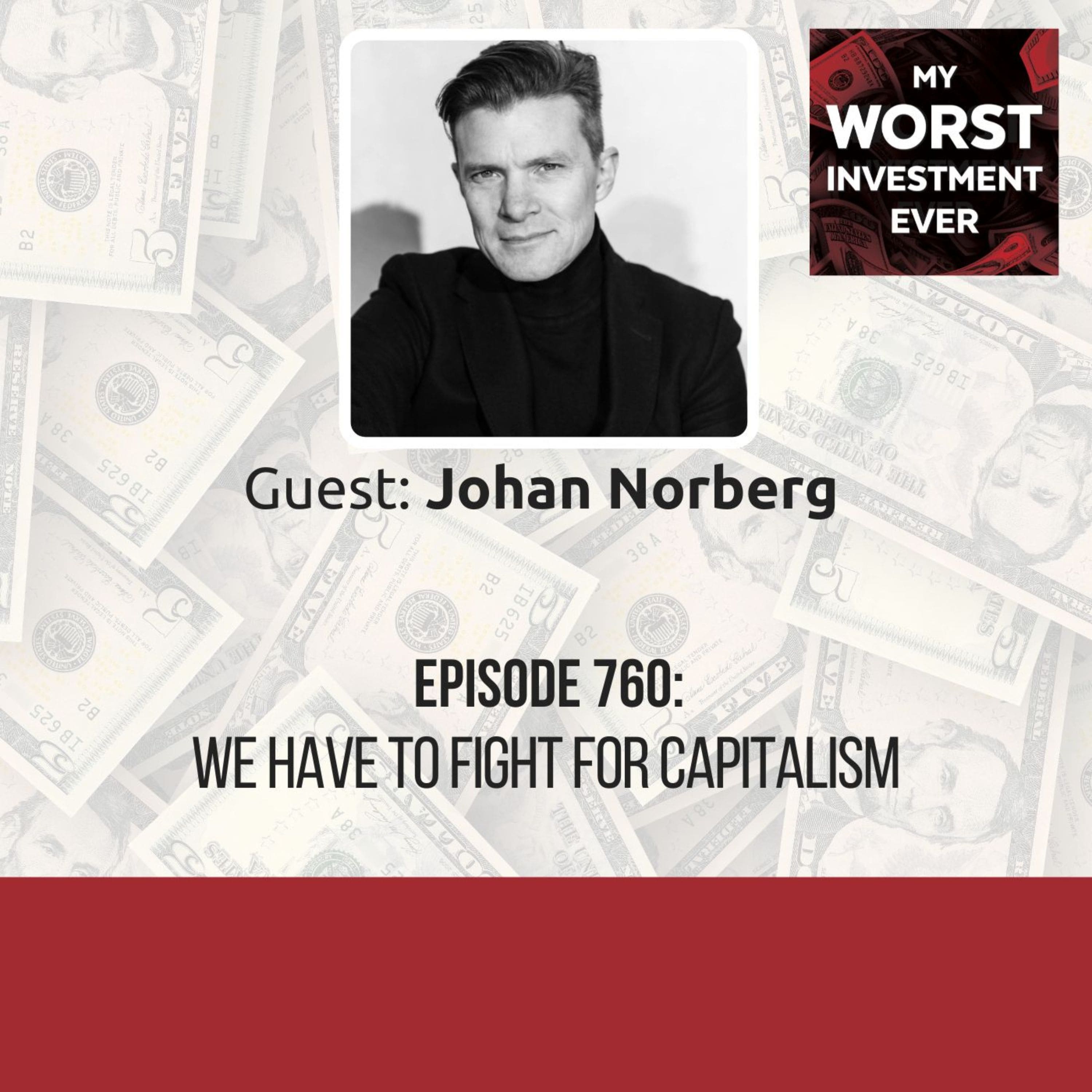
EPISODE · Dec 25, 2023 · 48 MIN
Johan Norberg - We Have to Fight for Capitalism
from My Worst Investment Ever Podcast
BIO: Johan Norberg is an author, lecturer, and historian of ideas from Stockholm, Sweden. His books on economics, politics, and history have been translated into more than 30 languages.STORY: Johan talks about capitalism and why it’s important.LEARNING: We should never lose sight of the benefits of capitalism. Capitalism is about peace, trust, and voluntary exchange, not war. “No matter what your long-term objective is, it’s better to be wealthy using resources in an effective manner and being more productive.”Johan Norberg Guest profileJohan Norberg is an author, lecturer, and historian of ideas from Stockholm, Sweden. His books on economics, politics, and history have been translated into more than 30 languages.In today’s episode, Johan discusses capitalism and its importance. Johan recently published his latest book, The Capitalist Manifesto. Like the title, the book is brilliant! Elon Musk said: “This book is an excellent explanation of why capitalism is not just successful, but morally right, especially chapter 4.” Have we lost sight of the benefits of capitalism?Without free markets and free trade, we’d probably be nowhere because it was only with the advent of higher productivity, open global markets, and free enterprise. Remember that when you give people more freedom to seek out opportunities to innovate, develop new business models, and exchange their best with the best of others, you have the machinery to reduce poverty and hunger worldwide.We must never forget this process because once people reach a certain threshold, they take wealth, opportunities, and technologies for granted and forget where they came from. This happens to many countries worldwide, electing the populace who use wealth without realizing that it’s not a pile of cash that happens to lie around.If we were to stop producing and innovating and start consuming and redistributing the wealth already on the planet, all of it would be gone in around four years. So wealth has to be created every day by hard work.Can government and capitalism co-exist?For your business to make a profit, you must make all the other groups happy. You have to satisfy your customers by giving them something they value more than the money they hand you. You must also pay your workers, suppliers, and those who lent you money. Then, and only then, if you made all these groups happy, and there’s something left for you, which will be heavily taxed, can you make a profit. The bigger your profit, the more good you’ve done to society.However, some profit is made not by competing over having the best goods and services but by having good connections with politicians and governments. They get subsidies and tariff protection from governments picking taxpayers’ pockets and handing them to businesses. That’s the opposite of a free market and capitalism—cronyism. It’s a horrible thing that can only end by stopping politicians from entering the game of business, picking winners, and deciding who gets what.Unfortunately, the future has no lobbyists, business organizations, or trade unions to defend them, only the incumbents and the old alternatives who constantly tailor all the regulations and policies to their needs and demands. Johan says the natural history of business regulation is always that you have, at first, a combination of people who want to do good. They see problems and want to improve upon things, so they want to regulate and ensure that it’s in the interest of society.But these well-meaning do-gooders often ally with people genuinely interested in their business models and the trade unions. So, in combination, they come forth with new regulations, constantly tailor-made to support incumbents in what they are doing. Then, the do-gooders move on to the next field to the next sector because they’ve succeeded. But those with a particular economic interest in those regulations stay behind because this is their sector. They constantly adapt it more to their own situation and to keep the competitors out. And that’s incredibly dangerous.Johan’s take is that businesses have one objective: to make the world a better place by being successful. By doing so, businesses ensure that our resources, machinery, and labor are being used as efficiently as possible. He doesn’t believe that successful businesses have to give something back to society as some apology for being successful in making a profit because the fact that they made a profit proves that they’ve done something for the community.Capitalism is about peace, trust, and voluntary exchangeJohan says that capitalism is for peace. The only people who benefit from war are politicians and companies that make weapons of war. Capitalism is the first economic system where you only get rich by enriching others, where everybody’s free to walk away from any deal.Capitalism is the first instance where if you want the resources of others, then you’d better give them something that they value even more. That’s a peaceful exchange, by definition.Johan adds that the first rule of good business is not to kill your customers and suppliers. People want to trade peacefully, and they have their best ideas, suppliers, and markets in other places. Only the dictators and the rulers wish to wage war.Johan insists that the natural way to make society a better place, in the long run, is to ensure that our resources are used decently and not wasted or used as people’s pet projects. So, no matter what your long-term objective is, it’s better to be wealthy by effectively using resources and being more productive.Parting words “I think capitalism deserves a manifesto and some praise because it’s tough work. It’s difficult to create wealth and opportunities for people. So, if you actually create value for other people, know that you’re a hero. That’s what I’m trying to do.”Johan Norberg [spp-transcript] Connect with Johan NorbergLinkedinTwitterInstagramFacebookWebsiteBookAndrew’s booksHow to Start Building Your Wealth Investing in the Stock MarketMy Worst Investment Ever9 Valuation Mistakes and How to Avoid ThemTransform Your Business with Dr.Deming’s 14 PointsAndrew’s online programsValuation Master ClassThe Become a Better Investor CommunityHow to Start Building Your Wealth Investing in the Stock MarketFinance Made Ridiculously SimpleFVMR Investing: Quantamental Investing Across the WorldBecome a Great Presenter and Increase Your InfluenceTransform Your Business with Dr. Deming’s 14 PointsAchieve Your GoalsConnect with Andrew Stotz:astotz.comLinkedIn<a href="https://www.facebook.com/andrewstotzpage" rel="noopener noreferrer"...
Embed this episode
Ready to play
Johan Norberg - We Have to Fight for Capitalism
No transcript for this episode yet
Similar Episodes
No similar episodes found.