Jumping Worms: An Update, Again
from Beyond the Garden Basics Hosted by Fred Hoffman
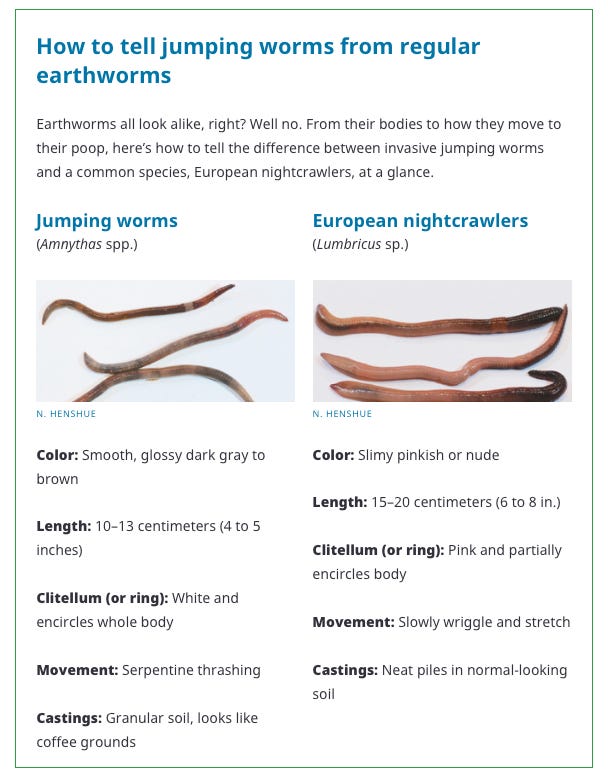
Jumping worms, and the publicity about them, are spreading. Debbie Flower (America’s Favorite Retired College Horticulture Professor) and I talked about this in August of 2021 in Episode 126 of the Garden Basics with Farmer Fred podcast. We provided an update on Episode 217 in August of 2022 (listen to that chat in today’s newsletter podcast). Jumping worms have been in the United States for more than a half century. And they’re moving around the country, with our unknowing help. As Debbie pointed out in the podcast (above), one of the biggest threats is their poop. Because they tend to reside near the surface and move horizontally through the mulch layer, their poop is more highly mineralized and not incorporated deeper into the soil. Plus, that poop tends to be hydrophobic: it repels water. As a result, the soil fungi and bacteria that would be incorporating typical castings into forms of nutrients for plant availability isn’t happening. The biggest threat is to emerging native plants that would use the nutrients and moisture normally in the soil to germinate, either as understory plants in the forest, or freestanding wildflowers in pastures or prairies. Verified, effective controls at this point, are still being studied. From Cornell University, come this: “Research is currently being conducted on invasive worms at the University of Wisconsin and several practices do show some promise of control. Abrasive materials such as biochar (ground up charcoal) and diatomaceous earth (fossilized diatoms) may show some promise in killing adult jumping worms. Incorporate one of these products into the infested soil to a depth where the worms are located; worms that come in contact with the materials will be adversely affected.” Again, that is ongoing research. Debbie and I, in the newsletter podcast, suggest other possible control measures, including using mustard to bring them to the surface, identify them as jumping worms, and discard them (the recipe is in the podcast). Oh, you don’t want to listen? OK, here’s the transcript, which can also be found in Episode 217 of the Garden Basics podcast: Sarah in Sacramento Hi, Fred and Debbie. This is Sarah from Sacramento. My question is about jumping worms. I've heard they're very destructive. And unfortunately, I recently found three in my yard. So I'd like to know a little more about them. My question has three parts. First, how much of a concern are these worms for the home gardener? And second, is there anything I could or should be doing about the jumping worms? Should I kill the worms when I find them, or just leave them be? And third, I keep reading that their castings deplete the soil? I'm wondering if that's actually true. And if so, why are these worms so different from other types of worms which are generally good for the soil? I have heard the jumping worms eat organic matter really quickly. So could I offset this by simply adding a lot more mulch? Any other advice for me? Thank you so much. Farmer Fred Jumping worms. Yes, indeed. We've tackled this topic before here on the garden basics podcast, but the jumping worms are jumping all over the place. Debbie Flower is here, America's favorite retired college horticultural professor, and golly now we have them in our own backyard, Debbie. Debbie Flower Yeah, that's unfortunate. Right. Farmer Fred And one of the primary ways they spread is through fishing bait. If you go to a bait shop, you may see see worms intended for fishing, and they go by a variety of names, like jumping worm or Asian jumping worm or crazy worms or Alabama jumpers, or snake worms. Don't buy them. And if you do buy them and you have bait left over at the end of your little trip, get rid of them, put them in the trash. Yes, jumping worms, as the caller said, they kind of destroy organic matter because they have a rather big mouthpiece. Debbie Flower And super, super, super fast. And that's the problem. Regular earthworms that we're used to and maybe keep in our house to consume our kitchen waste also consume organic matter, but they do it much more slowly. And when the jumping worms consume all the organic matter on the surface of the soil, especially in forests or places around lakes or natural areas, then the there is no organic matter on the surface of the soil that allows other plants, typically their native plants, in those situations, to establish and grow. And so it's causing fast destruction of the mulch layer and is causing destruction of the native plants. Farmer Fred And they live very shallowly. Unlike earthworms that tend to go vertically, the jumping worms tend to live horizontally. Debbie Flower yes, just below the mulch layer and on top of the soil, that's one way to identify them. If you find a worm there, along with their, their poop, their feces, their black and crumbled, it looks like coffee almost, then that's probably a jumping worm. They're also recognizable because they do jump. And they have a white collar that goes all the way around one end, close to one end of the worm itself, much like a Nightcrawler, which is also used as bait. It has a collar. But in the Nightcrawler, it's kind of a pinkish color. And in the jumping worm, it's a white color, and it is smooth, it doesn't have any ridges in it. Farmer Fred It's interesting how it's spread rather quickly, it was first reported back in around 1950, 1960, in the United States, it started off in the east, jumped over to the central states. And that's where it has changed the soil composition there in areas where it is living, its soil composition changes so that the soil is more water resistant, actually, Debbie Flower Yeah, the soil becomes more mineral, because they're not bringing the organic matter into the soil like an earthworm would do. They leave it on the surface. And they've already broken it all the way down, the mineral component of soil becomes greater, but an ideal soil will have 45% mineral and then about 5% organic. That 5% doesn't sound like much, but it makes a huge difference in the quality of the soil. Farmer Fred The soil gets so crumbly, that it does improve water percolation, but way too much. Debbie Flower Yeah, that's the problem there. Farmer Fred And it's basically not helping your plants out, because it's destroying that matter before the microbes in the soil have a chance to work it. Debbie Flower Right, it's not bringing it down into the soil. The healthy soil has a poop loop. And the bigger things that we can see, like worms, first eat the organic matter, they get what they can from it, they poop out there. And then the next level of organisms eats their poop and does the same thing. They do their pooping and the next level of smaller organisms eats their poop, et cetera, et cetera, et cetera. And each one releases something different into the soil that is beneficial for the plants. And we don't get that poop loop with when we have the jumping worms. Farmer Fred Oregon State University has a lot of good information online on the jumping worms. I'll have a link to that in today's show notes. And they advise that the jumping worms and their cocoons can be transported via soil, compost or other organic materials. So you want to check all that stuff when you're transporting material from one property to another, or bringing home a new purchase. And check all soil and organic material, especially if you're buying it from a sand and gravel yard, to make sure that it doesn't have any in there. Debbie Flower right. And if you're getting soil from a community garden, or organic mulching going on where you live. And let's say you're using your blower or rake to collect your leaves and you put them at the curb or you put them in your Greenwaste can. However you do that, because you can collect the egg cases with it. And then it goes to the organic waste station or maybe it gets used as mulch somewhere else. And so it ca… This is a public episode. If you'd like to discuss this with other subscribers or get access to bonus episodes, visit gardenbasics.substack.com/subscribe
Embed this episode
No transcript yet.