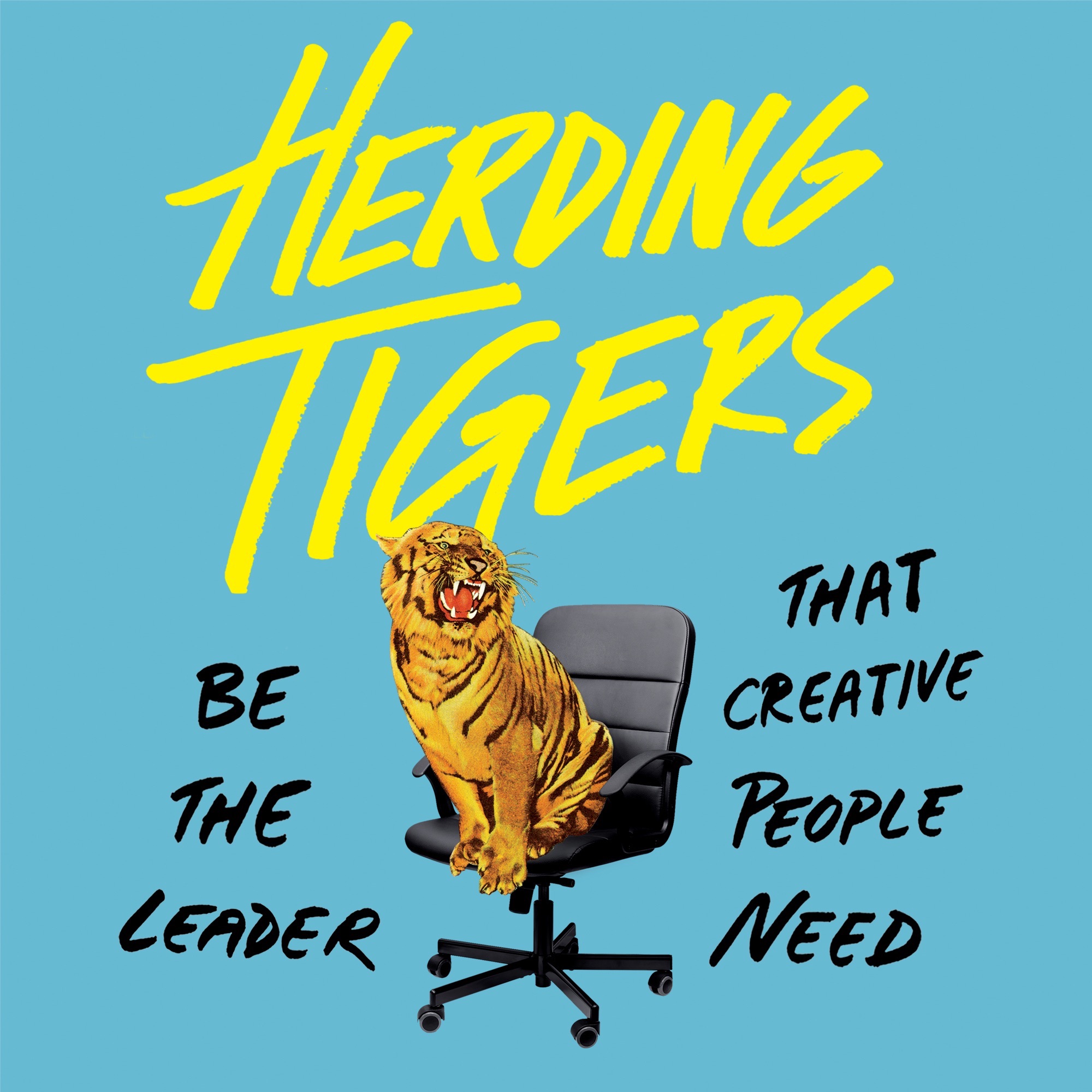
Everyone look to their podcast. This is the podcast about how to create a people who are, specifically how to be the leader that creative people, my name is Todd Henry, I'm the author of the book, Hurting Tigers. And on the show, we talk about some practical, tactical things we can do as leaders of creative people to understand better what it is that they need from us and to make sure that we're positioning ourselves to bring more of what they need every day as leaders. Listen, a lot of times we aren't aware of how our actions affect the people around us.
And we're not aware of how our decisions trickle down within the organization, how they affect the work as a whole. And when we are a leader, when we put the position of responsibility and we're leading the work, we're not responsible for doing the work, we're responsible for leading the work, which means we own the culture, we own the talent on the team, meaning the development of the people on the team. And we also own, very specifically, we own the work, but the work with the capital W. We own the work as a whole.
We own the environment in which the work happens. And so primarily on this show, we're gonna focus on those three things. We're gonna focus on the culture, how do we develop a culture in which creative people can thrive? What do they need from us?
How do we create more of a culture in which they feel like, I love working here, I feel pushed, I feel challenged, I feel like I have the stability and I need to be able to take risks? How do we develop talent? So how do we understand what makes people unique and how do we push them to be more of who they are, to bring more of what they do uniquely to the table every day as creative pros? And then finally, the work as a whole, the capital W work, how do we create an environment in which the work gets done and it gets done well, it gets done with excellence?
And as we do these three things, as we focus on culture, talent and work, it becomes almost like a dream loop, right? It becomes a self-perpetuating cycle where, a great culture attracts great talent and great talent produces great work and great work provides the resources we need to invest in the culture. And it becomes this self-perpetuating cycle over time. And if we get them wrong, if we have a culture in which creative people cannot thrive, then we're gonna begin to lose talent.
And the work is gonna suffer. And as the work suffers, the culture is gonna suffer. And it becomes this Jim Collins called a doom loop, right? Things get worse and worse and worse.
We don't know why. We don't understand why. Well, it's because we're not focusing on those three primary responsibilities. We have the leader, the culture, the talent and the work.
So today on the show, we're gonna focus primarily on the talent piece of this. What is it that we need to do as a coach? How can we step up, and there's an entire chapter and hurting tigers on this? How can we step up from peer to coach as a leader?
You know, as a peer, we wanna be liked. As a peer, we wanna be friends with people on our team. But the problem is we can't do that a friend encourages other people and tells them, hey, you're great, I love you, you're wonderful. Here's what's good about you.
Go do that thing. If somebody comes to us and says, hey, I'm thinking about taking this risk. What do you think? Yeah, go do that.
Sure, absolutely. A friend encourages, but a coach challenges people to get better. And in order to be able to coach people effectively, we have to understand how they're wired. We have to understand what makes them unique.
And so today I wanna talk about the three categories that came up in the conversation I had for hurting tigers with a guy named David Weiser. David is a hiring consultant. He has a company that helps place chief marketing officers within organizations. But primarily he is obsessed with what makes people tick and how to put people in positions where they're likely to thrive.
So I wanna share with you some insights from hurting tigers today specifically about how we can better understand the people on our team and understand what they're wired for and then how we can position them to succeed. And maybe even as importantly, we can begin to identify some things that we're good at and things we're not good at in places where perhaps we are creating havoc within our organization because we are not positioned to be able to bring the best of who we are to what we do because we're trying to do things we're not naturally wired for. So I wanna read an excerpt from hurting tigers right now. This is a in the chapter called leading brilliance which is primarily about coaching your team.
But I wanna read an excerpt that's called help them understand what drives them. This is about understanding what drives your team positioning them to be able to bring their best work. So thus begins the excerpt. Creative people often have broad shoulders and diverse capabilities.
There are a lot of things that people on your team could do. The question is should they? If you put someone in a position where every day of work feels like drudgery, he might succeed for a while but his motivation will wane over time. He will struggle with burnout and dissatisfaction.
As we saw in chapter two, which you didn't, but you will read the book, people grow bored if they do not feel appropriately challenged. Being in a role that pushes people to grow can make the difference between passable work and exceptional work. As a coach, it's your job to help the talented creative people discover the work they are made for and that lights their fire. This doesn't mean that they will love every task they do.
No one does, but it does mean that they are generally doing work that gives them a sense of engagement and gratification. Executive recruiter David Weiser told me just because they have the experience and skills to do the work doesn't mean they are right for a particular job. They will get bored very quickly if they are not in the right place and that will create problems for everyone. Weiser categorizes most jobs into one of three categories.
Jobs for builders, jobs for fixers, and jobs for optimizers. So I want to talk about these three categories. Jobs for builders, jobs for fixers, and jobs for optimizers. Because if you don't understand how the people on your team are naturally wired, they might end up in the job where they're bored, they're frustrated, they're creating havoc for everyone around them.
You don't know why, they don't know why. And the reason is they're not doing tasks that they're naturally wired for. So who are builders? Builders are people who live for the process of creating something new.
These are people who love wide open spaces. These are the innovators. These are the people who don't want to work on existing systems. They want to be thrown into a wide open space and be told, hey, go figure it out.
Go build something. These are the entrepreneurial types. These are the people who want a new challenge and they need wide open spaces. If they feel like you're putting them in a role where they're primarily maintaining, they're gonna get bored, they're gonna get frustrated.
They're gonna start blowing things up just for the sake of inventing something new. This is what builders do. And so if you have a builder on your team that's tasked with maintaining the relationship with the client or who's primarily tasked with doing production work, that isn't very exciting. It's not very innovative.
They're gonna get bored very quickly. Now maybe that's the job. That's fine. But you have to figure out some ways a leader of giving them tasks that allow them to exercise that builder nature that's inside of them.
It could be a skunk works type project, something on the side that you give them. You can give them something that helps them, explore, challenge themselves, push themselves, try something new. But you have to identify the builders on your team because if you don't identify them, they will begin to, they're the ones who in a meeting will say, why are we doing this? Right, okay, I know we're way down the path.
Why are we doing this? Let's try something completely different. And sometimes you think, well this person's just a troublemaker. This person's never satisfied.
Well, it could just be that they're trying to find expression for their builder tendencies that is not finding form in their current work. Okay, so who are the builders on your team? The second category is the fixer. Fixers are people who get charged up by analysis and diagnosis.
They can quickly look at what's going on and they can identify the problem and they can fix it. They're great at fixing problems. So if you have a fixer on your team, you want to assign them to big problems that nobody else can seem to diagnose or solve. They're great at that, right?
So if there's a broken system, if there's there's a broken client relationship, these are the people that you want to assign to these projects because they're great at fixing things. The problem with fixers is they look for problems where no problems exist. And so if fixers don't have a problem to solve at any given time, they will look for problems to solve, even if there really isn't a problem. They will look for a problem to solve.
So you have to identify the fixers. These are the people who by the way are constantly looking for the problems. They're constantly bringing up issues. They're constantly approaching you with, hey, this is a thing over here.
You need to pay attention to this thing. No, it's okay, it's fine. No, no, no, this is a problem. This needs to be solved right now.
Here, let me go work on this. These are the people who are constantly raising problems for you, organization, not that they're being a problem, but they're raising problems because they're fixers. They're wired to look for problems. If you put a fixer against a job for a builder, then they're gonna get frustrated because a wide open space is not helpful to them.
They need to find a problem to solve. They need some inputs, right? They need some open loops to close. If you assign a fixer to a brand new project and new parameters, they'll become paralyzed.
They're great at problem solving, but they don't do well with few parameters. So you have to ensure that your fixers are in an environment where they're gonna thrive. And then the third category that we're gonna thrive is optimizers. Optimizers are excited about taking something that's good and making it great.
They're great at tweaking systems at, you know, sort of getting the most efficiency out of something. That's what they're really, really good at. They're great at that. But the problem is if you put an optimizer in a builder role, again, they're gonna become paralyzed because they're not wired to invent something new.
They're wired to take something that exists and make it as efficient as it can possibly be. So as you think about your team right now, who are your builders? Who are the people that come alive in group brainstorms or the beginning of a client initiative? They're the people who will stay late into the night when you're having those early conversations, but they get really bored once you've decided on what you're gonna do and it's really hard to keep them engaged.
Who are those people? And how can you put them against initiatives that will allow them to exercise their builder tendencies? Can you put them against maybe some back burner projects that need new kinds of ideas, new thoughts, new initiatives, new new kinds of exploratory work that nobody's doing right now? Can you give them a couple of sort of side projects to keep them engaged if the work itself isn't engaging for them?
Or, you know, if you find that they tend to come alive early in the project, well, maybe you need to reshape their work portfolio so that they're primarily working against some of these early stage initiatives, okay? Who are your fixers? Are there problems, are there problems in your organization that haven't yet been tackled? And how can you identify those problems?
How can you assign people, your fixers to those problems so that you can ensure that they have something, some open loop to close at all times. That's what fixers do well. And then who are your optimizers? Who are the people that are constantly tweaking systems, right?
Who are the people who are constantly looking for ways to make things more efficient? Is there something you can put them against? Or is there a way you can rebalance their portfolio so that you're ensuring that they have some optimization focused tasks in their portfolio of work? Now listen, again, none of us, none of us get to do things we only want to do all that.
We all have to do tasks we don't want to do. We are creating underman professionals, emphasis on the professionals. We have to do tasks we don't want to do. But if the biggest part, the biggest chunk of your work portfolio is outside of your area of core competence, or your area of core interest.
If you're a builder and you're primarily optimizing things all day, you're going to get frustrated. You're going to get bored. And you need to have that conversation with your manager. Or for you as a leader, think about the kinds of ways that you were deployed on behalf of your organization.
And if you find that I'm a builder, I'm primarily about building new things, creating new systems, tackling new projects. But you essentially find yourself solving problems all day. This is over the course of time. This is going to be great on you.
It's going to become really difficult for you to stay engaged. So how can you negotiate a rebalancing of your work portfolio so that you're primarily doing tasks that you're wired to do? Now, again, we don't all get to do work that we love to do all the time. But as a leader, you need to make sure that you are bringing your best to your team, which means that you're operating within your area of core competence and your primary motivational archetype.
But also for your team, as you look at the balance of work on your team, how can you shift things around to ensure that your builders are engaged early in a project, on those entrepreneurial type initiatives? How can you ensure that your fixers are being given problems to solve open loops and assign them open loops to solve at certain parts of the project? Project, and how can you ensure that they're not being put against these wide open space type initiatives where they're going to get paralyzed? And same for your optimizers.
Can you find systems in your organization to help them squeeze efficiency, help them do what it is they do best again? I go into a lot more of this, including some questions you can ask to help you identify in all of this in herding tigers in the chapter called League Brilliant. But for now, these are just a couple of categories, a couple of things you can think about as a leader to ensure that you're positioning your team to bring their best every day. All right, hey, we love you, your thoughts, your feedback, your comments about this, interactive, accidental, creative.com is my email address, we'd love to hear from you there.
You can learn more about herding tigers at herdingtiggers.com We'll see you next time.