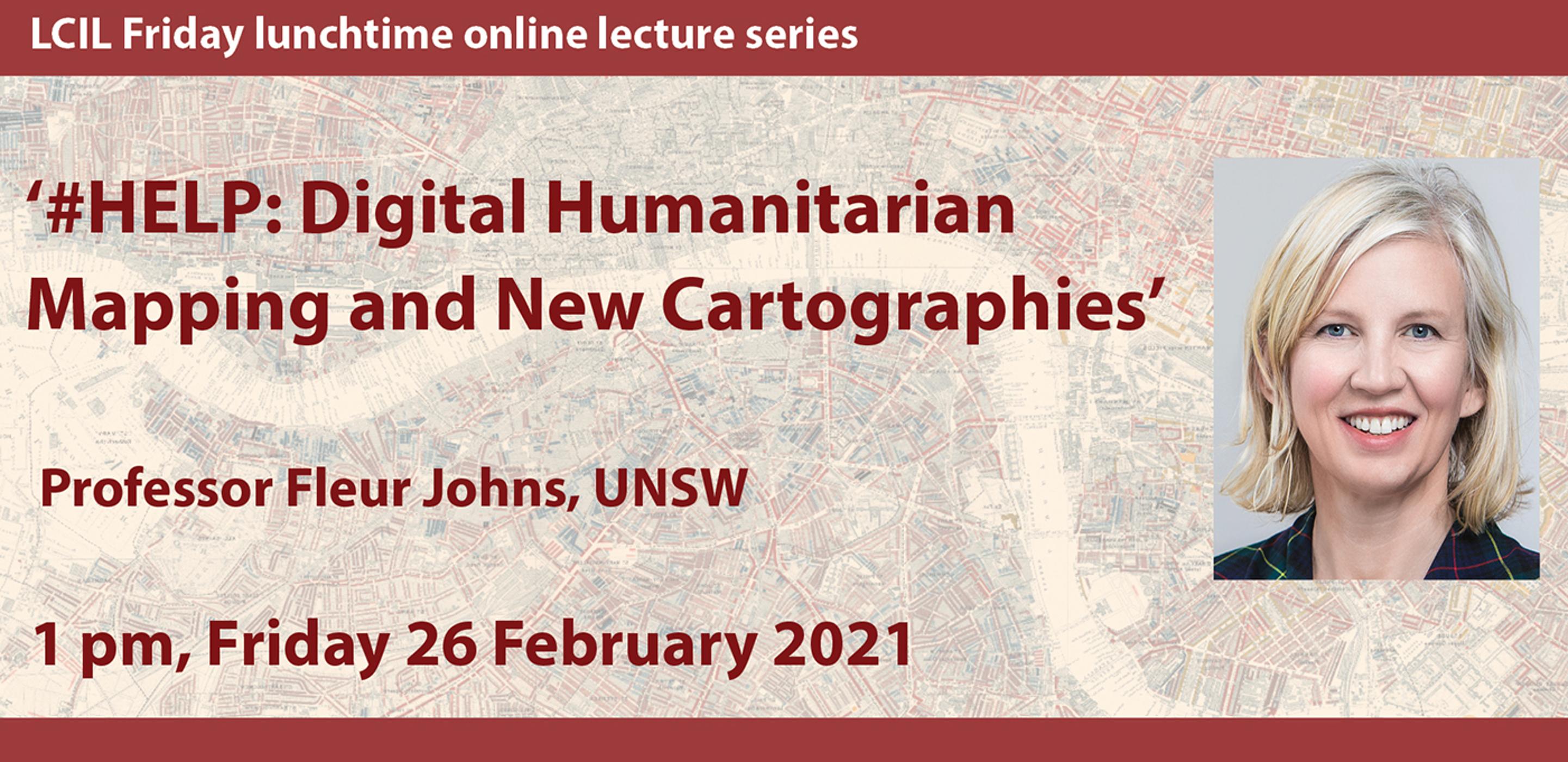
LCIL Friday Lecture: ‘#HELP: Digital Humanitarian Mapping and New Cartographies of Governability’ - Prof Fleur Johns, UNSW episode artwork

EPISODE · Mar 1, 2021 · 42 MIN

LCIL Friday Lecture: ‘#HELP: Digital Humanitarian Mapping and New Cartographies of Governability’ - Prof Fleur Johns, UNSW

from LCIL International Law Centre Podcast

Lecture summary: Like many other areas of work, international humanitarian practice and thinking are being transformed by digital technology and associated socio-technical practices. Institutional developments within the United Nations (UN) are telling. Just over ten years ago, the UN Secretary General announced the launch of the UN Global Pulse project, dedicating to enabling, showcasing and promoting the “scaled adoption of big data innovation for sustainable development and humanitarian action”. This project has since been advanced through Pulse Labs in Jakarta, Kampala and New York and one soon to be set up in Samoa. Other, cognate initiatives have been launched throughout the UN system. Prominent, international public-private collaborations aim to harness digital technology for humanitarian ends: initiatives such as the Global Partnership for Sustainable Development Data. And more or less every major technology company across the world is investing in the humanitarian field: Facebook’s Data for Good initiative; Google.org’s Crisis Response work; and Alibaba’s collaboration with the World Food Program to develop Hunger Map LIVE are indicative examples. International humanitarianism is taking on new imperatives, protagonists, investments, techniques and objects of inquiry in connection with the expanding reach of the digital. Given the centrality of humanitarianism to the way that the international plane has been imagined, regulated, materialized and militarized throughout the 20th and 21st centuries, these shifts are worthy of close attention.This talk will present one chapter of a book project investigating this domain of ‘digital humanitarianism’ – a chapter concerned with maps and mapping. It focuses on recent shifts from two-dimensional mapping for humanitarian ends towards multi-dimensional, real-time mapping for the same purposes, associated with geographic information systems (GIS) and the generation and deployment of map cubes (multi-dimensional arrays of data values presenting cartographic visualization of each dimension). It offers a brief recollection of humanitarian mapping through “snapshots” from the practice in the 18th, 19th, and 20th centuries (Valentine Seaman’s yellow fever maps; Charles Booth’s poverty maps; Bangladesh flood mapping; and the FAO’s Food Insecurity and Vulnerability Information and Mapping Systems). Against this background, we will consider the rise of crowd-sourcing as a digitally facilitated way of making cartographic knowledge for humanitarian governance purposes, as illustrated by the Missing Maps Project (a joint project of the Humanitarian OpenStreetMap Team – a U.S.-registered non-profit – and three other not-for-profit organizations: American Red Cross; British Red Cross; and Médecins Sans Frontières). We will explore how this affects how particular spaces are assembled, delimited, surveyed and readied for humanitarian intervention and with what implications for international legal relations and the jurisdiction of different actors on this terrain.Fleur Johns is Professor in the Faculty of Law, working in the areas of public international law, legal theory, law and development, law and society (or socio-legal studies), and law and technology. Fleur studies emergent patterns of governance on the global plane, and their social, political and economic implications, employing an interdisciplinary approach that draws on the social sciences and humanities and combines the study of public and private law. In 2021, Fleur will commence a four-year Australian Research Council Future Fellowship working on a project entitled 'Diplomatic Knowledge, Disasters and the Future of International Legal Order'. In 2021-2022, Fleur will be a Visiting Professor at the University of Gothenburg in Sweden. Fleur is a Fellow of the Academy of the Social Sciences in Australia.

Lecture summary: Like many other areas of work, international humanitarian practice and thinking are being transformed by digital technology and associated socio-technical practices. Institutional developments within the United Nations (UN) are telling. Just over ten years ago, the UN Secretary General announced the launch of the UN Global Pulse project, dedicating to enabling, showcasing and promoting the “scaled adoption of big data innovation for sustainable development and humanitarian action”. This project has since been advanced through Pulse Labs in Jakarta, Kampala and New York and one soon to be set up in Samoa. Other, cognate initiatives have been launched throughout the UN system. Prominent, international public-private collaborations aim to harness digital technology for humanitarian ends: initiatives such as the Global Partnership for Sustainable Development Data. And more or less every major technology company across the world is investing in the humanitarian field: Facebook’s Data for Good initiative; Google.org’s Crisis Response work; and Alibaba’s collaboration with the World Food Program to develop Hunger Map LIVE are indicative examples. International humanitarianism is taking on new imperatives, protagonists, investments, techniques and objects of inquiry in connection with the expanding reach of the digital. Given the centrality of humanitarianism to the way that the international plane has been imagined, regulated, materialized and militarized throughout the 20th and 21st centuries, these shifts are worthy of close attention. This talk will present one chapter of a book project investigating this domain of ‘digital humanitarianism’ – a chapter concerned with maps and mapping. It focuses on recent shifts from two-dimensional mapping for humanitarian ends towards multi-dimensional, real-time mapping for the same purposes, associated with geographic information systems (GIS) and the generation and deployment of map cubes (multi-dimensional arrays of data values presenting cartographic visualization of each dimension). It offers a brief recollection of humanitarian mapping through “snapshots” from the practice in the 18th, 19th, and 20th centuries (Valentine Seaman’s yellow fever maps; Charles Booth’s poverty maps; Bangladesh flood mapping; and the FAO’s Food Insecurity and Vulnerability Information and Mapping Systems). Against this background, we will consider the rise of crowd-sourcing as a digitally facilitated way of making cartographic knowledge for humanitarian governance purposes, as illustrated by the Missing Maps Project (a joint project of the Humanitarian OpenStreetMap Team – a U.S.-registered non-profit – and three other not-for-profit organizations: American Red Cross; British Red Cross; and Médecins Sans Frontières). We will explore how this affects how particular spaces are assembled, delimited, surveyed and readied for humanitarian intervention and with what implications for international legal relations and the jurisdiction of different actors on this terrain. Fleur Johns is Professor in the Faculty of Law, working in the areas of public international law, legal theory, law and development, law and society (or socio-legal studies), and law and technology. Fleur studies emergent patterns of governance on the global plane, and their social, political and economic implications, employing an interdisciplinary approach that draws on the social sciences and humanities and combines the study of public and private law. In 2021, Fleur will commence a four-year Australian Research Council Future Fellowship working on a project entitled 'Diplomatic Knowledge, Disasters and the Future of International Legal Order'. In 2021-2022, Fleur will be a Visiting Professor at the University of Gothenburg in Sweden. Fleur is a Fellow of the Academy of the Social Sciences in Australia.

NOW PLAYING

LCIL Friday Lecture: ‘#HELP: Digital Humanitarian Mapping and New Cartographies of Governability’ - Prof Fleur Johns, UNSW

0:00 42:30

No transcript for this episode yet

We transcribe on demand. Request one and we'll notify you when it's ready — usually under 10 minutes.

That Hoarder: Overcome Compulsive Hoarding That Hoarder Hoarding disorder is stigmatised and people who hoard feel vast amounts of shame. This podcast began life as an audio diary, an anonymous outlet for somebody with this weird condition. That Hoarder speaks about her experiences living with compulsive hoarding, she interviews therapists, academics, researchers, children of hoarders, professional organisers and influencers, and she shares insight and tips for others with the problem. Listened to by people who hoard as well as those who love them and those who work with them, Overcome Compulsive Hoarding with That Hoarder aims to shatter the stigma, share the truth and speak openly and honestly to improve lives. The Small Business Startup School – Business Notes | Financial Literacy | Retail Psychology – For Professionals & Entrepreneurs The Small Business Startup School Inc. Starting or buying a small business? While personal circumstances may vary, business patterns remain timeless. On The Small Business Startup School, we explore strategies, insights, and practical solutions to help entrepreneurs confidently navigate their journey.Hosted by Ola Williams—a retail entrepreneur, fintech founder, and financial coach with over two decades of experience—this podcast marries financial awareness and retail psychology with optimism to deliver actionable takeaways.Join us to learn, grow, and connect as we uncover the keys to business success.Let’s continue to learn together and be encouraged to keep on connecting! DIOSA. Carolina Sanper This podcast is a sacred space created by Carolina Sanper where you connect with your inner wisdom and embody your magnetic feminine power.It is the realization that the mystical realm is where you plant the seeds of your desired reality.It is a portal to your true essence: awareness, presence, and receiving with ease. Welcome home, DIOSA. 🖤 XXX Tech by SOVRYN Dr. Brian Sovryn The crossroads between technology, sensuality, and metaphysics - and the longest running anarchist podcast in the world! Brought to you by Dr. Brian Sovryn.

Frequently Asked Questions

How long is this episode of LCIL International Law Centre Podcast?

This episode is 42 minutes long.

When was this LCIL International Law Centre Podcast episode published?

This episode was published on March 1, 2021.

What is this episode about?

Lecture summary: Like many other areas of work, international humanitarian practice and thinking are being transformed by digital technology and associated socio-technical practices. Institutional developments within the United Nations (UN) are...

Can I download this LCIL International Law Centre Podcast episode?

Yes, you can download this episode by clicking the download button on the episode player, or subscribe to the podcast in your preferred podcast app for automatic downloads.
URL copied to clipboard!