
EPISODE · Jun 12, 2026 · 20 MIN
Long‑term clinical course and outcome in patients with primary Sjögren syndrome‑associated interstitial lung disease
from Medical Journal Club with Dr. Takuji Shirasawa · host Takuji Shirasawa, MD
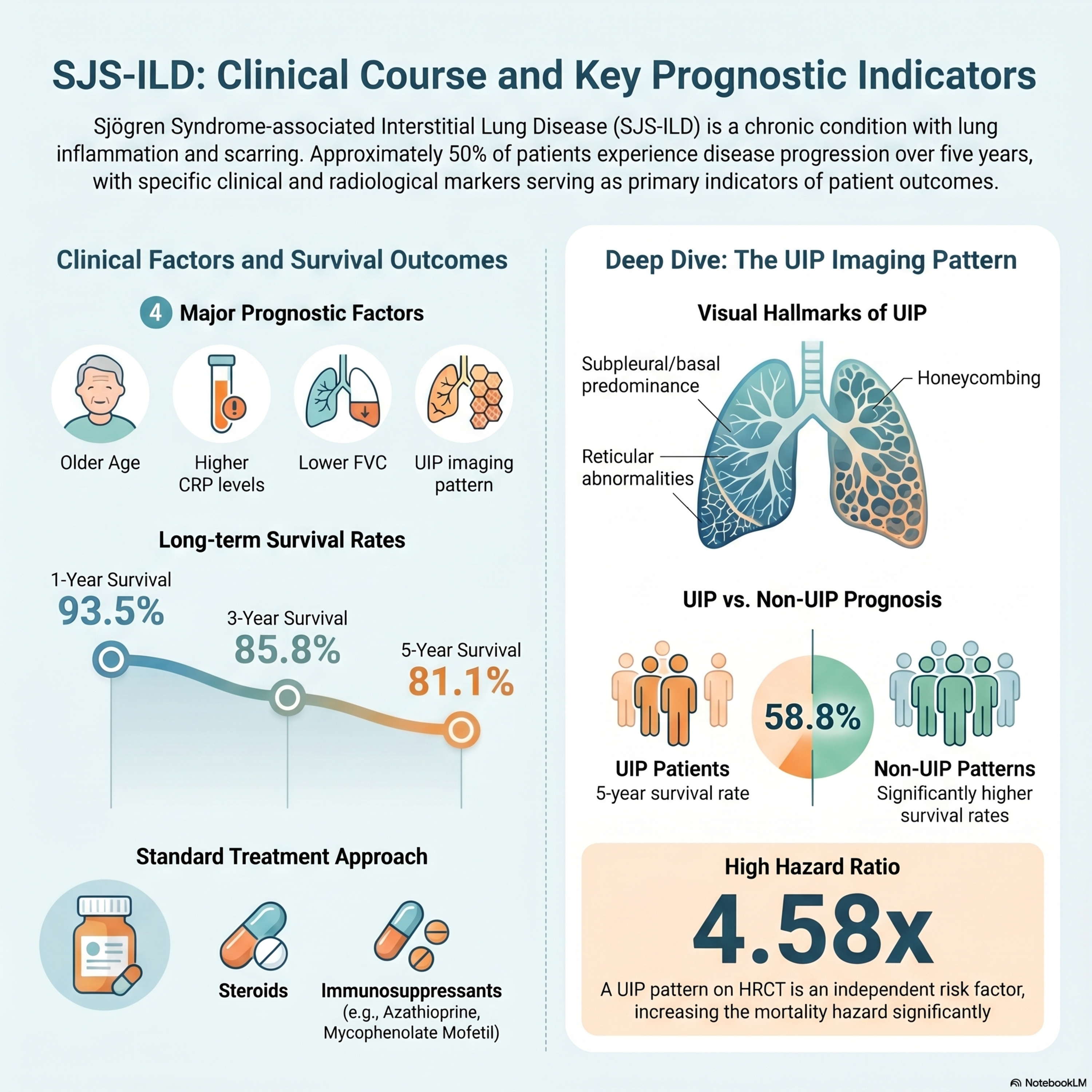
Interstitial lung disease (ILD) is the most common lung manifestation in patients with Sjögrensyndrome (SJS) and is associated with poor outcomes. This study aimed to investigate the longtermclinical course and prognostic factors in patients with SJS-ILD. Clinical data and high-resolutioncomputed tomography (HRCT) images of 62 patients with primary SJS-ILD were retrospectivelyanalyzed (biopsy-proven cases, n = 16). The mean patient age was 59.8 years; 83.9% of the patientswere females, and 38.7% showed a usual interstitial pneumonia (UIP) pattern on HRCT. The medianfollow-up period was 61.5 months. During follow-up, 15 patients (24.2%) died, 7 (11.3%) experiencedacute exacerbation (AE), and 27 (43.5%) progressed. The 1-, 3- and 5-year survival rates were 93.5%,85.8%, and 81.1%, respectively. Age (hazard ratio [HR]: 1.158, P = 0.003), C-reactive protein (CRP)level (HR: 1.212, P = 0.045), FVC (HR: 0.902, P = 0.005), and a UIP pattern on HRCT (HR: 4.580,P = 0.029) were significant prognostic factors in multivariable Cox analysis. In conclusion, death, AE,and ILD progression occurred in 25%, 10%, and 50% of the patients with SJS-ILD, respectively. Olderage, higher CRP level, lower FVC, and a UIP pattern on HRCT indicated poor prognosis.Primary Sj.gren syndrome (SJS) is a chronic systemic inflammatory disorder characterized by impaired
Embed this episode
NOW PLAYING
Long‑term clinical course and outcome in patients with primary Sjögren syndrome‑associated interstitial lung disease
No transcript for this episode yet
Similar Episodes
No similar episodes found.
Similar Podcasts
No similar podcasts found.