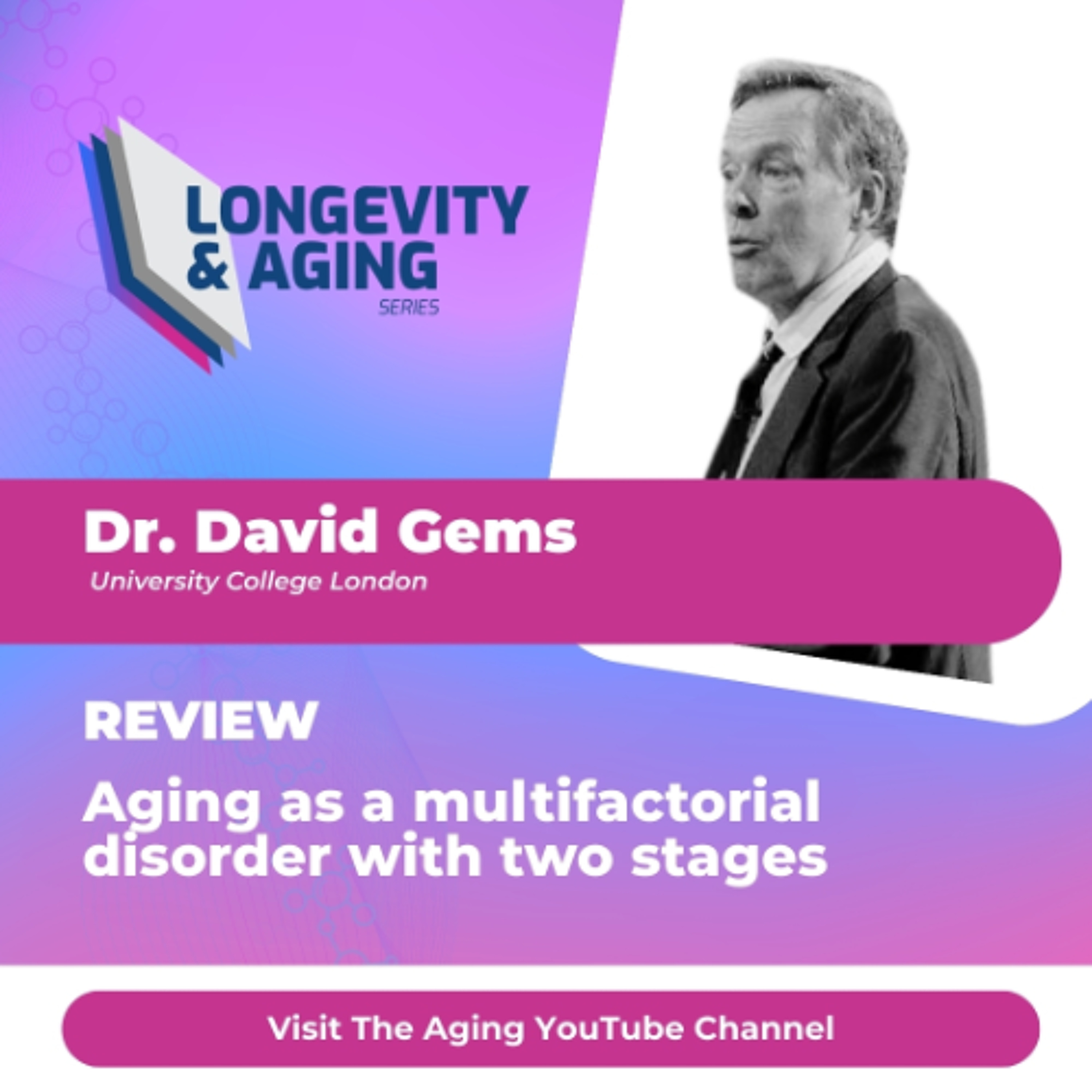
Longevity & Aging Series (S4, E2): Dr. David Gems
from Aging-US Hosted by Aging Podcast
Dr. David Gems from University College London joins new host Dr. Yuan Zhao from Queen Mary University of London to discuss a review they co-authored in Volume 17, Issue 12 of Aging-US, titled “Aging as a multifactorial disorder with two stages.” DOI - https://doi.org/10.18632/aging.206339 Corresponding author - David Gems - [email protected] Video interview - https://www.youtube.com/watch?v=JqZuAm7I4oQ Longevity & Aging Series - https://www.aging-us.com/longevity About Dr. Yuan Zhao - https://www.qmul.ac.uk/sbbs/staff/yuan-zhao.html Abstract video - https://www.youtube.com/watch?v=d4TSI4Ot3yM Abstract Aging (senescence) is characterized by development of diverse senescent pathologies and diseases, leading eventually to death. The major diseases of aging, including cardiovascular disease, cancer and chronic obstructive pulmonary disease (COPD), are multifactorial disorders, resulting from complex interactions between multiple etiologies. Here we propose a general account of how different determinants of aging can interact to generate late-life disease. This account, initially drawn from studies of the nematode Caenorhabditis elegans, depicts senescence as the product of a two-stage process. The first stage involves the diverse causes of disease prior to aging, that cause disruption of normal biological function. These include infection, mechanical injury and mutation (somatic and inherited). Second, etiologies largely confined to aging: deleterious, late-life consequences of evolved wild-type gene action, including antagonistic pleiotropy. Prior to aging, diverse insults lead to accumulation of various forms of injury that is largely contained, preventing progression to major pathology. In later life, wild-type gene action causes loss of containment of latent disruptions, which form foci for pathology development. Pathologies discussed here include osteoarthritis, cancer, late-life recrudescence of infection, and consequences of late-acting deleterious mutations. Such latent injury foci are analogous to seeds which in later life, in the context of programmatic senescent changes, germinate and develop into disease. Sign up for free Altmetric alerts about this article - https://aging.altmetric.com/details/email_updates?id=10.18632%2Faging.206339 Subscribe for free publication alerts from Aging - https://www.aging-us.com/subscribe-to-toc-alerts Keywords - aging, C. elegans, disease, hyperfunction, multifactorial model To learn more about the journal, please visit https://www.Aging-US.com and connect with us on social media at: Bluesky - https://bsky.app/profile/aging-us.bsky.social ResearchGate - https://www.researchgate.net/journal/Aging-1945-4589 X - https://twitter.com/AgingJrnl Facebook - https://www.facebook.com/AgingUS/ Instagram - https://www.instagram.com/agingjrnl/ LinkedIn - https://www.linkedin.com/company/aging/ Reddit - https://www.reddit.com/user/AgingUS/ Pinterest - https://www.pinterest.com/AgingUS/ YouTube - https://www.youtube.com/@Aging-US Spotify - https://open.spotify.com/show/1X4HQQgegjReaf6Mozn6Mc [email protected]
Embed this episode
No transcript yet.