
EPISODE · Jul 4, 2026 · 13 MIN
Luo Siling | Arendt’s Foresight and Lament for America Fifty Years Ago: Also On Prof. Moyn’s One-Sided Quotation and Misreading of Arendt
from 波士頓書評 Boston Review of Books Podcast · host 之間書評In-Between Review
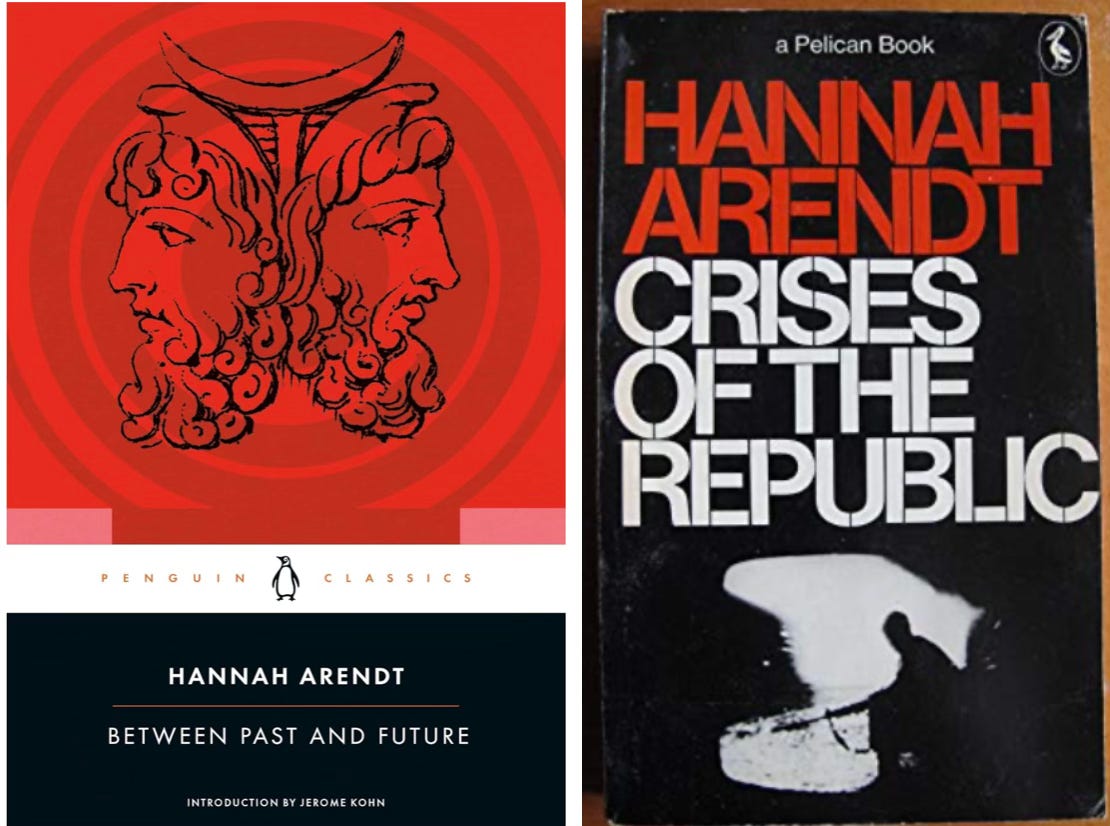
Editor’s Note:In May 1975, Hannah Arendt delivered the speech Home to Roost: A Bicentennial Address at the Bicentennial Forum held in Boston. The full text was published in the June 26, 1975 issue of The New York Review of Books.The speech attracted considerable attention for its unusually somber and profound tone. Unlike the blind optimism or “doctrinaire” reflections on the American system prevalent in mainstream academia at the time, Arendt offered a sharp critique of America’s “image politics” and “systematic lying,” which was highly provocative then. At the time, her prognosis for America’s future was considered overly pessimistic. Today, however, one can only marvel at how prophetic her warnings from fifty years ago have proven to be.In fact, shortly after arriving in the United States, Arendt began writing critical essays about the country. Reading these pieces today fills one with both admiration for her foresight and a deep sense of unease.This article was originally written in Chinese. Today is Independence Day. This article commemorates the 250th anniversary of American Independence.Arendt’s Foresight and Lament for America Fifty Years Ago-PART 1Arendt’s Foresight and Lament for America Fifty Years Ago—PART 2On June 30, Yale professor Samuel Moyn published the article “How America Went Awry : Hannah Arendt was blind to the present” in Unherd. In it, Prof.Moyn argues that over the past decade, faced with political shocks such as Trump’s election, many “Resistance liberals” have elevated Hannah Arendt to the status of a prophet. They have weaponized her theory of totalitarianism to explain the current crisis, claiming that today’s world is in precisely the kind of crisis Arendt would have recognized. However, Prof.Moyn contends that this is often posterity projecting its own fears onto Arendt. In reality, Arendt lacked sufficient foresight regarding the flaws in America’s own system and its subsequent evolution. Prof.Moyn believes Arendt had a blind spot about the essence of America: she “never did glimpse the possibility that America itself had been, or could indeed become, an empire.” She mistakenly diagnosed crises such as the Vietnam War and Watergate as mere temporary “aberrations” that deviated from the founding ideals, and she prescribed a remedy rooted in a nostalgic worship of the 1776 founding myth. Prof.Moyn emphasizes that it is precisely the global hegemony and militaristic expansion pursued jointly by both American parties over the past fifty years that abandoned the domestic underclass and ultimately gave rise to Trumpism. He criticizes contemporary liberals for falling, like Arendt, into blind worship, using the false proposition of “returning to normalcy” to evade reality and refusing to acknowledge that the current democratic crisis is the inevitable price of America’s long-term maintenance of its imperial system.I do not deny that if “Resistance liberals” use Arendt’s The Origins of Totalitarianism as a weapon against Trump and hope to “restore” the pre-Trump American political normalcy through a Biden-style or mainstream Democratic approach, this is indeed a misreading of Arendt—and a misjudgment of America’s own problems. At the same time, however, I believe Prof.Moyn’s understanding of Arendt is equally one-sided and constitutes a serious misreading. In fact, Arendt issued early warnings about many of America’s problems and crises, and her bicentennial address Home to Roost: A Bicentennial Address stands as her final lament for America.Prof.Moyn’s One-Sided Reading of ArendtProf.Moyn’s article primarily relies on Arendt’s 1975 bicentennial address Home to Roost: A Bicentennial Address, supplemented by limited quotations from The Origins of Totalitarianism and On Revolution, to reach the conclusion that “Arendt was blind to contemporary America.” Yet he makes no mention of the many other important essays Arendt wrote specifically about the United States. In reality, from the 1940s to the 1970s, Arendt — describing herself as a European immigrant and “outsider” — produced at least a dozen commentary pieces on American current affairs. These are mainly collected in Between Past and Future (1961/1968) and Crises of the Republic (1972). Therefore, in my view, both the “Resistance liberals” and Prof. Samuel offer one-sided interpretations of Arendt.First, Prof.Moyn claims that Arendt failed to foresee the global hegemony and militaristic expansion pursued jointly by both American parties. The truth is exactly the opposite. As early as 1954, in the early years of the Cold War, Arendt warned of America’s “imperialist tendencies” in her essay Dream and Nightmare. In 1971, in Lying in Politics: Reflections on the Pentagon Papers, she explicitly pointed out that America is a republic at home but an empire abroad, and that imperial expansion is structurally incompatible with republican constitutionalism. This overseas expansion and covert operations were irreversibly poisoning the foundations of the republic. She sharply warned that if America chose to become an “overseas empire,” it would have to rely on systematic lying — driven by interests and image — to rule (as exemplified by McNamara’s Pentagon Papers). This would inevitably destroy the rule of law at home. This was not an accidental “wrong turn,” but the inherent incompatibility between republic and empire. Prof.Moyn not only ignores Arendt’s warnings and diagnosis of the republic’s crisis, but fundamentally misreads her intention. Even in the very speech Home to Roost on which Prof.Moyn bases his argument, Arendt describes the failure in Vietnam and the Watergate scandal as a “disarray” of the republic’s foundations, directly attributing them to the boomerang effect of imperialist foreign policy. Prof.Moyn’s assertion that she was completely unaware of the “American empire” is clearly unfair.The reason Arendt was so vigilant against imperialism is precisely and profoundly explained in The Origins of Totalitarianism. Arendt argued that the transformation from nation-state to totalitarian state must pass through the intermediate stage of “imperialism.” The nation-state is based on legal equality and civil rights, whereas late-19th-century imperialism operated on the principle of “unlimited expansion,” shattering national boundaries and legal constraints. It gave rise to race-thinking, bureaucratic rule, and the concept of “superfluous populations,” treating the conquered as objects to be disposed of at will. This logic of expansion destroyed the stable structure of the nation-state and cleared the path for totalitarianism: totalitarian regimes simply brought the methods of imperial rule overseas — terror, propaganda, and ideology — back to the European homeland, ultimately devouring Europe’s civilized order. In Arendt’s view, although imperialism is not itself totalitarianism, it is indeed the historical precondition and bridge to totalitarianism. It was precisely because of this historical lesson that she remained highly vigilant and continually warned America against repeating the mistakes of imperialism.Even in Home to Roost, the very text Prof.Moyn relies upon, Arendt offered a detailed analysis of America’s economic ills at the time. She pointed out that although the New Deal is often regarded as a success story, purely economic data (such as unemployment rates and industrial production indices) show that it had not fundamentally resolved the Great Depression by the late 1930s. What truly pulled America out of the economic quagmire was not the New Deal itself, but the wartime economy forcibly implemented after the outbreak of World War II — that is, the massive military expansion that absorbed vast numbers of unemployed people. For this reason, she specifically praised the economist Seymour Melman and his book The Permanent War Economy: American Capitalism in Decline (1974). Melman argued that since World War II, the United States had developed a “permanent war economy.” He contended that excessive military spending ruthlessly diverted large quantities of technical talent, R&D funds, and productive resources away from the civilian sector (the so-called “Pentagon capitalism”), severely weakening the competitiveness and innovative capacity of American civilian industries (such as steel, machine tools, and electronics). This, he argued, was the underlying cause of America’s long-term economic decline and lagging infrastructure.Secondly, Prof.Moyn also argues that the “alternative facts” of the Trump era were something Arendt could not have anticipated. Once again, the opposite is true.The relationship between lying in politics, truth, and politics itself was one of the central themes of Arendt’s late thinking. In essays such as Truth and Politics (1967), Lying in Politics (1971), and Washington’s “Problem-Solvers” (1972), Arendt provided a profound analysis of the nature, mechanisms, and consequences of political lying.Arendt pointed out that lying is not an accidental flaw in politics, but is rooted in the human capacity for imagination and action: humans have the ability to deny facts and fabricate possibilities in order to change the world. The factual truth is extremely fragile. It depends heavily on witnesses and public speech; once subjected to systematic deception, it is easily “de-factualized.” Political power frequently replaces reality with “image-making” and public-relations logic. Lies, which may appear to serve “higher goals” or national image, in fact create a vicious cycle of self-deception. In the case of Vietnam War decision-making, Arendt revealed how the “problem-solvers” filtered reality through abstract models, probability calculations, and ideology. Instead of judging facts, they constructed self-consistent “solutions” and prioritized the preservation of America’s false image as “the world’s strongest power.” This led to the comprehensive distortion of intelligence, battlefield reports, and policy. Such deception eventually shifted from being aimed at the public to becoming the self-deception of the decision-makers themselves, creating a “credibility gap” and a complete disconnect from reality.Arendt warned that organized lying is different from traditional political deception. It erodes the foundations of the common world: when people are forced to ignore the boundary between truth and falsehood in order to survive, truth disappears entirely from the public realm, and political action loses its stable anchor. Although lies may succeed temporarily, they cannot ultimately prevail over reality. They will inevitably lead to catastrophic policy failures and the total collapse of trust. These analyses directly address the dangers of modern “alternative facts” and underscore that defending factual truth is fundamental to maintaining a political community.Finally, Prof.Moyn completely misunderstands Arendt’s political intention in calling for a return to the founding spirit.In Arendt’s political philosophy, the most important legacy of 1776 was not a great “nation,” but the “power of citizens to act together and resist tyranny” as well as the “constitutional consensus.” As early as 1960, in her essay Revolution and Public Happiness, Arendt reinterpreted the American Revolution. She criticized modern America for deviating from the “public happiness” and constitutional consensus of the founding era, drifting instead toward consumerism and bureaucratization.A decade later, in 1970, she wrote Reflections on Civil Disobedience, clearly stating that when faced with government lies and imperial atrocities (such as the Vietnam War), the only legitimate resource for citizens’ resistance was to return to the founding tradition of “association and resistance.” Her call to “return to the beginning” stemmed from her belief that America was already facing a serious “crisis of the republic.”Crises of the Republic (1972), another of her well-known collections of American commentaries, contains four interconnected essays: Lying in Politics, Reflections on Civil Disobedience, On Violence (1969), and the interview-form Thoughts on Politics and Revolution (1971). These works were written in the late 1960s and early 1970s, precisely when America was deeply embroiled in the Vietnam War, the civil rights movement, student protests, and widespread social turmoil. From the perspective of a political philosopher, Arendt viewed these contemporary crises as fundamental challenges to the core principles of the republican system. She used them to reflect on the nature of power, lying, truth, action, and violence, and to diagnose the deeper causes confronting the modern republic. At the same time, she offered a remedy: through the restoration of genuine public action, the defense of factual truth, and the assumption of civic responsibility, the republican spirit could still be reborn.The crises of America that Arendt identified more than fifty years ago have not become outdated; on the contrary, they are even more evident today.Concerns about “Progressivism”A comprehensive reading of Arendt’s writings reveals that her foresight regarding American politics and society goes far beyond what has been discussed. This is something both the “Resistance liberals” and Prof.Moyn may have overlooked. In addition to her essays on “imperialism” and “politics and lying,” Arendt expressed concerns about American “progressive” education as early as seventy years ago.In pieces such as The Ivory Tower of Common Sense (1946) and The Crisis in Education (1958), Arendt analyzed the crisis in American (and modern) education. She argued that the crisis stemmed from the politicization of education, the erosion of adult authority, and the excessive emphasis of “progressive education” on children’s autonomy and practicality. These trends caused schools to become detached from “the world,” failing to prepare children for entry into the public realm.Among these writings, the most controversial and famous is her 1959 essay Reflections on Little Rock.Reflections on Little Rock was written in the autumn of 1957, originally commissioned by the editor of Commentary magazine as a timely commentary on the racial integration crisis in the United States. Because its content was extremely controversial, the magazine held it for several months. Arendt eventually withdrew the manuscript and published it in the winter of 1959 in the left-wing magazine Dissent. The editors accompanied its publication with a statement declaring that they disagreed with her views and simultaneously ran two rebuttal articles. The essay sparked enormous controversy, even damaging her reputation, and became one of Arendt’s most famous and most controversial works — far more so than Home to Roost (“chickens coming home to roost”), as Prof.Moyn suggests.The Little Rock Crisis was a landmark event in the 1957 American civil rights movement. It occurred at Central High School in Little Rock, Arkansas. In 1954, the U.S. Supreme Court ruled in Brown v. Board of Education that racial segregation in public schools was unconstitutional, overturning the “separate but equal” doctrine established in 1896. However, Southern states fiercely resisted and delayed implementation.In September 1957, the Little Rock School Board decided to implement limited racial integration, allowing nine Black students (later known as the “Little Rock Nine”) to enroll in the previously all-white Central High School. Supported by the NAACP, the nine students applied for admission. However, Arkansas Governor Orval Faubus, citing the need to “maintain order,” deployed the National Guard to blockade the school and prevent the Black students from entering.On September 4, Black student Elizabeth Eckford arrived at the school alone and was met with a hostile mob of hundreds of white protesters who hurled insults, spat at her, and threatened her. The iconic photograph of her walking alone, isolated and in visible distress, quickly spread across the nation and became one of the most powerful images of the civil rights movement. As the crisis escalated, President Eisenhower federalized the Arkansas National Guard and on September 24 sent the 101st Airborne Division to escort the students into the school. In 1958, the governor even closed all high schools for a full year (known as the “Lost Year”). Only under pressure from federal courts was integration eventually enforced.The crisis exposed the fierce Southern resistance to desegregation and highlighted the federal government’s determination to uphold the principle of equal citizenship. It became a major turning point in the civil rights movement.Arendt’s essay directly challenged the mainstream liberal narrative in America at the time. Her core argument was grounded in her strict distinction between the private, social, and political realms. She maintained that the political realm operates on the principle of equality, and that laws should abolish legally enforced racial segregation (such as Jim Crow laws). However, the social realm should permit “discrimination” — that is, people’s freedom to associate and choose their company according to their own preferences. This, she argued, is an essential right of social life.Education, in her view, belongs to the social rather than the purely political sphere. The government should not use coercive force (such as sending troops or mandating school integration) to eliminate social prejudice or enforce social equality. Therefore, she criticized the Supreme Court’s 1954 Brown decision and federal intervention, arguing that they blurred the boundaries between these domains, potentially violated parents’ private right to educate their children, and placed children on the front lines of political conflict. While she found Southern whites’ social discrimination against Blacks shameful, she believed that using state power to enforce integration was not the solution and could instead damage the republican polity.The article provoked intense controversy and was accused of showing a lack of sympathy for the Black struggle. After criticism from figures such as Ralph Ellison, Arendt partially acknowledged that she had underestimated the courage and sacrifices of Black parents. Nevertheless, she consistently maintained her position: political equality cannot be achieved through social engineering or the coercive use of state power.The “three realms” theory she employs in the essay is one of the most original and controversial concepts in her political philosophy. Particularly notable is her analysis of the “social realm,” whose contentiousness rivals that of her famous concept of the “banality of evil.” This theoretical framework was first systematically articulated in The Human Condition (1958). Arendt believed it was the key to understanding the crises of modernity: while ancient Greece and Rome maintained a clear distinction between the public and private spheres, the rise of “the social” in the modern age had blurred this boundary, paving the way for dangers such as totalitarianism.Arendt drew a clear distinction between the responsibilities of different realms. The government has a duty to eliminate legal discrimination and to uphold absolute equality in the “political and legal realm” — for example, guaranteeing equal voting rights for Black citizens. However, the government cannot forcibly erase prejudices and distinctions in the social realm, because that belongs to the domain of social life and lies beyond the legitimate limits of political power.Consequently, Arendt argued that placing the main focus of desegregation on public education was a serious mistake. Education is essentially a social matter, not a purely political one. Federal government intervention in schools not only confused these boundaries but also risked setting a dangerous precedent of excessive state intrusion into social life, ultimately threatening private freedom and plurality.Another important reason Arendt opposed the federal government’s forced implementation of school integration was her concern for protecting states’ rights. She pointed out that the federal government’s use of troops to forcibly intervene in public schools essentially amounted to a violent administrative takeover of an area (education) that the Constitution had not explicitly granted it authority over, constituting a serious infringement upon the legislative sovereignty of the states. She stressed that no just goal could justify bypassing constitutional procedures, for doing so would destroy the very structural foundations upon which legitimate power rests — and states’ rights were one of the sources of federal power.After its publication, the essay drew fierce criticism from civil rights activists and left-wing intellectuals, triggering intense controversy and severely damaging Arendt’s reputation within liberal intellectual circles. Despite the backlash, the piece demonstrates Arendt’s unwavering commitment to preserving the purity and plurality of the political realm.Reading this essay today against the backdrop of intensifying identity politics, cancel culture, and the breakdown of checks and balances, one cannot help but acknowledge that Arendt’s concerns were not without merit. In her view, such coercive approaches cannot truly eliminate prejudice; instead, they deprive citizens of the space in the public realm where genuine consensus can be reached through speech and action. The current crisis in America is precisely the bitter fruit of the loss of that space.Foresight of the “a society of laborers without labor”The work by Arendt that is actually more original and more prescient than The Origins of Totalitarianism is The Human Condition (1958) — a book that remains significantly underappreciated today.In The Human Condition, Arendt divides human active life (vita activa) into three fundamental activities: labor, work, and action. Labor corresponds to animal laborans — the biological, cyclical process of sustaining life itself, in which production and consumption are identical and endlessly repeat, closely tied to natural necessity. Work corresponds to homo faber, the maker who creates a durable artificial world. Action is political in nature, revealing human plurality and freedom in the public realm.Modern society has evolved into a “society of laborers,” in which labor is elevated to the highest value and the entire society revolves around production and consumption. Labor is no longer the burden of the few but the universal human condition. Arendt points out that this transformation stems from the liberation brought about by modern technology and productive forces, but it also brings profound crises. Automation represents the culmination of this crisis: it promises to free humanity from “the most ancient and most natural burden” — the toil and necessity of labor. Factories may become empty within decades, and humanity seems finally poised to escape toil and trouble.Yet Arendt foresaw that this would not be liberation, but a greater tragedy. She wrote: “What we are confronted with is the prospect of a society of laborers without labor, that is, without the only activity left to them. Surely, nothing could be worse.”In a society of laborers, people have already forgotten the nobler activities — the durability of the world created by work and the political freedom and immortality opened up by action. All that remains for them is labor, the activity that sustains bare life. When automation eliminates even that, the laborer is left in emptiness.Arendt further argues that this “liberation” will not lead to meaningful leisure, but to endless consumption. Accustomed to spending free time satisfying biological needs, people will fill the time freed by automation with ever more consumption, creating an accelerating cycle of “labor-consumption.” Society becomes a pure consumer society; human existence degenerates into the mere continuation of biological processes, losing connection to a durable world and the capacity for action in the public realm. Loneliness (not mere isolation) will become dominant: human beings will be cut off both from the world and from one another.In today’s world, where artificial intelligence (AI) and intelligent automation are comprehensively reshaping our society and lives, this foresight is strikingly prophetic. Arendt criticized modernity for sanctifying labor, only to leave the laborer foundationless at the moment of its apparent triumph. She warned that automation is not merely technical progress but a fundamental threat to the human condition. If human beings exist only as animal laborans, without the durable world built by work and without the plurality unfolded through action, freedom becomes impossible. Instead, it may intensify meaninglessness and unhappiness — a universal pursuit of happiness accompanied by universal unhappiness.In this book, Arendt’s foresight is not limited to America; it concerns human society as a whole. She reminds us that true liberation does not lie in the elimination of labor, but in restoring space for humanity’s higher capacities — rising from the necessity of labor toward the freedom of work and action. Otherwise, the “laborer without labor” will face not a utopia, but the utter void of human dignity.ConclusionIn May 1975, the 68-year-old Hannah Arendt delivered an exceptionally somber speech in Boston titled Home to Roost: A Bicentennial Address.In this speech, Arendt offered a cold-eyed analysis of the American political situation. She argued that the United States was facing a profound crisis triggered by the defeat in Vietnam, the Watergate scandal, and economic decline. Yet the government’s response was to replace factual truth with “image politics.” In order to sustain the false illusion of being “the most powerful force on earth,” America not only abused military power overseas but also built a domestic system of Madison Avenue-style public relations lies, even attempting to evade political responsibility through collective “amnesia.”Arendt warned that this flight from reality would corrode power and turn the republic into a breeding ground for the “banality of evil.” She also criticized an economy that had turned production into mere job-maintenance wastefulness and mocked the elite’s “secret longings for the man on horseback.” She called on citizens to regain their “sense of reality,” stop escaping into utopias and grand theories, and bravely accept the “bitter fruits.” Only by confronting both the best and the worst in human nature could the collapsing republican tradition be saved.A few months later, in December 1975, Arendt died suddenly of a heart attack at a dinner with friends. This bicentennial address on the founding of America became her last public speech and published text — a political philosopher’s final warning to the United States.Unfortunately, Arendt’s warning was never heeded. The “crisis of the republic” she described was not alleviated but has only grown deeper. “Trump” and “Trumpism” are precisely the greatest “chickens coming home to roost.” Neither the “Resistance liberals” nor Prof. Samuel Moyn have truly seen this.If, fifty years ago, Arendt warned that America’s chickens were already coming home to roost, then today they are coming home to roost with even greater vengeance. This is a public episode. If you'd like to discuss this with other subscribers or get access to bonus episodes, visit inbetweenreview.substack.com/subscribe
Embed this episode
Ready to play
Luo Siling | Arendt’s Foresight and Lament for America Fifty Years Ago: Also On Prof. Moyn’s One-Sided Quotation and Misreading of Arendt
No transcript for this episode yet
Similar Episodes
No similar episodes found.
Similar Podcasts
No similar podcasts found.