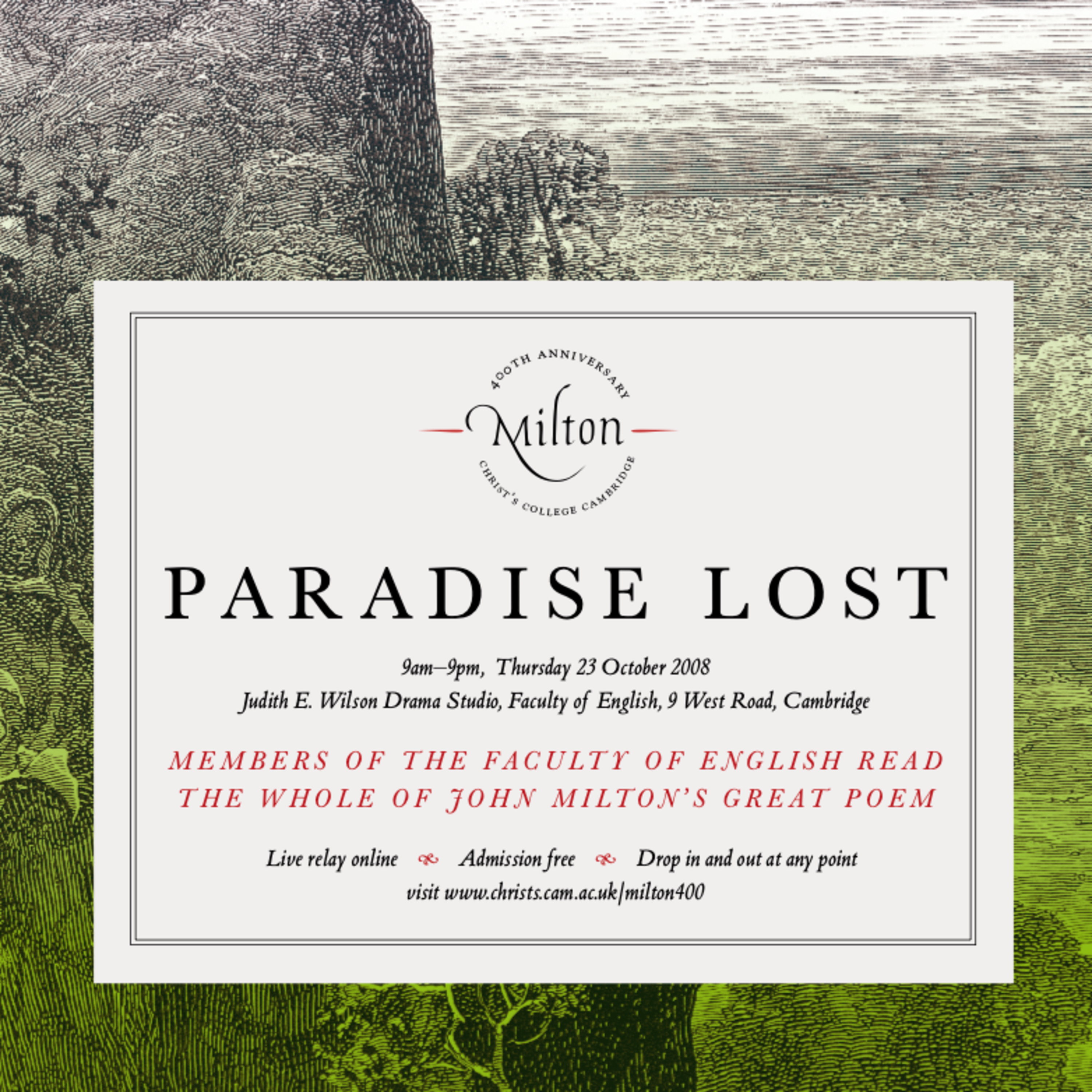
Milton 400 - Paradise Lost: Book 9 (Alternate) episode artwork

EPISODE · May 20, 2026 · 51 MIN

Milton 400 - Paradise Lost: Book 9 (Alternate)

from Cambridge English Audio · host Faculty of English University of Cambridge

(N.B. These recordings were made during a live reading in late 2008 and are not professional quality. We've done what we can to clean them up, but please just bear in mind how old they are and how new we were!)This event was held on Thursday 23 October 2008 from around 9 am-9 pm, in the Judith E. Wilson Drama Studio, Faculty of English, Cambridge.4.30pm, Book IXRead by: Jeremy Hardingham, with Alice Goodman and Jonathan Styles (This alternate version of book IX exists because some listeners found the additional audio difficult to unpick from the reading. In this version, Alice and Jonathan's contributions to the art have been, mostly, muted. Please listen to the 'As Broadcast' version for the full experience. )Book IX Summary by Ned Allen (2008)The book opens with a personal prologue and a restatement of the poem's central theme. The poem is said to be, from here on, of the tragic mode. What Milton has to relate is, moreover, epic, and he means to demonstrate how the Fall - a Christian story - is superior to other stories in which legend and myth play a significant part. It is thanks to his celestial (heavenly) muse that he is able to commit his thoughts to paper.The action starts with Satan, compassing the earth, soliloquizing on his torment. He finds a way to sneak in to Paradise and adopts the guise of the serpent.As day dawns, Eve suggests that they divide their labours in the garden to work more effectively, unheeded by the distractions of 'smiles' and 'casual discourse' (222-23). Adam admits the sense of Eve's suggestion, and despite voicing at some length his fear for her safety, and the pair debating whether virtue were better left untried, he eventually allows her to go. The narrator declaims against this folly, unable to let the 'event perverse' (405) pass without comment. Satan catches sight of Eve - the 'fairest unsupported flower' (432) - and he is momentarily disarmed. But he gains her attention and begins his fraudulent temptation. Eve marvels at the serpent's human voice and Satan leads her to the tree which he claims gave him the power of speech. She resists when she discovers it is the one forbidden, but Satan commands her to look at him, and to see that the tree has yielded him a 'life more perfect' (689). Astonished by Satan's command of reason, persuaded by his flattery, and in hunger of knowledge and godhead, Eve begins to persuade herself to succumb, and plucks and eats the 'intellectual fruit' (794). She considers keeping it for herself, but decides finally to share all and brings her spouse a sample. Adam is horrified. However, he cannot bear to be separated from Eve, even if this means death, and he reconciles himself to what seems necessary: he completes the 'mortal sin | Original' (1003) by eating the fruit himself.Adam and Eve later wake to find themselves naked and miserable. They cover themselves, ashamed, and weep at the discord of the post-lapsarian world. The book leaves them arguing and casting blame at one another.

Episode metadata supplied by the publisher feed · Published May 20, 2026

(N.B. These recordings were made during a live reading in late 2008 and are not professional quality. We've done what we can to clean them up, but please just bear in mind how old they are and how new we were!)This event was held on Thursday 23 October 2008 from around 9 am-9 pm, in the Judith E. Wilson Drama Studio, Faculty of English, Cambridge.4.30pm, Book IXRead by: Jeremy Hardingham, with Alice Goodman and Jonathan Styles (This alternate version of book IX exists because some listeners found the additional audio difficult to unpick from the reading. In this version, Alice and Jonathan's contributions to the art have been, mostly, muted. Please listen to the 'As Broadcast' version for the full experience. )Book IX Summary by Ned Allen (2008)The book opens with a personal prologue and a restatement of the poem's central theme. The poem is said to be, from here on, of the tragic mode. What Milton has to relate is, moreover, epic, and he means to demonstrate how the Fall - a Christian story - is superior to other stories in which legend and myth play a significant part. It is thanks to his celestial (heavenly) muse that he is able to commit his thoughts to paper.The action starts with Satan, compassing the earth, soliloquizing on his torment. He finds a way to sneak in to Paradise and adopts the guise of the serpent.As day dawns, Eve suggests that they divide their labours in the garden to work more effectively, unheeded by the distractions of 'smiles' and 'casual discourse' (222-23). Adam admits the sense of Eve's suggestion, and despite voicing at some length his fear for her safety, and the pair debating whether virtue were better left untried, he eventually allows her to go. The narrator declaims against this folly, unable to let the 'event perverse' (405) pass without comment. Satan catches sight of Eve - the 'fairest unsupported flower' (432) - and he is momentarily disarmed. But he gains her attention and begins his fraudulent temptation. Eve marvels at the serpent's human voice and Satan leads her to the tree which he claims gave him the power of speech. She resists when she discovers it is the one forbidden, but Satan commands her to look at him, and to see that the tree has yielded him a 'life more perfect' (689). Astonished by Satan's command of reason, persuaded by his flattery, and in hunger of knowledge and godhead, Eve begins to persuade herself to succumb, and plucks and eats the 'intellectual fruit' (794). She considers keeping it for herself, but decides finally to share all and brings her spouse a sample. Adam is horrified. However, he cannot bear to be separated from Eve, even if this means death, and he reconciles himself to what seems necessary: he completes the 'mortal sin | Original' (1003) by eating the fruit himself.Adam and Eve later wake to find themselves naked and miserable. They cover themselves, ashamed, and weep at the discord of the post-lapsarian world. The book leaves them arguing and casting blame at one another.

PodParley-generated summary based on available episode metadata and transcript content.

NOW PLAYING

Milton 400 - Paradise Lost: Book 9 (Alternate)

0:00 51:34

No transcript for this episode yet

We transcribe on demand. Request one and we'll notify you when it's ready — usually under 10 minutes.

Frequently Asked Questions

How long is this episode of Cambridge English Audio?

This episode is 51 minutes long.

When was this Cambridge English Audio episode published?

This episode was published on May 20, 2026.

What is this episode about?

(N.B. These recordings were made during a live reading in late 2008 and are not professional quality. We've done what we can to clean them up, but please just bear in mind how old they are and how new we were!)This event was held on Thursday 23...

Can I download this Cambridge English Audio episode?

Yes, you can download this episode by clicking the download button on the episode player, or subscribe to the podcast in your preferred podcast app for automatic downloads.
URL copied to clipboard!