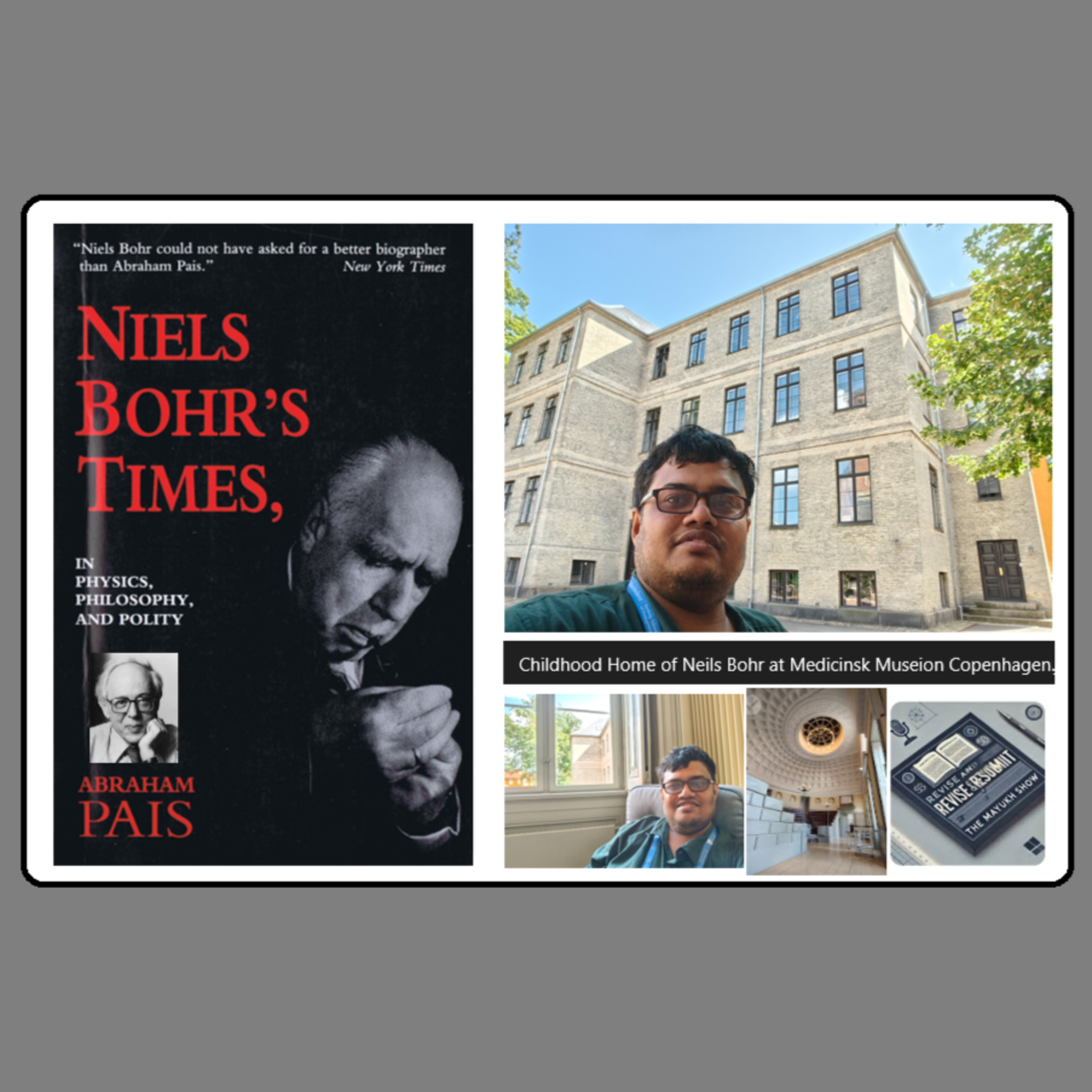
Niels Bohr's Times (Pais 1991) - Weekend Classics episode artwork

EPISODE · Aug 3, 2025 · 29 MIN

Niels Bohr's Times (Pais 1991) - Weekend Classics

from Revise and Resubmit - The Mayukh Show · host Mayukh Mukhopadhyay

English Podcast starts at 00:00:00Bengali Podcast Starts at 00:15:10Hindi Podcast Starts at 00:22:32🎧✨ Welcome to "Revise and Resubmit"—your weekly stop for deeper dives and second looks! I’m thrilled to have you on this special edition: "Weekend Classics", where we crack open books that don’t just line library shelves, but leap into our imaginations and change the way we see the world.📚 This weekend, we’re exploring a true heavyweight of scientific biography: "Niels Bohr's Times: In Physics, Philosophy and Polity" by the remarkable Abraham Pais, published back in 1991 by Clarendon Press. It’s open access, which means everyone can journey into the depths of brilliance! Isn’t that something worth celebrating?Who was Abraham Pais? Well, let me take you on a little side trip. Pais wasn’t just a chronicler of great minds—he was one himself. Born in the Netherlands, Pais survived World War II in hiding, often by the thinnest thread of fate, with help from heroes such as Tineke Buchter, who hid Jews in her Amsterdam attic while risking everything. Pais survived, went on to join the very circles he wrote about—walking Einstein home, sitting beside Feynman as science leapt forward, and partnering with Gell-Mann to discover the quantum property called "strangeness." When Pais retired from physics, he didn’t just rest; he rewrote the history of physics, scribbling down the lives of Bohr, Einstein, and Oppenheimer, not as distant figures, but as colleagues, friends, and sometimes rivals. That proximity fills this book with rare warmth and insight.In "Niels Bohr’s Times", Pais illuminates the extraordinary story of Bohr himself—a gentle, private Dane who reshaped physics. Alongside Einstein, Bohr was a titan pushing open the quantum door. But he was also a mentor who gathered young minds in Copenhagen, a leader agonizing over nuclear weapons, and a family man devastated by personal loss. Pais captures Bohr’s public triumphs and private sorrows. Through it all, fundamental questions echo: What does it mean to measure reality? How do we balance scientific progress with moral responsibility? And what kind of person shapes the times they live in?So here’s a question I’ve been turning over: If Bohr shaped the modern world with ideas we can barely grasp, what hidden legacies do scientists create today—often far from the limelight? 🌌🔬Big thanks to Abraham Pais, who lived this history, and to Clarendon Press for keeping this work open to all curious minds. 🙏📖If you enjoyed today's journey, please subscribe to "Revise and Resubmit" wherever you listen—on Spotify, on our YouTube channel Weekend Researcher, and yes, you can find us on Amazon Prime Music and Apple Podcast as well. Every follow helps our community of seekers grow! 🎙️💡Now, are you ready to see quantum theory through Bohr’s eyes? Let’s begin.ReferenceAbraham Pais (1991). Niels Bohr's Times, in Physics, Philosophy, and Polity. Oxford University Press. https://philpapers.org/rec/PAINBT‌Youtube channel link https://www.youtube.com/@weekendresearcherSupport us on Patreonhttps://patreon.com/weekendresearcher

English Podcast starts at 00:00:00Bengali Podcast Starts at 00:15:10Hindi Podcast Starts at 00:22:32🎧✨ Welcome to "Revise and Resubmit"—your weekly stop for deeper dives and second looks! I’m thrilled to have you on this special edition: "Weekend Classics", where we crack open books that don’t just line library shelves, but leap into our imaginations and change the way we see the world.📚 This weekend, we’re exploring a true heavyweight of scientific biography: "Niels Bohr's Times: In Physics, Philosophy and Polity" by the remarkable Abraham Pais, published back in 1991 by Clarendon Press. It’s open access, which means everyone can journey into the depths of brilliance! Isn’t that something worth celebrating?Who was Abraham Pais? Well, let me take you on a little side trip. Pais wasn’t just a chronicler of great minds—he was one himself. Born in the Netherlands, Pais survived World War II in hiding, often by the thinnest thread of fate, with help from heroes such as Tineke Buchter, who hid Jews in her Amsterdam attic while risking everything. Pais survived, went on to join the very circles he wrote about—walking Einstein home, sitting beside Feynman as science leapt forward, and partnering with Gell-Mann to discover the quantum property called "strangeness." When Pais retired from physics, he didn’t just rest; he rewrote the history of physics, scribbling down the lives of Bohr, Einstein, and Oppenheimer, not as distant figures, but as colleagues, friends, and sometimes rivals. That proximity fills this book with rare warmth and insight.In "Niels Bohr’s Times", Pais illuminates the extraordinary story of Bohr himself—a gentle, private Dane who reshaped physics. Alongside Einstein, Bohr was a titan pushing open the quantum door. But he was also a mentor who gathered young minds in Copenhagen, a leader agonizing over nuclear weapons, and a family man devastated by personal loss. Pais captures Bohr’s public triumphs and private sorrows. Through it all, fundamental questions echo: What does it mean to measure reality? How do we balance scientific progress with moral responsibility? And what kind of person shapes the times they live in?So here’s a question I’ve been turning over: If Bohr shaped the modern world with ideas we can barely grasp, what hidden legacies do scientists create today—often far from the limelight? 🌌🔬Big thanks to Abraham Pais, who lived this history, and to Clarendon Press for keeping this work open to all curious minds. 🙏📖If you enjoyed today's journey, please subscribe to "Revise and Resubmit" wherever you listen—on Spotify, on our YouTube channel Weekend Researcher, and yes, you can find us on Amazon Prime Music and Apple Podcast as well. Every follow helps our community of seekers grow! 🎙️💡Now, are you ready to see quantum theory through Bohr’s eyes? Let’s begin.ReferenceAbraham Pais (1991). Niels Bohr's Times, in Physics, Philosophy, and Polity. Oxford University Press. https://philpapers.org/rec/PAINBT‌Youtube channel link https://www.youtube.com/@weekendresearcherSupport us on Patreonhttps://patreon.com/weekendresearcher

NOW PLAYING

Niels Bohr's Times (Pais 1991) - Weekend Classics

0:00 29:31

No transcript for this episode yet

We transcribe on demand. Request one and we'll notify you when it's ready — usually under 10 minutes.

Frequently Asked Questions

How long is this episode of Revise and Resubmit - The Mayukh Show?

This episode is 29 minutes long.

When was this Revise and Resubmit - The Mayukh Show episode published?

This episode was published on August 3, 2025.

What is this episode about?

English Podcast starts at 00:00:00Bengali Podcast Starts at 00:15:10Hindi Podcast Starts at 00:22:32🎧✨ Welcome to "Revise and Resubmit"—your weekly stop for deeper dives and second looks! I’m thrilled to have you on this special edition: "Weekend...

Can I download this Revise and Resubmit - The Mayukh Show episode?

Yes, you can download this episode by clicking the download button on the episode player, or subscribe to the podcast in your preferred podcast app for automatic downloads.
URL copied to clipboard!