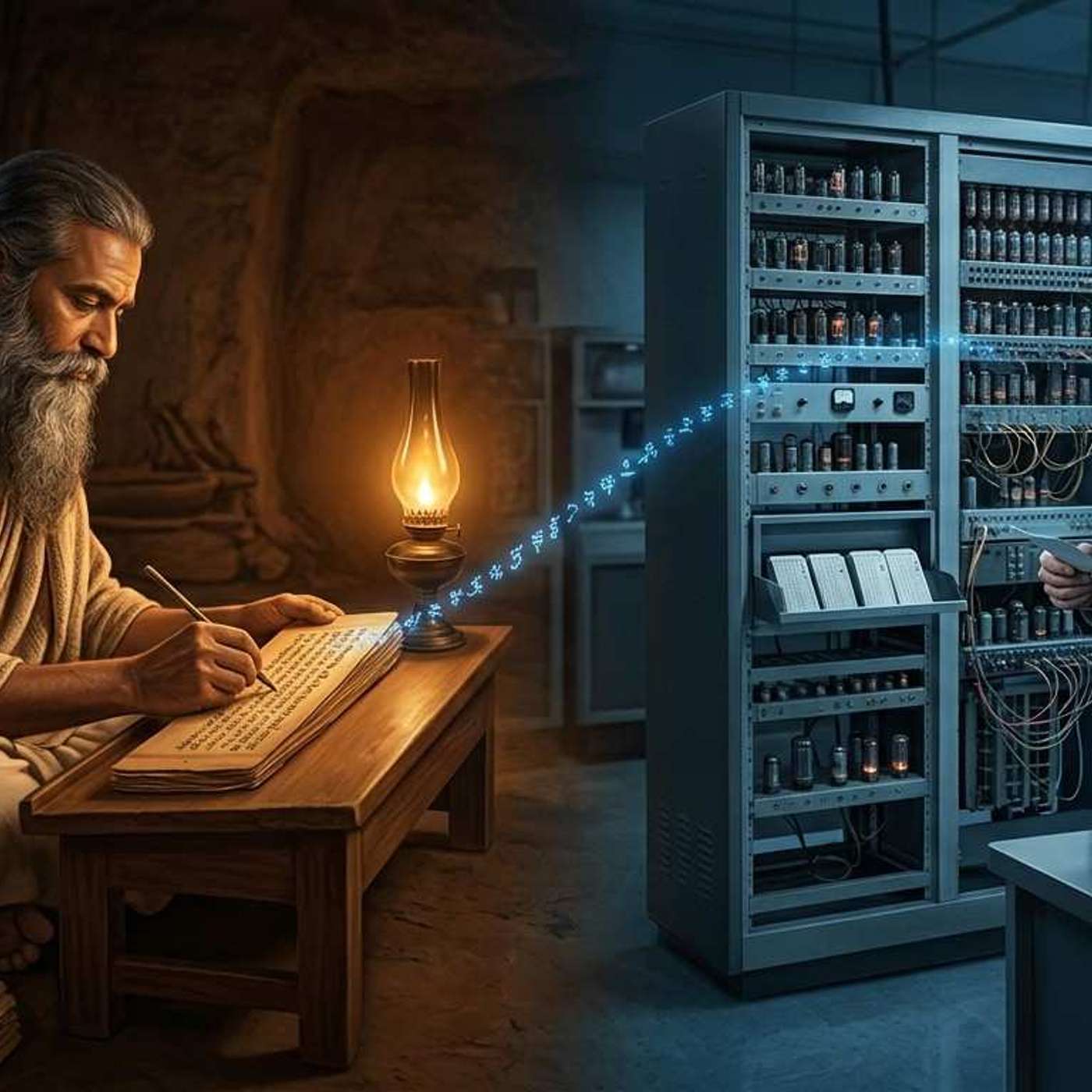
Panini: The World's First Programmer Wrote Code in Sanskrit, Twenty Five Centuries Before Computers Existed episode artwork

EPISODE · Jun 21, 2026 · 18 MIN

Panini: The World's First Programmer Wrote Code in Sanskrit, Twenty Five Centuries Before Computers Existed

from Incredible India Travel | Social Impact & Culture Tours · host 5 Senses Tours | Cultural Experiences & Social Impact Guides

In 1959 a computer scientist named John Backus invented a notation for describing the grammar of programming languages.It is called Backus Naur Form, and it is one of the foundational tools of modern computer science. Every programming language you have ever used was at some point defined using a descendant of this notation.In 1967 a researcher reading an old Sanskrit grammar wrote a letter to the Communications of the ACM, the most respected computer science journal in the world, to point out something extraordinary.Someone had already invented Backus Naur Form. Twenty five hundred years earlier. In Sanskrit.Panini was a scholar who flourished between 400 and 200 BC, and in order to describe the rules of Sanskrit grammar he invented a notation equivalent in its power to that of Backus.The researchers proposed a new name for the notation computer scientists had been using for nine years.The Panini Backus Form.This episode tells the story of Panini, the Sanskrit grammarian born near the Indus river in what is now Pakistan, who wrote a grammar so rigorous, so mechanical and so completely rule based that twenty five centuries later, computer scientists building the first programming languages discovered he had already solved their problem.What You Will Discover in This EpisodeThe complete story of Panini, born in Shalatula near Attock on the Indus river sometime between the 4th and 7th century BC, and his likely connection to the ancient university of Taxila, which also produced Chanakya, the strategist behind the Mauryan Empire, and Charaka, the father of Ayurvedic medicineThe structure of the Ashtadhyayi, Panini's eight chapter grammar of Sanskrit containing approximately 4000 sutras, generative rules that completely define the language mechanically rather than through memorised examples, in a structure modern linguists compare directly to a formal computer programming languageHow Panini classified 1700 basic linguistic elements into systematic categories using single letter symbolic markers called anubandhas, a technique functionally identical to how modern programmers define variable classes and apply functions across entire categories of dataThe 1967 letter to the Communications of the ACM in which researcher P Z Ingerman demonstrated that Panini's notation was structurally equivalent in power to Backus Naur Form, leading to the proposed term Panini Backus Form, and why this discovery mattered so much precisely because Backus had developed his notation independently, with no knowledge of Panini's workHow Panini's rule based grammar uses recursion, transformations and metarules, rules about rules, in an architecture that mirrors exactly how a modern compiler operates, where certain rules transform raw input and higher order rules determine which transformations apply and in which orderWhy Sanskrit, structured according to Panini's deterministic grammar, has become a subject of active research in modern artificial intelligence and large language models, with researchers finding that Panini's generative rules offer measurable computational efficiency advantages over languages that rely on memorised patternsThe honest and important distinction between what Panini actually achieved, a complete formal system describing an existing human language, and what Backus and Naur achieved, an artificial language built for a machine, and why the structural toolkit required to solve both problems with total precision turned out to be, almost exactly, the same toolkitHow Panini connects to India's broader ancient scientific tradition, including Kanada's atomic theory in Gujarat, the calculus described by Karnataka's mathematicians five centuries before Newton, and the modern physics achievements of Kolkata's Bengali scientists, forming an unbroken line of rigorous Indian thought spanning more than two thousand yearsHow 5 Senses Tours brings the complete ancient Indian science and intellectual heritage trail to life for international travellers through expert guided experiences connecting Delhi, Gujarat, Karnataka and KolkataExperience Panini's World With 5 Senses ToursPanini's birthplace near the Indus river sits within reach of one of the most historically layered regions accessible from northern India, and the broader story he belongs to stretches across the entire subcontinent.Our Delhi tours connect international travellers to the closest major gateway for exploring this ancient intellectual landscape at https://5sensestours.com/home-delhi-tours/Travellers who want to walk the same ground that shaped Kanada's atomic theory can extend their journey to our Ahmedabad tours in Gujarat at https://5sensestours.com/home-ahmedabad-tours/The calculus described by Karnataka's mathematicians five centuries before Newton comes alive through our Karnataka tours at https://5sensestours.com/home-karnataka-tours/The quantum physics breakthroughs of Kolkata's Bengali scientists are covered in full through our Kolkata tours at https://5sensestours.com/home-kolkata-tours/For a customised journey tracing the complete ancient Indian science and intellectual heritage trail, explore our full range of tours at https://5sensestours.com/5 Senses Tours is recognised by India's Ministry of Tourism, winner of the Tripadvisor Travellers Choice Award and the Outlook Responsible Tourism Award. Every tour is private, expert guided and completely customised for your group.

In 1959 a computer scientist named John Backus invented a notation for describing the grammar of programming languages.It is called Backus Naur Form, and it is one of the foundational tools of modern computer science. Every programming language you have ever used was at some point defined using a descendant of this notation.In 1967 a researcher reading an old Sanskrit grammar wrote a letter to the Communications of the ACM, the most respected computer science journal in the world, to point out something extraordinary.Someone had already invented Backus Naur Form. Twenty five hundred years earlier. In Sanskrit.Panini was a scholar who flourished between 400 and 200 BC, and in order to describe the rules of Sanskrit grammar he invented a notation equivalent in its power to that of Backus.The researchers proposed a new name for the notation computer scientists had been using for nine years.The Panini Backus Form.This episode tells the story of Panini, the Sanskrit grammarian born near the Indus river in what is now Pakistan, who wrote a grammar so rigorous, so mechanical and so completely rule based that twenty five centuries later, computer scientists building the first programming languages discovered he had already solved their problem.What You Will Discover in This EpisodeThe complete story of Panini, born in Shalatula near Attock on the Indus river sometime between the 4th and 7th century BC, and his likely connection to the ancient university of Taxila, which also produced Chanakya, the strategist behind the Mauryan Empire, and Charaka, the father of Ayurvedic medicineThe structure of the Ashtadhyayi, Panini's eight chapter grammar of Sanskrit containing approximately 4000 sutras, generative rules that completely define the language mechanically rather than through memorised examples, in a structure modern linguists compare directly to a formal computer programming languageHow Panini classified 1700 basic linguistic elements into systematic categories using single letter symbolic markers called anubandhas, a technique functionally identical to how modern programmers define variable classes and apply functions across entire categories of dataThe 1967 letter to the Communications of the ACM in which researcher P Z Ingerman demonstrated that Panini's notation was structurally equivalent in power to Backus Naur Form, leading to the proposed term Panini Backus Form, and why this discovery mattered so much precisely because Backus had developed his notation independently, with no knowledge of Panini's workHow Panini's rule based grammar uses recursion, transformations and metarules, rules about rules, in an architecture that mirrors exactly how a modern compiler operates, where certain rules transform raw input and higher order rules determine which transformations apply and in which orderWhy Sanskrit, structured according to Panini's deterministic grammar, has become a subject of active research in modern artificial intelligence and large language models, with researchers finding that Panini's generative rules offer measurable computational efficiency advantages over languages that rely on memorised patternsThe honest and important distinction between what Panini actually achieved, a complete formal system describing an existing human language, and what Backus and Naur achieved, an artificial language built for a machine, and why the structural toolkit required to solve both problems with total precision turned out to be, almost exactly, the same toolkitHow Panini connects to India's broader ancient scientific tradition, including Kanada's atomic theory in Gujarat, the calculus described by Karnataka's mathematicians five centuries before Newton, and the modern physics achievements of Kolkata's Bengali scientists, forming an unbroken line of rigorous Indian thought spanning more than two thousand yearsHow 5 Senses Tours brings the complete ancient Indian science and intellectual heritage trail to life for international travellers through expert guided experiences connecting Delhi, Gujarat, Karnataka and KolkataExperience Panini's World With 5 Senses ToursPanini's birthplace near the Indus river sits within reach of one of the most historically layered regions accessible from northern India, and the broader story he belongs to stretches across the entire subcontinent.Our Delhi tours connect international travellers to the closest major gateway for exploring this ancient intellectual landscape at https://5sensestours.com/home-delhi-tours/Travellers who want to walk the same ground that shaped Kanada's atomic theory can extend their journey to our Ahmedabad tours in Gujarat at https://5sensestours.com/home-ahmedabad-tours/The calculus described by Karnataka's mathematicians five centuries before Newton comes alive through our Karnataka tours at https://5sensestours.com/home-karnataka-tours/The quantum physics breakthroughs of Kolkata's Bengali scientists are covered in full through our Kolkata tours at https://5sensestours.com/home-kolkata-tours/For a customised journey tracing the complete ancient Indian science and intellectual heritage trail, explore our full range of tours at https://5sensestours.com/5 Senses Tours is recognised by India's Ministry of Tourism, winner of the Tripadvisor Travellers Choice Award and the Outlook Responsible Tourism Award. Every tour is private, expert guided and completely customised for your group.

NOW PLAYING

Panini: The World's First Programmer Wrote Code in Sanskrit, Twenty Five Centuries Before Computers Existed

0:00 18:47

No transcript for this episode yet

We transcribe on demand. Request one and we'll notify you when it's ready — usually under 10 minutes.

Breaking News Show | eTurboNews Juergen Thomas Steinmetz News is relevant to the global travel and tourism industry, human rights and global issues.Breaking news when it happens and only from the source. Solving for Change MOBIA Technology Innovations Solving for Change welcomes business and technology leaders to share stories of bold business transformation within complex organizations. In an era when technology and markets are changing around businesses, the key to staying competitive is to evolve in response to those changes.  MOBIA’s Mike Reeves and Marc LeBlanc investigate business transformation, deconstructing the challenges, ambitions, and market disruptions that drive companies to embark on transformation journeys, and exploring their unique approaches to achieving meaningful outcomes.  What sparks leaders to pursue business transformation? How do they overcome the challenges along the way? What are the keys to creating enduring change?  Through in-depth conversations with business and technology leaders, Mike and Marc answer these questions and explore how businesses evolve by pulling four key transformation levers: people, process, technology, and culture. Cool Story Bro TheSneakyBros Welcome to *Cool Story Bro*, a dynamic podcast hosted by TheSneakyBros, where gaming takes center stage. Join us for engaging discussions, insights, and stories about your favorite games and gaming culture. Tune in for an entertaining exploration of the virtual world! RAISING THE BAR MUSICHYPEBEAST The RAISING THE BAR Podcast is dedicated to providing a fresh and unconventional broadcast platform for the biggest names in music and entertainment.The interview insight provided by the staff of MUSICHYPEBEAST separates us from the pack. The passion of RAISING THE BAR podcast is fueled by Millennial Music culture. Hosted on Acast. See acast.com/privacy for more information.

Frequently Asked Questions

How long is this episode of Incredible India Travel | Social Impact & Culture Tours?

This episode is 18 minutes long.

When was this Incredible India Travel | Social Impact & Culture Tours episode published?

This episode was published on June 21, 2026.

What is this episode about?

In 1959 a computer scientist named John Backus invented a notation for describing the grammar of programming languages.It is called Backus Naur Form, and it is one of the foundational tools of modern computer science. Every programming language you...

Can I download this Incredible India Travel | Social Impact & Culture Tours episode?

Yes, you can download this episode by clicking the download button on the episode player, or subscribe to the podcast in your preferred podcast app for automatic downloads.
URL copied to clipboard!