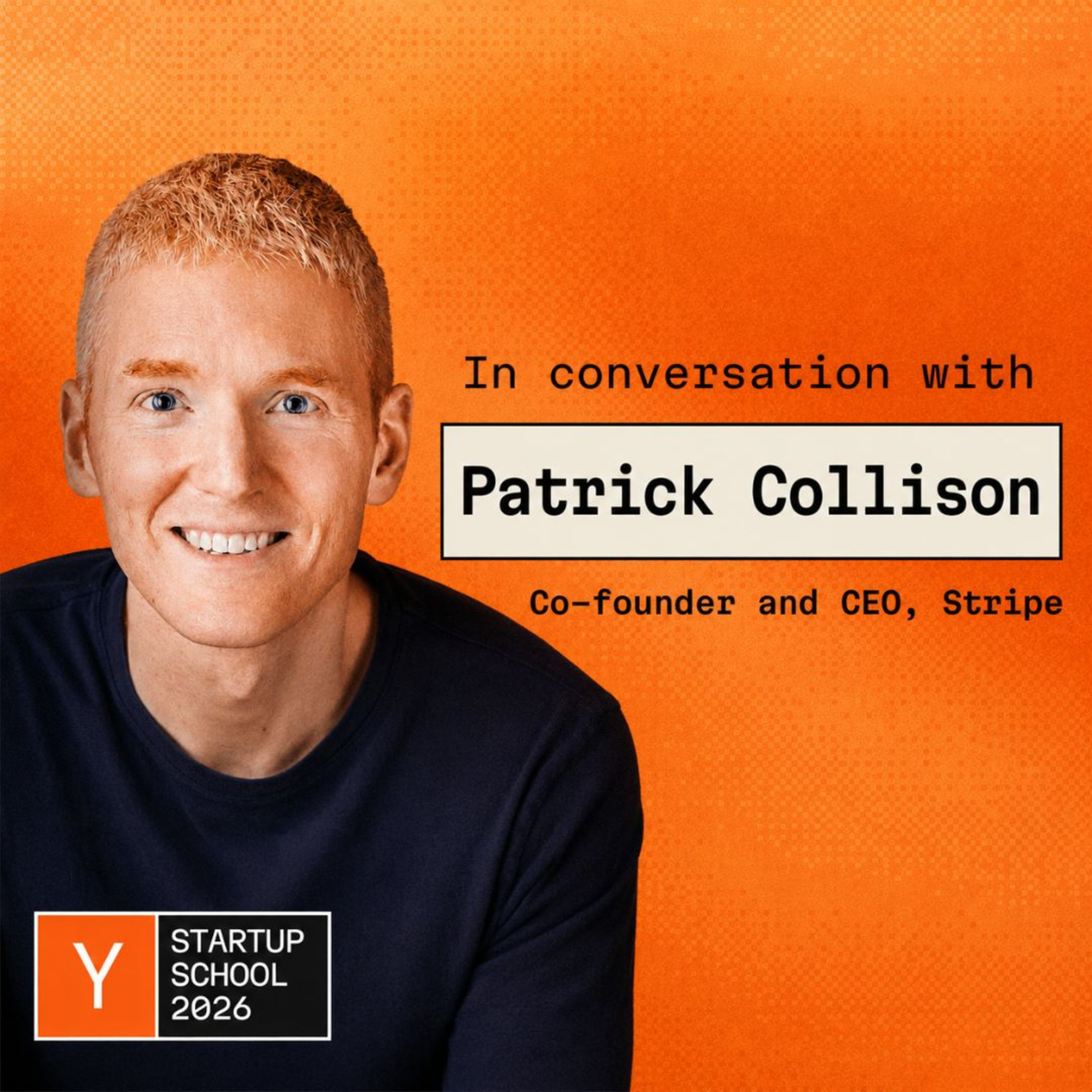
Okay, Patrick, thanks so much for being here. Welcome to StartUp School. Great to be here. Harj and I first met 20 years ago, and we started a company together. That's how I'm giving away the introduction.
Yeah, I thought this was my interview, but I keep going. Well, I was going to start a company together many, many years ago, and I learned a huge amount from Harj, so it's really fun to do this. All right, let's, well actually, I mean, speaking of that, so when I think when I first met you 20, something years ago, at the time, your most impressive achievement, I would argue, was Chroma, your dialect of Lisp. Any Lisp programmers here? Oh, wow, okay, that was, I think I heard one whoop just more than I expected.
But yeah, I really like Lisp when I was in high school. Yeah, so what I was going to ask is a prolific 16-year-old today, you could presume you just prompt call to write their Lisp dialect, would you advise them to not do that and still do it? Is there any value in such things? I don't know, I wonder a lot. Yeah, like I was saying, on the one hand, it used to be really fun to write all this assembly and machine code and optimize your instructions and layout and memory and everything, and now we don't have to do that anymore, or compilers do it for us.
We don't mourn it too much. And so maybe in the same way, we shouldn't mourn source code, we should just transcend to the plane of instructions to Claudius at all. Emotionally, I'm sorry. How about, I think just as I've been hanging out here with these students, they're making the question behind it as many of them are just wondering, what should they be learning at college? Like what is sort of in this AI world, like how much are they trying to learn and derive from first principles and how much are they just outsourced to the AI?
Right, I mean, my model of this is cash, the CH and SH, where Jeff Dean has this famous set of numbers that every programmer should know, bandwidths and leakencies and just kind of relevant constants. You show the reason about it as you build systems. And obviously, when you're thinking about building any system or distributors or whatever, like all lookups and all the bandwidths between different components are very different. And you're treating something from L1 cash as very different from RAM as very different from treating across the network or whatever. And I think it's like that was knowledge.
We're fine. Yes, you can ask the agent or something to compute something for you or to look something up or whatever. That's a hell of a lot slower than knowing it in cognitive L1 cash. And you can have way more round trips in your brain than you can muttering through super whisperer or typing it out or whatever. And so I think even granting the full capabilities of the models, I still think this is a pretty, I think for a long time to come, neuronal lookups will be much faster.
And then look at revealed preference at what companies themselves are doing, whether they are companies like Stripe or Labs or what have you. There still seems to be an enormous premium on cognitive ability. And so I think renouncing that before there's evidence that we've saturated those benefits, we can't make sure. Are there specific things that maybe you personally, either personally or as CEO of Stripe, you still purposely choose to sort of do yourself and retrieve from your own cash, even though the agents would probably do a reasonably good job.
I still write myself. Like I both philosophically but also specifically, substantively dislike the writing of the models. I mean, it's very interesting, right? Because these can prove the Jacobian conjecture, whatever. And so clearly they're capable of these monumental feats.
But somehow, I still haven't read the LLM essay that I found super compelling. Now, it's just very hard to like RL them in that domain because the utility function or something is kind of hard to define. But yeah, I think writing is a pretty interpersonal communication and writing I think are so very fundamental. And so it'll be also reason sensibly in the multi-dimensional space of the alley. And in some kind of indescribable way, I feel like a model is kind of deficient to that.
And so I've never yet to send, you know, every tool is now trying to prompt me with pre-written suggestions, whether it's Gmail or apparently Pot's app to roll this out. And I think I still send zero of those in my life. How about so if you talk about the Stripe story, the only days in particular a little bit, you were at MIT, then you left to start Stripe. How did you think about that decision? And obviously, we're in a stadium full of college students.
How should they think about it? How do they know if it's the right decision for them to leave college early and go start a company versus a? Yeah. Well, I think I have the slightly unusual distinction of having dropped out of college twice to start a company. So maybe one thing to know is that it's not totally trapped or you can drop out and in fact return.
So I dropped out of my freshman semester to start this company with Harge. That was super fun. And then after a couple of years of that, I went back to another year at MIT and then dropped out again to start Stripe. And when I went to college, I had a lot of people here. I had this vision of my life involving becoming an academic and I realized physics and I thought, I'll do all this physics stuff.
It's so cool. I've read all the finding books, all this. And I guess I am growing up in Ireland. I hadn't thought much about the possibility of startups. Hello to the other guys from Zurich.
And way back then, in the sort of pre-cambrian era, startups were definitely much less well-known, even on campus and so forth. When I was dropping out, people thought it was super weird. I think overall, if you enjoy college, I would actually, I think there's no harm in finishing. I felt this real sense of urgency, which I think in hindsight was a bit unnecessary. But if you don't enjoy college, just whatever, it's not your thing.
It's not captivates you. You don't really want to learn all the physics things or whatever. I think a lot of parents think of dropping out is very risky and impugning your reputation for the rest of your life and so forth. And as far as I can tell, nobody has ever cared. So I both think you don't need to, but also the cost of doing so are doing this.
But what was the urgency you were feeling? The urgency? Yeah, to kind of do something. I don't know. I like this short, right?
And I mean, it was a general kind of haste. A lot of us, I'm sure many people here, you kind of get into this mode of speed running high school and then once you get to college, obviously I'm going to speed run that as well and do all the things. So a bit of that, a bit of marking these amounts I talked about a version of this. I thought that a bunch of the opportunities in startups in Silicon Valley and so forth were ephemeral and fleeting. And if we didn't build it then, it wouldn't be possible to do it in three or four years.
And maybe all the opportunities will be gone. In hindsight, I think that there was a poor intuition. It's been pretty robustly and reliably the case over many decades in Silicon Valley has a surface of opportunities. Yeah, I think it's going to go through things. I mean, this is a very common thing that we hear from students now is that they are part of the reason they want to drop out on masks, it seems, at this point.
Is there worry that actually now is the moment that there's sort of, I think the mean going around is that if you don't sort of drop out and start a company and make lots of money, you're going to be trapped in the permanent underclass. So should everyone here be worried about being stuck in the permanent underclass, I guess the question? I think humanity has always had an affinity for these millenarian models of how everything will soon come to an end and be this permanent transformation of society. And so forth, actually, it's a great book, The Winged Gospel. People thought that after the invention of aviation, that it was just, like, civilization was just entering and humanity as a species were entering a new era.
And nothing is going to be the same. And the aviation was a pretty big deal, but I don't think it was quite the sociological rewriting that some of the exciting proponents of the time imagined. So it's hard to predict anything in the future, but I would take the under on this being the last couple of years to actually have to go. Fair enough. So going back to the story, Strybot ostensibly seems like a good idea.
Even on day one, it's the internet's a big deal, money's a big deal, they combine those two things. Because you mean, is that how it went when you went and saw people, you wanted to start Strybot? They wanted to say, hey, this is a great, this is obviously a good idea. It was kind of funny, it was something we learned from IC was the importance of focusing on very concrete, easy to explain customer problems. It's very easy to hallucinate or to imagine some customer problem that's not actually something disruly felt by a person who would pay money.
And so of course, in part working on automatic together, we used to have been captured this issue of being really annoying to deal with movement of money or payments or whatever on the internet. And on the one hand, it seemed like an obviously good idea. In the sense that nobody liked the existing ways of doing so. And they were broadly extremely unpopular and antiquated and legacy and yet to sell. There's paperwork and go to the bank in person and the paperwork is in lacking and just like it's all bad.
But then the flip side is it just seems kind of ridiculous that two kids would start a financial services business. And FinTech didn't exist as a sector at the time, like the words literally didn't exist. And so it's just kind of, we felt like proverbial squirrels in a trench coat, trying to masquerade as a sort of a real business or as serious adults, but obviously knowing nothing coming in about the space and answering a lot of people we met and pitched or partners or whatever that we talked to. I mean, it didn't literally laugh at the room, but I kind of see them looking for the buttons and like call security under the desk to have them call us out because it just seems so improbable.
Anyway, I'd say it's both an obviously good idea that people really wanted this, but also a bad idea that we did seriously. But I think the fact that it was ultimately the fact that it was grounded in such a concrete actual real user problem saved us. You actually speaking about how did you, you know how to actually build a product, you had to get a banking partner and do things at a typical software company did not have to do. As two young founders, how did you manage to convince a bank to trust you at the end? Yeah, actually this is not an answer to your question.
But just I think the strikes that I sit here is the reason we decided to start Stripe is because so John and I were in college together, he was in his freshman year and we went to startup school in 2009, which was held in Berkeley. And we thought it was pretty cool. And so we went to be got sushi afterwards in Portraero and we were walking back from sushi and we're like, you know, we've kind of been taking around this idea for a payment thing or we've been thinking of the space. And it was walking back that evening after a startup school that we decided to start Stripe. I remember it was really where we were on the road.
And I remember we said to each other, which was, yeah, you know, we might as well because it probably won't be that hard. Okay, so more of the story is go get sushi in Portraero tonight and you might start the next stripe. And yes, be aware of sort of these ultimate Yak Shaves, we thought we could do it on the side, while in college, take a couple months, and that was almost 17 years ago. At the time, I remember you were also unusual in that you took sort of longer to do a big public launch. And especially within the YC world, the motto is very much to launch early, launch quickly, be out there and iterate.
Could you maybe talk us through a little bit about that? Why did you do it that way? Yeah, so we started working on Stripe seriously in the week after that startup school, but we're going to end college one full time. We started working full time, the summer 2010, we launched publicly September 2011. So almost two years after like the first lines of code, after the week it started.
And yeah, we didn't two years to launch, it seems, I mean, for a good YC meeting every week, I think we have a, you know, bludgeoned on the head. I think, and many domains probably use the wrong thing to do. In our main country last question, because we had to do so much stuff around security and partners and money movement and infrastructure and reliability and all the things, it just, we didn't feel like we could scale a really good self-serve experience without getting a lot of the kind of the preconditions and infrastructure in place. The, I think the thing that saved us and meant that it wasn't the total walk in the wilderness is we had production users almost from the very beginning.
So first line of code in a follow nine, we got our first live production user in January of 2010. So like two months into working on whatever. And it did very little, like it was very larval and incomplete and our first production customer was Ross Boucher at a company called The Too Any North and all I could do was charge a card. And so, you know, Ross would charge the cards and then you would ask some reasonable questions. Like, how do I, how can I look at all my charges?
Like, reasonable requests. And so, you know, let's code up a little dashboard here and maybe like, well, I want to refund a payment and build a refund support. And then you have for a couple of weeks, it's like, you know, at some point, do I get my money? I'm like, also a reasonable request. So let's fill that functionality.
So it was very kind of just in time development. Hey, so we did a production customer very early and then we did increase, it was in private beta, we increased the number of customers every single month all the way to that public launch. And so every week we had actual customer feedback requests, new users coming in, we're learning things from reality as opposed to our own type of size, or extrapolated conception of it. And I think if you have a significant stream like that of grounding, I think it's probably okay to not be like launch launch. Once you, I mean, you're an expert, you're an expert, you're a really good question.
Yeah, I mean, it is, this is the issue with advice in general is it sort of generalised and like especially in startups, the exception proves the rule. So I think those are certainly, certainly if, you know, the cost of failure is high, then it'll always certainly have to sort of take longer to like build. Maybe we just like Tanger, but something I'm curious about later to this though is, with these coding agencies, just like build and produce software actually, and quickly, I wonder, should people be taking more of this path, should people be more ambitious in general with what the version one of the thing that they launch is, or is it still fundamentally good product design to start like narrow and focus and then expand out once you know what people want?
Yeah, it's a good question. I think probably in the era of AI, I don't know, and sometimes I see, well, we'll be an expert here, but the whole kind of traditional lean startup doctrine, like I said, you say, like start out by buying the Google ads or something and identify this credits or whatever, and it's usually a fan out from it. I think you can certainly imagine that that becomes much more competitive and much more aggressively tilled and it's kind of hard to find those little niches, the internet's a much bigger place than it was 20 years ago when some of those ideas emerged, whereas taking these really divergent starting points where nobody else is trying to occupy that territory is maybe a more, like, maybe you have to more aggressively decorate in the era of AI, and I think about it about maybe the most successful over the last 10 years, so many of them are every anti-lean startup, right?
Whether it's the lamps themselves or andril or you can go down the list a lot of them have this characteristic. So I think, maybe a better way of saying it is 20 years ago, the whole lean startup thing was almost the only thing to do because of capital available, you didn't have AI, that made spinning up an organization with many different potentialities to give it to be so much easier, whereas now I think you can start these much more aggressive and ambitious things up front. Within sort of YC, I probably saw a lot of this point, you're famous for the, at least the pool-grame term, you're schlep blindness, this stripe. At least on the surface was not, you know, a lot of schleps, like things that, between me, weren't like the intellectually most interesting things to work on.
And I always find that especially interesting for you because you just mentioned you, you had academic interests in physics and I just, like, you know, a deep intellectual and have very many things that you're interested in. As Stryp has sort of grown into this big company, in what ways, sort of, you know, in what ways are this sort of like intellectual rewards that you've given up and which ones have you gained? Yeah, I mean, in any company, there's a bunch of stuff that's not that rewarding or in and of itself, all that interesting, like setting a payroll, no one sort of starts a company, so that you can set a payroll and sort of building those inferences, all sorts of more arcane and extensive versions of that. I think that, I actually feel like truly lucky with Stryp and in this respect.
And I think this is something, I don't know if you need to think about it that much upfront, but I think, when to think about it maybe before you raise a significant amount of money, you know, you always worry naturally about possibly a failure and, you know, what will happen if you fail and how to mitigate and avoid failure and all those things. I need you to ask the sort of converse of that, what if you succeed and you raise money and you've customers and you've employees and a whole thing, like are you gonna enjoy that? Are you gonna want to work on that for 10 years, for 17 years, for 30 years? I mean, Larry Ellison in Oracle is going for, I guess it'll be a half century soon, right?
So, what if you succeed? And in the case of Stryp, I really love it because we're working with the world's most interesting and innovative companies. Like we're 25% of all Delaware corporations are started with Stryp via Atlas and then we get to partner with them and work with them and hear from them and get their feedback and get their requests and everything through the entirety of the journey up to being the Shopify's and the Open AIs and all the standout successes. Oh, and actually speaking of Atlas, we're getting free Atlas incorporation to every start up school. So, if you are struck by the urge to found something over dinner this evening as we work at e-mail startupschool.com and we will get to your link for free Atlas.
But yeah, I think PG latched onto something where you had all these kind of menial tasks, but in the kind of totality of Stryp, I find it so interesting. Like every business is a kind of applied theory on how some aspect of the world works or how some market works or how some, if the new company with the new model, it's kind of a contrarian thesis on some kind of factual, but yeah, it's like it's, I've never met a Stryp customer in thought that's boring. So, it's actually, the business of all has been the opposite of the shut blindness insect. And you have a particular unique perspective in this because you work with the big model providers, big lab companies and you work with all the fast varying AI startups on the ground.
Something that came up about here yesterday, obviously comes up in the batches too, is people just worried about, is my idea going to get sort of trampled by the big lab providers? And I'm giving you a perspective and just curious like how should people think about that? Yeah, again, predictions are hard and certainly the labs are very competent in cable organizations. And maybe to separate a little bit, will rapidly improving AI capabilities do this or will the labs specifically themselves do this? I think in general, the track record of like, no organization, if we go back 20 years, there's some of the sense with Google, like when we were doing automatic, the question was always for our company and every other company, you know, Google does this.
And Google seemed kind of omnipotent and had this immense number of incredibly talented people and essentially infinite access to capital and server. And there's all the things. And just human organizations are complicated and it's very hard to manage to aggressively prosecute 100 different priorities and to deal with all the issues and interference that rises among them and so forth. And so Google has done really well in a bunch of specific places, but it's not like Google has done all the things, even if it's in some kind of basic material sense, Google maybe had that ability. So I'd say that the kind of the track record that is checker in general, I think that fear has been overstated.
Now, I think there is a more specific thing. I'm just like models themselves, forget the labs, even the labs aren't specifically ambitious about expanding their scope. We just like literally, at a length will obviously a bunch of identicabilities will have yet a bunch of specific verticals or tasks or something. Hard to say, obviously contingent on one's forecast of the model capabilities themselves, but in certain cases, I'm sure that will happen. I mean, in certain domains, it has already happened.
Looking at the striped data, one thing I will say that I think is germane to people here. There are many more businesses getting started now than there were a year ago, like as little as a year ago, way, way more than we're getting started, five years ago. And actually the relative change between last year and this year is pretty much the largest relative change we've seen in any given year. So for example, from 2019 to 2020, we saw a big jump, understandable during COVID. So in February to April of 2020 or whatever, I think the growth rate inflected to maybe 50% were there about Euro a year because of the new business getting started.
As I speak, the number of new business starting on stride is up around, it's a bit under, but around 2x Euro a year, which again is the largest relative jump we've seen. And you might think, okay, fine, there's way more vibe-coded, kind of lightweight slop, whatever, like fine, there's more things, but like I've been actually succeeding. But actually the median business is doing better this year than a year ago. And so, and then if we kind of stratify as you look at the probability that any given business will reach some revenue threshold, $1,000, $5 million, $5 million, $10 million, whatever, those all seem to be getting better.
Business are the time to revenue for new companies and growth analysts is declining. And so by all that kind of objective metrics we can look at, it seems to be a better time than ever to start a business. And again, things can change out of the world, it looked like in five years, but speaking today on July 26th or whatever it is of 26, I think the Stripe data would suggest it's never a better time. I mean, we see the exact same thing the YC batches, companies are just able to grow faster than ever, certainly within the back. Back in again, the old days when Arjun and I were first starting out, which like getting to $1 million in revenue, like when we're in revenue, was a big deal.
Like people would know about that company. They'd be like, you know, I heard that X company got to $1 million in revenue. And now, I mean, that's- Yeah, actually, you should be, what your first month, if you guys like, that's an exaggeration for everyone here. I mean, it's only within sort of that sort of like the YC part of the life cycle, like day zero to 90, it's really been driven by, I would say, enterprises willing to buy from startups, which have new things, you can sign these new contracts within like the batch. You have the data as the companies keep growing.
I'm curious, are there other factors that are driving these sort of inflicted growth curves from like one to 10 and 10 to 100? I think it's really the benefit you just mentioned, which is businesses everywhere are more spring loaded to adapt and to try new things. And they have a real terror of being left behind with archaic and antiquated ways of operating. And so in normal times, when you start up, you have some mechanisms for doing whatever, and you pitch the CIO or the CTO or the whoever at some company, and they kind of don't want to talk to you because your thing is not validated, maybe it'll be around in two years, all the kind of obvious objections.
But now, people know that, well, the risk of the status quo is actually extremely high. And so even if there's risk in doing all the new things, well, this path also looks pretty dangerous. And so I really think there's never been a better time for startups to sell. And to have their products get adopted at a pretty meaningful scale right out of the gate, a lot of YC companies in recent times have demonstrated this, but I think it's a really pervasive dynamic. And this is a bit of an I think also, I mean, Stripe is not a consumer company obviously, but I think there's some version of this on the consumer side, where I think consumers, I mean, are also pretty, I mean, consumers have complicated views on AI, and maybe they don't want the data centers, but people are very intrigued by the products.
And I think there is a kind of, they're kind of beguiled by them, and there's a predisposition and an openness to experimenting with the new. Maybe some of the broad ways I'm curious about is again, the data you have at Stripe, has anything you've seen in that data changed a belief you have about AI broadly, say over the last 12 months? I mean, there's a fear that AI is going to be this hegemonic centralizing, totalizing force, where a small number of companies gobble up a very large share of the economy, and many companies at the forefront of AI have done incredibly well, and I think will continue to do incredibly well for sure.
But basically we can see at Stripe the hunger and the intensity with which other companies are either getting started, taking advantage of these new capabilities, or existing companies are retooling. I don't worry about the centralization in the same way. I think there are going to be many thousands of winners. And again, we try not to offer any definitive prognostications because the future is not predetermined, but based on the trend lines we can see, I think we are heading towards a more decentralized world and one with more broad base prosperity. All right, well, I think that is all we have time for today.
So thanks so much, Patrick. Thank you for having me. And it would be remiss if we not to say that Stripe would not exist without YC. Oh, cool. All right.
Thank you so much.