
EPISODE · Jun 3, 2026 · 6 MIN
Piazza Maggiore-ingl.
from The Squares of Bologna · host ASPPI
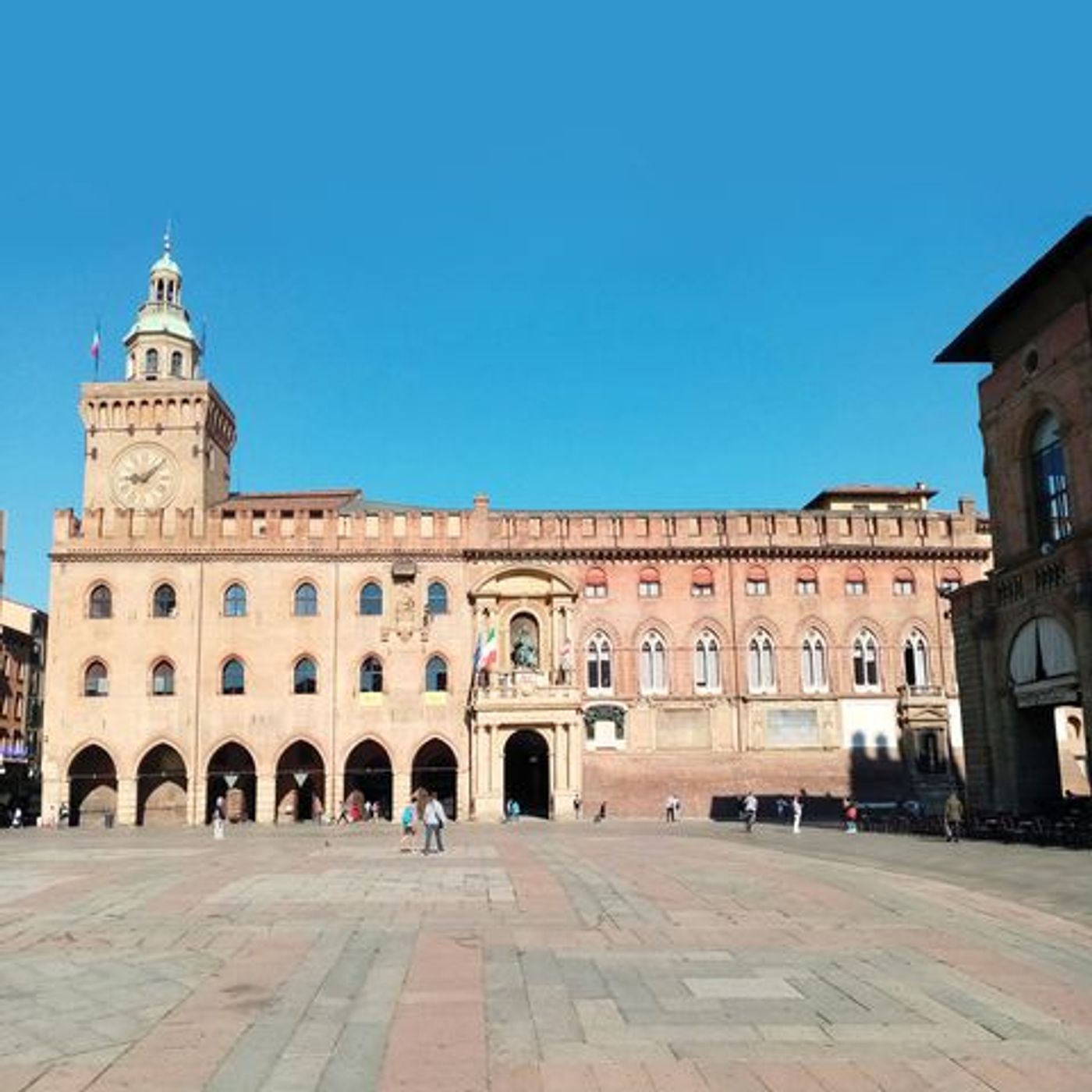
PIAZZA MAGGIORE In the heart of Bologna lies Piazza Maggiore, one of the most iconic and meaningful urban spaces in medieval and modern Italy. Since its creation in the 13th century, it has been the main stage for the city’s political, religious, and social life. The square was officially established in the early 1200s, when the city’s government decided to create a public space to represent civil power and meet the needs of a growing urban population. Many buildings and towers were expropriated and demolished, opening up an area defined by ancient Roman roads. One ran east to west, corresponding to today’s façade of San Petronio and continued toward one of the city gates. Another ran north to south, along Via dell’Archiginnasio and the Palazzo dei Banchi. A third aligned with the current Town Hall, while a fourth passed under the Palazzo del Podestà, ending at the Fountain of Neptune. This was the first large square in a city that had none before—and it was large enough to hold all of Bologna’s 50,000 inhabitants in 1200. At the same time, the Palazzo del Podestà was built and nearly completed by 1208. It served both administrative and commercial functions. Beneath it, a covered crossroads of streets became the city’s new focal point. But it was soon nicknamed the “old” palace, as a new building rose nearby: the one where Enzo of Swabia, son of Emperor Frederick II, would live in captivity for over 20 years. This building became known as Palazzo Re Enzo—King Enzo’s Palace. Today, only the bell tower remains of the original Palazzo del Podestà. Known as the Torre dell’Arengo, it had already been summoning citizens to assembly as early as 1212. Beneath the Voltone del Podestà, the vaulted passage linking Piazza Maggiore to Piazza Re Enzo, lies a fascinating curiosity. If two people stand at opposite corners of the vault and whisper toward the wall, they can hear each other perfectly, thanks to a unique acoustic reflection phenomenon. According to tradition, friars once used this trick to listen to the confessions of the contagious without risk of infection. To the west of the square stands Palazzo d’Accursio, now the Town Hall, originally built in 1287 and later expanded and restored. The left wing is the oldest part, having been the home of the Accursio family in the 12th and 13th centuries, and from 1336, the seat of the city’s ruling magistrates, the Anziani. The current clock tower was raised in the late 15th century, during which Niccolò dell’Arca also created the terracotta Madonna and Child on the façade. The right wing, in Gothic style, features eight windows from the early 1400s, designed by Fioravante Fioravanti. In the 1500s, the Umbrian architect Galeazzo Alessi added a large Renaissance window and created a grand triumphal entrance. Above it stands the statue, sculpted by Alessandro Menganti, of Pope Gregory XIII—born Ugo Boncompagni of Bologna and known for the 1582 calendar reform. In 1796, to save the statue from destruction by Napoleonic troops, the people of Bologna disguised it as Saint Petronius, their patron saint. This move preserved the sculpture until it was restored to its original form at the end of the century. On the façade of the Town Hall, a marble plaque displays the ancient units of measurement once used in Bologna, placed there for public reference since the square hosted the city’s largest market until 1877. Above the plaque are two terracotta eagles, replicas of the originals destroyed during a popular uprising in 1511. According to tradition, one of the original eagles was sculpted by Michelangelo during one of his stays in Bologna. Between the 16th and 19th centuries, the palace housed the Papal Legates. Today, it serves as the seat of Bologna’s municipal government and contains the Civic Art Collections and the Morandi Museum. Facing the square stands the Basilica of San Petronio, originally intended to be the largest civic church in Europe. Construction began in 1390, based on designs by Antonio di Vincenzo. However, in the 17th century, expansion was halted when Pope Pius IV had the nearby Jesuit College built to block its development. The current façade, half covered in marble and half in brick, reflects this clash between religious and civic power. On the other side of the square is the Palazzo dei Notai, built between 1384 and 1422 by the Notaries’ Guild as their headquarters. The building, also designed by Antonio di Vincenzo, features their emblem on its façade —a shield with three inkwells and quills. It was restored in 1908 by Alfonso Rubbiani, who emphasised its medieval character. In the 1500s, the entire area underwent significant reshaping under papal orders. The nearby Piazza del Nettuno and the Palazzo dell’Archiginnasio were built. In 1568, architect Jacopo Barozzi, known as Il Vignola, closed the eastern side of the square by constructing the Palazzo dei Banchi and the Portico del Pavaglione, behind which the medieval Mercato di Mezzo was hidden. In 1860, the square was named after King Victor Emmanuel II; it was only in June 1945 that it officially regained its original name, Piazza Maggiore. At its centre lies a slightly raised pedestrian platform, built in 1934 from pink and white granite. It’s affectionately known as the “Crescentone”, a name believed to come from the traditional Bolognese flatbread, the crescenta. Over the centuries, Piazza Maggiore has remained the beating heart of Bologna. Here took place religious processions and civic parades, public executions and solemn oaths. In modern times, it witnessed the protests of the Risorgimento, anti-fascist demonstrations, and Resistance celebrations. Even today, the square hosts concerts, open-air cinema, rallies, and gatherings. Piazza Maggiore is not just a public space—it is an open-air archive of Bologna’s rich and layered history.
What this episode covers
PIAZZA MAGGIORE In the heart of Bologna lies Piazza Maggiore, one of the most iconic and meaningful urban spaces in medieval and modern Italy. Since its creation in the 13th century, it has been the main stage for the city’s political, religious, and social life. The square was officially established in the early 1200s, when the city’s government decided to create a public space to represent civil power and meet the needs of a growing urban population. Many buildings and towers were expropriated and demolished, opening up an area defined by ancient Roman roads. One ran east to west, corresponding to today’s façade of San Petronio and continued toward one of the city gates. Another ran north to south, along Via dell’Archiginnasio and the Palazzo dei Banchi. A third aligned with the current Town Hall, while a fourth passed under the Palazzo del Podestà, ending at the Fountain of Neptune. This was the first large square in a city that had none before—and it was large enough to hold all of Bologna’s 50,000 inhabitants in 1200. At the same time, the Palazzo del Podestà was built and nearly completed by 1208. It served both administrative and commercial functions. Beneath it, a covered crossroads of streets became the city’s new focal point. But it was soon nicknamed the “old” palace, as a new building rose nearby: the one where Enzo of Swabia, son of Emperor Frederick II, would live in captivity for over 20 years. This building became known as Palazzo Re Enzo—King Enzo’s Palace. Today, only the bell tower remains of the original Palazzo del Podestà. Known as the Torre dell’Arengo, it had already been summoning citizens to assembly as early as 1212. Beneath the Voltone del Podestà, the vaulted passage linking Piazza Maggiore to Piazza Re Enzo, lies a fascinating curiosity. If two people stand at opposite corners of the vault and whisper toward the wall, they can hear each other perfectly, thanks to a unique acoustic reflection phenomenon. According to tradition, friars once used this trick to listen to the confessions of the contagious without risk of infection. To the west of the square stands Palazzo d’Accursio, now the Town Hall, originally built in 1287 and later expanded and restored. The left wing is the oldest part, having been the home of the Accursio family in the 12th and 13th centuries, and from 1336, the seat of the city’s ruling magistrates, the Anziani. The current clock tower was raised in the late 15th century, during which Niccolò dell’Arca also created the terracotta Madonna and Child on the façade. The right wing, in Gothic style, features eight windows from the early 1400s, designed by Fioravante Fioravanti. In the 1500s, the Umbrian architect Galeazzo Alessi added a large Renaissance window and created a grand triumphal entrance. Above it stands the statue, sculpted by Alessandro Menganti, of Pope Gregory XIII—born Ugo Boncompagni of Bologna and known for the 1582 calendar reform. In 1796, to save the statue from destruction by Napoleonic troops, the people of Bologna disguised it as Saint Petronius, their patron saint. This move preserved the sculpture until it was restored to its original form at the end of the century. On the façade of the Town Hall, a marble plaque displays the ancient units of measurement once used in Bologna, placed there for public reference since the square hosted the city’s largest market until 1877. Above the plaque are two terracotta eagles, replicas of the originals destroyed during a popular uprising in 1511. According to tradition, one of the original eagles was sculpted by Michelangelo during one of his stays in Bologna. Between the 16th and 19th centuries, the palace housed the Papal Legates. Today, it serves as the seat of Bologna’s municipal government and contains the Civic Art Collections and the Morandi Museum. Facing the square stands the Basilica of San Petronio, originally intended to be the largest civic...
NOW PLAYING
Piazza Maggiore-ingl.
No transcript for this episode yet
Similar Episodes
Mar 26, 2026 ·1m
Mar 19, 2026 ·34m
Feb 18, 2026 ·11m
Feb 11, 2026 ·45m