
PODCAST · education
The Squares of Bologna
by ASPPI
Introduction to The Squares of Bologna Walking through Bologna means crossing centuries of history, preserved not only in its buildings and porticoes but, above all, in its squares. These are living spaces where the city reveals its true self: a harmonious blend of culture, spirituality, politics, and daily life. Its squares—whether vast or intimate, monumental or secluded—tell the story of the city’s life. They are places where the past is not merely remembered but still lived: settings for markets, art, religion, struggle, and celebration. Every stone tells a chapter of collective life and in an era where cities tend to become uniform, Bologna proudly preserves its squares as a living memory of its history and culture. The most important is Piazza Maggiore, the symbolic and geographical heart of the city. It was established in the Middle Ages as a space for markets and civic administration and is flanked by the city’s main public and religious buildings, including the basilica
-
20
Piazza Galvani-ingl.
PIAZZA GALVANI Behind the majestic Basilica of San Petronio, nestled between the elegant architecture of Via Farini and the historic porticoes of the city centre, one finds Piazza Galvani — one of the most refined and historically rich corners of Bologna. Once known by various names — Piazza dell’Accademia, dell’Archiginnasio, delle Scuole, della Pace, and more popularly as Piazza del Pavaglione — this square has always been a significant crossroads, both culturally and socially. Its name evokes the scientific brilliance of Luigi Galvani, the renowned 18th-century Bolognese physician and physicist, famous for his pioneering studies on animal electricity. At the centre of the square stands a marble statue of the scientist, depicted observing an open book on which a frog — symbol of his electrophysiological experiments — rests. The statue was sculpted by Adalberto Cencetti and unveiled in 1879. It is not uncommon to see students stop to photograph it or, as a gesture of respect and a touch of superstition, gently touch the frog before an exam. Adding even more significance to this space is the presence of the Civic Archaeological Museum, housed in Palazzo Galvani, which faces directly onto the square. Considered one of the most important archaeological museums in Italy, it holds rich Egyptian, Etruscan, Roman, and Greek collections — proving Bologna’s deep historical and cultural roots. Even before the square was dedicated to the celebrated scientist, this area was an integral part of the Basilica of San Petronio’s complex. The decision to open a new square dates back to 1563, when Pope Pius IV, for reasons of town-planning but also as a political move, wanted to create an open space in front of the Archiginnasio, the new seat of the University. The project was entrusted to Antonio Morandi, known as “il Terribilia,” and commissioned by Cardinal Carlo Borromeo. In less than two years, the Archiginnasio was completed, with a two-story façade and a portico made of terracotta and sandstone, that still impresses with its simplicity and elegance. The portico, with its 15 bays marked by Corinthian pilasters, initially hosted small shops which, with their rent, helped fund the construction of San Petronio. A curious aspect of the square is linked to the silk cocoon market, which took place here as early as 1449. The name Pavaglione — derived from the local dialect word for pavilion — remains in widespread usage. Silk was for centuries one of the city’s primary economic resources. To this day, beneath the Pavaglione portico stands the historic Zanichelli Bookstore, where poet Giosuè Carducci used to retreat in the late 19th century. The bookseller even reserved a room for him to read and write undisturbed — a small gesture we might now call “fan service,” but one that contributed to Bologna’s cultural vibrancy at the time. Also under the portico, in the 1920s, opened the historic Bar Zanarini — now one of the city’s most iconic cafés. Nearby, the Veronesi jewellery shop, which moved here in 1922 from Via degli Orefici, continues to embody the timeless elegance of this corner of Bologna. Another unique feature of Piazza Galvani is the remarkable concentration of art and artists who have left their mark here. Michelangelo sculpted his statue of Julius II here in 1506, Giambologna created his Neptune in 1564, and Alessandro Menganti cast the statue of Gregory XIII in 1580. The square was also home to sculptor Alfonso Lombardi, author of many works, amongst which the statues of the Four Patron Saints of Bologna beneath the arch of Palazzo del Podestà and the famous Lamentation over the Dead Christ. From this square, one enjoys a privileged view of one of the city’s most fascinating architectural imperfections: the apse of the Basilica of San Petronio. If you look closely, you can see that the masonry was sealed off in a makeshift manner. Legend has it that it was Pope Pius IV Medici himself who obstructed the completion of the church, fearing it would outshine St. Peter’s Basilica in Rome. And so, to this day, San Petronio remains unfinished — but perhaps even more captivating because of it.
-
19
Piazza Lucio Dalla-ingl.
PIAZZA LUCIO DALLA one of the most recent urban plannings in Bologna, is situated in the heart of the Bolognina district, just steps away from the Central Station (Stazione Centrale). This area was formerly home to the Fruit and Vegetable Market on Via Aristotile Fioravanti. Inaugurated in 2022 and named after the famous Bolognese singer-songwriter, the square is part of an ambitious urban redevelopment project that has transformed a large section of the city’s former industrial landscape into a multifunctional hub featuring a mix of residential, commercial, cultural, and office spaces. More than simply a tribute to one of Italy’s most cherished artists, Piazza Lucio Dalla represents a new vision for public spaces: it is an open, accessible, and vibrant area designed to welcome the community and inspire creativity. At its center is an urban arena with tiered seating, created to host events, performances, and civic gatherings—making the square a dynamic venue, ready to serve as a stage, an agora, or a communal meeting point. The choice of paving materials prioritizes durability and continuity, making them suitable for heavy pedestrian use. Additionally, the urban furnishings seamlessly combine contemporary design with functionality, incorporating LED lighting, wooden and steel benches, and landscaped flower beds of native plants. Together, these elements foster a welcoming atmosphere while promoting environmental sustainability. Due to its strategic location, which connects it to the city’s central railway lines and bike routes, the square acts as a vital link between historic Bologna and the newer developments to the north. The surrounding buildings, constructed in accordance with environmental sustainability standards, help create an innovative urban landscape that successfully combines architectural modernity with historical identity and enhances the overall quality of urban life.
-
18
Piazza Liber Paradisus-ingl.
PIAZZA LIBER PARADISUS In Bologna, just beyond the central station and leaving behind the chaos of the busy avenues, there is an oasis of modernity and light: Piazza Liber Paradisus. Located in the heart of the Bolognina district, this square is one of the city’s most recent and symbolic urban spaces, a place that remarkably blends history and innovation. Its name is rooted in a historical document of universal significance: the Liber Paradisus of 1256. It was then that the Municipality of Bologna abolished serfdom, freeing thousands of serfs and marking one of the earliest formal declarations of personal freedom in Europe. This pioneering act remains a milestone in the history of law and humanism, granting Bologna a leading role that is still felt in the atmosphere of this square today. Surrounded by modern buildings, including the prominent Palazzo Bonaccorso—dedicated to the podestà who enacted the Liber Paradisus law—the square stands at the centre of an ambitious urban redevelopment project. It hosts a cutting-edge institutional hub, perfectly connected to the high-speed train station and the rest of the city, embodying Bologna’s determined vision for the future. Aesthetically, Piazza Liber Paradisus captivates with its contemporary architecture: clean, minimalist lines, wide pedestrian spaces, and urban furnishings featuring essential, modern design. A striking fountain uses the natural slope of the square’s ramps to keep the water in constant motion, adding a refreshing and lively element to the environment. Walking among the glass and steel buildings surrounding it is like crossing a bridge between different eras—a continuous dialogue between past and future. The municipal offices housed in the large complex on the northern side tell the story of a city in transformation, committed to transparency, efficiency, and openness—values reflected in its modern geometries, transparent panels, and sleek surfaces. Piazza Liber Paradisus is not just an urban space; it is a living symbol of a Bologna that continues to be reborn and renewed while firmly holding onto its historical roots.
-
17
Piazza dei Tribunali-ingl
PIAZZA DEI TRIBUNALI located behind the Basilica of San Domenico, was opened between 1826 and 1827, when the block in front of Palazzo Ruini was demolished. The order was given by Felice Baciocchi, who at the time owned the palace. He was a politician and the husband of Elisa Bonaparte, sister of Napoleon. However, the new square did not turn out to be very large because Baciocchi lacked the funds to compensate the expropriated owners. Financial difficulties hindered his attempts to modernise the city and create new urban spaces, but some historians believe that, had his original plans been accomplished, the square could have become one of the most important centres of Napoleonic Bologna, with imposing buildings and a central role in public affairs. The main building, Palazzo Ruini, features a façade completed around 1582, likely based on a design by Andrea Palladio. It is called Ruini because it belonged to the Ruini family until 1634, after which it passed to the Ranuzzi family and, finally, in 1822, to the Baciocchi. In a final change of ownership, it was purchased in 1873 by the Municipality of Bologna, which designated it as the seat of the Public Prosecutor’s Office of Bologna. Initially, after the expropriation, the square was named after Felice Baciocchi, but following the transformation of the palace into a courthouse, it was renamed Piazza dei Tribunali in 1878. Between 1920 and 1940, it was renamed Piazza Giulio Giordani, after the liberal councillor who died during the fascist attack on Palazzo d’Accursio in 1920. After the war, it resumed its current name. During renovation works in the 20th century, remains of ancient medieval structures were discovered beneath the square, including drainage channels and parts of the original city walls. These findings suggest that the area was a strategic point since medieval times, directly connected to the city’s defence. Some artefacts are on display in city museums, but there remains an air of mystery around the still unexplored sections beneath the square.
-
16
Piazza Aldrovandi-ingl.
PIAZZA ALDOVRANDI is located in the heart of the Santo Stefano district and is recognizable by its long and narrow shape, stretching from north to south. Like the nearby Via Petroni and Via Guerrazzi—of which it serves as a sort of hinge—the square was created by filling in the ancient moat that once bordered Bologna’s second city wall, dating back to the 11th century and partially destroyed by Frederick Barbarossa in the 12th century. Once the moat was filled, the area became one of the first to be paved with stone—a rare privilege at the time—which earned it the name “Seliciata dei Servi,” later changed to “Seliciata di Strada Maggiore.” It was only in 1874 that the square was renamed in honour of Ulisse Aldrovandi, a renowned physician, naturalist, and true pioneer of modern science, who in the 16th century founded the Botanical Garden of Bologna, one of the oldest in Europe. At the southern end of the square, where Strada Maggiore and Via Guerrazzi intersect, one finds a fascinating corner of history and architecture. On the left stands Palazzo Bianchetti, originally built in the 15th century and renovated in 1790 by architect Angelo Venturoli. The façade facing the square is adorned with a late 16th-century fresco depicting a Crucifixion with the Virgin Mary and Saints John, Paul, and Peter—an artwork that is not widely known, yet holds great spiritual and artistic value. On the opposite side stands one of Bologna’s Baroque masterpieces: Palazzo Davia Bargellini, designed in the 17th century by architect Bartolomeo Provaglia. Its monumental entrance is flanked by two gigantic telamons—colossal sculpted figures that appear to support the portal—now iconic among Bolognese citizens. Today, the building houses the Civic Museum of Industrial Art, which showcases collections illustrating the history of design, craftsmanship, and Bolognese elegance through the centuries. At the northern end, the square opens onto Via San Vitale and Via Petroni, right in front of the picturesque Torresotto di San Vitale and the refined Palazzetto Scagliarini Rossi. The torresotto, part of the medieval city walls, dates back to the late 12th century. The elegant turret at the top—with its loggia and twelve windows—was added in the 15th century, while the passage below was modified in 1603 by the Borzani family, who had acquired the property. Nearby stands Palazzo Scagliarini Rossi, originally built in the 15th century and converted into a Benedictine nunnery in the following century. However, it was during the Napoleonic era that the building underwent a dramatic transformation. Architect Giovanni Battista Martinetti, who made it his residence, redesigned it with taste and originality, even including a rare English-style garden, an uncommon feature in Bologna. His cultured and charming wife, Cornelia Rossi Martinetti, made the palazzo famous as one of the most brilliant literary salons of the 19th century. Among its guests were celebrated figures such as Giacomo Leopardi, Ugo Foscolo, Antonio Canova, Lord Byron, Vincenzo Monti, and even Stendhal, all captivated by her intellect and beauty. In 1877, Piazza Aldrovandi—already known as a stop for horse-drawn carriages (fiacres)—was selected as the new site of the herb market, which until then had been held in Piazza Maggiore. Starting in the early 1990s, permanent kiosks were installed to sell fruits, vegetables, and other goods. While these stalls provide a valuable service, they have also somewhat altered the visual harmony of the square, creating a barrier between the historic porticoes and the open space.
-
15
Piazza Carducci-Ingl.
PIAZZA CARDUCCI Piazza Carducci is located in the heart of the Santo Stefano district and tells a story deeply intertwined with one of the greatest names in Italian literature: Giosuè Carducci, the first Italian to receive the Nobel Prize in Literature, in 1906. Carducci lived in Bologna for most of his life and taught Italian literature at the University for over forty years. For him, Bologna was much more than a place to live: it was a muse, a refuge, and the silent backdrop to many of his works. One of the most striking elements of the square is the monument dedicated to the poet, created in the Art Nouveau style by sculptor Leonardo Bistolfi. The sculpture portrays Carducci seated in thoughtful meditation, surrounded by allegorical figures representing poetry, history, and science, almost suggesting that the poet’s mind embraced the whole of human knowledge. The project was approved shortly after his death and took no less than eighteen years to complete, culminating in its inauguration in 1927. It is said that Bistolfi aimed to portray not only the intellectual, but the man himself, with his stern and melancholic gaze turned toward the passing of time. The green area of the square was donated by Queen Margherita to the city, along with the nearby building: the former 16th-century Oratory of Santa Maria del Piombo, which was converted into a residence in the early 1800s. It was here that Carducci lived from 1890 until his death in 1907, and today the building houses the Carducci House Museum, a true treasure trove of memories: manuscripts, letters, books, and personal objects tell the more intimate side of the poet, where academic rigor coexists with political passion. Today, Piazza Carducci is a lively cultural hub, with cafés, restaurants, and bookshops that make it a popular spot for both locals and visitors. Exhibitions, concerts, book presentations, and small literary festivals are often held here, keeping the poet’s legacy alive in a modern context. Interestingly, many students in Bologna, when passing by the statue, greet it with a playful joke or a respectful nod—a kind of secular ritual for those who love literature, but also for those who know that Carducci was not exactly an easy character: stern, atheist, anti-clerical, yet capable of writing profound and unforgettable verses. Piazza Carducci is not just a tribute to a great intellectual, but a symbol of cultured, secular, and passionate Bologna, a spirit that still lives on in its streets today.
-
14
Piazza VIII Agosto-ingl.
PIAZZA VIII AGOSTO La piazza si trova nella zona nord-orientale del centro storico di Bologna, nei pressi di Porta Mascarella e lungo l’asse viario che conduce alla Stazione Centrale. È una delle piazze più vaste della città e la sua storia è strettamente intrecciata agli usi collettivi e alla vita sociopolitica di Bologna, in epoca ottocentesca e contemporanea. È circondata da edifici realizzati tra il XIX e il XX secolo, mentre sul lato sud si affaccia il Parco della Montagnola, uno dei giardini pubblici più antichi della città. Secondo gli scavi archeologici, in epoca villanoviana (IX-VII secolo a.C.) nell’area sorgeva un grande complesso di impalcati lignei, forse destinato ad assemblee pubbliche della città etrusca di Felsina. Dopo l’abbandono di queste strutture, nel VII secolo a.C., il sito fu trasformato in necropoli e successivamente destinato ad uso agricolo. Dal Medioevo al XVIII secolo, l’area oggi occupata dalla piazza era un campo aperto usato per fiere, mercati e transito merci. Acquisita dal Comune nel 1219, fu chiamata Piazza del Mercato nel 1251 per il mercato del bestiame. Nel 1390 la Repubblica bolognese vi istituì una fiera franca, libera da tasse (tranne il sale), attiva intorno alla festa di San Petronio. Al centro, una croce segnava il luogo delle messe quotidiane. Nel 1656 papa Alessandro VII vi aggiunse una fiera dei cavalli a maggio, commemorata con una colonna dorica con stemma papale. La piazza fu spianata nel 1662 per facilitare le fiere e già nel Seicento era nota anche come “Campo del Mercato” o “Campo di Marte”, per via delle esercitazioni militari. L’attuale nome della piazza ricorda un momento chiave del Risorgimento: la battaglia dell’8 agosto 1848, durante la Prima Guerra d’Indipendenza, quando una sollevazione popolare di studenti, artigiani, contadini e Guardia Civica riuscì a respingere le truppe austriache, pur con mezzi molto inferiori. I combattimenti più intensi si svolsero proprio nell’area della piazza, casa per casa. La vittoria, celebrata in tutta Italia, fu uno dei primi esempi di insurrezione popolare riuscita contro un esercito imperiale. Nel 1903 il Comune dedicò la piazza all’VIII Agosto, erigendo il monumento del Popolano: una statua bronzea, realizzata da Pasquale Rizzoli, che raffigura un giovane patriota armato, simbolo del popolo in rivolta. Da allora, la piazza è divenuta luogo di comizi, proteste e manifestazioni pubbliche. In questa piazza ha parlato Giuseppe Garibaldi, ci sono state manifestazioni antifasciste, proteste studentesche negli anni Settanta, e continua a essere un luogo centrale per la vita pubblica cittadina. Nel Novecento la piazza è stata più volte modificata per adattarsi ai mutamenti urbani. È diventata sede stabile del mercato settimanale della Piazzola, tra i più grandi e frequentati dell’Italia settentrionale. Il mercato ha origini molto antiche e si tiene ancora oggi ogni venerdì e sabato, con centinaia di bancarelle disposte ordinatamente nella piazza. Oltre alla sua funzione commerciale, Piazza VIII Agosto ospita regolarmente eventi pubblici, comizi, concerti e fiere. Accanto alla Montagnola sorgono i resti della Chiesa di San Giovanni Decollato, un tempo sede di esecuzioni. Sullo stesso terreno fu costruito nel 1821 lo Sferisterio, destinato al gioco del pallone col bracciale, realizzato su progetto di Giuseppe Tubertini, poi chiuso nel 1955 e oggi spazio polifunzionale. Nel 1974, all’angolo con via Indipendenza, una lapide ha ricordato Oreste Biavati, ambulante celebre per l’arguzia e i discorsi monitorati dal regime. Nel 2004, un’altra lapide sullo sferisterio ha omaggiato Laura e Nella, “le due pantere”, venditrici instancabili per 65 anni. Nel 2000 è stato inaugurato un parcheggio sotterraneo alla piazza con 980 posti. Al centro, una torre nera alta 10 metri per l’aerazione è stata soprannominata “la Kaaba” per la somiglianza con l’edificio sacro islamico. PIAZZA VIII AGOSTO in inglese The square is located in the northeastern part of Bologna’s historic centre, near Porta Mascarella and along the road axis leading to the Central Station (Stazione Centrale). It is one of the city’s largest squares, and its history is deeply intertwined with Bologna’s collective life and sociopolitical dynamics, both in the 19th century and today. It is surrounded by buildings constructed between the 19th and 20th centuries, and its southern edge borders the Montagnola Park, one of the oldest public gardens in the city. Archaeological excavations have revealed that, during the Villanovan period (9th–7th century BCE), the area was home to a large wooden structure, likely used for public assemblies in the Etruscan city of Felsina. After its abandonment in the 7th century BCE, the site became a necropolis and was later used for agriculture. In the Middle Ages and up until the 18th century, the area now occupied by the square was largely undeveloped, serving as a field for seasonal fairs, markets, and as a transit hub for goods from the Apennines and the Po Valley. The Municipality of Bologna officially acquired the land in 1219, and in 1251, it named it Piazza del Mercato (Market Square), establishing the livestock market. In 1390, the Bolognese Republic established a fiera franca in the square—an open fair exempt from taxes (except on salt), held around the feast of San Petronio. At its centre stood a cross where Mass was celebrated daily. In 1656, Pope Alexander VII introduced a horse fair in May, commemorated by a Doric column bearing the papal coat of arms. The square was levelled in 1662 to better host fairs, and by the 17th century, it was also known as the “Market Field” or “Field of Mars” due to its use for military drills and parades. The current name of the square recalls a key moment of the Risorgimento: the battle of August 8, 1848, during the First War of Independence, when a popular uprising of students, artisans, farmers, and the Civic Guard managed to repel Austrian troops, despite being vastly outmatched. The fiercest fighting took place right in the area of the present-day square, house by house. Celebrated throughout Italy, the victory became one of the first successful examples of a popular insurrection against an imperial army. In 1903, the city dedicated the square to August 8, erecting the monument of the Popolano: a bronze statue of a young armed patriot, by sculptor Pasquale Rizzoli, symbolising the people’s uprising. Since then, the square has been a site for rallies, protests, and public gatherings. Speeches by Giuseppe Garibaldi, anti-fascist demonstrations, and student protests in the 1970s have all taken place here, and it remains a central space for civic life. In the 20th century, the square underwent various transformations in response to urban development. It became the permanent home of the Piazzola market, one of the largest and most popular in northern Italy. The market, with ancient roots, still takes place every Friday and Saturday, filling the square with hundreds of stalls. Beyond its commercial function, Piazza VIII Agosto regularly hosts public events, rallies, concerts, and fairs. Next to the Montagnola are the remains of the Church of San Giovanni Decollato, once used for executions. On the same site, in 1821, the ball court (Sferisterio) for the distinctive Italian game of ball with bracelet (pallone col bracciale) was built, designed by Giuseppe Tubertini.It was later closed in 1955 and now used as a multipurpose space. In 1974, a plaque at the corner of Via Indipendenza commemorated Oreste Biavati, a street vendor known for his wit and speeches monitored by the regime. In 2004, another plaque on the sferisterio honoured Laura and Nella, “the two panthers,” tireless vendors for 65 years. In 2000, an underground car park with 980 spaces was opened. At its centre, a 10-meter-high black ventilation tower was nicknamed “the Kaaba” for its resemblance to the Islamic holy site.
-
13
Piazza Verdi-ingl.
PIAZZA VERDI It is dedicated to the Italian composer Giuseppe Verdi and is located in the historic centre of Bologna, at the heart of the university district. For a long time, the square was not officially recognised in the city’s street naming system and was considered part of Via Zamboni; it was formally named after the famous composer only in 1951. It emerged in the 15th century as an open space in front of Palazzo Bentivoglio. Initially, it bore the name of that noble family until their residence was destroyed in the early 1500s. It is said that during the demolition of the palace by an enraged Bolognese populace, even the latrines were destroyed to erase all traces of their rule. Some claim that valuable objects hidden in the rubble were never found. On the ruins of the palace rose the Teatro Comunale, designed by architect Antonio Galli Bibiena in 1750. Its façade, however, was only completed in 1937, with the addition of a terrace meant to host fascist authorities during public events. The theatre is surrounded by mystery: local legends speak of the ghost of a tenor who tragically died during rehearsals, whose spirit is said to wander the stage and dressing rooms still, whispering and playing lone notes at night. On the southeast side of the square, opposite the theatre, parts of the ancient stables of Bologna’s ruling lords remain—vast, columned spaces that once housed horses, carriages, and weaponry. Along the southwest side of the square runs a section of the city’s second ring of walls, uncovered in 1906. From there, one can see the apse of the Basilica of San Giacomo Maggiore and the final stretch of the elegant Renaissance portico that leads to the Church of Santa Cecilia. In the 18th century, the square was known as Piazza di Santa Cecilia. One Bolognese legend tells of a now-lost garden behind the church where white swans—symbols of purity—were once raised. One of these swans was stolen by a French nobleman to gift to his beloved, but he was caught at the border, and the swan was returned in a sort of popular procession. Since then, people say no love stolen in Piazza Verdi ever lasts. At the corner of the square, at number 25 of Via Zamboni, stands Palazzo Paleotti. Architecturally, it appears as a solid, portico-less block of medieval origin and now houses the university library and multimedia centre. Built by the Salaroli family in the late 15th century, it still preserves a beautiful courtyard with 16th-century frescoes. Among university students, a superstition circulates: entering the inner courtyard before graduation is said to doom one never to graduate. For this reason, many choose to walk around the building, even in bad weather. Throughout the 20th century, Piazza Verdi played a central role in the political and cultural life of the city. During the 1968 student movement and the Years of Lead, it was the stage for protests, marches, and spontaneous assemblies. Police constantly monitored the area, while voices from pirate radio stations echoed from the balconies. In the 1980s and 1990s, the square became a spontaneous performance space, hosting outdoor jam sessions by young musicians who gathered large crowds—some of whom would later go on to have successful musical careers in Italy. Today, especially in the summer, the square continues to host cultural events in the open air, reaffirming its role as a dynamic and symbolic space of university life in Bologna.
-
12
Piazza Malpighi-ingl.
PIAZZA MALPIGHI Located in the Porto-Saragozza district, Piazza Malpighi is named after the 17th-century physician and anatomist Marcello Malpighi. A key junction in the city’s traffic network, it is where several major streets converge— Ugo Bassi, Marconi, San Felice, Pratello, Sant’Isaia, Nosadella, Barberia, Porta Nova, and Piazza San Francesco. The square stretches along what was once the western perimeter of the Roman city, and later of the 12th-century Torresotti wall circuit, of which the elegant Porta Nova is still visible. Before 1874, it was known as Seliciata di San Francesco, a name that referred both to the filling of the city moat in 1290 and its proximity to the Basilica of San Francesco. The Torresotto once housed the residence of the infamous “strega enormissima” (great and terrible witch) Gentile Budrioli— an astrologer, healer, and herbalist who became renowned for her therapeutic skills. Educated, charming, and wealthy, she attracted envy and suspicion, eventually being accused of witchcraft and tried by the Inquisition Tribunal. After enduring brutal torture, she confessed to crimes she had never committed and was sentenced to death. She was executed in 1498 in Piazza San Domenico, her body covered in tar and gunpowder to heighten the spectacle of the execution. At the northern end of the square stands the Column of the Immaculate Conception, designed by Francesco Dotti. At the top is a copper statue of the Virgin Mary, created in 1638 by the painter Giovanni Tedeschi, possibly based on a design by Guido Reni. Facing the square is also the former convent of San Francesco, restored in 1926, which still preserves several sections and a cloister dating back to 1460. The external portico, completed in 1646, contains 17th-century lunettes depicting episodes from the life of Saint Anthony of Padua. On the opposite side of the square stands the apse of the Basilica of San Francesco, next to which are found three of the five monumental tombs of the Glossatori—jurists and professors from the University of Bologna in the 13th century. These scholars, among the earliest commentators on Roman law, wrote marginal notes known as glosses to clarify legal texts. Owing to their prestige, they chose to be buried in areas of great urban prominence. Although later urban changes have altered the original cemetery context, their tombs remain unique monuments in the Italian landscape. After the portico of the former convent, one encounters the tomb of the Accursii father and son, followed by that of Odofredo Denari, and finally that of Rolandino dei Passaggeri. In 1883, near what is now the bus stop, the departure station of the steam tramway Bologna–Casalecchio–Vignola, popularly known as the “vaporino”, was inaugurated. On the same side of the square, there is a small green area with a majestic plane tree, part of an elegant senatorial palace overlooking Via Barberia. This building, probably designed by Alfonso Torreggiani, was constructed in the mid-18th century by the Dondini-Ghiselli family over a preexisting structure. In the following century, it passed to the Rusconi family, who, in 1825, under the direction of architect Antonio Serra, transformed a 17th-century riding school (called a “cavallerizza”, a public venue for performances and exhibitions of exotic animals) into a refined raised garden. During the summer of 1943, the square suffered heavy damage from bombings of WWII and underwent substantial restoration in the post-war period.
-
11
Piazza Minghetti-ingl.
PIAZZA MINGHETTI is one of the symbolic sites of Bologna’s urban transformation during the post-unification period. Located in the heart of the city, very close to Via Farini and just a short distance from Piazza Cavour and Piazza Galvani, it represents a refined junction between the medieval historic center and the bourgeois architecture of the 19th and early 20th centuries. Dedicated to Marco Minghetti, a prominent political figure of Italy’s historical Right, the square is surrounded by elegant buildings, including the Palazzo della Cassa di Risparmio, the Palazzo delle Poste, and the imposing Palazzo delle Assicurazioni Generali, a neo-Renaissance structure that contributes to the square’s sober and monumental character. The square emerged in the context of the major urban renovations of the 19th century, when Bologna, now part of the Kingdom of Italy, launched a modernization process inspired by European models. New, airier, and more orderly public spaces replaced the crowded and deteriorated medieval districts. Within this framework, Piazza Minghetti became one of the first examples of a modern, bourgeois square—a symbol of a city aspiring to enter modernity with elegance. Before its construction, the area was occupied by the Contrada delle Lame, a maze of damp, unhealthy alleys considered among the most rundown in the city. Although the demolition of the old district was seen as a symbol of progress, it provoked protests from families who had lived there for generations, concerned about the loss of the city center’s historical identity. The new square was built between 1893 and 1896 based on a design by Ernesto Balbo Bertone di Sambuy, also the designer of the Giardini Margherita. His intervention took place in the area now corresponding to Via de’ Toschi, home to the so-called Case Gotiche, facing the Voltone dei Caccianemici. The original plan envisioned a larger space, but the final result was more limited in size. At the center of the square stands the monument to Marco Minghetti, a work by sculptor Giulio Monteverde, inaugurated in 1896. The bronze statue portrays the statesman in a reflective, oratorical pose: holding his hat in his left hand, he appears to address an imaginary audience, emphasizing his political charisma and rhetorical skills. Minghetti is remembered especially for his role as Minister of Finance, the first to achieve a balanced state budget in unified Italy. Satirical voices, however, mocked the statue, claiming it depicted him begging for money to rescue the nation’s finances. The square has a more intimate and reserved atmosphere compared to other central areas. Neatly tended flower beds, century-old trees, and benches offer a tranquil setting—perfect for reading, a quick lunch, or simply resting in the shade. A large plane tree, still visible in one corner, has been nicknamed by students “the philosopher tree” because generations of university students have read, debated, and reflected beneath its branches. Piazza Minghetti is one of the finest expressions of 19th-century Bologna—a successful balance of understated monumentality, historical memory, and contemporary urban life. It is a place where students read, office workers eat lunch, and passersby enjoy peace and shade. In the 1950s and ’60s, the square became a meeting point for the city’s elite—lawyers, notaries, university professors, and industrialists gathered in nearby cafés and under the porticoes. For anyone visiting Bologna, a stop in Piazza Minghetti is not to be missed: a corner of elegance, history, and everyday life, where politics, art, and civil life come together in silent harmony.
-
10
Piazza del Baraccano-Ingl.
PIAZZA DEL BARACCANO In the heart of the Santo Stefano district, just beyond the live arteries of Bologna’s historic center, lies a discreet yet evocative square: Piazza del Baraccano, a collection of historic, civil and religious buildings located near the Margherita Gardens. It includes the Sanctuary of the Madonna del Baraccano and several structures along Via Santo Stefano and facing the square. The name “Baraccano” is a distortion of the medieval word barbacane, a fortification or watchtower. Fittingly, the site stands at a segment of Bologna’s ancient city walls. At the heart of the square’s identity is the Sanctuary of Santa Maria del Baraccano, also known as the “Madonna of Peace.” Its origins date back to 1403, when a fresco of the Madonna and Child by Lippo di Dalmasio, painted on the city walls, became the focus of widespread popular devotion. A chapel was erected by Giovanni I Bentivoglio, then ruler of Bologna. A plaque recounts a legend: on February 1, 1512, during a papal siege, engineers of Pope Julius II blew up a section of the city wall near the Baraccano. Miraculously, the stones were said to have fallen back into place—an event interpreted as a sign of divine protection.As the image’s miraculous fame grew, the chapel was expanded and eventually transformed into a full-fledged sanctuary. Its architectural evolution reflects shifting tastes and community needs: a portico was added in 1524, and the dome in 1682. Inside, visitors can admire frescoes by Francesco del Cossa (famed for the Griffoni Polyptych) and paintings by Prospero and Lavinia Fontana. The façade features statues of Bologna’s four patron saints: Saint Petronius, Saint Dominic, Saint Proculus, and Saint Francis. Locals affectionately call it the “Church of Peace”—newlyweds traditionally visit it on their wedding day to pray for a peaceful marriage. Expectant mothers also came here to seek protection during their pregnancy and childbirth, offering small tokens such as ribbons or blessed cloths. As early as 1438, in the square in front of the church, an oratory and lodgings were built to host poor pilgrims on their way to Rome or Jerusalem: the Pilgrims’ Hospital, the earliest nucleus of what would become the Conservatorio of the Baraccano. The structure was expanded over time with the addition of a portico on Via Santo Stefano in 1491, and the grand Voltone (archway) between 1497 and 1524. It was in 1528 that, as pilgrimages declined due to ongoing wars and the number of people in need increased, the local Confraternity decided to transform the entire complex into the “Conservatorio delle Putte del Baraccano”, a welfare and charitable institution dedicated to young orphaned girls. These girls were required to be in good health, come from socially respectable but economically stable families, and possess physical beauty, believed to make them more vulnerable to losing their purity. The girls of the Baraccano were highly sought after: they were beautiful, healthy, well-educated, obedient, and especially skilled in the arts of embroidery and weaving, particularly silk—an industry that underpinned much of Bologna’s economy throughout the sixteenth century and beyond. The Baraccano Institution continued its activities even after the arrival of the French in Bologna, a period during which many monasteries and religious institutions were closed. Precisely because of its continued operation, it became necessary to expand the complex in 1812 which gave the current configuration of both the church and the conservatory. The Baraccano Conservatory ultimately ceased to function as a welfare institution in 1969, losing its original purpose by the end of the 1960s. In 1972, the complex became the property of the Municipality of Bologna, and following restoration works, it was converted into a site for municipal offices. In its Renaissance portico, the Voltone del Baraccano, cultural events, exhibitions, concerts, and community gatherings are now regularly held. This space has been incorporated into Bologna’s UNESCO Porticoes system, recognized as a World Heritage Site not only for its architectural significance but also for its social value. Near the church are the Gardens of Santa Teresa Verzeri, a small green space enlivened during the summer season by performances and musical festivals, making Piazza del Baraccano a vibrant and dynamic place within the urban fabric of the city.
-
9
Piazza San Francesco-Ingl.
PIAZZA SAN FRANCESCO In the heart of Bologna’s historic center, just a short walk from Via del Pratello and Via Ugo Bassi, one finds Piazza San Francesco, dominated by the majestic Basilica of the same name—one of the greatest masterpieces of Gothic architecture in Emilia-Romagna. Construction began in 1236, only ten years after the death of Saint Francis of Assisi, when the Franciscan friars arrived in Bologna. The choice of location was no coincidence: it stood on the outskirts of the city, yet close to main roads and commercial areas, perfectly in tune with the humble and itinerant spirit of the Franciscan order. The church was consecrated in 1251, thanks also to the support of the city government and several of Bologna’s most influential families. The complex was built in an area known as civitas antiqua rupta, or “ancient ruined city,” referring to the western, decayed section of the old Roman settlement, located outside both the first and second city walls perimeter. Along the eastern side of today’s square once ran a stretch of the second circuit of medieval walls, of which only Porta Nova remains visible today. During the Napoleonic era, the convent was closed, and the church deconsecrated: it was turned into a customs warehouse, its artistic treasures were dispersed, and the building itself suffered serious damage. After the unification of Italy, the area experienced decades of neglect and improper use. It wasn’t until between 1886 and 1906, thanks to the major restoration work led by Alfonso Rubbiani, that the Basilica regained its splendour—though with some significant changes to its original appearance. During World War II, the church suffered further collapses due to bombing, but important reconstruction efforts took place between 1946 and 1948. Upon entering the Basilica, visitors are struck by the splendid marble altarpiece above the high altar, sculpted between 1388 and 1393 by the Venetian brothers Jacobello and Pier Paolo dalle Masegne. The interior also houses several notable funerary monuments, including the tomb of the anti-pope Alexander V, the Muzzarelli Chapel in Romanesque style, and the convent’s beautiful cloisters, which date back to the 14th and 15th centuries. The complex also includes the Library of San Francesco, which holds an impressive collection of 39,000 books and pamphlets, along with the Rubbiani Archive, the Historical Archive of the Bolognese Province of the Franciscan Conventuals, and the Musical Archive. Today, the Basilica remains a vibrant place, hosting concerts, cultural events, and religious celebrations—maintaining a balance between spirituality and public life. One of the square’s most valuable treasures is the group of three Gothic arche (funerary monuments) dedicated to the Glossatori, the medieval jurists who interpreted and commented on the laws. These include the tombs of Accursius and his son Francesco d’Accursio, as well as those of Odofredus and Rolandino dei Romanzi. These monuments celebrate the prestige of the University of Bologna in the 13th and 14th centuries and highlight the connection between the religious orders and the social groups who were shaping the city’s leadership. Visiting this square means rediscovering an authentic piece of Bologna, where time seems to flow with respect for its deepest roots.
-
8
Piazza San Domenico-ingl.
PIAZZA SAN DOMENICO Just a short walk from Via Garibaldi and Piazza Cavour, in the heart of medieval Bologna, lies Piazza San Domenico, one of the city’s most charming historic spaces. The square takes its name from the monumental Basilica of San Domenico, a masterpiece of Italian Gothic architecture begun in 1236 by the Dominicans on the site of the earlier church of San Nicolò delle Vigne. This earlier church, dedicated to the patron saint of winemakers, stood in an area once surrounded by vineyards—hence the name of nearby Via delle Vigne, now a private passage. The Basilica of San Domenico played a central role in European spirituality thanks to the presence of the relics of the order’s founder, Saint Dominic of Guzman, housed in the famous Arca di San Domenico. This sculptural masterpiece was created in stages by renowned artists such as Niccolò Pisano, Niccolò dell’Arca, and a young Michelangelo, who sculpted statues of two saints and the angel holding a candelabrum—legend has it that Michelangelo carved the angel in a single day to impress his fellow friars. Over the centuries, the basilica has undergone various alterations but still preserves important works by artists like Guido Reni, Filippino Lippi, and Guercino. Surrounding the basilica was the large Dominican convent, home to a valuable library that remains active today with over 90,000 volumes and has long attracted scholars and religious figures from across Europe. Among its most famous residents was Father Giovanni Battista Martini, a renowned composer and music teacher, who counted a young Mozart among his pupils. In 1770, the fourteen-year-old Mozart was examined by Martini here for admission to the Philharmonic Academy and performed on the organ of the Rosary Chapel during the Feast of the Madonna. At the center of the square stands the Column of San Domenico, erected in 1627 and designed by Francesco Gessi, a student of Guido Reni. A second, lesser-known but highly symbolic monument is a stone and copper column at the back of the square, created by Giulio Cesare Conventi to commemorate the end of the devastating plague of 1630. Noteworthy are two tombs belonging to 13th-century Bolognese jurists known as glossatori. The first, next to the church, is Rolandino de Passeggeri’s, who famously challenged Emperor Frederick II in a written duel to free his son Enzo. Rolandino’s tomb is an elegant sarcophagus supported by columns and topped with a canopy featuring green tiled roofing. Its bas-reliefs show Rolandino teaching, surrounded by students. Legend says he often held lessons in the square itself, sometimes pausing to answer questions from passersby, fostering a dialogue between academic knowledge and public life. The smaller mausoleum beside a nearby house belongs to Egidio Foscherari, the first layman to teach canon law at the University of Bologna. Ancient noble palazzi line the sides of Piazza San Domenico, once the homes of families closely tied to Bologna’s medieval religious and political life. The Dominicans still live in the convent attached to the basilica, keeping their centuries-old presence alive. Among the square’s ancient trees stands a plane tree known as the “Tree of Thinkers,” said to have been a gathering spot for theology and philosophy students engaged in lively debates. Between the 19th and 20th centuries, the square became a hub for scholars and intellectuals, a role that strengthened from the 1970s with the expansion of the DAMS program. Since then, Piazza San Domenico has flourished as a vibrant cultural center, alive with concerts, performances, and debates. According to some, even the bolognese musician and song-writer Lucio Dalla, in the early days of his career, found inspiration in this square.
-
7
Piazza Cavour-ingl.
PIAZZA CAVOUR Conceived from the very beginning as the city’s new “elegant drawing room”, Piazza Cavour was designed to gracefully host the new national and local institutions, particularly the banks. Its main entrance is from Via Farini, planned during the same years and today one of Bologna’s most refined shopping streets. The square is named after statesman Camillo Benso, Count of Cavour, the first Prime Minister of unified Italy, who died in 1861. Construction took place between 1859 and 1866, under the direction of engineer Coriolano Monti, who defined its symmetrical layout and mandated the inclusion of porticoes. Several 16th-century buildings were demolished to make way for the new urban plan, replaced by more contemporary palazzi. Among these stands out Palazzo Guidotti, the façade of which was redesigned during this period. It is decorated with alternating friezes and sculpted portraits of notable figures by Augusto Viallet — including a profile of Monti himself, the designer of the square. Next to it are the Bottrigari-Ratta buildings, designed by engineer Zannoni. Their façade is marked by a giant-order loggia and an unusually tall architectural crown, quite rare in Bolognese tradition. To the south is Palazzo Silvani, while to the west stands the imposing Palazzo della Banca d’Italia, considered the most remarkable building in the square. Designed in 1865 by architect Antonio Cipolla, it features a neo-Renaissance façade topped with a pediment and an elegant portico that extends along Via Farini. The portico was frescoed by painter Gaetano Lodi, with each vault illustrating a historical or cultural scene — from ancient events and geographical explorations to Italian city emblems. The square was officially inaugurated in 1867 and completed in 1870 with an English-style garden, in line with the tastes of the era, featuring flowerbeds, walkways, and a wrought-iron fence. The restored Roman aqueduct supplies the fountain, and the bust of Cavour was placed here in 1892. A poetic detail: it was this very square that inspired Lucio Dalla’s famous song Piazza Grande. The beloved Bolognese singer-songwriter lived here in his youth, and to honour his memory, in 2021 a bench with his bronze statue — created by sculptor Antonello Paladino — was installed in the square.
-
6
Piazza Santo Stefano-ingl.
PIAZZA SANTO STEFANO is also known as the Square of the Seven Churches and it takes its name from the religious complex of Santo Stefano, an extraordinary example of medieval architecture. The square is dominated by the basilica of the same name, built over an ancient pagan temple dedicated to the goddess Isis, and is surrounded by elegant noble palaces featuring medieval and Renaissance porticoes. The oldest porticoes are marked by a low wall between the columns, originally serving as a barrier between the street and the walkway. According to legend, Bishop Petronius, patron saint of Bologna, wanted to create a symbolic replica of the Holy Sepulchre of Jerusalem here, recreating key locations from Christ’s Passion. The complex originally consisted of seven churches, though today four remain well preserved: the Church of the Crucifix, the Church of the Holy Sepulchre, the Church of Saints Vitale and Agricola, and the Church of the Trinity or Martyrium. Each has its own unique history and architectural style, ranging from Romanesque to Gothic. Over the centuries, the square has undergone several transformations, partly due to the sloped terrain descending toward the basilica, located at the lowest point. The most recent redesign was completed in 1991 by Luigi Caccia Dominioni, who shaped the square into a large continuous basin. In addition to the religious complex, the square is bordered by historic buildings of great value, such as Palazzo Bolognini and Palazzo Isolani, both contributing to the square’s evocative atmosphere. Throughout the year, the square hosts markets, concerts, and events, serving as a gathering place for locals and visitors alike. To the left of the basilica stands the group of aristocratic residences purchased and joined together over time by the Isolani family. The 15th-century façade is divided into two levels by a string course: below, a portico with round arches supported by marble Corinthian columns — a rare example of Tuscan style in Bologna — and above, a row of decorated medieval windows, each with a circular medallion featuring human faces curiously styled with 19th-century hairstyles, likely the result of a later restoration. From this portico, one can reach Corte Isolani, a covered passage leading to Strada Maggiore. Facing the basilica on the right are the Beccadelli-Tacconi Houses, with a façade that reflects multiple construction phases. Next is Casa Bianchi-Pasquini, featuring a tall portico with fluted sandstone columns and cross-vaults. Following is a row of 15th-century merchant houses, where a series of unique porticoes appear: a Renaissance triumphal-arch style portico with terracotta moldings, a 15th-century portico with spiraled terracotta columns (each one different), and finally a stunning portico with octagonal columns and water-leaf capitals. At the corner with the narrow Via de’ Pepoli, the last house in the Tacconi complex retains Romanesque elements and is thought to have housed one of Bologna’s earliest Jewish synagogues. At No. 2 of this street, the first Maserati workshop was founded in 1914. A commemorative plaque with the Maserati logo still marks the site. The square is closed by the grand and scenic Palazzo Bolognini Amorini Salina. In 1525, part of its façade was decorated by Alfonso Lombardi and Nicolò da Volterra with terracotta heads, later completed in the 1600s by Giulio Cesare Conventi. Twenty-six heads adorn the upper floors between the windows, and thirteen are set into the portico arches. Each face is different, including a turbaned Turk and a grinning devil — the latter particularly vivid and realistic.
-
5
Piazza della Mercanzia-ingl.
PIAZZA DELLA MERCANZIA is located just a few steps from the Two Towers, at the intersection of the ancient Via Emilia (now Strada Maggiore) and the Via Salaria to Ravenna (now Via San Vitale). The square developed as early as Roman times and, during the Middle Ages, became the heart of a bustling market that extended to the Asinelli and Garisenda Towers. At the centre of the square stands the Palazzo della Mercanzia, built between 1384 and 1391, designed by Antonio di Vincenzo and Lorenzo Bagnomarino. The building, originally used as the customs house and now the seat of the Chamber of Commerce, was constructed with Istrian stone and brick. Its façade features two large ogival arches, Gothic double-arched windows, and a small sculpted marble balcony, from which public verdicts were once read aloud to the crowd, marked by the tolling of the Lucardina bell. Those convicted of what we would now call fraudulent bankruptcy were tied to a central column and exposed to public humiliation. The portico is adorned with statues of saints, attributed to the Dalle Masegne brothers, Venetian Gothic sculptors. In the central niche, beneath the balcony, stands a statue of the Virgin enthroned. The building has undergone various restorations, including a Renaissance-era one after the nearby Torre de’ Bianchi collapsed onto it, partially destroying it, and others following World War II. The palace is topped by the Torre delle Perle, now visible only from elevated viewpoints, as its height was reduced after a collapse in 1448. Inside, a curious detail is the official repository of traditional Bolognese recipes, including those for ragù, tortellini, certosino (a traditional Christmas cake), and green lasagna. It also houses the famous “golden tagliatella”, a gold strip indicating the ideal width of this egg pasta. Fun fact: on the side facing Via Castiglione, a 15th-century plaque is embedded in the wall, commemorating the privileges once granted by the city to university students. At number 3, Piazza della Mercanzia, and the entrance to Via Santo Stefano, are the Reggiani and Seracchioli Houses, once used as offices for the Gabella (tax collection). The house on the left, dating back to the 13th century, retains its original doorway and some pointed arch windows of the mezzanine; the rest of the façade is modern but inspired by medieval Bolognese architecture. The house on the right features a restored wooden portico and a picturesque balcony added in 1924. The rightmost column toward Via Santo Stefano is not made of wood, but of reinforced concrete covered in wood. Next to them stands the Torre degli Alberici, which houses the oldest shop in the city, operating since 1273. Its windows open like small drawbridges, with side shutters dropping down to form counters and an upper shutter that lifts with chains, typical of the Medieval era.
-
4
Piazza Ravegnana-ingl
PIAZZA RAVEGNANA The square, named after a gate in the first circle of city walls that opened toward Ravenna, is one of Bologna’s most iconic places. It is located in the heart of the historic city center and serves as a hub for several major streets: Via San Vitale, Strada Maggiore, Via Rizzoli, Via Zamboni, and Via de’ Giudei. Already documented in the 11th century as the Trivio di Porta Ravegnana, it assumed the character of a proper square by the end of the 13th century, when the Municipality of Bologna purchased and demolished several houses to create a public space suitable for the city’s growing urban activity. The square is dominated by the famous Two Towers, the Asinelli Tower and the Garisenda Tower, undisputed symbols of the city of Bologna. Built between the 12th and 13th centuries by noble families for defensive purposes and as a display of power and prestige, they are among the most fascinating examples of medieval architecture in Italy. The Asinelli Tower, nearly 97 meters tall, is one of the tallest medieval towers in Europe, while the Garisenda Tower, much shorter (just under 50 meters), is famous for its pronounced tilt of over 3 meters, caused by the settling of its foundations. Dante Alighieri mentioned it in The Divine Comedy, comparing the leaning tower to the giant Antaeus in Canto XXXI of the Inferno. Initially, the Garisenda was as tall as the Asinelli but was shortened in the 14th century to prevent collapse. At one time, the Asinelli Tower was equipped with a hanging cage known as the “gabbia degli Asinelli”, where criminals convicted of shameful crimes were exhibited publicly, often insulted by the crowd. In the Middle Ages, the square was a vital node of city life, frequented by merchants, students, and citizens. It hosted one of Bologna’s most important markets, where goods from across Europe and the East were traded. It was a place of both everyday activity and major public events: from sermons to executions, from civic parades to religious processions. In addition to the towers, the square is home to a 17th-century statue of Saint Petronius, the patron saint of Bologna. Commissioned by Cardinal Legate Lazzaro Pallavicini and sculpted by Gabriele Brunelli (with the pedestal by Giovanni Battista Albertoni), the statue was originally placed here by the Guild of Drapers (Arte dei Drappieri). In 1871, for both political and traffic-related reasons, the statue was moved to the Basilica of San Petronio. On October 4th, 2001, the feast day of the saint, it was returned to the square. On the eastern side of the square stands the Church of Saints Bartolomeo and Gaetano. In contrast, on the western side, at number 1, rises the Palazzo degli Strazzaroli, the former headquarters of the Guild of Drapers. Built by Giovanni Piccinini da Como between 1486 and 1496 during the Bentivoglio era, the building recalls elements of the now-lost Bentivoglio Palace, destroyed in 1507. The façade, attributed to Francesco Francia, features a ground level with nine blind arches separated by composite pilasters, a second level with elegant mullioned windows, and a top level with circular openings. A projecting cornice crowns the structure. The building was restored in 1620, when a balcony and a niche with the Madonna and Child were added. This sculpture, created by Gabriele Fiorini, is known as the “Madonna del Campanello” (“Madonna of the Little Bell”) because a small bell rings whenever the red curtain covering the statue is lifted—something that happens only on solemn occasions or important feast days. In the central pediment of the façade is a relief depicting Saint Jerome, the patron saint of the Drapers’ Guild. Since 1964, the building has housed one of Bologna’s most beloved bookstores, Feltrinelli in Piazza di Porta Ravegnana, which has successfully integrated itself into the historical fabric of the square while preserving its memory.
-
3
Piazza del Nettuno-ingl
PIAZZA DEL NETTUNO In the vibrant heart of Bologna, just a few steps from Piazza Maggiore, lies Piazza del Nettuno—one of the city’s most significant urban spaces in terms of artistic, political, and symbolic value. The square is named after the monumental Fountain of Neptune, familiarly called “il Gigante” (the Giant) by the people of Bologna. It was created between 1563 and 1566 by the Flemish sculptor Jean de Boulogne, known as Giambologna, based on a design by the architect Tommaso Laureti. From the beginning, this space was conceived as a visible manifestation of papal power within a city that had for centuries maintained a strong communal tradition. The Fountain of Neptune was commissioned by the papal legate Cardinal Pier Donato Cesi to celebrate the Church’s control over Bologna following its final incorporation into the Papal States. As such, it is not only a masterpiece of Mannerist sculpture but also a political object. The sea god, who dominates the composition with an expansive gesture of his hand, symbolizes the organizing power of the pope who, like Neptune over the seas, governs the Italian cities. At Neptune’s feet are four cherubs, representing the Ganges, Nile, Amazon, and Danube rivers—symbolizing the waterways of the continents then known. The sirens and female figures at the base of the fountain, which spray water from their breasts, were considered scandalous at the time! But Giambologna defended them, stating that these sirens represent abundance, fertility, and life flowing with water, alluding to the prosperity that the papal government promised to ensure. Another clever visual trick is found in the statue’s left hand. Giambologna, under direct orders from the pope, had to sculpt Neptune’s genitalia modestly. However, the artist is said to have added a hidden visual device: when viewed from a specific spot (known as “the black stone” or “the stone of shame”), the outstretched thumb of the left hand creates the optical illusion of an erect male organ. This detail, perhaps intentionally ironic, highlights Giambologna’s ingenuity and his subtle critique of ecclesiastical authority, introducing an element of ambiguity and symbolic complexity into the work. According to tradition, stepping on that spot is said to bring good luck—especially to students awaiting exams—who refer to it as the “lucky point.” In 1926, Neptune’s trident was adopted as the symbol by the newly founded Bolognese car manufacturer Maserati for its now-famous logo. The square connects Piazza Maggiore with Via dell’Indipendenza, making it a key junction between medieval Bologna and the post-unification 19th-century city. On the western side of the square stands the Palazzo del Podestà, while on the northern side is the Palazzo di Re Enzo, bearing witness to the city’s ancient civic power. The slightly off-center placement of the fountain was carefully designed so that visitors arriving from Via Ugo Bassi could see it from afar, enhancing its visual impact. Over the centuries, Piazza del Nettuno has served many functions: a venue for public celebrations, speeches, political rallies, and religious ceremonies. During the Fascist period, the Pavaglione portico and the square were used for regime gatherings and proclamations. After World War II, the square became a key space for civic memory. Inside the Sala d’Ercole of the Salaborsa Library (which overlooks the square), a plaque honors the fallen Bolognese partisans. Today, Piazza del Nettuno hosts cultural initiatives, musical events, and public gatherings. One of the square’s most significant features is the Salaborsa Library, inaugurated in 2001 within the Palazzo d’Accursio, symbolizing Bologna’s cultural rebirth in the 21st century. Inside, visible through a glass floor, are the remains of the ancient Roman settlement of Bononia, giving this space a historical depth that connects the modern city to its millennia-old layers. Piazza del Nettuno is much more than a decorative square: it is a living space where art, power, history, and community intersect. It reflects the identity of Bologna—a city that has managed to preserve the traces of its past while embracing openness, participation, and innovation. Through the forms of Mannerist sculpture, the geometries of the square, and the social practices that animate it, Piazza del Nettuno remains a lens through which to read the civic consciousness and collective spirit of the city of Bologna.
-
2
Piazza Maggiore-ingl.
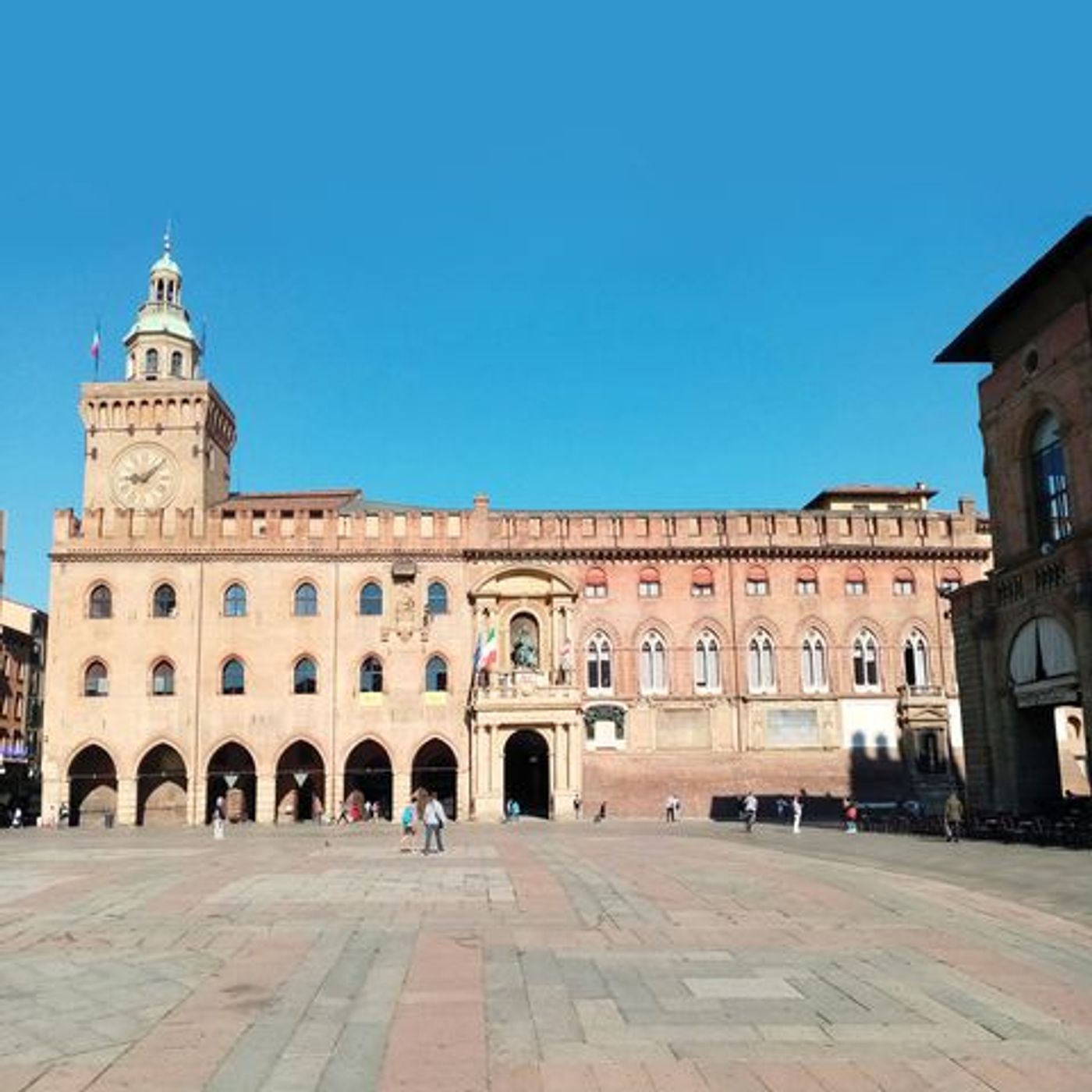
PIAZZA MAGGIORE In the heart of Bologna lies Piazza Maggiore, one of the most iconic and meaningful urban spaces in medieval and modern Italy. Since its creation in the 13th century, it has been the main stage for the city’s political, religious, and social life. The square was officially established in the early 1200s, when the city’s government decided to create a public space to represent civil power and meet the needs of a growing urban population. Many buildings and towers were expropriated and demolished, opening up an area defined by ancient Roman roads. One ran east to west, corresponding to today’s façade of San Petronio and continued toward one of the city gates. Another ran north to south, along Via dell’Archiginnasio and the Palazzo dei Banchi. A third aligned with the current Town Hall, while a fourth passed under the Palazzo del Podestà, ending at the Fountain of Neptune. This was the first large square in a city that had none before—and it was large enough to hold all of Bologna’s 50,000 inhabitants in 1200. At the same time, the Palazzo del Podestà was built and nearly completed by 1208. It served both administrative and commercial functions. Beneath it, a covered crossroads of streets became the city’s new focal point. But it was soon nicknamed the “old” palace, as a new building rose nearby: the one where Enzo of Swabia, son of Emperor Frederick II, would live in captivity for over 20 years. This building became known as Palazzo Re Enzo—King Enzo’s Palace. Today, only the bell tower remains of the original Palazzo del Podestà. Known as the Torre dell’Arengo, it had already been summoning citizens to assembly as early as 1212. Beneath the Voltone del Podestà, the vaulted passage linking Piazza Maggiore to Piazza Re Enzo, lies a fascinating curiosity. If two people stand at opposite corners of the vault and whisper toward the wall, they can hear each other perfectly, thanks to a unique acoustic reflection phenomenon. According to tradition, friars once used this trick to listen to the confessions of the contagious without risk of infection. To the west of the square stands Palazzo d’Accursio, now the Town Hall, originally built in 1287 and later expanded and restored. The left wing is the oldest part, having been the home of the Accursio family in the 12th and 13th centuries, and from 1336, the seat of the city’s ruling magistrates, the Anziani. The current clock tower was raised in the late 15th century, during which Niccolò dell’Arca also created the terracotta Madonna and Child on the façade. The right wing, in Gothic style, features eight windows from the early 1400s, designed by Fioravante Fioravanti. In the 1500s, the Umbrian architect Galeazzo Alessi added a large Renaissance window and created a grand triumphal entrance. Above it stands the statue, sculpted by Alessandro Menganti, of Pope Gregory XIII—born Ugo Boncompagni of Bologna and known for the 1582 calendar reform. In 1796, to save the statue from destruction by Napoleonic troops, the people of Bologna disguised it as Saint Petronius, their patron saint. This move preserved the sculpture until it was restored to its original form at the end of the century. On the façade of the Town Hall, a marble plaque displays the ancient units of measurement once used in Bologna, placed there for public reference since the square hosted the city’s largest market until 1877. Above the plaque are two terracotta eagles, replicas of the originals destroyed during a popular uprising in 1511. According to tradition, one of the original eagles was sculpted by Michelangelo during one of his stays in Bologna. Between the 16th and 19th centuries, the palace housed the Papal Legates. Today, it serves as the seat of Bologna’s municipal government and contains the Civic Art Collections and the Morandi Museum. Facing the square stands the Basilica of San Petronio, originally intended to be the largest civic church in Europe. Construction began in 1390, based on designs by Antonio di Vincenzo. However, in the 17th century, expansion was halted when Pope Pius IV had the nearby Jesuit College built to block its development. The current façade, half covered in marble and half in brick, reflects this clash between religious and civic power. On the other side of the square is the Palazzo dei Notai, built between 1384 and 1422 by the Notaries’ Guild as their headquarters. The building, also designed by Antonio di Vincenzo, features their emblem on its façade —a shield with three inkwells and quills. It was restored in 1908 by Alfonso Rubbiani, who emphasised its medieval character. In the 1500s, the entire area underwent significant reshaping under papal orders. The nearby Piazza del Nettuno and the Palazzo dell’Archiginnasio were built. In 1568, architect Jacopo Barozzi, known as Il Vignola, closed the eastern side of the square by constructing the Palazzo dei Banchi and the Portico del Pavaglione, behind which the medieval Mercato di Mezzo was hidden. In 1860, the square was named after King Victor Emmanuel II; it was only in June 1945 that it officially regained its original name, Piazza Maggiore. At its centre lies a slightly raised pedestrian platform, built in 1934 from pink and white granite. It’s affectionately known as the “Crescentone”, a name believed to come from the traditional Bolognese flatbread, the crescenta. Over the centuries, Piazza Maggiore has remained the beating heart of Bologna. Here took place religious processions and civic parades, public executions and solemn oaths. In modern times, it witnessed the protests of the Risorgimento, anti-fascist demonstrations, and Resistance celebrations. Even today, the square hosts concerts, open-air cinema, rallies, and gatherings. Piazza Maggiore is not just a public space—it is an open-air archive of Bologna’s rich and layered history.
-
1
Introduz a The squares (piazzas) of Bologna-ingl.
Introduction to The Squares of Bologna Walking through Bologna means crossing centuries of history, preserved not only in its buildings and porticoes but, above all, in its squares. These are living spaces where the city reveals its true self: a harmonious blend of culture, spirituality, politics, and daily life. Its squares—whether vast or intimate, monumental or secluded—tell the story of the city’s life. They are places where the past is not merely remembered but still lived: settings for markets, art, religion, struggle, and celebration. Every stone tells a chapter of collective life and in an era where cities tend to become uniform, Bologna proudly preserves its squares as a living memory of its history and culture. The most important is Piazza Maggiore, the symbolic and geographical heart of the city. It was established in the Middle Ages as a space for markets and civic administration and is flanked by the city’s main public and religious buildings, including the basilica of San Petronio with its unique façade—unlike any other in the world—and, nearby, the elegant and solemn Piazza del Nettuno with its magnificent fountain by Giambologna. Then there are the more secluded squares, like Piazza Santo Stefano, with its uneven paving and the namesake church that seems to belong to another time. Here, silence replaces tourist chatter, and time seems to slow down. Or Piazza Verdi, in the heart of the university district: chaotic, colorful, creative, inhabited by students who, with their books, guitars, and slogans, transform it daily into a living stage. Bologna’s squares are not just urban spaces—they are places of the soul. They do not merely connect streets, but connect people. They tell different stories, speak with different architectures, but each has a clear identity. Some are solemn and heavy with memory, others more intimate and part of everyday life. But all embody the unique spirit of Bologna.
We're indexing this podcast's transcripts for the first time — this can take a minute or two. We'll show results as soon as they're ready.
No matches for "" in this podcast's transcripts.
No topics indexed yet for this podcast.
Loading reviews...
ABOUT THIS SHOW
Introduction to The Squares of Bologna Walking through Bologna means crossing centuries of history, preserved not only in its buildings and porticoes but, above all, in its squares. These are living spaces where the city reveals its true self: a harmonious blend of culture, spirituality, politics, and daily life. Its squares—whether vast or intimate, monumental or secluded—tell the story of the city’s life. They are places where the past is not merely remembered but still lived: settings for markets, art, religion, struggle, and celebration. Every stone tells a chapter of collective life and in an era where cities tend to become uniform, Bologna proudly preserves its squares as a living memory of its history and culture. The most important is Piazza Maggiore, the symbolic and geographical heart of the city. It was established in the Middle Ages as a space for markets and civic administration and is flanked by the city’s main public and religious buildings, including the basilica
HOSTED BY
ASPPI
CATEGORIES
Loading similar podcasts...
Frequently Asked Questions
How many episodes does The Squares of Bologna have?
The Squares of Bologna currently has 20 episodes available on PodParley. New episodes are automatically indexed when they're published to the podcast feed.
What is The Squares of Bologna about?
Introduction to The Squares of Bologna Walking through Bologna means crossing centuries of history, preserved not only in its buildings and porticoes but, above all, in its squares. These are living spaces where the city reveals its true self: a harmonious blend of culture, spirituality, politics,...
How often does The Squares of Bologna release new episodes?
The Squares of Bologna has 20 episodes. Check the episode list to see recent publication dates and frequency.
Where can I listen to The Squares of Bologna?
You can listen to The Squares of Bologna on PodParley by clicking any episode. We provide an embedded audio player for direct listening, and you can also subscribe via your preferred podcast app using the RSS feed.
Who hosts The Squares of Bologna?
The Squares of Bologna is created and hosted by ASPPI.
URL copied to clipboard!