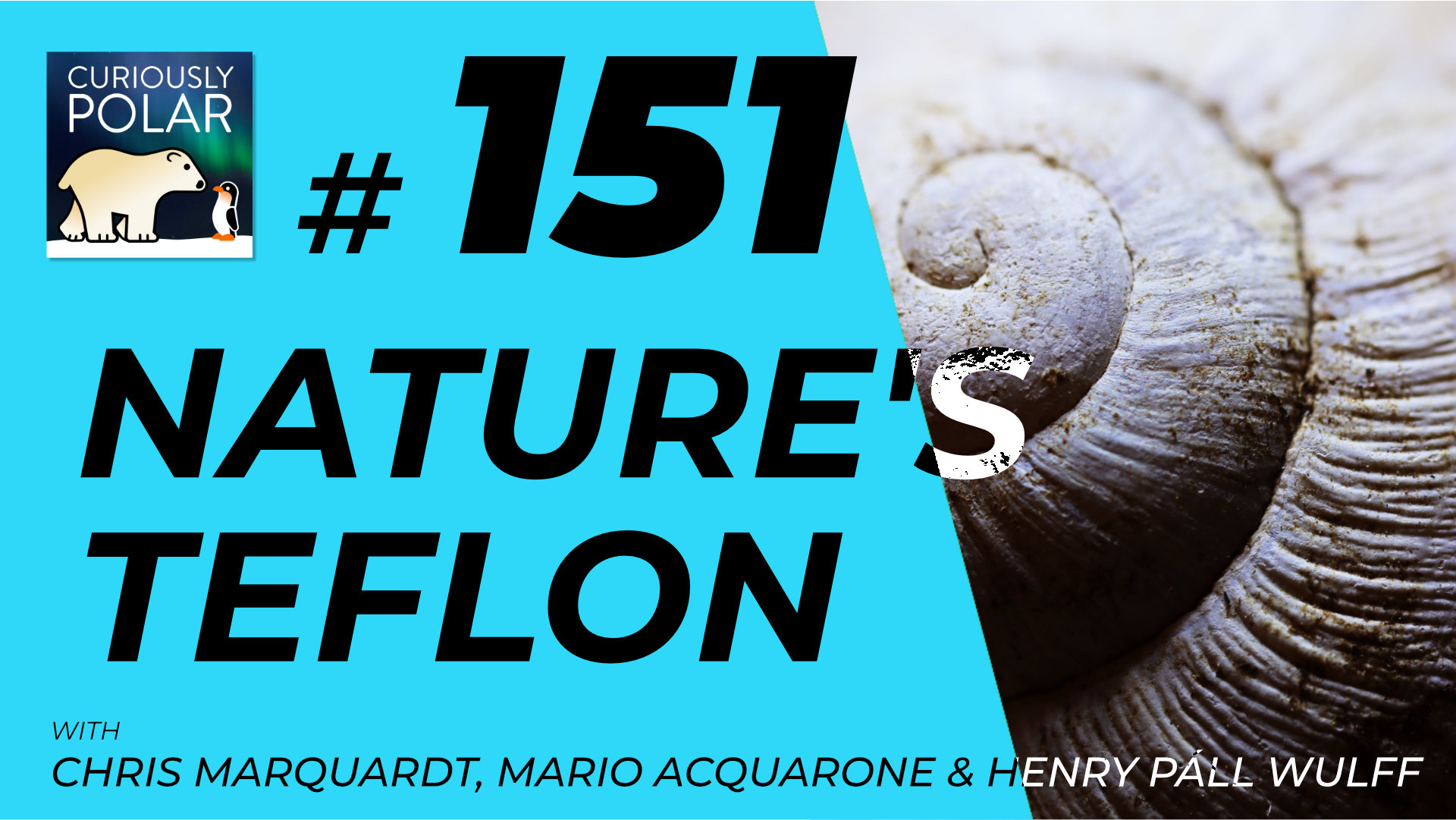
Polar Newsreel: Nature's Teflon 🐚 episode artwork

EPISODE · Apr 5, 2022 · 37 MIN

Polar Newsreel: Nature's Teflon 🐚

from Curiously Polar · host Chris Marquardt

The Arctic and the Antarctic are privileged locations for observers interested in understanding how our world is shaped by the forces of nature and the workings of history. These areas have inspired countless humans to undertake epic expeditions of discov

Watch this on video | Buy us a coffee: Chris / Henry / Mario POLAR NEWSREEL: 32000 year old plant revived Scientists in Vienna are seeking to sequence the genome of an ancient flowering plant (Silene stenophylla) believed to have been buried 32,000 years ago by an Ice Age squirrel near the banks of the Kolyma River, a top site for people looking for mammoth bones today. | Sudden halt in Ukraine's Antarctic expedition The RV Noosfera, formerly RRS James Clark Ross, is in Punta Arenas since 14th March to pick up scientists and specialists and is ready for Ukraine's National Antarctic Scientific Centre (NASC) first Antarctic Expedition in 20 years, but the war is jeopardizing the mission and crew change at Vernadsky station. | Ocean temperature change calls for redefining acoustic hotspots Sounds travel faster and further in a warmer and saltier ocean and this calls for the identification of acoustic hotspots to allow for timely mitigation of anthropogenic sounds. One of these areas is located in the northwestern Atlantic Ocean close to Greenland. Others are found in the Barents Sea, northwestern Pacific, Southern Ocean between 0 and 70E, at 500m in the Arctic Ocean, Gulf of Mexico and Southern Caribbean Sea. | Holes in the bottom of the Arctic ocean Longer-term climate cycles might be at the origin of rapid thawing of submerged permafrost at the bottom of the Beaufort Sea between 2013 and 2019. An investigation using robots and sonar discovered the formation of large, city block sized craters in the seabed. | Detecting salinity from satellite Salinity estimates derived from data by the European Space Agency (ESA) SMOS satellite was used by the researchers at the Barcelona Expert Center (BEC) of the Institut de Ciències del Mar (ICM-CSIC) to improve prediction of Arctic marine circulation of the TOPAZ Arctic prediction model. Salinity is measured using passive microwave remote sensing, which captures the electromagnetic energy emitted by surfaces and which, in the case of the ocean, depends on temperature and salinity. | Ice-proof scallops The Antarctic scallop Adamussium colbecki does seldom freeze even in supercooled water. Researchers from the Max Planck Institute for Polymer Research (MPI-P) in Mainz have discovered that the particular structure shape of its shell is resistent to cryofouling, the ice does not attach to it, unless it is colonized by other organisms. This is an episode of the Curiously Polar podcast with Chris Marquardt https://chrismarquardt.com/ Henry Páll Wulff: https://henrypall.com/ Mario Acquarone https://www.buymeacoffee.com/polarmario Listen to all podcast episodes at https://curiouslypolar.com All video episodes at https://tfttf.com/curiouslypolarvideo Find us here: Web: https://curiouslypolar.com Twitter: https://twitter.com/curiouslypolar Instagram: https://instagram.com/curiouslypolar

NOW PLAYING

Polar Newsreel: Nature's Teflon 🐚

0:00 37:20

No transcript for this episode yet

We transcribe on demand. Request one and we'll notify you when it's ready — usually under 10 minutes.

Marine Conservation Happy Hour Dr Scarlett Smash & Dr Craken MacCraic The Marine Conservation Happy Hour is a podcast that looks at the many different sides of Marine Science and Conservation in an informal setting - a during a pub Happy Hour, chatting casually over a few (or more) drinks. The show is co-hosted by @DrScarlettSmash and @Craken_McCraic. Everyone is a marine scientist who is passionate about the Ocean, marine mammals (whales, seals, dolphins, porpoises, polar bears and more), sharks and other fish, invertebrates (especially squid & octopuses because they are cool), and other marine biology things that live under the sea. Join us as we gossip about, for example, how shows like Game of Thrones are similar to Marine Conservation, the sex lives of sea creatures, hot marine science & conservation topics of the week and learn about the challenges of attaining a marine biology or conservation career.Podcast Owners, Creators, Producers, & Hosts: Dr Scarlett Smash and Dr Craken MacCraic.You can support the show at: www.patreon.com/marineconserva Double Vie – Les Voix de l’Imaginaire Mickaël Rémond Double Vie (https://mickaelremond.com/double-vie/) est un podcast d'interviews sur la science-fiction, la fantasy, le fantastique, le polar et le thriller.Animé par Mickaël Rémond, hacker et auteur, cette émission explore ces genres populaires de la littérature et de la BD et donne la parole aux voix de l'imaginaire, raconteuses et raconteurs d’histoires, créatrices et créateurs qui stimulent notre intelligence, explorent nos émotions et portent un regard différent sur le monde.Pour plonger dans l'univers de ses invité•es, le podcast propose également des lectures et des débats.Crédits :• Illustrations : Pauline Pourcelot Into The Planet Podcast Jill Heinerth JILL HEINERTH is a Canadian cave diver, underwater explorer, writer, photographer, and filmmaker. She is a veteran of over thirty years of filming, photography, and exploration on projects in submerged caves around the world. She has made TV series, consulted on movies, written several books and is a frequent corporate keynote speaker. Jill is the first Explorer in Residence for the Royal Canadian Geographical Society, recipient of Canada's prestigious Polar Medal and the diving world's highest honor from the Academy of Underwater Arts and Sciences, the NOGI Award. In recognition of her lifetime achievement, Jill was awarded the Sir Christopher Ondaatje Medal for Exploration. She is a Fellow of the Explorers Club and member of the inaugural class of the Women Divers Hall of Fame. Embodied Curiosity Micheala Ranz What does embodiment feel like?​How can I listen to my body, feel less shame and cultivate more curiously?​How can I move in novel and indulgent ways?​What does it feel like in my body to be curious?How can I cultivate curiosity towards my body and it’s signals?​These are some of the guiding questions of my embodied curiosity practice, a practice that incorporates many philosophies and modalities.On this show ​I will be interviewing big thinkers and changemakers in the fields of embodiment, movement, herbalism, nature connection, holistic health, neuroscience, ancestry, and more!

Frequently Asked Questions

How long is this episode of Curiously Polar?

This episode is 37 minutes long.

When was this Curiously Polar episode published?

This episode was published on April 5, 2022.

What is this episode about?

The Arctic and the Antarctic are privileged locations for observers interested in understanding how our world is shaped by the forces of nature and the workings of history. These areas have inspired countless humans to undertake epic expeditions of...

Can I download this Curiously Polar episode?

Yes, you can download this episode by clicking the download button on the episode player, or subscribe to the podcast in your preferred podcast app for automatic downloads.
URL copied to clipboard!