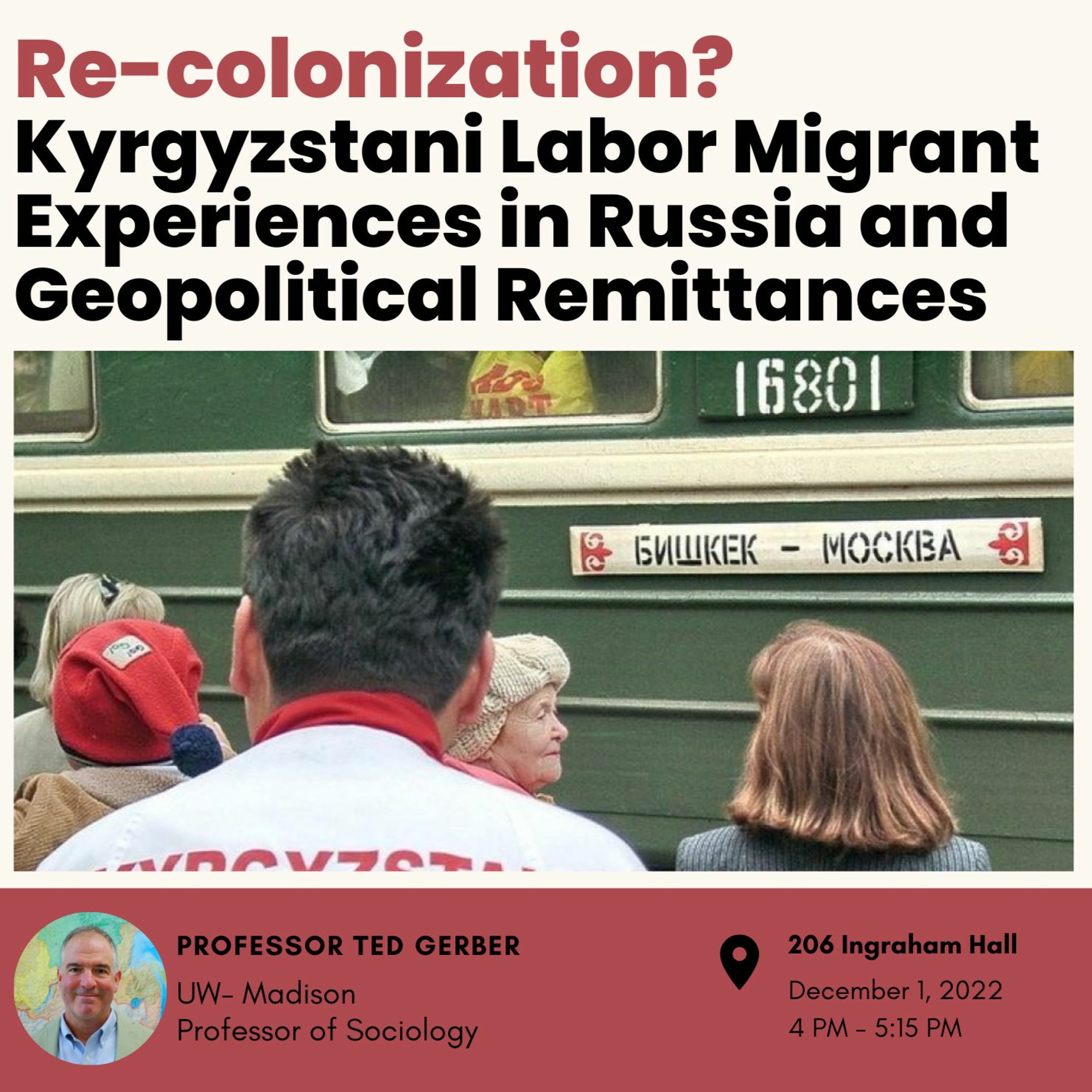
Re-colonization?  Kyrgyzstani Labor Migrant Experiences in Russia and Geopolitical Remittances episode artwork

EPISODE · Dec 2, 2022 · 56 MIN

Re-colonization? Kyrgyzstani Labor Migrant Experiences in Russia and Geopolitical Remittances

from CREECA Lecture Series Podcast · host Center for Russia, East Europe, and Central Asia at the University of Wisconsin, Madison

with Ted Gerber (UW-Madison Professor of Sociology) - After Russia recovered from the economic woes of the 1990s, its government sought to maintain and expand its influence over former Soviet republics of Central Asia by opening the doors to large numbers of labor migrants from them. However, many accounts of the experiences of Central Asian labor migrants in Russia during the 2010s emphasize their exploitation and mistreatment at the hands of officials, police, employers, and the general population. Indeed, cruel, demeaning, and racist treatment of Central Asian immigrants testifies to the type of imperial mentality on the part of Russia’s state and society criticized by the movement to “de-colonize” research about Russia. However, research the speaker conducted in Kyrgyzstan in 2016 and 2017, including focus groups and a survey in Bishkek of Kyrgyzstani migrants who had recently returned from Russia, suggests that they had a range of experiences, positive as well as negative. If anything, these experiences were linked to more positive than negative assessments of Russia’s institutions and foreign policy, which appears to reinforce, rather than undermine, Russia’s imperial objectives in its geopolitical conflict with the United States. Apart from calling for caution in analyses of how Russia’s imperial legacy is perceived outside of Europe, the findings suggest that migration scholars should devote more attention to studying “geopolitical remittances”–that is, how experiences in a host society can advance or impede its efforts to project soft power abroad.

with Ted Gerber (UW-Madison Professor of Sociology) - After Russia recovered from the economic woes of the 1990s, its government sought to maintain and expand its influence over former Soviet republics of Central Asia by opening the doors to large numbers of labor migrants from them. However, many accounts of the experiences of Central Asian labor migrants in Russia during the 2010s emphasize their exploitation and mistreatment at the hands of officials, police, employers, and the general population. Indeed, cruel, demeaning, and racist treatment of Central Asian immigrants testifies to the type of imperial mentality on the part of Russia’s state and society criticized by the movement to “de-colonize” research about Russia. However, research the speaker conducted in Kyrgyzstan in 2016 and 2017, including focus groups and a survey in Bishkek of Kyrgyzstani migrants who had recently returned from Russia, suggests that they had a range of experiences, positive as well as negative. If anything, these experiences were linked to more positive than negative assessments of Russia’s institutions and foreign policy, which appears to reinforce, rather than undermine, Russia’s imperial objectives in its geopolitical conflict with the United States. Apart from calling for caution in analyses of how Russia’s imperial legacy is perceived outside of Europe, the findings suggest that migration scholars should devote more attention to studying “geopolitical remittances”–that is, how experiences in a host society can advance or impede its efforts to project soft power abroad.

NOW PLAYING

Re-colonization? Kyrgyzstani Labor Migrant Experiences in Russia and Geopolitical Remittances

0:00 56:17

No transcript for this episode yet

We transcribe on demand. Request one and we'll notify you when it's ready — usually under 10 minutes.

French Your Way Jessica: Native French teacher founder of French Your Way Boost your French listening skills and test your comprehension with this one of a kind series of podcasts. Get the chance to listen to a real conversation between native speakers talking at normal speed AND customise your learning experience through carefully designed sets of questions (2 levels of difficulty) available for download at www.frenchvoicespodcast.com. All interviews also come with the transcript. French teacher Jessica interviews native speakers of French from around the world who share a bit of their life and passion. Where else would you meet in one same place a French yoga teacher based in Melbourne, a soap manufacturer from Provence, or a couple cycling around the world? That Hoarder: Overcome Compulsive Hoarding That Hoarder Hoarding disorder is stigmatised and people who hoard feel vast amounts of shame. This podcast began life as an audio diary, an anonymous outlet for somebody with this weird condition. That Hoarder speaks about her experiences living with compulsive hoarding, she interviews therapists, academics, researchers, children of hoarders, professional organisers and influencers, and she shares insight and tips for others with the problem. Listened to by people who hoard as well as those who love them and those who work with them, Overcome Compulsive Hoarding with That Hoarder aims to shatter the stigma, share the truth and speak openly and honestly to improve lives. The Small Business Startup School – Business Notes | Financial Literacy | Retail Psychology – For Professionals & Entrepreneurs The Small Business Startup School Inc. Starting or buying a small business? While personal circumstances may vary, business patterns remain timeless. On The Small Business Startup School, we explore strategies, insights, and practical solutions to help entrepreneurs confidently navigate their journey.Hosted by Ola Williams—a retail entrepreneur, fintech founder, and financial coach with over two decades of experience—this podcast marries financial awareness and retail psychology with optimism to deliver actionable takeaways.Join us to learn, grow, and connect as we uncover the keys to business success.Let’s continue to learn together and be encouraged to keep on connecting! DIOSA. Carolina Sanper This podcast is a sacred space created by Carolina Sanper where you connect with your inner wisdom and embody your magnetic feminine power.It is the realization that the mystical realm is where you plant the seeds of your desired reality.It is a portal to your true essence: awareness, presence, and receiving with ease. Welcome home, DIOSA. 🖤

Frequently Asked Questions

How long is this episode of CREECA Lecture Series Podcast?

This episode is 56 minutes long.

When was this CREECA Lecture Series Podcast episode published?

This episode was published on December 2, 2022.

What is this episode about?

with Ted Gerber (UW-Madison Professor of Sociology) - After Russia recovered from the economic woes of the 1990s, its government sought to maintain and expand its influence over former Soviet republics of Central Asia by opening the doors to...

Can I download this CREECA Lecture Series Podcast episode?

Yes, you can download this episode by clicking the download button on the episode player, or subscribe to the podcast in your preferred podcast app for automatic downloads.
URL copied to clipboard!