
EPISODE · May 18, 2026 · 12 MIN
Reading Hidden Flowpaths in Stream Chemistry
from Waterlines: How Water Shapes Our World · host jaywen
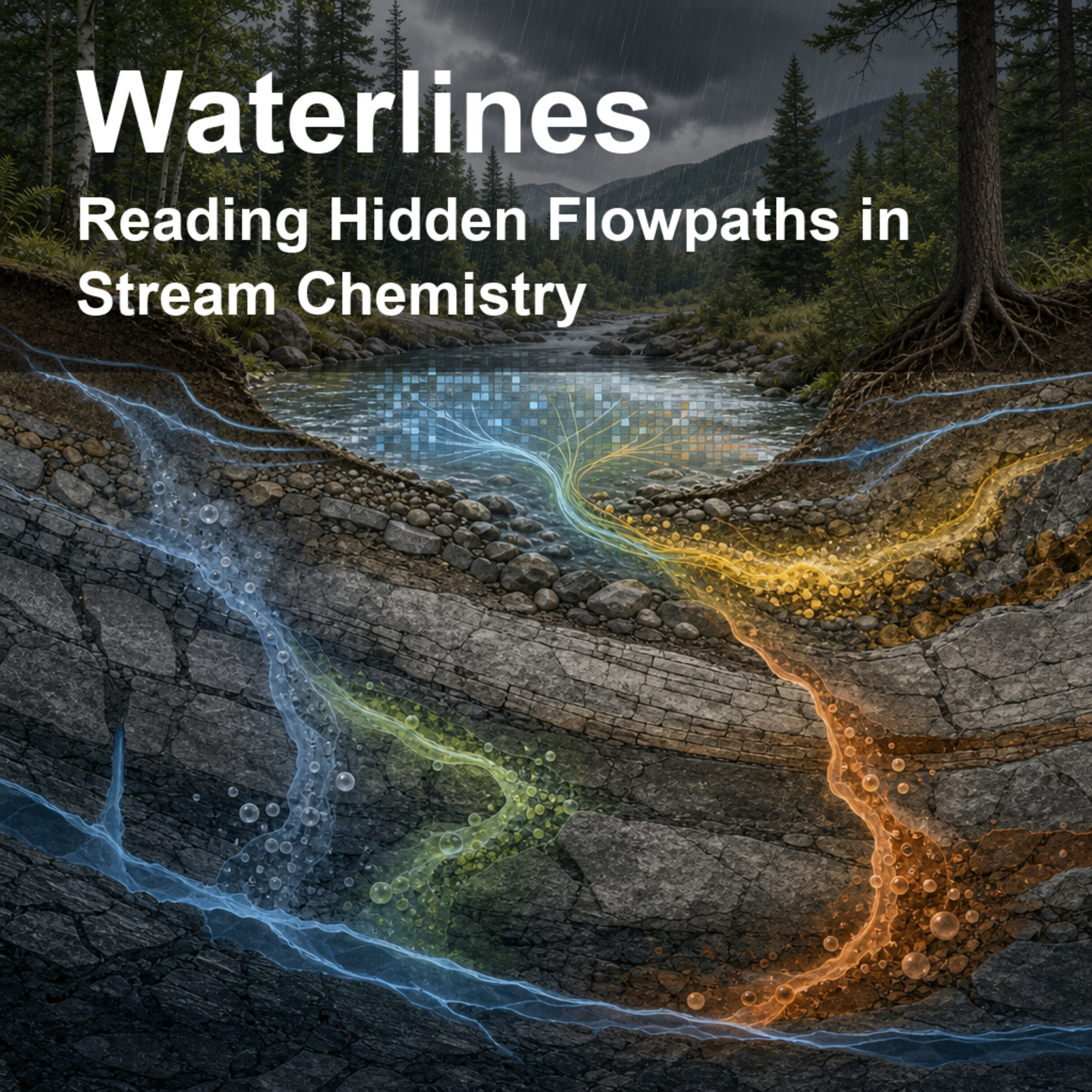
This Waterlines episode discusses how stream chemistry can reveal both subsurface water pathways and whether rock weathering is likely to remove or release CO₂ over geologic timescales. The featured paper uses non-negative matrix factorization, a machine-learning approach, to separate chemical signals in streams without first defining the endmembers. It applies the method to Shale Hills in Pennsylvania, East River in Colorado, and Hubbard Brook in New Hampshire, showing how acid rain, sulfide minerals, silicate weathering, and carbonate dissolution interact in different landscapes. Citation: Shaughnessy, A. R., Gu, X., Wen, T., and Brantley, S. L.: Machine learning deciphers CO2 sequestration and subsurface flowpaths from stream chemistry, Hydrol. Earth Syst. Sci., 25, 3397–3409, https://doi.org/10.5194/hess-25-3397-2021, 2021.Disclosure: this episode package is written for Waterlines and is intended to be performed using AI-generated voices.
Embed this episode
NOW PLAYING
Reading Hidden Flowpaths in Stream Chemistry
No transcript for this episode yet
Similar Episodes
No similar episodes found.
Similar Podcasts
No similar podcasts found.