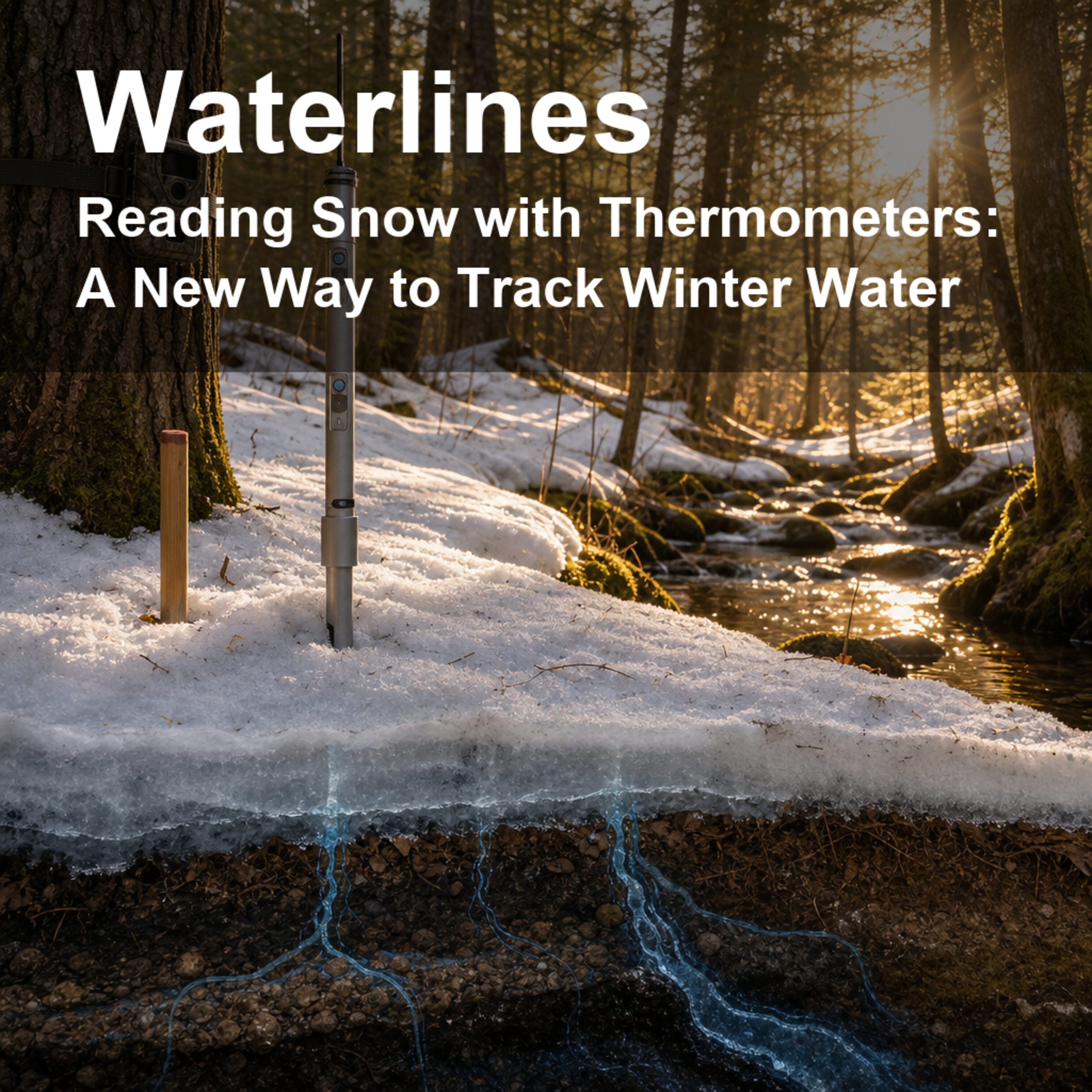
Reading Snow with Thermometers: A New Way to Track Winter Water episode artwork

EPISODE · May 27, 2026 · 11 MIN

Reading Snow with Thermometers: A New Way to Track Winter Water

from Waterlines: How Water Shapes Our World · host jaywen

Snow is more than winter scenery. It is a slow-release water reservoir, a blanket over soils and tree roots, and a clue to flood risk when warm spells or rain-on-snow events arrive. This episode follows researchers in New York’s Adirondack Mountains who asked a practical question: can simple temperature sensors, paired with machine learning, tell us how deep the snow is when no one is there to measure it?We unpack how snow acts like insulation, why temperature changes inside a snowpack can reveal its depth, and how field scientists used iButton sensors, PVC pipes, snow stakes, trail cameras, and random forest models to estimate snow depth across a forested watershed. The result: errors as low as about 1.8 to 6.5 centimeters at trained sites, with larger uncertainty when applying the model to a new site. We also talk about bear-damaged cameras, melting midwinter snow, forest canopy effects, and why better snow monitoring matters for streams, forests, water supply, and climate adaptation.Citation: Gunn, Madison, James S. Mills, Michael Mahoney, Colin Beier, Tao Wen, and Samuel E. Tuttle. 2025. “A Machine Learning Approach for Snow Depth Estimation From Temperature Sensors.” Hydrological Processes 39: e70273. https://doi.org/10.1002/hyp.70273Disclosure: This Waterlines episode uses AI-generated voices for the hosts.

Episode metadata supplied by the publisher feed · Published May 27, 2026

Snow is more than winter scenery. It is a slow-release water reservoir, a blanket over soils and tree roots, and a clue to flood risk when warm spells or rain-on-snow events arrive. This episode follows researchers in New York’s Adirondack Mountains who asked a practical question: can simple temperature sensors, paired with machine learning, tell us how deep the snow is when no one is there to measure it?We unpack how snow acts like insulation, why temperature changes inside a snowpack can reveal its depth, and how field scientists used iButton sensors, PVC pipes, snow stakes, trail cameras, and random forest models to estimate snow depth across a forested watershed. The result: errors as low as about 1.8 to 6.5 centimeters at trained sites, with larger uncertainty when applying the model to a new site. We also talk about bear-damaged cameras, melting midwinter snow, forest canopy effects, and why better snow monitoring matters for streams, forests, water supply, and climate adaptation.Citation: Gunn, Madison, James S. Mills, Michael Mahoney, Colin Beier, Tao Wen, and Samuel E. Tuttle. 2025. “A Machine Learning Approach for Snow Depth Estimation From Temperature Sensors.” Hydrological Processes 39: e70273. https://doi.org/10.1002/hyp.70273Disclosure: This Waterlines episode uses AI-generated voices for the hosts.

PodParley-generated summary based on available episode metadata and transcript content.

NOW PLAYING

Reading Snow with Thermometers: A New Way to Track Winter Water

0:00 11:33

No transcript for this episode yet

We transcribe on demand. Request one and we'll notify you when it's ready — usually under 10 minutes.

Eat to Live Jenna Fuhrman, Dr. Fuhrman Our health is our most precious gift and smart nutrition can change your life. Each month, join Dr. Fuhrman and his daughter, Jenna Fuhrman as they discuss important topics in the world of nutrition. Eat to Live will change the way you eat and think about food. French Your Way Jessica: Native French teacher founder of French Your Way Boost your French listening skills and test your comprehension with this one of a kind series of podcasts. Get the chance to listen to a real conversation between native speakers talking at normal speed AND customise your learning experience through carefully designed sets of questions (2 levels of difficulty) available for download at www.frenchvoicespodcast.com. All interviews also come with the transcript. French teacher Jessica interviews native speakers of French from around the world who share a bit of their life and passion. Where else would you meet in one same place a French yoga teacher based in Melbourne, a soap manufacturer from Provence, or a couple cycling around the world? HOMELAND HOMELAND The Church is a body not a building. It's the bride of Jesus Christ! Jesus is coming back for a mature bride. That means it's time for the church of Jesus Christ to move from milk to meat. This is the hour of maturity!HOMELAND is an announcement that the church is being set free. Only the church has the ability to transform the world. The kingdom's of this world will become the kingdoms of our Lord and Savior!All of creation has been waiting for this moment! Sons and daughters of God are rising up and taking their seat! XXX Tech by SOVRYN Dr. Brian Sovryn The crossroads between technology, sensuality, and metaphysics - and the longest running anarchist podcast in the world! Brought to you by Dr. Brian Sovryn.

Frequently Asked Questions

How long is this episode of Waterlines: How Water Shapes Our World?

This episode is 11 minutes long.

When was this Waterlines: How Water Shapes Our World episode published?

This episode was published on May 27, 2026.

What is this episode about?

Snow is more than winter scenery. It is a slow-release water reservoir, a blanket over soils and tree roots, and a clue to flood risk when warm spells or rain-on-snow events arrive. This episode follows researchers in New York’s Adirondack Mountains...

Can I download this Waterlines: How Water Shapes Our World episode?

Yes, you can download this episode by clicking the download button on the episode player, or subscribe to the podcast in your preferred podcast app for automatic downloads.
URL copied to clipboard!