The following podcast is part of the mindbodyspirit.fm podcast network. At Blinds.com, it's not just about window treatments. It's about you, your style, your space, your way. Whether you DIY or want the pros to handle it all, you'll have the confidence of knowing it's done right. From free expert design help to our 100% satisfaction guarantee, everything we do is made to fit your life and your windows. Because at Blinds.com, the only thing we treat better than windows is you. Visit Blinds.com now for up to 40% off site-wide, plus a professional measure at no cost. Rules and restrictions apply. In this episode, we talk about relaxation being a skill.
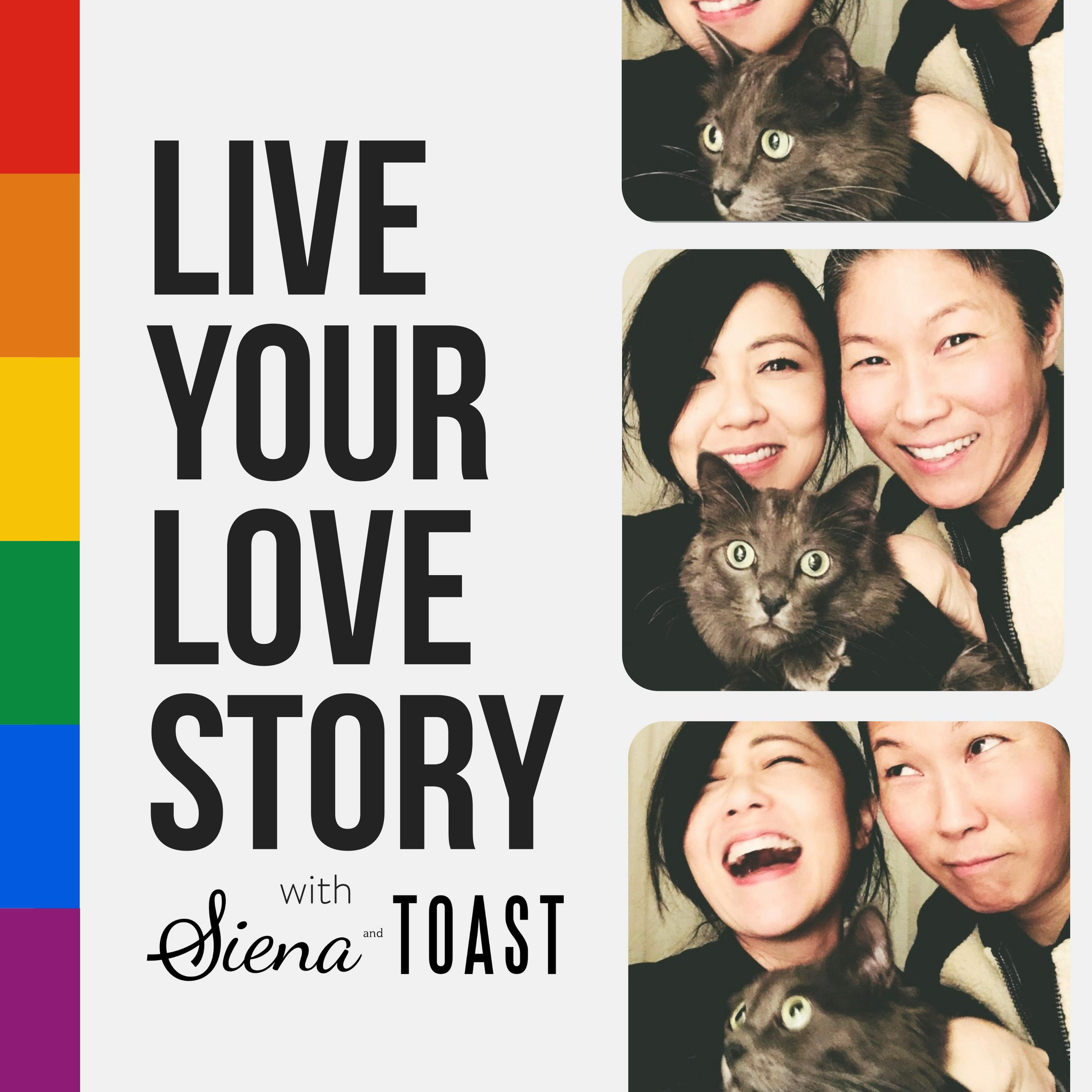
how relaxation is not even really thought of as being a skill, why that is, and more. Welcome to the podcast where it's all about living your love story and making your life a story where love wins. My name is Sienna and my name is Toast. We're married and we've been partners in life, love, and music since 2001, over 20 years. On this show, we share our life as an Asian American lesbian couple. Some of our favorite topics are positive spirituality, holistic health, sometimes cat, lesbian alert, and other things we hope are entertaining, uplifting, and helpful for living your love story. So here we go. Welcome to our home studio in the Pacific Northwest.
Welcome to this episode that's all about relaxation. Relaxation. So take a deep breath. All right. So I don't know if any of you are TV watchers, but I certainly am one. And from time to time, I will try my luck and see if Toast would be willing to watch something with me, especially a series, which is very challenging because Toast does not have much capacity for TV. She's the type of person who can only do one episode. And then even if the whole season's available, she's just not a binge watcher. I don't have the stamina. She does not have the stamina. And so...
So the best kinds of shows for Toast and I to watch are the ones where the episodes are dripped out like the good old-fashioned way, one a week, one a week, because it's not bingeable. So these are the only types of shows that I can invite Toast to watch with me on. So in a previous episode, we did mention 1923. Now, the season just ended. As we record this, the season has just ended. But this podcast will be released.
Probably like a month from now. Now, I don't know about the ending on that. 1923, the ending. Is this a spoiler? I felt like they should have given us more at the ending. I mean, I won't. I guess we won't go into it, but then it's hard for people to. I mean, any other people out there watching 1923 on Paramount? It's good. It's good. It's the prequel to Yellowstone, which is a popular series on Hulu.
I guess it's originally from Paramount and then it's on Hulu. Anyways, Yellowstone. I think Yellowstone. Wasn't Yellowstone on regular like network old-fashioned broadcast? I have no clue. But it's basically the cowboy cattle herding life in Montana. And you see these people in present day and you just.
don't know what their lives are really truly like and then we are let into the history of their families and how they even got to this existence in present present day cowboy living cowboy living so there's a show called 1883 and then the one toast and i recently saw this the series 1923 that leads us up to yellowstone today so if you like a good old cowboy show cowboy living um try it and you don't need you don't need to have watched yellowstone any of yellowstone to enjoy 1883 or 1923 It helps, but you don't need it. Anyways, I'm not sure about the ending. The other show we wanted to quickly mention is The Last of Us.
Okay. Now, who's watching The Last of Us? Anybody watching The Last of Us? I am. It kind of blew my mind to find out it's based on a video game. That kind of ruined it for me when you told me that. So I sort of was in denial that that's actually true. But it's true. Nothing against video games. We just don't understand the current iteration of video games because we're from the Atari generation. We're from the base of Kong and Space Invaders and then Donkey Kong and Santa Fe and Frogger. Frogger toast. Frogger's where it's at.
Have the frog. You're the frog. You're trying to get your frog across the street without getting run over. That's just kind of sad. And the rivers of logs floating through this. But The Last of Us. Now, you might be afraid to watch it because you're going to think, oh, my God, I heard it's scary. You might be afraid to watch it because you're like, oh, I don't like zombie movies. And some of the visuals are truly horrifying. Some of the visuals are horrifying. The stuff coming out of people's mouths. Oh, my God. Okay. But I'm trying to help them. Talk about that. Heebie-jeebies. I'm trying to help the people. But for those moments of terror, it's worth it.
all the other moments are worth it because it's just like, if you can see through how they're telling the story, using these, these individuals, these mushroom. Folk? Fungus people. The fungus folk. Then you can really grasp onto the relationships that they're sharing about. And maybe you've heard the buzz about episode three in particular. Episode three could have been a whole series in and of itself. It's beautiful. So even if you don't think you're going to watch The Last of Us, but you're a little curious now, get through episode one, two, just to fully commit to three. Then you can stop. But episode four is also great. Episode five is also great. But number three, I hope that episode wins an Emmy.
All right, we are done with a little chit chat. Sienna's TV corner. I must say, Sienna, you really are a, I mean, who am I to say this, right? Because I'm not a big TV watcher, but it's fun to hear you. I give toast the 411 on my shows. Yeah, it's fun to hear your predictions about like, ah, okay, this is what's going to happen or, you know, and then it happens. And I'm like, oh, yeah, you're really good at watching shows. I'm good at stories. I'm good at appreciating a story.
predicting where it's going to go, yet being so incredibly delighted when I'm just surprised. And like, oh my God, that was so great. Like, I love a good story. I love a great story. Speaking of, since we're talking about this, you all need to watch Where the Crawdads Sing. It is going to crack your heart open. You're going to boo-hoo and ball, but in a way that is beautiful. Like, if you haven't felt, if you feel like Groundhog Day vibes, if you're just feeling numb, watch Where the Crawdads Sing. So if you want to feel alive again? Well, if you want to just feel your heart.
Crack open. If you want to care about humans. If you want to care, if you want to just feel for something, wear the crawdads sing. And next, we're going to talk about relaxing as a skill. Let's play Burlington's Guess That Price. Back to school means back to saving. We're bringing you kids jeans starting at, hold on a minute, just $11.99. Burlington's acing this test. What about character backpacks? We've got them starting at $12.99. Burlington's done it again. How about sneakers for the kids? A-plus brands and right on trend starting at $11.99. Saving is now in session. Burlington, deals, brands, wow. Styles and selections vary by location.
Lowe's knows tough jobs call for tougher tools. The new DeWalt Elite Series power tool accessories are built to last for the pro who doesn't stop. With precision fitment, durability, and impact resistance, finishing jobs faster has never been easier. Shop the new DeWalt Elite Series at an everyday low price exclusively at Lowe's. We help. You save.
Relaxation. Let's talk about it. Relaxation is a skill. It absolutely is a skill. And there was one particular time where Toast said, you know it's a skill, right? Oh, did I say it like that? Yeah, you did. And then I went, huh. And it made me think, I guess you're right. And so sometimes before bed, when I can't sleep and I'm tossing and turning, I remember Toast's words of relaxation is a skill. And so I purposefully pay attention to my body.
And intentionally relax it. Relax it. Let it sink into the bed. And I notice it makes a huge difference. And so I'm a believer now that it absolutely is a skill. And it's definitely a skill worth learning and practicing. And this is not to say that you ever thought that, no, it's not a skill.
It's more to say that. It's the perspective. Yeah, it's more to say that I think our culture at large doesn't even ask the question. It kind of just assumes that relaxation is what's there whenever you're not doing anything else. Exactly. And that doesn't help, right? I guess. Yeah, because first of all, our culture of productivity doesn't help, right? You always got to be doing, doing, doing. Because something only exists if it's active. Yeah. And then if you're not working.
then you must be relaxing. Because you're either working, you're at work, you're working, or else you're relaxing. But that's absolutely not true. It's not true. Do not believe that, folks. It's not true. I'm crossing it off on my paper. So then what is true? If you're not working, then what are you doing? If you're not working, then you're doing other things. You might be doing household chores, but it doesn't mean you're relaxing. What if you're sitting on the sofa and watching an episode of 1923? It doesn't mean you're relaxing. It does not mean you're relaxing. Relaxation.
therapeutic relaxation requires awareness and paying attention. Yes. Awareness and intention. But let's kind of take it, like, first of all, everyone knows this, but let's just say it. Why bother relaxing? Why even bother? We want to, like, why is it so important to learn this? Like, you know, why should people even listen to this podcast? It's because relaxation really does help with anxiety, really being aware of yourself throughout the day, learning how to relax your body. And here's the thing. You can still be working.
from a relaxed state, which is important, right? Do you want to be crazy and working and have your body in that stress mode? So relaxation is important to help your anxiety levels, to help any kind of blood pressure issues, especially hypertension. I even read that it helps IBS, insomnia, chronic pain, chronic inflammation. All of that is worth learning the skill of relaxation. That makes sense. I think it probably not only helps you and your own individual health.
and even performance and enjoyment of your life and work in general. But, you know, being able to relax also makes you a more pleasant person to be around. Absolutely. So help us out and relax. Be a good person.
I know. You know what's interesting, though? And I'd love to just kind of expand on this a bit. And I want to hear from you. Toast, I want to hear from you. I'm sure the people want to hear from you. You're calling on me. But how has your relationship with relaxation been? Growing up, now, just your relationship to relaxation, this idea of relaxation. I don't think very great because only within the past maybe three years did I really start to take seriously and question the status of relaxation being a skill.
But why do you think your relationship with relaxation was not good? What did you grow up around or what influenced that? I think I grew up in the United States of America and Western civilization in general, which has, I think, a dysfunctional and really paranoid view about the human status on planet Earth. I think we have a primal fear of our own mortality. And so our culture, I don't think, has accepted that. And it tries to make up stories about salvation and living forever and stuff like that. And growing old is something that we don't like to talk about. It just disturbs us a lot in this particular culture. And so no wonder we don't want to relax because we feel like if we work hard enough, then maybe we can fend off that thing that we're so afraid of.
But I think in living with that awareness more and more, I really have tried to accept that more. Accept that old age and death comes to all of us and it's okay. It's okay. And we do belong on earth as part of the family of life. We belong here. Whether we work hard or not, honestly. And so to enjoy that and relaxation is, I think, comes.
hand in hand with that posture and that point of view about living life okay so you never learned so you never had any messages from watching your parents and how they their relationships with relaxation and there's nothing that came from them no i think it came i think there were messages that came not only from them but from but what were the messages from them that's more relatable for people who are not thinking about their own mortality uh I just think it's helpful to look at when we see our relationship to something. Is that truly our choice of how we want that relationship to be? Or is it something that we learned and we just adopted versus choosing? Like, okay, well, how do I want to see my relationship with relaxation now? So sometimes I think it's good to see.
How I even got to my perspective on relationships. I mean, not relationships, relaxation. So in order to change it, you know, like, you know, that's not my voice. I learned that. So let me change it. I want to change it. You know, or maybe you had a parent who's really good at, you know, making sure you carve out time to relax your body, your mind, your spirit. And you learned that. Wow. Lucky for people who have learned that. Yeah. That's right. Yeah. I think more.
I would like to think more parents are teaching that, though. I hope so. I do think the culture at large is shifting, but in terms of answering your specific question about the messages from my parents, for instance, I think it was in line with the messages I got from the church and the culture at large, which is about, like, if you work hard, then that means you're a better person. And if you have a good work ethic, if you are productive and making the most out of yourself, then... then that's what makes you a better person. And therefore... Don't relax. Because you've got to keep hauling it. And if you do that, then therefore you have earned your place in society and in the world.
You know, you have proven your value. You have quote unquote added value. But so that all relates to relaxation because you can't base relaxation wasn't valued. It needs to be because. Right. Yeah. Yeah. Not valued. It has to be earned, which is an example of a relationship with relaxation. Yeah. Something you earn. It's earned. And the reason you do it. Relaxing. Yeah. If you do it.
It's to work harder. It's to make you a better worker. It's to make, right? You know what I mean? It's like, oh, the reason you should meditate or the reason you should get a good sleep and the reason you should take care of yourself and relax is because then you're going to be an even better worker. Everything is centered around producing, improving, and earning your value. Very stressful. Very, very stressful. So I know that for me, when I think about...
Well, I can either think about it when I look at any regular weekend. You know, if I think about the weekend and here comes Saturday, I feel like by the time Sunday evening rolls around, that's when I'm finally almost ready to relax. Oh, geez. But then I start to panic a little about Monday. Oh no, I have to go to work. Oh, what do I have to do? Oh, I have to sleep by a certain time because I have to wake up at 4.30. And so then when I want to, when I naturally, when my body starts to feel like, okay, it's good, you can relax, I'm actually revving up for the work week already. So I really love the three-day weekends when there's a holiday because I feel like that is wonderfully balanced. So sometimes, you know, a lot of the holidays fall on a Monday. So by the time Sunday evening rolls around, Sunday afternoon, then it's like, okay, my body is naturally wanting to relax and it can because I have Monday.
I think that's really interesting. Like if you leave your, if you let your body choose its own cadence of when it feels it can relax or not. I also find that to be true about vacation. You know, not that we've gone on a lot of vacations, but with the handfuls of times when we have gone traveling, when we've traveled, it's like, I remember going, I remember one trip going back home to Hawaii and then I was like, we got there. and got to the hotel or whatever. And I'm like, okay, wait, what are we doing today? Wait, so what are we doing? What are we doing? And the next day it's like, okay, what's on the agenda? And it's like, I could not relax. And it was really hard because Hawaii is a whole different vibe. It's a whole different vibe. And it is much more relaxed than California at the time. And to really feel that difference and to feel so out of place in your energetic, in your body, you know, and I'm like, okay, I was trying to make myself relax. And then by the time...
We were almost done with the trip. I was really feeling like, oh, I can breathe a little more. I can take even deeper breaths and things like that. So going back to relaxation as a skill, it's definitely worth learning how to relax so that you aren't at kind of the mercy of just letting your body relax when it wants because it may never want to. Yeah, if it's in the inertia of always tension, then that's what's probably going to continue. You know, I just want to follow up on what we said earlier about...
relaxation in our culture so far being framed as like, well, it's good because then it helps you work more, you know? And what I'm about to say, I feel like I need to say because I think our culture might respond to that and say, well, what's the alternative? Like, then why would you relax? You know what I mean? For better health. So that you don't have high blood pressure, so that you don't have to have anxiety. Yes. So you don't have to have IBS or insomnia. And health, those are all good things. But I guess the example or analogy that comes to mind is about like learning to maybe like...
Like hug someone, learning to be an embrace, learning to be held and to hold another. And that's a pleasant experience if you really do feel like hugs. Yeah, if you do feel a genuine belonging, a genuine belonging and a sense of safety, then it's a pleasant thing to experience, right? And you're not, in that particular instance, you're not doing it. So that you can get more out of yourself or get more out of that person that you're hugging. You're doing it because it's an expression of your belonging. And I guess that's how one could view relaxation. It's an expression. And that's how you can also view work too. It's an expression of your belonging in this world and in your role and in your relationship, whether it's your family or work or community. It's just an expression of belonging here.
It doesn't have to be like for, in order to achieve something else. You know what I mean? Yeah, I mean, that's like so many things. Why are we doing this thing? Why are we doing that thing? Oh, it's only worth doing thing A because it's going to help you to get to from A to Z. You know, it's just. And that might be part of it. But anyway. So, yeah. Okay. Okay. Done. So, we kind of got, we kind of got.
off on several tangents here, but let's get back to the, cause we have a few more things to cover. So sometimes we cannot like, why can't we relax aside from like the culture and everything and how we've learned, um, to view relaxation. A lot of times it's trauma, trauma in the body, whether it's your own trauma that you've held, whether it's ancestral trauma, whether it's trauma that you've experienced in the womb, which is very real. Um, if you are in, if you have a trauma history or are carrying ancestral trauma, all the different kinds of traumas, um, your nervous system. will have a harder time relaxing because you're on alert. You are on alert. And so sometimes you think like, God, why can't I relax? You know, maybe think about, okay, do I have that in my history? Could it be that? Because it's interesting how a lot of the trauma we have isn't even our own. Not in a personal, individual way. Yeah, that's a whole other podcast because that's really, really interesting when we learned about that. Okay, so going back, relaxation is a skill. So what do we mean by skill? So it's actually a skill.
You learn to deliberately and physically, deliberately and physically relax your muscles. I mean, maybe you assume that. Maybe you assume that. But just to say it, you know, it's deliberately and physically relaxing your muscles. So when you do really learn this skill, it's so helpful because it just creates more awareness, body awareness to know when you're tense, to know where you're holding stress so that throughout your day.
you'll be more attuned to, oh gosh, I noticed that I'm breathing really shallow. You know, my breathing is really shallow. So then when you notice that, you can do something about it, right? It's like, oh, let me stop and just take a deep breath. Open up my chest area here. Let's just get more air here. And what's good about that is when you are taking care of yourself in those ways throughout the day, you are more likely to hold on to the stress. Because one of the things that they found is anytime your muscles are even just
a little tense, anytime our muscles are just a little tense, we don't notice it. And sometimes if we do carry a lot of stress, if our muscles are really tense, we don't notice it because we just get used to things that maybe start off as a little uncomfortable and now they're really uncomfortable, but we've just gotten used to it. So when you don't notice those things, you can't fix it. You know, you can't remedy it. And then you go, say, if you get a gift certificate for a massage, you go and then they're telling you, oh, did you get into a car accident? And you're like, oh no, I, no, no, it's just life.
So anyways, the skill is definitely worth learning. And there is a doctor named Dr. Edmund Jacobson, who was a doctor that studied the connection between physical tension and mental wellness. Physical tension and mental wellness. So he's the one that developed something called progressive muscle relaxation. Progressive muscle relaxation.
This is a little exercise that it's very easy, but it's just about doing it. Like a lot of times something's easy, but it's like you just got to do it. Or simple, but I think if you're not used to doing it, it's not easy at first, I think. Like I think you can get better at it is what I mean. So one way you can do this, like I like doing this as I'm falling asleep because it just feels like the most natural place. Because otherwise during the day I tend to go, oh my God, I have to go and do whatever, whatever. So before I go to bed, you can.
or before you go to bed, you can notice, just lay there and notice if your body feels tense. You know, just kind of start scanning your body from your head to your toes and just kind of check in on your head, check in on your neck, check in on your shoulders. So do that all the way to your feet. And then after you do that, you know, just keep taking some nice deep breaths, nice deep breaths to signal to your body that it's time to relax. And then what you'll do is starting with your extremities.
Maybe start with your left hand and make a fist and really tense it up. Tense it, tense it, tense it, tense it. And as you're tensing it, feel what it feels like to be tense. Can you feel maybe the pressure in your fist? Can you feel maybe your nails kind of poking into your palm the harder you squeeze and tighten your fist? What does it feel like? Does it feel hot? Does it feel pokey or warm? What does it feel like? So notice all the ways, all the things you can notice about what it feels like for your left hand to be tense. And then...
You relax it and just open your fist and just relax it and notice what it feels like to relax. Does your hand feel heavy? Do you feel the tingling from having tensed it? What does it feel like to relax your hand? So you're basically going through various parts of your body and tensing, noticing what it feels like, and then relaxing and noticing what it feels like. And soon you will become really fluent in what it feels like to be tense and then what it means to relax.
So that, what I just described is the progressive muscle relaxation technique by Dr. Jacobson. And I don't always do it like how he recommends doing it. For me, something really simple is just feeling my body. sink into the bed. Because for me, it's really amazing when, because first of the hardest thing for me really is remembering to that relaxation as a skill. That's the hardest thing for me to remember. And then once I remember it, then I check in with my body and I'm like, oh my gosh, I am not relaxed. Like I'm laying here in bed about to go to sleep, but I am not relaxed. And when I tell my body, okay, relax and just sink into the bed, I almost feel like I'm literally sinking into the bed. You know, there's a definite thing and I feel like I'm feeling the energetics of it, but I know you do something a little bit different. Against when I remember. Yeah.
I mean, I guess when you were describing the progressive muscle relaxation thing and noticing how your body feels and describing it, I know that for me, when I have, I think maybe I get tripped up by being overly concerned about looking for the right words to describe it. You know what I mean? It's a lot of pressure. Right. But there's not right words. Yeah, exactly. You don't feel like you can just say whatever words? You feel like this internal like...
Well, when the assignment is, well, how does it feel? Then the assignment is to answer that question. Usually that requires words, which I would need to come up with. So instead of having that be the assignment for me, like I find it very helpful and refreshing to be in a world where words are not needed. And instead, it's more just like, let my consciousness fill with.
the feeling. Yeah. Let your consciousness, and it could even be just let your consciousness, let consciousness be filled with the sounds, whatever the sounds are. Let the consciousness be filled with the smells. Let it be filled with the taste. Let it be filled with the kinesthetic sensations. Let consciousness be filled with that. And just having that experience feels refreshing and relaxing to me in a way. It can even feel relaxing in the middle of a workout and just feeling like, well, the consciousness is filled with this.
The feeling of, I want to say strain, but again, that's not exactly right because I don't know the right word for it. It's not a word. It's just, you know it by feeling it. Yeah. So I think that, you know, I mean.
Okay, so everyone can learn how to do it, how to relax in this way, right? We've given a few tips. Something else that I had learned is that for people who have work-obsessed brains, like they're just in that, exactly what you were talking about. Like, you know, these are the people who will relax in order to be able to work better. So these people, should they not learn that relaxation is a skill? No, they should still learn it, even if it's to work better, right? Yeah, go for it, learn it. But something, if you are that personality type, if that's how your relationship is with relaxation, then to see relaxation as a goal.
okay, I'm going to learn how to relax because of this. My goal is to relax for five minutes every day because whatever, right? I mean, it's still going to be helpful. Whatever gets you motivated to do it. So that's helpful. But in addition to this, to all the different ways to kind of learn about relaxation and to relax the body.
There are also all the other things that you've heard about, like with meditation, deep breathing, eating better, not eating so close to bedtime, exercise. Exercise also helps you to relax. Having set bedtimes, a set sleep routine, that also helps you to relax when it's time for going to sleep and all of that. And the last thing we will mention is... Flower essences. So we do have a flower essence called Calm, which is the formula we have for relaxation. So that's also something you can try. So this is really for people who are a little bit more sensitive to energies. Flower essences are excellent for especially those types of people. We also have an aromatherapy blend. If you love aromatherapy, you can have that as a roller with flower essences also added in.
And it's super nice to roll that on your wrist right before bed and keep it on your bedside and really take the deep breath in because for people who love aromatherapy, it is almost instant because you just smell that lavender and you're just like, oh my God, so good. I love lavender. It is very soothing. All right. Well, hopefully just having the concept of relaxation being a skill, that alone is helpful. Concepts are helpful, especially when they're not concepts that the culture at large.
It doesn't get. It doesn't get. You need to kind of be taught these things. So relaxation is a skill. So have fun with that. Enjoy that. Whether you work hard because of it or not. Thanks for joining us. As always, your friendly neighborhood lesbians here signing off. We'll see you on Instagram. We are Sienna and Toast on Instagram. So come say hi. Other than that, as always, we just encourage you to live your love story.