
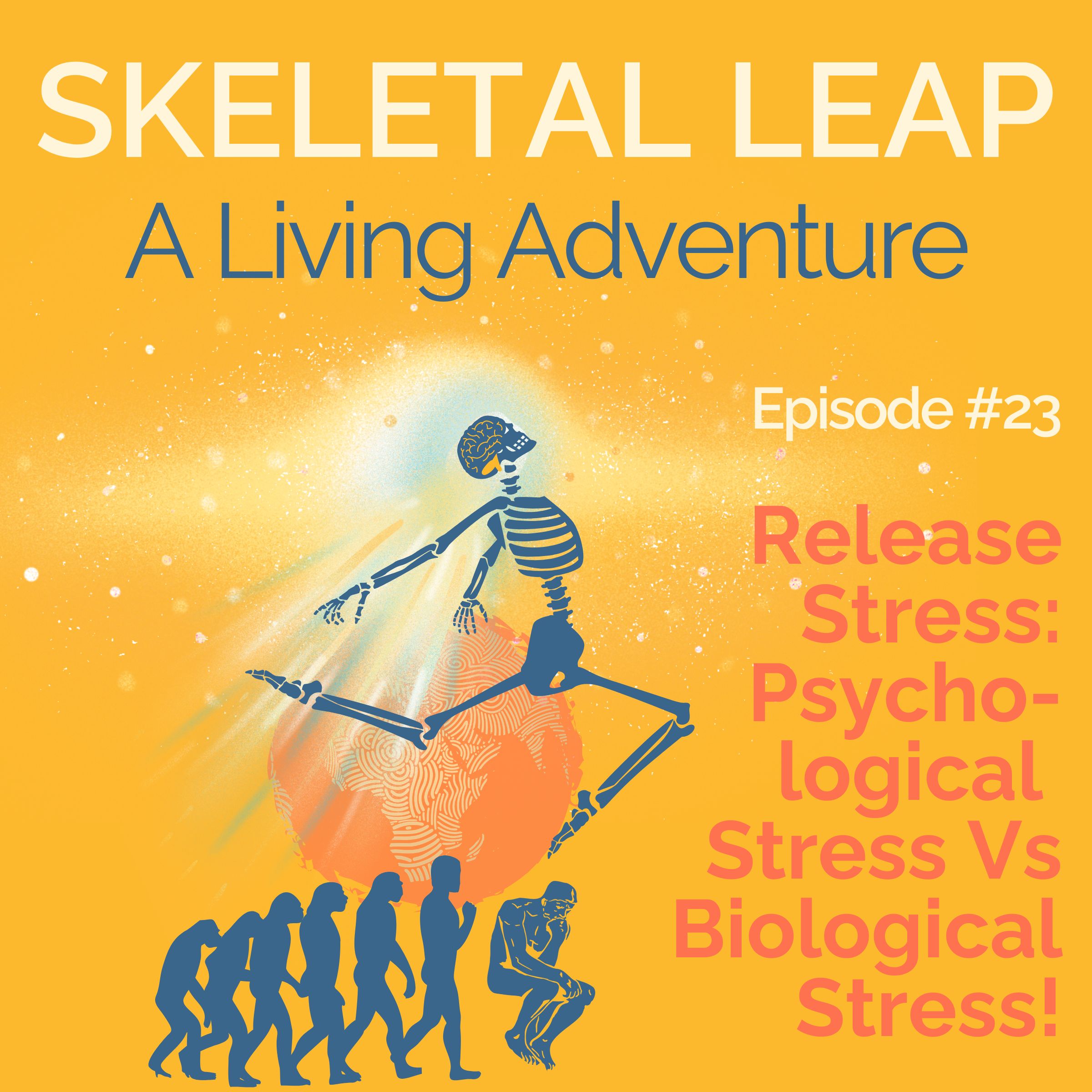
EPISODE · May 12, 2026 · 17 MIN
Release Stress: Psychological Stress Vs Biological Stress! – Podcast Episode 23
from SKELETAL LEAP · host Laadi Ojas
Release Stress Techniques: Psychological Stress Vs Biological Stress! Welcome back to the 23rd episode of Skeletal Leap: A Living Adventure! Today’s episode titled “Release Stress: Psychological Stress Vs Biological Stress!” will tell you about what stress really means in terms of chakras and skeletal postures. Stress is a situation perceived by an organism either as a threat or a challenge that needs to be coped with. In case of Homo sapiens, this type of situation has two layers to it. The first one is biological stress and the second, psychological. SKELETAL LEAP, the mind body connection for mind and body healing, is a giant leap that our skeleton can take through the way it postures its joints. I had stumbled upon this miracle many years ago, coincidentally Release Stress: Psychological Stress Vs Biological Stress! - Show Notes Welcome back to another enlightening episode of Skeletal Leap: A Living Adventure! In today’s episode titled “Release Stress: Psychological Stress Vs Biological Stress,” I explain the multifaceted nature of stress, exploring its biological and psychological dimensions. Join me as I unpack the layers of stress, revealing how both external and internal factors contribute to our experiences of psychological pain. Discover the two primary forms of stress that affect Homo sapiens: biological stress, managed by our nervous system, and psychological stress, which is interpreted through our minds. Learn about the intricate workings of the autonomic nervous system and the HPA axis, and how they respond to perceived threats or challenges. This episode will also cover the various stressors, from acute challenges to chronic pressures, and their profound impacts on our health and well-being. Additionally, I share insights into the pioneering work of Hans Selye, who laid the groundwork for our understanding of stress and its effects on the body. Explore the concept of hardiness and how adopting a lightness mindset can transform our approach to stress management. Through the lens of Skeletal Leap, you’ll discover how skeletal re-posturing and chakra opening can alleviate stress, leading to a healthier mind-body connection. Tune in to learn how to cultivate resilience and lightness in your life. Here you will find: (00:00:00) - Stress is a situation perceived by an organism as a threat or a challenge (00:05:25) - Stress is a feeling of emotional pain that can be internal or external (00:15:39) - Skeletal Leap has a well researched and documented system of opening chakras Release Stress: Psychological Stress Vs Biological Stress! - Chapters Chapters: (00:00:01) - What is Stress? (Human Stress) (00:05:25) - Understanding the causes of stress in life 00:15:39) - How to Open Chakras Release Stress: Psychological Stress Vs Biological Stress! - Video Release Stress: Psychological Stress Vs Biological Stress! - Transcript with Timestamps 0:00:01.120,0:00:06.880 The source of psychological stress can either be external or internal, but in 0:00:06.880,0:00:26.480 both cases one internalizes the resultant pain. My name is Laadi Ojas. Welcome to “Skeletal Leap: 0:00:26.480,0:00:34.160 A Living Adventure”. Skeletal Leap transforms one’s life into a personal heaven. 0:00:34.160,0:00:38.400 Today’s episode will tell you about what stress really means 0:00:38.400,0:00:43.440 in terms of chakras and skeletal postures. 0:00:43.440,0:00:48.160 Stress is a situation perceived by an organism either as a threat or a 0:00:48.160,0:00:54.320 challenge that needs to be coped with. In case of Homo sapiens, this type of 0:00:54.320,0:01:02.240 situation has two layers to it. The first one is biological stress and the second, psychological. 0:01:02.240,0:01:06.960 In the case of biological stress, it is the nervous system that perceives 0:01:06.960,0:01:12.080 it as a threat or challenge. But in the case of psychological stress, 0:01:12.080,0:01:19.680 it is the mind that comprehends the brain’s perception as either a threat or as a challenge. 0:01:19.680,0:01:24.080 Biological Stress In Homo sapiens, the following 0:01:24.080,0:01:29.760 biological systems respond to stress: Autonomic nervous system 0:01:29.760,0:01:40.880 Hypothalamic pituitary adrenal (HPA) axis Sympathoadrenal medullary (SAM) axis is capable, 0:01:40.880,0:01:45.680 via the sympathetic nervous system, of switching a ‘fight or flight’ response 0:01:45.680,0:01:52.720 on. It directs a major portion of the body’s energy resources to cope with the perceived 0:01:52.720,0:01:59.600 stress before returning to homeostasis via the parasympathetic nervous system. 0:01:59.600,0:02:06.480 On the other hand, the HPA axis releases cortisol to take care of metabolic and immunological 0:02:06.480,0:02:14.640 functions in the meantime. The SAM and HPA axes are regulated by the following brain regions: 0:02:14.640,0:02:24.160 Limbic system | Prefrontal cortex | Amygdala | Hypothalamus | Stria terminalis 0:02:24.160,0:02:30.960 These coping mechanisms perceive stressors as one among the five possible categories: 0:02:30.960,0:02:37.120 Acute time-limited stressors posing a short term challenge 0:02:37.120,0:02:43.520 Brief naturalistic stressors normal yet challenging 0:02:43.520,0:02:50.880 Stressful event sequences - sudden onset continuing in immediate future 0:02:50.880,0:02:56.720 Chronic stressors continuing for long terms in future 0:02:56.720,0:03:03.440 Distant stressors - set to affect in distant future 0:03:03.440,0:03:09.840 Physiological stress disturbs the organism’s homeostasis which responds by stimulating the 0:03:09.840,0:03:16.240 nervous, endocrine and immune systems. This activates physical changes showing 0:03:16.240,0:03:23.440 their short or long term effects on the body. Homeostasis is an ideal state of biochemical 0:03:23.440,0:03:30.960 equilibrium. It often keeps getting disrupted by internal and external stimuli, thereby keeping it 0:03:30.960,0:03:37.840 in a state of continual flux. But if and when this disruption goes beyond a certain range, 0:03:37.840,0:03:44.080 we experience it as stress. In the presence of acute stress, 0:03:44.080,0:03:49.440 the sympathetic nervous system takes over with a ‘fight or flight’ response involving: 0:03:49.440,0:03:57.480 Mydriasis | Increased heart beats | Vasoconstriction | Glycogenolysis | 0:03:57.480,0:04:05.280 Bronchodilation | Gluconeogenesis | Sweating | Lipolysis | Decreased motility of digestive 0:04:05.280,0:04:14.400 system | Apinephrine and cortisol secretion from adrenal medulla | Relaxation of bladder wall 0:04:14.400,0:04:18.560 After having coped with stress, the parasympathetic nervous system 0:04:18.560,0:04:24.240 reestablishes ‘rest and digest’ aka homeostasis response involving: 0:04:24.240,0:04:33.120 Miosis | Bronchoconstriction | Increased motility of digestive system | Contraction of bladder walls 0:04:33.120,0:04:40.240 The HPA axis is a neuroendocrine system for stress response which stimulates the steroid hormones. 0:04:41.600,0:04:48.480 Stress also affects the immune system negatively. In fact, chronic long-term stress affects 0:04:48.480,0:04:53.280 our quality of life by creating: Immune system dysfunction | Chronic 0:04:53.280,0:04:59.120 diseases | Impaired growth in children | Fibromyalgia | Chronic fatigue 0:04:59.120,0:05:08.320 syndrome | Depression | Functional somatic syndromes | Heart disease | Asthma | Diabetes 0:05:08.320,0:05:16.480 | Headaches | Alzheimer’s disease | Accelerated aging | Premature death | Insomnia | Eating 0:05:16.480,0:05:25.840 disorders | Anxiety and panic attacks | Colds and viruses | Circulatory problems | Cancer 0:05:25.840,0:05:32.160 It is not only negative stressors that add to the stress level, even the positive stressors do the 0:05:32.160,0:05:38.720 same. Here is a list of some categories that some common stressors belong to: 0:05:38.720,0:05:46.960 Sensory inputs like pain, bright lights, noise, temperatures, etc. 0:05:46.960,0:05:57.120 Environmental issues like lack of food, water, housing, health, freedom, mobility, etc. 0:05:57.120,0:06:06.800 Social issues like struggles, defeats, relationship conflicts, deception, break ups, 0:06:06.800,0:06:16.560 births, deaths, marriages, divorces, etc. Life experiences like poverty, sudden 0:06:16.560,0:06:24.000 wealth acquisition, unemployment, depression, OCD, lack of sleep, 0:06:24.000,0:06:34.720 performance pressures, exams, deadlines, etc. Accidental experiences like sexual abuse, 0:06:34.720,0:06:40.320 traumas, etc. Psychological Stress 0:06:40.320,0:06:45.680 Psychological stress is a feeling of emotional pain. Small amounts of them 0:06:45.680,0:06:52.960 are manageable as well as motivating at times but their excess is debilitating. 0:06:52.960,0:06:58.720 The source of psychological stress can either be external or internal, but in 0:06:58.720,0:07:07.120 both cases one internalizes the resultant pain. Hans Selye came up with quite a few experiments 0:07:07.120,0:07:16.080 on stress and its theories in the 1930s. He conceived the theory of universal, non-specific 0:07:16.080,0:07:23.680 stress response and initiated extensive research programs in academic physiology. 0:07:23.680,0:07:31.040 Despite wide acceptance of his theories, experimental physiologists soon started opposing 0:07:31.040,0:07:39.840 what they considered ‘vague’ approaches in his research. Hence, in the 1950s, he turned away from 0:07:39.840,0:07:47.840 experimental physiology and started promoting his theories via popular books and public speeches. 0:07:47.840,0:07:54.320 His book titled ‘Stress of Life’ addressed to the general public turned out 0:07:54.320,0:08:00.080 to be an international bestseller. His was a biopsychosocial concept of 0:08:00.080,0:08:07.680 stress and dynamic adaptation to changing global challenges. It promised health and happiness to 0:08:07.680,0:08:16.080 anyone that successfully employed this approach. He coined the terms ‘eustress’ for positive stress 0:08:16.080,0:08:23.680 and ‘distress’ for negative stress. He also coined the term ‘stressor’ to mean the cause of stress 0:08:23.680,0:08:31.520 as separate from the state of stress. On top of it, he redefined tobacco smoking as a ‘diversion’ 0:08:31.520,0:08:38.960 or a ‘deviation’ from environmental stress. Starting from the latter part of the 1960s, 0:08:38.960,0:08:44.640 psychologists increasingly adopted Selye’s approach. They undertook 0:08:44.640,0:08:52.320 extensive research to establish connections between stress and stress-related diseases. 0:08:52.320,0:08:59.200 By the latter part of the 1970s, stress had entered the common parlance globally. 0:08:59.200,0:09:05.120 New research was conducted into the neuroendocrine, molecular and immunological 0:09:05.120,0:09:13.280 aspects of stress. This new research is no longer directly tied to Selye’s hypotheses though it 0:09:13.280,0:09:20.160 doesn’t negate it either. In the wake of the Vietnam War, a lot of research went into the newly 0:09:20.160,0:09:30.320 coined ‘post-traumatic stress disorder’ (PTSD). By the onset of the 1990s, stress had become one 0:09:30.320,0:09:37.680 of the biggest buzzwords while referring to the modern-day health and its complications. 0:09:37.680,0:09:41.680 The discourse on stress spanned the entire spectrum from mild 0:09:41.680,0:09:49.920 irritation to ultimate nervous breakdown. As recently as 2015, it was established 0:09:49.920,0:09:58.640 through surveys that people’s greatest stressors were ‘money’, ‘family responsibility’ and ‘work’. 0:09:58.640,0:10:06.880 A New Personality Style: Hardiness In the year 1979, Suzanne C. Kobasa 0:10:06.880,0:10:11.680 had discovered a new personality style, which he named ‘hardiness’. 0:10:11.680,0:10:19.040 It referred to the ability of a person to be chronically stressed yet healthy at the same time. 0:10:19.040,0:10:25.680 This meant that the harmful effects of stress were not the same for all. They were as much 0:10:25.680,0:10:32.400 due to stressors as they were due to the fallible personality styles. And if we were able to train 0:10:32.400,0:10:39.680 people to adopt ‘hardiness’ as their personality style, the problem of stress would be gone. 0:10:39.680,0:10:46.960 In 1984, Salvadore Maddi with Kobasa and their graduate students in the University 0:10:46.960,0:10:54.960 of Chicago came up with another book. The book was titled “The hardy executive: Health under 0:10:54.960,0:11:02.880 stress” and it further elaborated the analysis of hardiness. It carried along a series of research 0:11:02.880,0:11:09.440 reports done with executives in it. Since then, a lot of further research 0:11:09.440,0:11:18.960 has been done on military groups, teachers, firefighters and students along with executives. 0:11:18.960,0:11:23.280 In addition, several efforts have been made to train people to adopt 0:11:23.280,0:11:30.160 hardy personalities with mixed results. Research is still going on as newer 0:11:30.160,0:11:34.480 training modules are being tried to achieve definitive results. 0:11:35.200,0:11:40.720 Hardiness suggests a personality structure dispositioned along the traits of commitment, 0:11:40.720,0:11:45.040 control and challenge: Commitment was defined 0:11:45.040,0:11:52.640 as a trait to get involved in what one was doing. Control was defined as a trait that made one 0:11:52.640,0:11:59.600 believe one would be able to effect a change. Challenge was defined as a trait that took 0:11:59.600,0:12:04.720 everything including life in flux rather than stability. 0:12:04.720,0:12:09.920 In my opinion, the best example of a hardy personality was the co-founder of Apple 0:12:09.920,0:12:17.760 Inc. named Steve Jobs. But the most charismatic man that he was, he too could not keep himself 0:12:17.760,0:12:24.800 healthy. This exceptionally hardy man died of pancreatic neuroendocrine tumor resulting in 0:12:24.800,0:12:31.760 respiratory arrest at a young age of 55. What does that show? Is the entire 0:12:31.760,0:12:39.360 hypothesis of Suzanne C. Kobasa a faulty one? I don’t think so. I have my own example in 0:12:39.360,0:12:46.400 front of me having similar (though not the same) traits in my personality. And I cannot write off 0:12:46.400,0:12:53.680 hardiness that easily. I’m quite healthy in my 70s while I am speaking these lines. As 0:12:53.680,0:13:00.560 you already know, although I was born with myopia and contracted viral arthritis which then turned 0:13:00.560,0:13:07.520 into rheumatoid arthritis in six months, I was able to cure both with central fixation. 0:13:07.520,0:13:13.040 I see a huge potential in Kobasa’s hypothesis of hardiness. 0:13:13.040,0:13:20.480 A Newer Personality Style: Lightness I would like to change a few things in Kobasa’s 0:13:20.480,0:13:28.320 hypothesis. First of all, I would change its name from ‘Hardiness’ to ‘Lightness’. Next, I would 0:13:28.320,0:13:37.680 change its traits from ‘commitment, control and challenge’ to ‘interest, insight and adventure’. 0:13:37.680,0:13:44.320 Hardiness, in general, can be heavy but we need it to be light rather than heavy. 0:13:44.320,0:13:50.320 Doesn’t matter if it is hard or soft. If it is light, it’ll be able to fight; 0:13:50.320,0:13:56.800 like traveling light is always way more manageable than traveling with a lot of heavy stuff. 0:13:56.800,0:14:02.480 Commitment, as a structure of the mind, requires us to believe in it. And belief 0:14:02.480,0:14:08.880 turns the mind heavy. On the other hand, interest is an instinct generated out of 0:14:08.880,0:14:17.920 curiosity. We don’t need to believe in it. Thus, curiosity keeps our mind light. At the same time, 0:14:17.920,0:14:26.560 it is much hardier and lighter than commitment. Control evokes conflict. It makes our mind even 0:14:26.560,0:14:33.520 heavier. Insight, on the other hand, keeps it light because it arises directly out of the 0:14:33.520,0:14:41.040 lightness of curiosity and interest. Therefore, it is more effective in creating change. 0:14:41.840,0:14:49.040 Challenge, again, evokes conflict rather than passion or joy. It fills us with pride which, 0:14:49.040,0:14:53.440 in turn, makes our mind heavy. Adventure, as an instinct, 0:14:53.440,0:15:01.920 is the better alternative. It has very deep roots in our psyche and it keeps us light and agile. 0:15:01.920,0:15:08.240 These three traits - interest, insight and adventure - do a splendid job of 0:15:08.240,0:15:14.080 keeping us healthy. They are effective even under the toughest of biological stresses 0:15:14.080,0:15:20.560 born out of an ever-changing environment. Psychological stress doesn’t even stand a 0:15:20.560,0:15:27.920 chance because it vanishes the moment we become carefree and ‘light’ by emptying our mind. We 0:15:27.920,0:15:34.720 don’t need to be heavy like dinosaurs. We just need to be light like birds. That is perhaps why 0:15:34.720,0:15:42.240 the next phase of evolution after dinosaurs gave rise to birds. This brings us to the question, 0:15:42.240,0:15:48.080 “How can people be trained to adopt lightness as a personality style?” 0:15:48.080,0:15:54.320 That is easy. Skeletal Leap already has a well researched and documented system of opening 0:15:54.320,0:16:02.480 chakras through skeletal re-posturing. Once the re-postured skeleton becomes one’s first nature, 0:16:02.480,0:16:10.560 the opened chakras allow energy to rise through the body. Then comes guided meditation. It pulls 0:16:10.560,0:16:19.520 the Kundalini upward relieving the body of stress. This ascension of energy along Sushumna from the 0:16:19.520,0:16:25.360 coccyx to the crown chakra is the same as the neural communication along the vagus nerve from 0:16:25.360,0:16:33.600 the gut to the brain. The entire process results in a state of perennial joy and unbound passion, 0:16:33.600,0:16:40.800 turning the mind empty and hence light. In our following episodes, we will see 0:16:40.800,0:16:48.240 how this process unfolds, step by step. Thanks for listening to this episode of 0:16:48.240,0:16:55.280 Skeletal Leap: A Living Adventure! In the next episode, I will tell you about how 0:16:55.280,0:17:03.360 skeletal re-posturing opens chakras through completing our bipedal skeletal evolution. 0:17:03.360,0:17:07.280 Be a part of Skeletal Leap Community! Subscribe to Release Stress: Psychological Stress Vs Biological Stress! - Subscribe to Skeletal Leap Newsletter Get my book ‘Eyesight To Insight Memoir’ FREE when you Subscribe to Skeletal Leap Newsletter: https://www.SkeletalLeap.com/newsletter Release Stress: Psychological Stress Vs Biological Stress! - Get Skeletal Leap Book 1: The Mind Body Connection The paperback version of SKELETAL LEAP BOOK 1: The Mind Body Connection is available on https://www.SkeletalLeap.com/themindbodyconnection Skeletal Bones And Joints: How to Fix Jaw Posture Fast NOW! Podcast Episode 21 Deepest Mind Secrets: Dark Psychology Facts You Need! Podcast Episode 20 Brain Lift with Guided Breathwork Establishing Gut Brain Connection Discovered! – Podcast Episode 14 Unlocking The Secrets of Balancing The Chakras: Podcast Episode 4 Unlocking the SECRET of Instant Visual Clarity: Podcast Episode 3
Embed this episode
What this episode covers
Release Stress Techniques: Psychological Stress Vs Biological Stress! Welcome back to the 23rd episode of Skeletal Leap: A Living Adventure! Today’s episode titled “Release Stress: Psychological Stress Vs Biological Stress!” will tell you about what stress really means in terms of chakras and skeletal postures. Stress is a situation perceived by an organism either as a threat or a challenge that needs to be coped with. In case of Homo sapiens, this type of situation has two layers to it. The first one is biological stress and the second, psychological. SKELETAL LEAP, the mind body connection for mind and body healing, is a giant leap that our skeleton can take through the way it postures its joints. I had stumbled upon this miracle many years ago, coincidentally Release Stress: Psychological Stress Vs Biological Stress! - Show Notes Welcome back to another enlightening episode of Skeletal Leap: A Living Adventure! In today’s episode titled “Release Stress: Psychological Stress Vs Biological Stress,” I explain the multifaceted nature of stress, exploring its biological and psychological dimensions. Join me as I unpack the layers of stress, revealing how both external and internal factors contribute to our experiences of psychological pain. Discover the two primary forms of stress that affect Homo sapiens: biological stress, managed by our nervous system, and psychological stress, which is interpreted through our minds. Learn about the intricate workings of the autonomic nervous system and the HPA axis, and how they respond to perceived threats or challenges. This episode will also cover the various stressors, from acute challenges to chronic pressures, and their profound impacts on our health and well-being. Additionally, I share insights into the pioneering work of Hans Selye, who laid the groundwork for our understanding of stress and its effects on the body. Explore the concept of hardiness and how adopting a lightness mindset can transform our approach to stress management. Through the lens of Skeletal Leap, you’ll discover how skeletal re-posturing and chakra opening can alleviate stress, leading to a healthier mind-body connection. Tune in to learn how to cultivate resilience and lightness in your life. Here you will find: (00:00:00) - Stress is a situation perceived by an organism as a threat or a challenge (00:05:25) - Stress is a feeling of emotional pain that can be internal or external (00:15:39) - Skeletal Leap has a well researched and documented system of opening chakras Release Stress: Psychological Stress Vs Biological Stress! - Chapters Chapters: (00:00:01) - What is Stress? (Human Stress) (00:05:25) - Understanding the causes of stress in life 00:15:39) - How to Open Chakras Release Stress: Psychological Stress Vs Biological Stress! - Video Release Stress: Psychological Stress Vs Biological Stress! - Transcript with Timestamps 0:00:01.120,0:00:06.880 The source of psychological stress can either be external or internal, but in 0:00:06.880,0:00:26.480 both cases one internalizes the resultant pain. My name is Laadi Ojas. Welcome to “Skeletal Leap: 0:00:26.480,0:00:34.160 A Living Adventure”. Skeletal Leap transforms one’s life into a personal heaven. 0:00:34.160,0:00:38.400 Today’s episode will tell you about what stress really means 0:00:38.400,0:00:43.440 in terms of chakras and skeletal postures. 0:00:43.440,0:00:48.160 Stress is a situation perceived by an organism either as a threat or a 0:00:48.160,0:00:54.320 challenge that needs to be coped with. In case of Homo sapiens, this type of 0:00:54.320,0:01:02.240 situation has two layers to it. The first one is biological stress and the second, psychological. 0:01:02.240,0:01:06.960 In the case of biological stress, it is the nervous system that perceives 0:01:06.960,0:01
NOW PLAYING
Release Stress: Psychological Stress Vs Biological Stress! – Podcast Episode 23
No transcript for this episode yet
Similar Episodes
No similar episodes found.
Similar Podcasts
No similar podcasts found.