
EPISODE · Oct 19, 2024 · 1H
RevOps: Trends and Practices
from Thrivecast · host Anushka Karmakar
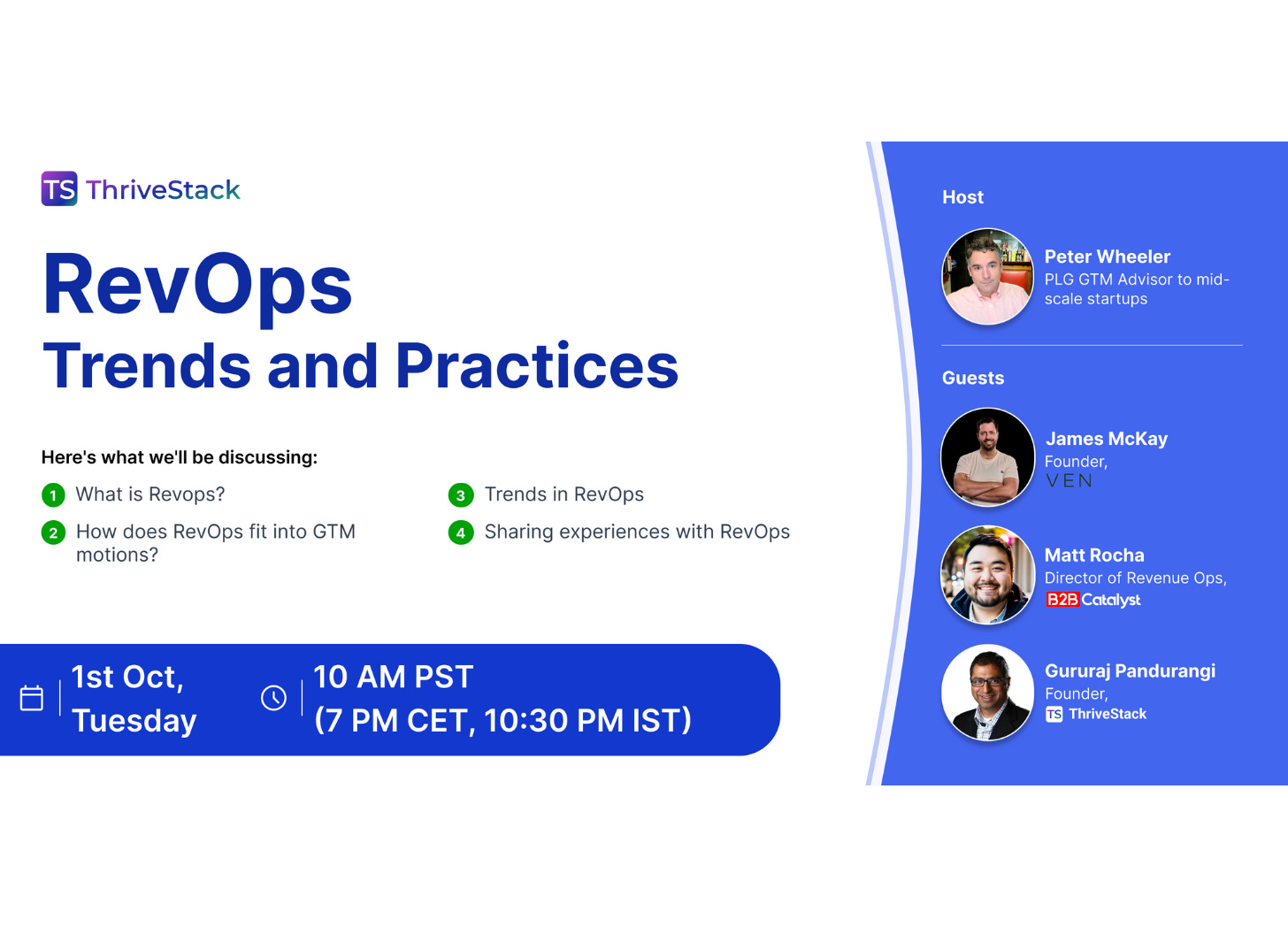
RevOps (Revenue Operations) is more than just a buzzword—it's a critical function for companies looking to streamline their revenue-generating processes. In a recent ThriveStack webinar, Peter Wheeler hosted an insightful discussion with James McKay (Founder, Venn), Matt Rocha (Director of RevOps, B2B Catalyst), and Gururaj Pandurangi (Founder, ThriveStack). Together, they explored the evolving landscape of RevOps, its role in go-to-market (GTM) strategies, and how businesses are sailing over the shift from sales-led to product-led growth. What is RevOps? At its core, RevOps (Revenue Operations) unifies sales, marketing, and customer success into a single operational system. The discussion emphasized how RevOps helps companies shift from siloed operations to a more integrated approach, ensuring that every part of the revenue-generating engine is aligned. By consolidating responsibilities such as sales ops, marketing ops, and enablement into one framework, RevOps allows businesses to scale more efficiently while maintaining clarity and alignment across teams. It's clear that RevOps is no longer a luxury—it’s a crucial function for businesses seeking sustainable growth. RevOps in GTM Motions When it comes to executing go-to-market (GTM) strategies, RevOps serves as the backbone for aligning cross-functional teams. The discussion highlighted several key roles that RevOps plays in this alignment: * Unifying teams: RevOps ensures that sales, marketing, and customer success work in sync, breaking down silos and creating a seamless flow of information between departments. * Accountability across the board: By standardizing data, tools, and processes, RevOps provides transparency into each team’s performance, holding everyone accountable for their part in the GTM strategy. * Adapting to changing conditions: RevOps makes it easier for teams to pivot when market conditions shift, enabling quicker adjustments to strategy while maintaining focus on growth goals. * Efficient scaling: With RevOps managing the framework, businesses can scale operations more effectively, avoiding the inefficiencies that typically arise from disconnected teams and unclear processes. RevOps transforms GTM efforts from isolated initiatives into a cohesive strategy, ensuring that the entire customer journey is optimized for success. Shifting from Sales-Led to Product-Led Growth The shift from sales-led growth to product-led growth (PLG) has transformed how businesses approach revenue generation. Traditionally, sales teams would guide the customer journey from the first interaction to the deal closure. However, with PLG becoming more popular, this process is now being driven by the product itself, often without the need for a sales team in the early stages. Key points discussed include: * Customer-driven adoption: In PLG, users interact with the product directly, allowing them to experience its value firsthand. This shift places more emphasis on product quality and user experience. * Earlier RevOps involvement: Unlike the sales-led model, where RevOps typically comes in during the scaling phase, PLG requires RevOps to play a role much earlier. Data, analytics, and tools need to be aligned from the start to measure success and drive growth. * Blurring lines between teams: The distinction between sales, product, and marketing becomes less rigid as PLG encourages closer collaboration. RevOps acts as the glue, ensuring that teams work together effectively to support the product-led motion. The transition to PLG represents a major opportunity for businesses, and RevOps plays a key role in making this shift successful. Tools, Systems, and IT's Role in RevOps As companies grow, managing tools and systems becomes increasingly complex. RevOps often relies on multiple technologies, but there’s been a notable shift: more responsibility for these systems is now being taken over by IT departments. While IT can handle the maintenance and servicing of tools, it often comes at the expense of speed and flexibility. RevOps teams, who need to move quickly with experiments and short-term adjustments, sometimes find their agility reduced when IT controls these systems. Integrating multiple systems—like CRMs, marketing automation platforms, and customer success tools—is crucial. RevOps needs to ensure that these tools work together seamlessly, allowing data to flow freely between teams for better decision-making. The challenge for RevOps is finding the balance between technical expertise and operational needs. With IT managing tool ownership, RevOps must focus on optimizing these systems while ensuring they support broader business goals. Challenges and Recommendations for RevOps Implementation Implementing RevOps successfully comes with its own set of challenges, especially in rapidly scaling businesses. One key challenge is determining when to bring in RevOps—whether it’s from the start or during growth phases. A few key challenges identified were: * Overlapping roles: In many organizations, the boundaries between sales, marketing, and customer success blur, making it difficult for RevOps to clearly define its scope and priorities. * Data complexity: Managing and unifying data from different systems remains a significant obstacle. Without clear data pipelines, teams can struggle to make informed decisions, reducing the effectiveness of RevOps. * Stakeholder management: As RevOps spans multiple teams, managing expectations and priorities across different stakeholders requires strong leadership and communication skills. To overcome these challenges, the discussion emphasized the importance of starting with clear alignment on goals. RevOps should be positioned as a strategic partner rather than just a support function, ensuring that it plays a central role in driving both growth and efficiency. Conclusion RevOps is transforming how companies align their sales, marketing, and customer success teams to drive revenue growth. As the shift from sales-led to product-led growth becomes more prominent, RevOps is playing a critical role earlier in the process. Key takeaways include: * Unifying teams and processes for better efficiency and transparency. * Adapting quickly to market changes with the right tools and data. * Overcoming challenges like role overlap, data complexity, and stakeholder management with strong alignment and leadership. As RevOps continues to evolve, companies that invest in it early will be better positioned to scale efficiently. This is a public episode. If you would like to discuss this with other subscribers or get access to bonus episodes, visit www.hybridgtm.com
Embed this episode
Ready to play
RevOps: Trends and Practices
No transcript for this episode yet
Similar Episodes
No similar episodes found.