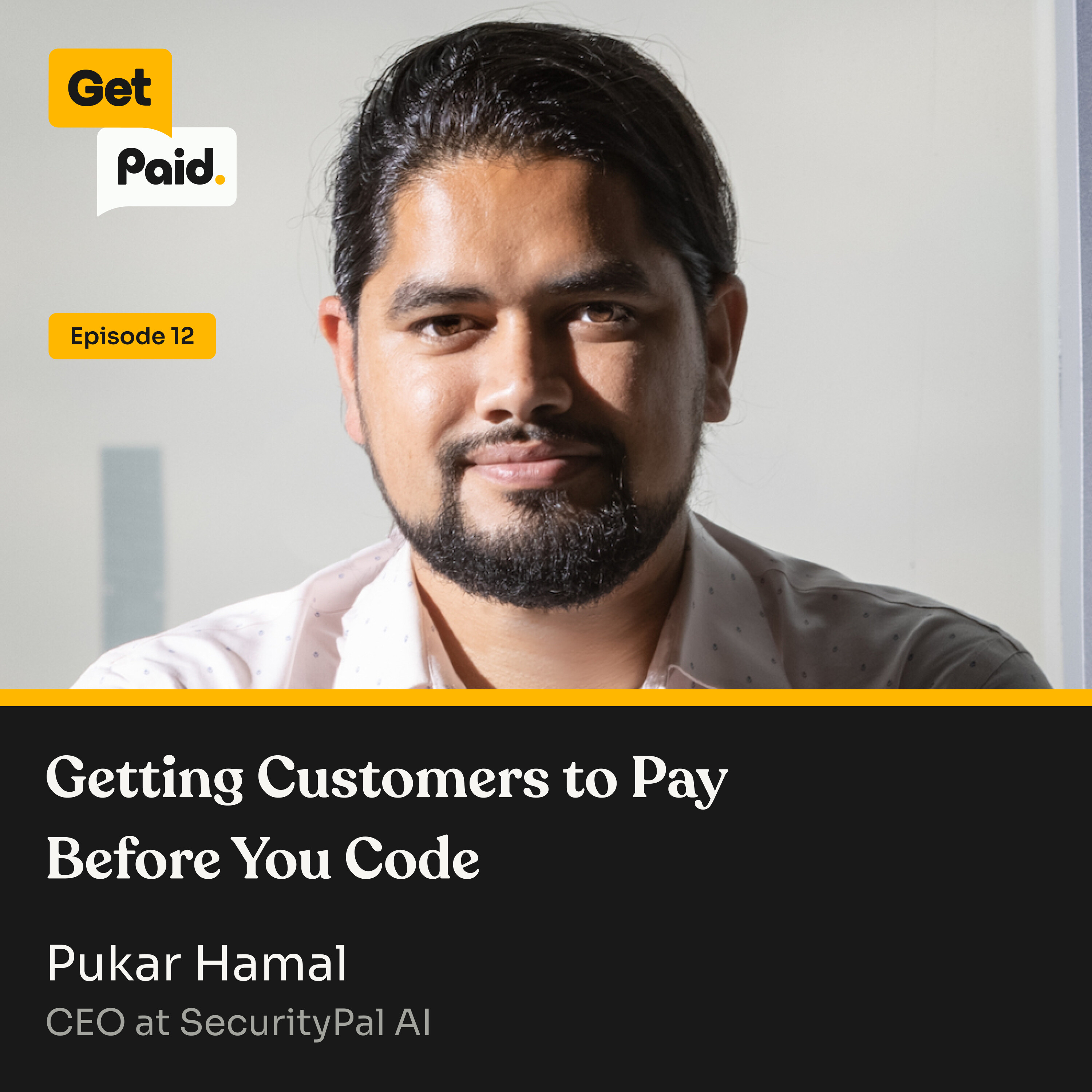
S2E12: Getting Customers to Pay Before You Code | Pukar Hamal (SecurityPal AI) episode artwork

EPISODE · Aug 1, 2025 · 34 MIN

S2E12: Getting Customers to Pay Before You Code | Pukar Hamal (SecurityPal AI)

from Get Paid with Manny Medina

When enterprise deals die at the finish line because of a 200-page security questionnaire, you know there's a billion-dollar problem hiding in plain sight. SecurityPal founder Pukar Hamal turned that pain into a service-as-software business that hit $2 million in revenue before building any actual software. The Pain That Creates Billion-Dollar Markets Picture this: you're about to close the deal that changes your company's trajectory. The champagne is ready. Then boom - instead of DocuSign, you get 200 pages of security questionnaires: "We were like ready to pop champagne bottles. And so, you know, we got hit with this, what is this? It's like hieroglyphics, you know, like, do I have barbed wire around my data center?" Pukar's insight was if startups can't afford armies of lawyers to fill out paperwork, only big companies with resources will win enterprise deals: "My like fundamental realization was if companies have to fill out a bunch of paperwork before they close a deal and they don't have the resources to do that, then all the big companies are gonna win, because they do have the resources." Service-as-Software: The $2M Validation Hack Instead of building software first, Pukar started with pure service. A prospect asked if he could just fill out their security questionnaire: "And I hadn't even incorporated the company. And the person was like, send me an invoice. I'm like, what is an invoice? I went on like Stripe Atlas and incorporated the company. So I had a company that wanted an invoice before I even incorporated it." While working a consulting day job, he'd stay up all night filling out compliance forms: "So at night I'd fill out these questionnaires and I had a customer send me a question. I'll be like, I need this back tomorrow morning, East coast time. Stay up all night. I fill it out. I send it at 3 a.m. They got the deal done." The magic was in the positioning - customers didn't want software, they wanted outcomes: "Yeah, so in the beginning, we didn't even have software. I was building this off of Google Sheets and Airtable dashboards. People would be like, when are we going to get a login? I was like, why do you need to log in? You have a form that needs to be filled out, and you want it filled out." This approach generated nearly $2 million before any real software: "We were well over a million, almost a two million before we even like built any software." Complexity-Based Pricing Beats Per-Seat Models SecurityPal charges based on complexity rather than user seats - questionnaire difficulty, product lines, regions, and SLA requirements: "I fundamentally anchored our pricing based on complexity. It's like how complex is your problem as it relates to security reviews and security questionnaires?" Want same-day turnaround? That costs more: "So I would say like the vectors for pricing for us are quantity of work. And then the SLA, right? So do you want it done same day? Or are you okay with like three, five days?" His pricing philosophy is refreshingly practical: "Biggest piece of advice from pricing standpoint that I can give anybody is like your pricing is going to change, forget about perfecting it today." AI Agents Won't Replace Premium Service While the industry rushes toward AI automation, Pukar sees the premium market wanting hyper-personalized service: "My friends that have it told me, you call them, you get a real person and like they're hell bent on figuring out how to help you solve your problem. And like that premium experience, it's like hard to really like get that through like AI agents." The Bootstrap Mentality That Scales Pukar's advice cuts through Silicon Valley hype: "If you really believe in something, you're really passionate about it, and you want a certain version of the world to be created, and you will literally eat ramen and work out of the corner of your apartment, you don't need to raise capital. You just need one customer to believe in you." The key insight: "You don't need to deliver for that customer, the perfect version of the product, you just need to deliver value. And you need to get that customer to say that you've delivered them value. You got to get paid." His brutal reality check: "But by the way, if you're not getting paid, it doesn't exist. It's just basically feel good conversations that are happening." Companies Mentioned: SecurityPalTalentBinTeamableDriftAirtableFigmaVantaCraft VenturesStripe Atlas See Privacy Policy at https://art19.com/privacy and California Privacy Notice at https://art19.com/privacy#do-not-sell-my-info.

When enterprise deals die at the finish line because of a 200-page security questionnaire, you know there's a billion-dollar problem hiding in plain sight. SecurityPal founder Pukar Hamal turned that pain into a service-as-software business that hit $2 million in revenue before building any actual software. The Pain That Creates Billion-Dollar Markets Picture this: you're about to close the deal that changes your company's trajectory. The champagne is ready. Then boom - instead of DocuSign, you get 200 pages of security questionnaires: "We were like ready to pop champagne bottles. And so, you know, we got hit with this, what is this? It's like hieroglyphics, you know, like, do I have barbed wire around my data center?" Pukar's insight was if startups can't afford armies of lawyers to fill out paperwork, only big companies with resources will win enterprise deals: "My like fundamental realization was if companies have to fill out a bunch of paperwork before they close a deal and they don't have the resources to do that, then all the big companies are gonna win, because they do have the resources." Service-as-Software: The $2M Validation Hack Instead of building software first, Pukar started with pure service. A prospect asked if he could just fill out their security questionnaire: "And I hadn't even incorporated the company. And the person was like, send me an invoice. I'm like, what is an invoice? I went on like Stripe Atlas and incorporated the company. So I had a company that wanted an invoice before I even incorporated it." While working a consulting day job, he'd stay up all night filling out compliance forms: "So at night I'd fill out these questionnaires and I had a customer send me a question. I'll be like, I need this back tomorrow morning, East coast time. Stay up all night. I fill it out. I send it at 3 a.m. They got the deal done." The magic was in the positioning - customers didn't want software, they wanted outcomes: "Yeah, so in the beginning, we didn't even have software. I was building this off of Google Sheets and Airtable dashboards. People would be like, when are we going to get a login? I was like, why do you need to log in? You have a form that needs to be filled out, and you want it filled out." This approach generated nearly $2 million before any real software: "We were well over a million, almost a two million before we even like built any software." Complexity-Based Pricing Beats Per-Seat Models SecurityPal charges based on complexity rather than user seats - questionnaire difficulty, product lines, regions, and SLA requirements: "I fundamentally anchored our pricing based on complexity. It's like how complex is your problem as it relates to security reviews and security questionnaires?" Want same-day turnaround? That costs more: "So I would say like the vectors for pricing for us are quantity of work. And then the SLA, right? So do you want it done same day? Or are you okay with like three, five days?" His pricing philosophy is refreshingly practical: "Biggest piece of advice from pricing standpoint that I can give anybody is like your pricing is going to change, forget about perfecting it today." AI Agents Won't Replace Premium Service While the industry rushes toward AI automation, Pukar sees the premium market wanting hyper-personalized service: "My friends that have it told me, you call them, you get a real person and like they're hell bent on figuring out how to help you solve your problem. And like that premium experience, it's like hard to really like get that through like AI agents." The Bootstrap Mentality That Scales Pukar's advice cuts through Silicon Valley hype: "If you really believe in something, you're really passionate about it, and you want a certain version of the world to be created, and you will literally eat ramen and work out of the corner of your apartment, you don't need to raise capital. You just need one customer to believe in you." The key insight: "You don't need to deliver for that customer, the perfect version of the product, you just need to deliver value. And you need to get that customer to say that you've delivered them value. You got to get paid." His brutal reality check: "But by the way, if you're not getting paid, it doesn't exist. It's just basically feel good conversations that are happening." Companies Mentioned: SecurityPalTalentBinTeamableDriftAirtableFigmaVantaCraft VenturesStripe Atlas See Privacy Policy at https://art19.com/privacy and California Privacy Notice at https://art19.com/privacy#do-not-sell-my-info.

NOW PLAYING

S2E12: Getting Customers to Pay Before You Code | Pukar Hamal (SecurityPal AI)

0:00 34:34

No transcript for this episode yet

We transcribe on demand. Request one and we'll notify you when it's ready — usually under 10 minutes.

MG Show MG Show The MG Show, hosted by Jeffrey Pedersen and Shannon Townsend, is a leading alternative media platform dedicated to uncovering the truth behind today’s most pressing political issues. Launched in 2019, the show has grown exponentially, offering unfiltered insights, comprehensive research, and real-time analysis. With a commitment to independent journalism and factual integrity, the MG Show empowers its audience with knowledge and encourages active participation in the political discourse. French Your Way Jessica: Native French teacher founder of French Your Way Boost your French listening skills and test your comprehension with this one of a kind series of podcasts. Get the chance to listen to a real conversation between native speakers talking at normal speed AND customise your learning experience through carefully designed sets of questions (2 levels of difficulty) available for download at www.frenchvoicespodcast.com. All interviews also come with the transcript. French teacher Jessica interviews native speakers of French from around the world who share a bit of their life and passion. Where else would you meet in one same place a French yoga teacher based in Melbourne, a soap manufacturer from Provence, or a couple cycling around the world? That Hoarder: Overcome Compulsive Hoarding That Hoarder Hoarding disorder is stigmatised and people who hoard feel vast amounts of shame. This podcast began life as an audio diary, an anonymous outlet for somebody with this weird condition. That Hoarder speaks about her experiences living with compulsive hoarding, she interviews therapists, academics, researchers, children of hoarders, professional organisers and influencers, and she shares insight and tips for others with the problem. Listened to by people who hoard as well as those who love them and those who work with them, Overcome Compulsive Hoarding with That Hoarder aims to shatter the stigma, share the truth and speak openly and honestly to improve lives. The Small Business Startup School – Business Notes | Financial Literacy | Retail Psychology – For Professionals & Entrepreneurs The Small Business Startup School Inc. Starting or buying a small business? While personal circumstances may vary, business patterns remain timeless. On The Small Business Startup School, we explore strategies, insights, and practical solutions to help entrepreneurs confidently navigate their journey.Hosted by Ola Williams—a retail entrepreneur, fintech founder, and financial coach with over two decades of experience—this podcast marries financial awareness and retail psychology with optimism to deliver actionable takeaways.Join us to learn, grow, and connect as we uncover the keys to business success.Let’s continue to learn together and be encouraged to keep on connecting!

Frequently Asked Questions

How long is this episode of Get Paid with Manny Medina?

This episode is 34 minutes long.

When was this Get Paid with Manny Medina episode published?

This episode was published on August 1, 2025.

What is this episode about?

When enterprise deals die at the finish line because of a 200-page security questionnaire, you know there's a billion-dollar problem hiding in plain sight. SecurityPal founder Pukar Hamal turned that pain into a service-as-software business that hit...

Can I download this Get Paid with Manny Medina episode?

Yes, you can download this episode by clicking the download button on the episode player, or subscribe to the podcast in your preferred podcast app for automatic downloads.
URL copied to clipboard!