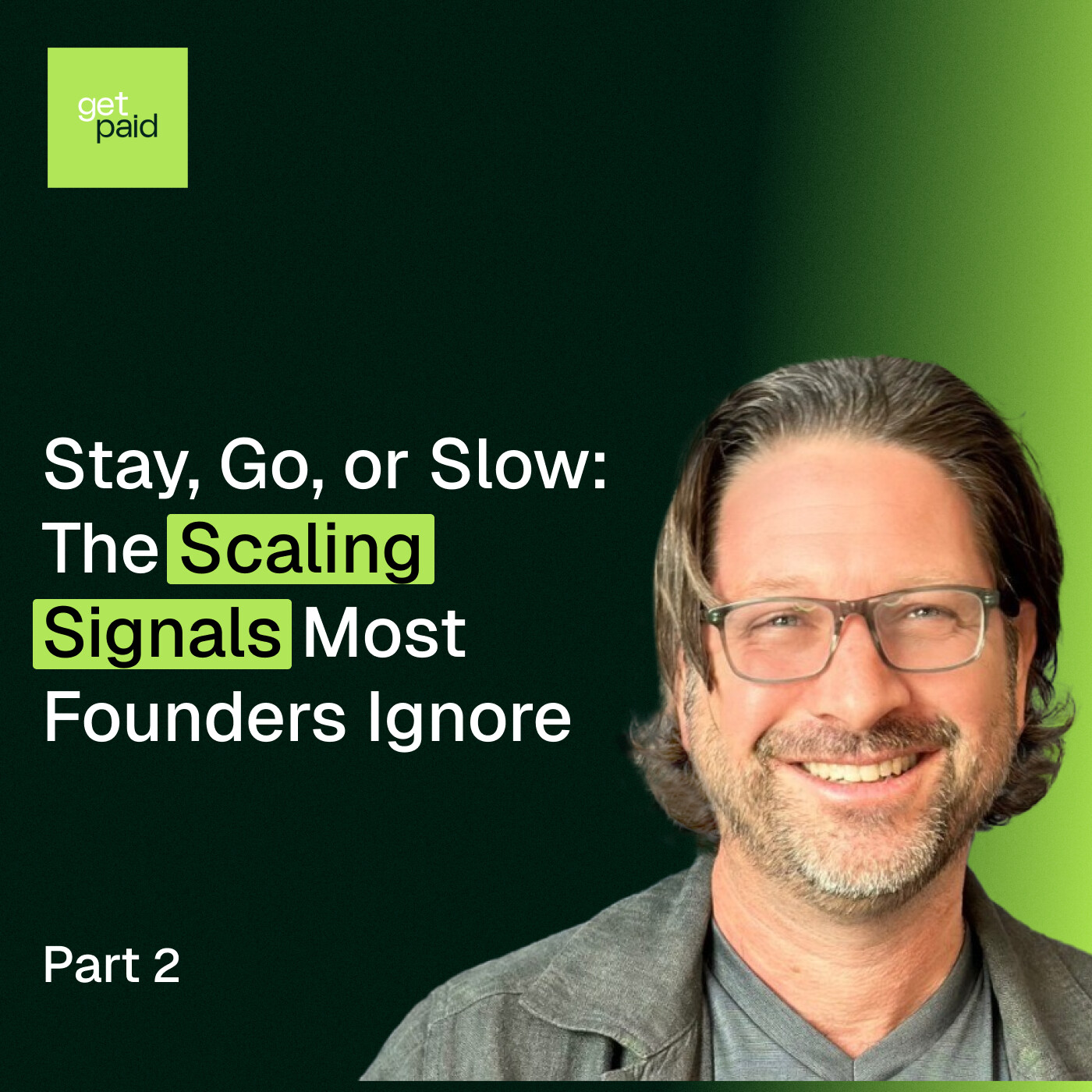
S2E39: Stay, Go, or Slow: The Scaling Signals Most Founders Ignore | Mark Roberge episode artwork

EPISODE · Feb 26, 2026 · 31 MIN

S2E39: Stay, Go, or Slow: The Scaling Signals Most Founders Ignore | Mark Roberge

from Get Paid with Manny Medina

In part 2 of this episode, Mark Roberge, Co-founder of Stage 2 Capital, former CRO of HubSpot, Harvard Business School professor, investor, and author of The Science of Scaling, joins Paid’s Manny Medina to break down the real mechanics of scaling in an AI-fueled market. They delve into execution, exploring how to decide when to accelerate, when to hold, and when to slam on the brakes. Mark also shares the Stay / Go / Slow model, founder versus VC misalignment, AI bubble dynamics, business model innovation, and why retention should be slide one in every board deck. “I have a beautiful hack for you called the stay or go or slow model.” The Anti-Annual Plan Mark challenges one of the most sacred startup rituals: the annual plan. “It’s so stupid that we build these annual plans when you're a $2,000,000 business and we abide by them like they’re scripture.” Instead of blindly chasing a 2-to-20 growth promise, Mark proposes a quarterly decision framework agreed upon in advance with the board. After each quarter, you evaluate three signals:Demand generation for healthConversion performanceLeading indicator of retention If all three are green, you accelerate. If any are yellow, you hold the pace. If any are red, you stop pouring gas and fix the system. Most Founders Are Scaling at the Wrong Pace According to Mark, roughly:45% are going too slow45% are going too fastOnly 10% are at the right pace.Going too slow means the window closes. Going too fast means burn outpaces signal. “If you burned a billion dollars this year and you’re not OpenAI, that’s probably too much.” But burning a dollar is too little. The real skill is calibrating scale risk to context. A high-moat airport software company does not scale like Cursor or Day AI. Winner-take-most markets require aggression. Most-driven markets reward discipline. New Logos Should Not Be Slide One In today’s AI wave, Mark sees a dangerous pattern:Pilot revenue labeled as ARR.Experimental deployments treated as durable revenue.Boards are obsessed with new logos.“The first slide in your board deck should be your leading indicator of retention.” Customer success must be a first-class citizen metric. Not logo count. Not headline ARR. Retention-leading indicators signal real value creation. Everything else is noise. Are We in an AI Bubble? Mark’s answer: yes. Signs of a classic bubble include:Extreme valuation multiplesExtraordinary burn ratiosOvercapitalized first movers‘Vibe revenue’ that looks sticky until renewals hitOn first mover advantage, Mark cites the broader pattern: fast followers win more often than first movers. The first mover wins roughly 35% of the time. The fast follower wins closer to 65%. “I think the last two-year cohort will see the highest failure rate in startup history.” At the same time, the breakout winners could define a generation. Founder vs. VC Incentives VCs have 20 bets. Founders have one. Investors optimize for outliers. Founders optimize for life-changing outcomes. Some investors would rather see a company fail fast than grow steadily at 60% for six years and sell for $700M. That tension fuels overscaling and unnecessary risk. Business Model Risk Is the Startup’s Advantage AI is forcing a rethink of monetization. Per-seat pricing made sense in traditional SaaS. AI automates work. It compresses seats. The safe play is per-module. The bold play may be consumption or outcomes-based pricing. Startups have an advantage: they can take business model risk. Incumbents can’t. Sales compensation plans, revenue expectations, and public market pressures trap incumbents in legacy structures. Today’s Value Prop Won’t Win Tomorrow One of the most strategic insights of the episode: the product printing money today will likely not be the long-term moat. Mark references Amazon’s early focus on books as a wedge. Design big. Start small. Print money in phase one while building infrastructure for phase two. If you build the future too early, the market isn’t ready. If you only optimize for what sells today, you lose the long game. Companies MentionedHubSpotOpenAIAmazonSlackNotionCursorDay AISiebelServiceNowHarvard Business School See Privacy Policy at https://art19.com/privacy and California Privacy Notice at https://art19.com/privacy#do-not-sell-my-info.

In part 2 of this episode, Mark Roberge, Co-founder of Stage 2 Capital, former CRO of HubSpot, Harvard Business School professor, investor, and author of The Science of Scaling, joins Paid’s Manny Medina to break down the real mechanics of scaling in an AI-fueled market. They delve into execution, exploring how to decide when to accelerate, when to hold, and when to slam on the brakes. Mark also shares the Stay / Go / Slow model, founder versus VC misalignment, AI bubble dynamics, business model innovation, and why retention should be slide one in every board deck. “I have a beautiful hack for you called the stay or go or slow model.” The Anti-Annual Plan Mark challenges one of the most sacred startup rituals: the annual plan. “It’s so stupid that we build these annual plans when you're a $2,000,000 business and we abide by them like they’re scripture.” Instead of blindly chasing a 2-to-20 growth promise, Mark proposes a quarterly decision framework agreed upon in advance with the board. After each quarter, you evaluate three signals:Demand generation for healthConversion performanceLeading indicator of retention If all three are green, you accelerate. If any are yellow, you hold the pace. If any are red, you stop pouring gas and fix the system. Most Founders Are Scaling at the Wrong Pace According to Mark, roughly:45% are going too slow45% are going too fastOnly 10% are at the right pace.Going too slow means the window closes. Going too fast means burn outpaces signal. “If you burned a billion dollars this year and you’re not OpenAI, that’s probably too much.” But burning a dollar is too little. The real skill is calibrating scale risk to context. A high-moat airport software company does not scale like Cursor or Day AI. Winner-take-most markets require aggression. Most-driven markets reward discipline. New Logos Should Not Be Slide One In today’s AI wave, Mark sees a dangerous pattern:Pilot revenue labeled as ARR.Experimental deployments treated as durable revenue.Boards are obsessed with new logos.“The first slide in your board deck should be your leading indicator of retention.” Customer success must be a first-class citizen metric. Not logo count. Not headline ARR. Retention-leading indicators signal real value creation. Everything else is noise. Are We in an AI Bubble? Mark’s answer: yes. Signs of a classic bubble include:Extreme valuation multiplesExtraordinary burn ratiosOvercapitalized first movers‘Vibe revenue’ that looks sticky until renewals hitOn first mover advantage, Mark cites the broader pattern: fast followers win more often than first movers. The first mover wins roughly 35% of the time. The fast follower wins closer to 65%. “I think the last two-year cohort will see the highest failure rate in startup history.” At the same time, the breakout winners could define a generation. Founder vs. VC Incentives VCs have 20 bets. Founders have one. Investors optimize for outliers. Founders optimize for life-changing outcomes. Some investors would rather see a company fail fast than grow steadily at 60% for six years and sell for $700M. That tension fuels overscaling and unnecessary risk. Business Model Risk Is the Startup’s Advantage AI is forcing a rethink of monetization. Per-seat pricing made sense in traditional SaaS. AI automates work. It compresses seats. The safe play is per-module. The bold play may be consumption or outcomes-based pricing. Startups have an advantage: they can take business model risk. Incumbents can’t. Sales compensation plans, revenue expectations, and public market pressures trap incumbents in legacy structures. Today’s Value Prop Won’t Win Tomorrow One of the most strategic insights of the episode: the product printing money today will likely not be the long-term moat. Mark references Amazon’s early focus on books as a wedge. Design big. Start small. Print money in phase one while building infrastructure for phase two. If you build the future too early, the market isn’t ready. If you only optimize for what sells today, you lose the long game. Companies MentionedHubSpotOpenAIAmazonSlackNotionCursorDay AISiebelServiceNowHarvard Business School See Privacy Policy at https://art19.com/privacy and California Privacy Notice at https://art19.com/privacy#do-not-sell-my-info.

NOW PLAYING

S2E39: Stay, Go, or Slow: The Scaling Signals Most Founders Ignore | Mark Roberge

0:00 31:54

No transcript for this episode yet

We transcribe on demand. Request one and we'll notify you when it's ready — usually under 10 minutes.

MG Show MG Show The MG Show, hosted by Jeffrey Pedersen and Shannon Townsend, is a leading alternative media platform dedicated to uncovering the truth behind today’s most pressing political issues. Launched in 2019, the show has grown exponentially, offering unfiltered insights, comprehensive research, and real-time analysis. With a commitment to independent journalism and factual integrity, the MG Show empowers its audience with knowledge and encourages active participation in the political discourse. French Your Way Jessica: Native French teacher founder of French Your Way Boost your French listening skills and test your comprehension with this one of a kind series of podcasts. Get the chance to listen to a real conversation between native speakers talking at normal speed AND customise your learning experience through carefully designed sets of questions (2 levels of difficulty) available for download at www.frenchvoicespodcast.com. All interviews also come with the transcript. French teacher Jessica interviews native speakers of French from around the world who share a bit of their life and passion. Where else would you meet in one same place a French yoga teacher based in Melbourne, a soap manufacturer from Provence, or a couple cycling around the world? That Hoarder: Overcome Compulsive Hoarding That Hoarder Hoarding disorder is stigmatised and people who hoard feel vast amounts of shame. This podcast began life as an audio diary, an anonymous outlet for somebody with this weird condition. That Hoarder speaks about her experiences living with compulsive hoarding, she interviews therapists, academics, researchers, children of hoarders, professional organisers and influencers, and she shares insight and tips for others with the problem. Listened to by people who hoard as well as those who love them and those who work with them, Overcome Compulsive Hoarding with That Hoarder aims to shatter the stigma, share the truth and speak openly and honestly to improve lives. The Small Business Startup School – Business Notes | Financial Literacy | Retail Psychology – For Professionals & Entrepreneurs The Small Business Startup School Inc. Starting or buying a small business? While personal circumstances may vary, business patterns remain timeless. On The Small Business Startup School, we explore strategies, insights, and practical solutions to help entrepreneurs confidently navigate their journey.Hosted by Ola Williams—a retail entrepreneur, fintech founder, and financial coach with over two decades of experience—this podcast marries financial awareness and retail psychology with optimism to deliver actionable takeaways.Join us to learn, grow, and connect as we uncover the keys to business success.Let’s continue to learn together and be encouraged to keep on connecting!

Frequently Asked Questions

How long is this episode of Get Paid with Manny Medina?

This episode is 31 minutes long.

When was this Get Paid with Manny Medina episode published?

This episode was published on February 26, 2026.

What is this episode about?

In part 2 of this episode, Mark Roberge, Co-founder of Stage 2 Capital, former CRO of HubSpot, Harvard Business School professor, investor, and author of The Science of Scaling, joins Paid’s Manny Medina to break down the real mechanics of scaling...

Can I download this Get Paid with Manny Medina episode?

Yes, you can download this episode by clicking the download button on the episode player, or subscribe to the podcast in your preferred podcast app for automatic downloads.
URL copied to clipboard!