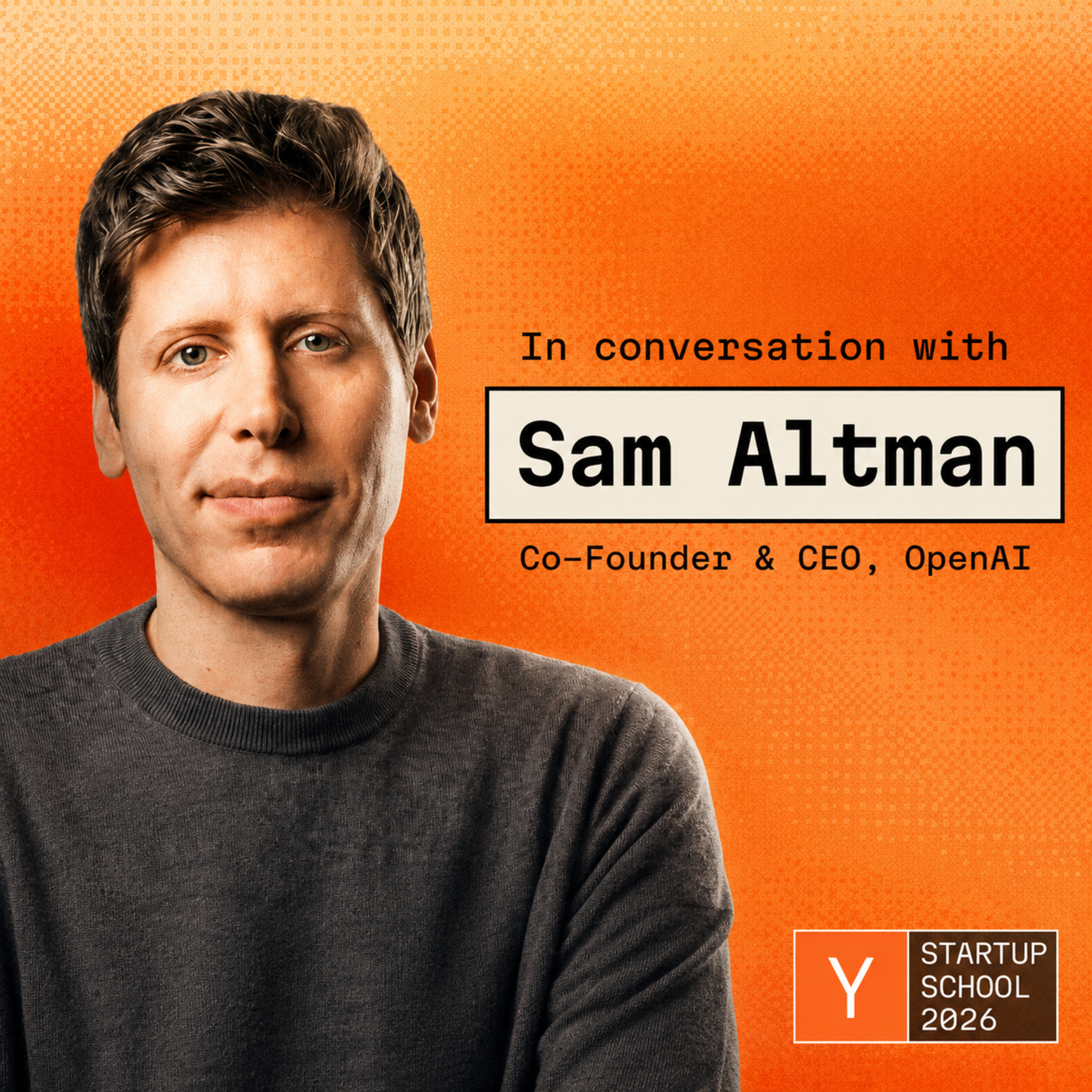
Sam, thanks for joining us. This is something. This is a lot bigger than the earlier startup schools. Yeah, I mean, startups are a lot bigger now than they've ever been. Sure.
I mean, they're bigger than they've ever been because of the vision that you had for AGI, which is Nye. I think this is going to be the best time in the world to do a startup, and it's going to be quite amazing to see. So I want to start with a time and place, which is you were in the very first batch of Y Combinator in 2005 with a location sharing company called LOOVED. What do you remember about that? And what was your best PG's program story?
I think if it were possible to get as far from this moment, as I can imagine, it was startups were not cool at all. We were hiding out in this little building in Cambridge. PG was making us dinner. And what took three months to build at the time that we each company built over the whole YC startup could now be done in seven minutes by a coding agent. And it was only 20 years ago.
And I think the difference in what's possible for a startup now, what a startup can take on. I think it would either be sad and be like, oh, man, like a Codex prompt is a whole startup, or you could be like, I can go start the world's most ambitious crazy company. I can have experts in every field working together. I can do these very hard technological things that were just impossible. And it's going to be amazing.
But at the time, it felt nothing like that. And it was very difficult to get anything to work. I think Paul Graham is probably the most important force in startups of the last few decades. And no question. Yeah.
No question. And my kind of Paul Graham memory is we would all every week come. I think it was on Tuesdays. And he would cook up, he himself would cook us dinner. And we would all walk in feeling very hopeless and very dejected.
And there were eight companies. And then we would all go home at the end of it. And he had convinced each of us that our startups were about to take over the world. And we're going to be like the next Google or whatever, Facebook maybe at the time. And that ability to create optimism and momentum and belief out of nothing was like a real PG special.
And in the early days, why seems like a terrible idea? And startups seemed like a bad idea. And certainly startups that were young technical founders with no business people seemed like a terrible idea. PG just sort of like wielded into existence. But it also takes someone who actually, I mean, you're famously par excellence, an agent person.
Like even before we thought about agents, period. I mean, you just, I remember Paul wrote, I mean, it's making the rounds on X today even, that Paul wrote in the late 2000s, that you were one of the top five entrepreneurs he never met. That's very nice to say. I think like many 20 year olds, I had a lot of energy and a lot of ambition, but it was sort of very not directed. And I wasn't sure what to do.
Paul had this thing used to say of like the job of being a good startup investor is a teacher. But it's a kind of teacher we don't usually use. Like we usually think of teachers, somebody like gives a lecture. And you can't help someone that much by like giving a lecture about a startup. There's another kind of teacher which is like a flight instructor.
The person who like sits next to you saying like, do this, don't do this, that work, this is a thing. You miss that thing or you're making these mistakes and I'm just gonna talk to you about this one. And that very like hands on kind of, you know, here's where to like direct this sort of like brownie and motion energy. That was very important to me. Yeah.
I guess later you came on to become president of YC and you sort of brought exactly the same energy to a great many YC founders over the years. Did you have anything, like did anything jump out at you from that time around, you know, taking this raw energy of someone really, really smart and maybe a little undirected and then driving them more towards agency? Yeah. So first of all, I love startups. I think not everyone, they're not like for everyone, but I think startups are the coolest thing in all of business.
I think startups are really like the main thing that keeps the economy from becoming stagnant. I think companies do just like drift towards suckiness and startups will continue to be important forever. In fact, if we are right that AI is gonna be such a big change, startups will be much more important to making sure that the power of this technology gets widely distributed throughout the economy and society and is not just concentrated in a few companies or models. So I think startups are just like unbelievably cool, fun, extremely painful and difficult, but wonderful thing. And I think a big part of the job of running YC is you are kind of the like unofficial flag bearer for the startup movement.
You know, like there's lots of startups, there's lots of ways to do a startup. You obviously don't need to do YC, but it has always been a huge help to companies and a very powerful force. And so starting with PG and then all of us like, you know, we have to make YC successful, but I think we really have to like fight for why startups are important and why people should consider startups and help put like relatively more power in the hands of founders and encourage more people to start them. And that's actually worked really well. I think thinking back to that really days of YC, it was like very little leverage in being a founder relative to an investor.
And that shift, you know, I think that's even good for the investors. I think it's just like much better for the whole startup ecosystem. So mostly what I tried to do at YC was just push for more startups and encourage people to think about startups and figure out what we could do to help founders and help make startups and the startup ecosystem as good as possible. Definitely part of that was pushing people towards more ambition and bigger swings, but it feels like the minor leads relative to now. I mean, I think you were one of the people who really brought hard tech to YC in a really grand way.
And then one of the things we're seeing at YC now is that number was, you know, maybe five or 10% for many years. And then now we're getting to 15, 20, 25%. I would argue on the back of how much easier it is to use agents and cost coming down. I think like ambitious startups are always awesome and hard tech startups are appealing to a lot of people, but they're hard, they still will be hard. But what you can do now to go take on a really ambitious project, like in the same way that you can make the startup that took us three months of nonstop work in 17 seconds with three months of work and a lot of agents.
You can do unbelievable things. So I think we will see a golden age of startups where people are like, you know what, I'm gonna do things that would have been completely impossible for a startup to even like dream that a year ago in sort of like the YC timeframe. I mean, that's actually a really big reframe. I mean, there are probably people even in this room who might be worried that well, intelligence on tap means that they might be looking at a looped or my startup posturist and they're like, well, I can't start that company anymore, but guys, I was like a long time ago actually. Man, there's this whole meme going around, which is like, you know, you have to join a frontier lab or you're gonna be a member of the permanent underclass because it's so dumb because there's gonna be like, you know, startups are over and there's like no economic value.
That's not true. I mean, if that were true, the world's like totally fucking set a very bad place, but it's, I would bet that the average startups created today will be like, I bet there's some future trillioners in this room and I would bet that the startups created today will be much more valuable, much more impactful than startups in the past. And I kind of think people see that a little bit more now. I mean, there was this period where like, are, is AI just gonna break the whole economy? And I think people are like mostly over the sort of shock response of that.
But there was like, yeah, definitely a time. I mean, I see, I'll be interested to see how the kind of like level of anxiety versus ambition was trending and it feel like it went through this like big trough where people were like, you know, it's over, it's just need everything. So now it's back towards like, let's go do it. What are some practical things here? I mean, part tech for instance, I was hearing, you know, at one of the breaks someone was asking like, should I go get my PhD?
How important are credentials? You know, how would you answer that? Especially people who want to do these part-or-tech things. I was a general observation first. I think startups tend to win when the sort of like technology landscape is moving very quickly, when costs are coming down, when cycle times are short, and all of those things are happening right now.
So if you look at when there had been like, the great clusters of startups in the past, you know, there was the internet boom and whatever that was like, 99, when new things became possible. There was another version of mini version that people building on top of basically like Facebook apps. There was then another big version when the iPhone apps were launched. But the great startups tend to cluster when the ecosystem shifts and incumbents lose a lot of their advantage. And then also when you have these like, cost and cycle time change.
This moment feels very big for those things. It also has this other thing that you were talking about, which is a lot of the traditional things that were hard to get expertise, you know, the ability to go like higher excellent people that could do specific things you needed. That's really shifted. And in the last few months, I have seen a lot of people who just kind of grew up using AI last few years where like I can kind of automate an entire startup of agents and four of us, four people and all this compute. And I think we're going to see much more about it.
Clearly like taste and agency and understanding of kind of like the physics of business, like where you can build up a valuable business, how to think about like a good network effect or sort of a good mode looks like versus a fake one. But I would bet that this generally will cut against many years of experience in favor of people who have a lot of fluency with the tools. I guess I want to get into the beginning of OpenAI and that it actually started as YC research, looking at this idea, I mean, kind of a crazy idea that you and a ragtag crew decided we're going to dedicate our lives to this creation of AGI. But you know, today it sounds fatal complete.
But that really wasn't how it felt when you started. It's really hard because it's the only thing people want to talk about. It's really hard to remember what it was like. It's not hard for me to remember this without like finding notes from the time, 10 years ago when everyone was like, not only are they wrong about saying they think it might be possible to build AGI, but they're single-handedly going to cause another AI winter. It's the wrong and irresponsible and bad.
It and maybe like my highest order, but like my highest bit of advice to all of you is find the things that you can develop like reasonable conviction in that people decide like the conventional wisdom is there just wrong and be okay with it taking a long time and having people be like very, you know, very frustratingly wrong and dismissive. For years at OpenAI, I felt like we knew the biggest secret in the world. Everybody was calling us an idiot and we had increasing data points to convince ourselves we weren't delusional.
And it was very frustrating. It was extremely frustrating. But looking back, it was like an incredible gift because it meant we didn't have this like massive competitors and we had time to do our research and build our stuff and build our company. And I've since noticed that this is the case for like a lot of companies in different ways. They end up doing something that other people that like experts in the field or the industry are convinced is a very bad idea.
And on the other side of this, if you're starting the same startup as everybody else, it's like you get a lot of hype and you can raise a lot of money, but it's sort of like those are much less frequently the big options, the big outcomes. So if I were you all, I would figure out what the really big brand new thing is that is possible now that wasn't possible a few years ago. In our case, it was no way I had really been working and then the deep learning magic moment happened in the world didn't update enough. The world, this is another great PGSM. The world does not understand how to intuit exponential.
And so they missed this one. There's got to be new exponential swarming right now. I don't know what they are. But if you can figure those out and if you can develop continuing conviction based on more data, be grateful that the world doesn't understand. They will eventually.
This is like a huge superpower. It sounds like in your journey, there were like a few different things that stacked. Maybe the first one was even that AGI was possible to be built and finding other people who believe that thing. You know, it didn't matter that lots of people didn't think it was possible. It mattered that you found really, really smart people who did believe that.
Yeah, we used to joke that only 50 people in the world believed that AGI was possible, but it was okay because 45 of them worked good over the night. And I think that's kind of true. Like you don't need a ton of people. And in fact, same, the heretical thing was probably why those people wanted to like all be together. So again, I think like really figuring out what you believe, being willing to be misunderstood for a long time and bringing together the crew of misfits that believes it.
That's also what I see was like, it really is. One of the things that's in the room or probably thinking is like, well, I believe this thing, but I haven't found my people yet. Like, is that delusion? You know, what, is that actually maybe even a gate that you would propose people have? It's like, well, you need to find, you know, five people who might believe that or even one like a co-founder, you know, people that maybe that's one of the explanations for why we like co-founders at YC so much.
Yeah, I think if you can't find anybody else that shares your belief, you should pay attention to that. And it's also very hard to do a startup on your own, very lonely, but I don't think you need to find a lot of people. And in fact, if everybody believes it, that's also like a bad sign. The question, I don't know if this is still what feels like a limiter on more startups, but five or 10 years ago, it felt like was limiting the number of good startups YC could fund is figuring out how to solve the co-founder-mashing problem. Like a lot of really talented people and they just couldn't find their tribe, they couldn't find their people.
You know, it used to be very heretical that YC told people they had to move to San Francisco. And looking back, it was clearly right. I think I don't know if this is still gonna be true for the next 10 years, I suspect it will be. But the best thing you could do if you wanted to like, find your people to do a startup with was to move to the Bay Area. You just like, magic happen, you got a lot of lucky chances and collisions.
I still think that's probably good advice, but I feel like I have less of an intuition for it now. I also think that, I can say this, Gary probably can't. I think that premium on doing YC is bigger now than it's like ever been before. The distance between like YC and second place is expanded. And this is a reminder of the power of network effects.
And so finding networks that you can be part of that help you just meet those people. Like the people that I started opening with, I met like many, many years in some cases before starting opening and I kind of like got to know them over the long, like a very long career journey. And this happens again and again. And so the sooner you can put yourself just in a flow where you're going to meet the people that will be your eventual co-founders for this startup or the next one or whatever, I think the better. It takes a long time to compound.
I guess I'm keying off what you just said, which is like some of the people you ended up starting, all these different things with, you didn't necessarily know what that was for or that it would be useful in a sort of network setting at all. Like you just collected cool, interesting people. I think you do this. I think Peter Keel does this really, really well. What would you say to a room full of people who are just starting out and like figuring out who their people are?
Just like, highest confidence piece of advice here, it's just like find a way to be like mildly helpful to a lot of people. It's like fun to do. You'll see a lot of interesting stuff. It's like kind of gratifying to be helpful. But even that example you were just talking about, I met Greg Brockman, my co-founder over in the eye, because I was a very early investor in Stripe when I was like 22 or something.
And they were like, this was before they had, like real investors that could really help them. And they said, we're trying to close our first hire. Will you like drag down the Palo Alto tonight and have dinner with this guy to convince him he should drop out of Swell and join Stripe, which is Greg Brockman. And then like eight years later, we started coming together. So, and I could like, you could too, we could like spend the rest of this time telling stories like that that was totally unpredicted, but ended up being important in big ways.
So, I have, yeah, it's fun to do. And I think you should do it for its own reason, or it's like its own sake, but just like helping people a lot really goes a long way in terms of these things coming together later. I mean, I think that's actually a really important message. One of the things, one of the memes right now is, I see it on X is a live action role play. That's like one of the things people have been saying on X.
I mean, I can't tell why they're doing it because it just seems wrong to me. Like, I mean, one of the things that we really love at YC for instance is earnestness. And also words matter. It's like kind of deeply offensive to me. It's very, sorry guys, please don't do that.
They say that about YC specifically. No, people just attendees in this room have been tweeting that and we'd like them to stop. What do they claim? What's the claim, blah? I think it's just being a little sarcastic about, and you know, sarcasm is sort of the opposite of what I think you and I like.
It's just like, we like earnestness. We're like, we're actually trying to do a thing here. I'll tell you another thing. Can I go on a little rant? Okay.
Rant away. One of the annoying thing, I can say these things for Gary because he can't say them right now, but he'll say them for the next guy. One of the many annoying things about running YC is you just have to deal with these haters on Twitter all of the fucking time. It's so frustrating. You have to sit there and be like a statesman, well, you're better at it.
I kind of like took the bait a lot. And you just want to argue with them. And the thing that I realized eventually, and take from this whatever you want, is it is very hard to run YC or run a startup or create like an actual thing of value in the world. It is very easy to go take shots on Twitter and make a sarcastic comment and get a lot of likes and feel like you're doing something really important and sticking it to the man and being like, Gary, ha ha, I got you, you idiot. And it will poison your soul.
It is a morally bankrupt thing to do. It is, and it's like bad in a very insidious way. Like I totally get blowing off steam and having fun, but don't like hold yourself to a higher burden. This don't, it's so easy to take shots that people that are trying to do hard things and trying to build companies. And you'll see some like, you know, kid with a bad startup idea, trying to get excited about what he's doing on Twitter.
It's so easy to like make a sarcastic comment and get the 10,000 likes and feel like, man, I really like, I scored my internet points today. But it'll have an effect on you. And when I like reflected on the years of like, Twitter trolls that said, mean things about YC and startup, I was running YC. I was like, I bet there were like a lot of days where they really felt like they got me. And like over the decade, none of them did.
And you should like put all of your energy into building stuff and like resist the easy shots. And I really like this as a content, seriously. I mean, I like this as a contrast to the story you just told about helping Patrick with Greg Brockman. I mean, you know, it helped, like there are people in this room who are gonna be lifelong friends and they're gonna do that for one another. And then sort of these magical connections happen.
You know, this already is the most rarefied set of people. And then when you join YC, it's like even more rarefied. And then there's just a set of people out there who like their amateurs. Yeah, someone in this room is gonna meet someone else that you're gonna start a company with and somebody, you'll meet somebody that'll introduce your spouse. Like there are all these things will happen.
And then there will be a bunch of non-obvious things that take a decade or two to figure out in some way, you know, one of you will help each other now which will turn into some amazing new thing. I think this is a huge part of what has made YC work in the broader startup ecosystem. I think this is like a, for all of the negatives of the culture of the barrier, this is the kind of like loose network and the spirit of helping each other. And it's like very long from my look has been an awesome thing. Yeah.
Well, let's get back to the impending AGI. Okay. I guess you had a, I mean, we've all had an eventful week with the hugging face. Yeah. I wonder what you can tell us about that.
I think that's actually a really big moment for people including me who, you know, in the past, I've been known to be skeptical about safety and AI. But on the other hand, like this is a real moment, like we're entering a new moment in what's happening with these frontier models. Yeah, this is the real deal. And I think anybody who's not taking it seriously and at least a little bit scared or humbled were a lot of those things, but at least a little bit, is not taking it seriously enough. You know, for a long time, the field has been talking about AI safety incidents of this kind of a shape.
And this is not a big one. I also don't want to over blow it and say, this is like real loss of control incident. And this is the thing. But if you had asked most people when we started 10 years ago, like where on the spectrum of nothing to super intelligence, do you have like an AI system breaking out of its sandbox and hacking into some other company and kind of, you know, doing what this happened? I think like people would have said pretty far towards the like super intelligence point.
Now the goalpost had moved and it's easy to say, well, you know, here's how this happened and here are the mistakes that open. I mean, we did make some big ones of course, but the assistance have gotten incredibly capable. So I think it's an aligned affiliate. I think it's a security failure. I think it's like a very serious thing, even though it's, you know, not the biggest example of consequence.
And I think it's a real reminder of the stakes of what's happening and that loss of control accidents are not entirely theoretical things. I think we will learn, we the whole field that we open. I will learn a lot from this one and be able to address it. But, you know, the things that I, there are all the things about like cyber safety and biosafety, but this other category of things that have been maybe just outside the public's over the window of it's really important. We don't have a loss of control accident with AI.
It's really important we don't have power to be too concentrated in a small number of models or companies, but diffused throughout the economy. So people can defend themselves like, you know, it's really important that people, human values are guiding the systems every step of the way. Yeah, I think we're like in the real, the real deal, face of this. I really like how you've been thinking about both concentration, but also thinking of opening AI as a utility, which is actually a really important message because not everyone out there is saying that message. Like, yeah, there's, yeah, there's a lot to be worried about in terms of concentration power.
I think concentration of power has basically been bad in every moment of human history to varying degrees, of course. But I have a real spirit and I think this is part of the startup spirit of thinking that the world, the economy society is the best off when power is very widely distributed. And when anybody with a great idea can start a company or make a great art project or, you know, run for office or do whatever they want. And I can totally imagine worlds where AI leads to the greatest distribution of power we've ever seen. And I can also imagine worlds where AI concentrates power to a degree we have never seen.
And one company or person or model having more power than everybody or everything else on earth put together, whatever the sci-fi stories have said, I think that's terrible and would really, you know, maybe we would get some short-term safety benefit from that, but long-term disaster. I don't think any of us should want to be locked into one AI's or one person's or one company's moral worldview. I think startups have a very important role to play here. You know, one way to that happens is too much economic concentration in one company or one AI model. And I think startups, because of the things we talked about earlier, will be naturally very well-suited to make sure that this is widely distributed.
But we want to enable as many startups as many companies as many people as possible. And that means that we have to, you know, be fairly quite reserved about not imposing our worldview about what we think people should or shouldn't do with AI or even what we think the good ideas are, while still making sure that we can ensure enough of a safety bar that stuff like the honey basin is not happening. One of the things is, you know, this is a room full of people who will do really amazing things that are often at the beginning of their career. And they might look at AI safety or concentration power and say, well, you know, I can't really do it. That must be something labs have to do.
Like, you know, there is something that can do, though. I mean, you can help on the concentration of power issues simply by starting a successful startup. That's the only thing you do. And the economy keeps working in the kind of magic of capitalism and having this ecosystem that works together continuing, that alone would be a huge contribution. But look, I think it's very natural at the beginning of a career to doubt yourself and not assume you can go and do an amazing thing.
I certainly went through that. I'm sure you went through that. You kind of learn as you go on, you can do more and more. There will be pharma. Like, I think it is both true that, you know, maybe creating super intelligence will be the most important thing yet to happen in the history of business or human society and also that it will pale in comparison to some new startup, something that hopefully one of you will do.
And so this whole trap of like, this is the end of history. This is the end of the economy, like clearly wrong. And I think the right approach is, you can now do three months of working 17 minutes, but you better just do three months of work in three months of work with whatever the new bar for that is. I guess I would be remiss in asking, you know, what Alpha League can you give us? What's the latest about, you know, how much more awesome are the models going to be?
To the extent you can say. I think it will feel like the next six months is like, maybe equivalent to the last two years of model progress, something like that. So I think we'll go through like a very steep, we'll go through like a very steep period, which again, never a better time to do a startup than right now. I hope we can say that again every year from now on, but it's certainly true about this to any moment in history. Let's see, if someone here has an idea that feels too ambitious, what would you tell them?
I would love to hear that pitch. I'd probably be very interested in that. Yeah, it sounds like it would take a similar shape to creating opening eye in that, like do you need to be ready for people to attack you or dismiss you? Definitely, I mean, if you do anything that matters in the world, you'll have a lot of people call you an idiot or just dismiss you the better you do, the more they'll attack you, the more you kind of like threaten the existing state of the world, it will just continue to escalate.
One thing that I've noticed about many of the best ideas is the vision is clear, like we wanted to build AGI, but the first steps were super unclear. Like we didn't know that we were gonna be a product company. We started this nonprofit research lab for many reasons, but one of which was it really didn't occur to us that we were gonna make a product that people would be able to pay for, like this was years till we came up with the idea of TatchiPT, the API. And so I think if the kind of like highest level vision is clear, but the first few steps are very unclear, that's not a bad thing that often happens with like very ambitious ideas. And I wouldn't let that cause you to lean out.
Now, you do still have to take some steps forward imperfect, though they may be an ours are certainly very imperfect. So there's like another failure case where you have this like really a big idea, and you can kind of never make any forward progress. It's something you gotta just like get some new data points. What do you think is gonna happen to inference? I really like Runes tweet about this.
Like you either die a model company or live long enough to sell inference, which is a very funny rune tweet. I think what he meant with that tweet is, like if you end up falling off of the sort of model frontier, you can at least sell the inference. Like what's that about? I didn't mean for the other people. Training can be, someone like compute is so valuable that if you buy a lot of compute as a AI lab, you've been okay by the fact that you can resell to somebody else.
But separately, I would guess that worldwide demand for inference, so I'm gonna kind of subjectively grow as 10x a year for the next many years. I mean, I don't know, by our accounts internal to YC, it might be 90,000 x. I mean, it's gonna be one of the wildest. So world can support that many years of 1,000 x in a row. But we'll try our best.
We'll figure something out. I mean, the capacity, I guess it's just a function of how much bigger your ambitions are for intelligence and how if you do a lot more, I think we will sort of never be out of the compute shortage. I've never seen any commodity quite like this one, but it seems to me like the demand for sufficiently high quality intelligence at a sufficiently low price is effectively uncapped. The demand for electricity certainly goes up as the price goes down, but at some point, like it gets harder to figure out incremental things to do with electricity, at least historically it has. But there's a lot of things to do with incremental intelligence.
You can just keep having stuff be better for you. It reminds me of some of those quotes from the early computing revolution. When people would say like, no one needs more than 640K of RAM or whatever in their computer, it turns out you do. We just keep thinking of like more and better stuff. And I think that's going to happen with AI and actually maybe a statistic here that I really like six and a half years ago, the world token leader was an open AI employee using about 100,000 tokens a month.
And this seemed ludicrous at the time. The worldwide average per capita is like zero. Now the worldwide average of tokens per month, which I think tokens are the dumbest metric but it's what we have, it's like 100,000. And the token leader at open AI uses something in the hundreds of billions. If that happens again, which I think it probably will, then in another six and a half years, the average person uses let's say 500 billion tokens a month and the token leader uses a quadrillion or quadrillion of tokens a month.
And I think that will just become the expectation. So all of these things happen, they come to pass, it's 10 years from now. What's the best version of that 10 years from now with intelligence fully on tap, super intelligence here? And we figure it out, we make it, you know, the society makes it. I kind of think if every year people have more freedom and agency to spend more of their time doing the stuff they want to do and they feel like the quality of life and the quality of their time is going up year after year, will probably be mostly okay.
We will have avoided like a crazy concentration of power or an economic collapse. We'll have necessarily have waited a huge safety incident. We'll have avoided like too much change in any one time unit. And you know, there's like one dystopia that I'm particularly nervous about 10 years from now is we overreact to AI safety. And so we say, look, everyone, you're gonna get a cure for cancer, you're gonna have material abundance, but you will have no freedom, you will have no agency, it will be a perfect surveillance state, there will be no privacy.
And that's what it, you're gonna get, you're gonna get great comfort, but you will have there will be nothing left in the world for you to really do, nothing that really matters. You'll just kind of live at the service of the AI giving you material wealth. I'd really like to avoid that. And I think it's easy to accept temporary trade off. So if we say every year, freedom and agency has gotta go out, people have gotta be more in control of their time and do more of the stuff they want.
And more long term fulfillment, I think that'd be very good. Let me put you back into sophomore year of Stanford. You're coming to YC. If you could give yourself like a message in a bottle to that Sam Altman, what would you say to him right now? It's all gonna work out.
Like it was, it feels like such a crazy, it is a crazy and it's a very stressful thing to do a startup. And my first startup didn't work out great and it was like a sort of difficult time in my life. But it, one of the things, I think as many people say this as they like look back on the early part of their career, you can make a lot of mistakes, you can fail at stuff. Like the tech industry in particular is very forgiving of this. And I would have just like, I wish I could have like told myself to like have all the drive in the ambition but just like be a little happier along the way and trust that like eventually it was gonna be okay.
Cause it feels so difficult and scary and painful moment. Well, I can't think of a better way to end startup school 2026, Sam Altman, thank you so much. Thanks.